

-
Leon Zhang sales consultant
-
Email: zxl635973785@gmail.com
-
Phone/WhatsApp: +86 13655813266
RMU Protection Relay for Medium-Voltage Ring Main Units
Introduction
Medium voltage (MV) ring main units (RMUs) are the backbone of modern urban, industrial, and renewable power distribution networks. Designed for compact, reliable ring-grid power distribution, RMUs ensure continuous power supply through flexible grid switching and fault isolation. However, the mechanical switchgear alone cannot detect electrical faults or execute automatic protection actions.
An RMU protection relay is the core intelligent control device that upgrades conventional passive RMUs into smart, self-protective switchgear. It monitors real-time electrical parameters, identifies abnormal grid conditions, and triggers accurate tripping actions to isolate faulty sections. This device directly improves grid stability, minimizes downtime, and reduces equipment damage across utility distribution, industrial facilities, solar and wind power plants, and commercial building power systems.
This guide covers the definition, working principle, core protection functions, application scenarios, selection criteria, and commissioning guidelines of RMU protection relays and ring main unit protection relays, delivering practical technical references for EPC contractors, power system engineers, and project owners.
What Is an RMU Protection Relay?
Definition of RMU Protection Relay
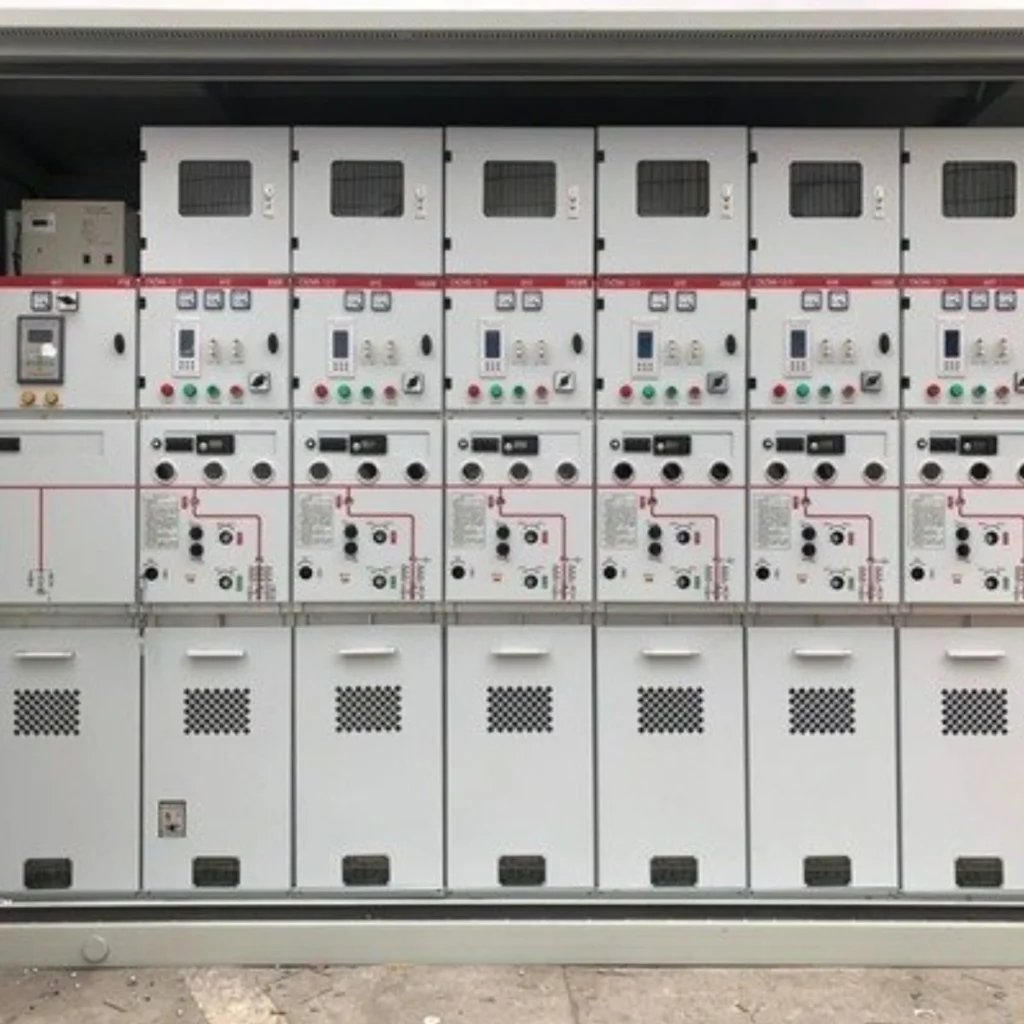
An RMU protection relay is a microprocessor-based digital protection relay specially optimized for compact medium voltage ring main units.
It acquires real-time electrical data via current transformers (CTs) and voltage transformers (VTs), executes professional protection logic calculations, and controls RMU circuit breakers or load break switches to isolate faults.
As one of the core medium voltage digital protection relays, it is tailored for the compact structure and ring network operation characteristics of standard MV RMUs.
Traditional Fuse RMU vs Intelligent Relay-Based RMU
Conventional RMUs rely solely on fuse protection, which features simple structure but poor controllability and scalability. Modern intelligent RMUs equipped with digital protection relays solve the defects of traditional schemes and adapt to smart grid and distributed energy access requirements.
| Item | Traditional Fuse-Only RMU | Intelligent RMU with Protection Relay |
|---|---|---|
| Protection Mode | Passive fuse breaking | Active numerical logic protection |
| Fault Monitoring | No real-time data monitoring or fault recording | Full real-time parameter monitoring + fault waveform recording |
| Grid Communication | No remote communication capability | Supports multiple standard protocols for SCADA integration |
| Fault Coordination | Poor selectivity, easy over-tripping | Precise time grading and zone selective interlocking |
| Maintainability | Fuse replacement required after faults | Resettable, low post-fault maintenance cost |
How Does an RMU Protection Relay Work?
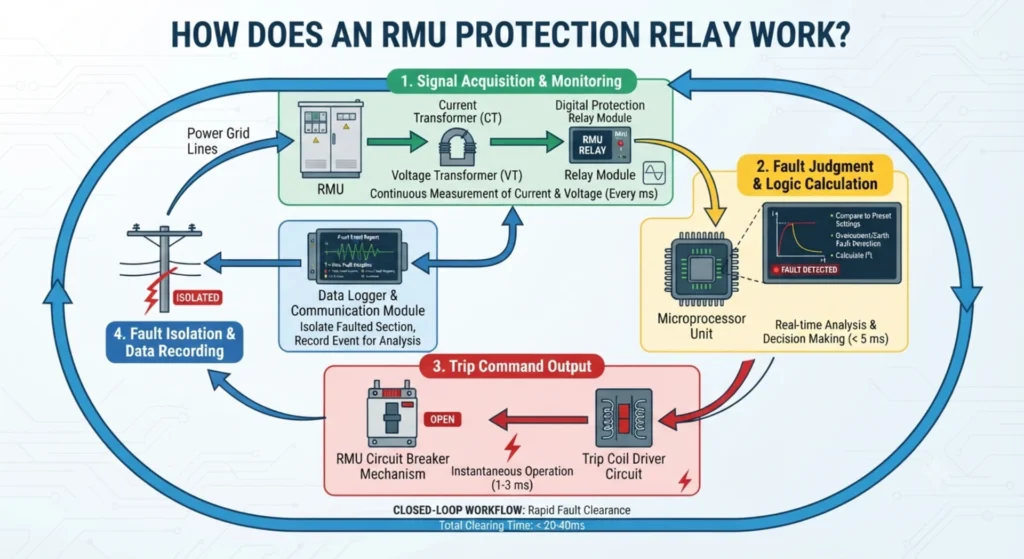
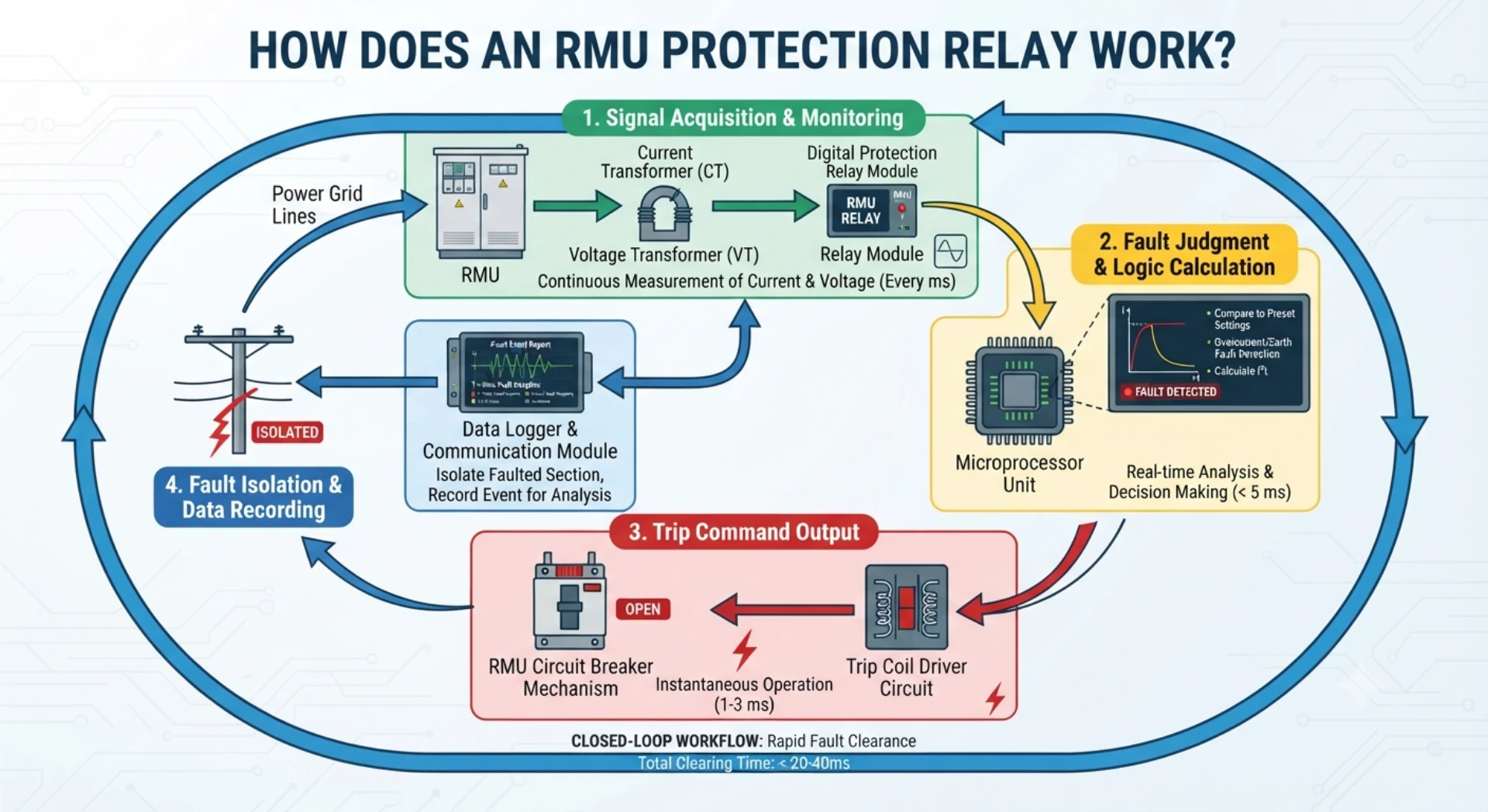
The working flow of an RMU protection relay follows a closed-loop logic: signal acquisition & monitoring → fault judgment & logic calculation → trip command output → fault isolation & data recording. The whole process takes only milliseconds to ensure rapid fault clearance.
Current & Voltage Signal Acquisition
The digital multifunction protection relay synchronously collects three-phase current, three-phase voltage, and zero-sequence current signals through matched CTs and VTs installed inside the RMU.
High-precision sampling circuits filter transient interference signals, accurately capture steady-state and fault electrical data, and provide reliable data sources for subsequent protection judgment, which is the core basis of medium voltage protection relay operation.
Protection Logic Judgment & Trip Execution
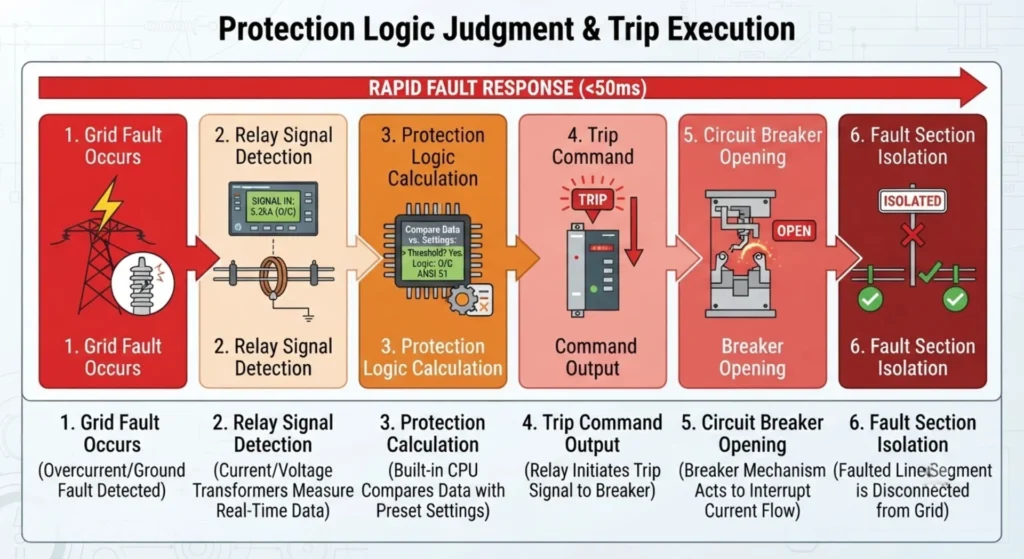
The built-in CPU compares real-time acquired data with preset protection setting values (current threshold, time delay, voltage limit, etc.). Once the system detects abnormal parameters exceeding the safe range, it immediately triggers the corresponding protection logic and outputs a trip signal to the RMU circuit breaker. The standard execution flow is as follows:
Grid Fault Occurs → Relay Signal Detection → Protection Logic Calculation → Trip Command Output → Circuit Breaker Opening → Fault Section Isolation
SCADA & Smart Grid Communication
Modern RMU protection relays support mainstream international industrial communication protocols, realizing seamless connection with smart grid SCADA systems. Engineers can remotely monitor operating status, adjust protection parameters, query fault records, and realize unattended operation of distribution stations. Supported protocols include:
- IEC 61850 (core protocol for smart substation grid access)
- Modbus RTU / Modbus TCP (universal industrial communication)
- IEC 60870-5-103 (traditional power system telecontrol protocol)
This multi-protocol compatibility makes the relay a qualified IEC 61850 protection relay for new energy and smart grid projects.
Main Protection Functions of RMU Protection Relay
Integrated with complete ANSI standard protection logic, the RMU protection relay covers all conventional and customized protection requirements for medium voltage ring networks, solving various fault risks in distribution systems.
Overcurrent Protection (ANSI 50/51)
As the most basic and core function of an overcurrent protection relay, it includes instantaneous overcurrent protection (ANSI 50) and definite/ inverse time overcurrent protection (ANSI 51). Instantaneous protection quickly clears short-circuit faults with large current; time-overcurrent protection acts on overload and small-current short-circuit faults.
Through properly set time grading parameters, the overcurrent protection relay using PIC microcontroller achieves precise protection coordination between upstream and downstream equipment and prevents large-scale power outages.
Earth Fault Protection (ANSI 50N/51N)
Distribution network cable faults and insulation aging problems easily cause single-phase earth faults, which will develop into phase-to-phase short circuits and damage equipment if not handled in time.
The earth fault relay judges fault conditions by monitoring zero-sequence current, effectively protecting MV cables, distribution transformers, and ring network equipment, and is widely used in urban residential and industrial distribution networks.
Directional Earth Fault Protection
For ring networks, multi-power supply systems, and distributed generation access scenarios (solar, wind, energy storage), conventional earth fault protection cannot accurately judge fault directions, leading to false tripping or missed protection.
Directional earth fault protection identifies fault current directions, ensures only faulty sections are tripped, and guarantees normal power supply of non-faulty ring network branches, greatly improving power supply reliability of multi-source grids.
Auxiliary Protection & Monitoring Functions
To adapt to complex grid operating conditions, modern RMU protection relays integrate multiple extended functions to realize full-condition grid protection:
- Overvoltage / Undervoltage protection: Abnormal voltage isolation to protect terminal electrical equipment
- Negative sequence protection: Detects three-phase unbalance faults caused by line failure or load abnormality
- Breaker failure protection: Triggers remote tripping when the local breaker fails to operate
- Frequency protection: Adapts new energy grid-connected frequency fluctuation requirements
- Auto reclosing: Restores power supply automatically for transient faults
- Fault recording & event logging: Provides accurate data support for post-fault analysis and maintenance
Typical Applications of RMU Protection Relay
RMU protection relays are suitable for 6.6kV to 33kV medium voltage ring network systems, covering utility power distribution, new energy, industrial manufacturing, and commercial infrastructure fields, and are core equipment for distribution network protection.
Utility Municipal Distribution Networks
Applied to 10kV, 11kV, 20kV, and 33kV urban and rural distribution ring networks, it realizes automatic fault isolation and power transfer, reduces urban grid outage time, and improves the stability of public power supply systems.
Renewable Energy Projects
Solar power stations, wind farms, and energy storage systems have volatile output and complex grid-connected working conditions. As a professional renewable energy protection relay, it adapts to distributed energy grid-connected characteristics, provides directional protection and anti-interference monitoring, and ensures safe and grid-compliant operation of new energy stations.
Industrial & Critical Infrastructure
Widely used in factory production lines, mining systems, oil and gas projects, and data center MV power distribution systems. It provides high-reliability power protection for high-load and high-precision industrial equipment and avoids economic losses caused by power faults.
RMU Protection Relay vs Feeder Protection Relay
Many engineers confuse RMU protection relays with conventional feeder protection relays. The two have obvious differences in application scenarios, functional positioning, and structural design, which can be clearly distinguished through the following comparison table:
| Comparison Item | RMU Protection Relay | Feeder Protection Relay |
|---|---|---|
| Installation Carrier | Compact Ring Main Unit | Traditional MV switchgear cabinet |
| Application Scenario | Ring network power distribution, terminal power supply | Main feeder incoming/outgoing line protection |
| Functional Positioning | Integrated basic protection + intelligent monitoring + communication | Supports complex differential protection and advanced grid coordination |
| Structural Feature | Ultra-compact design, suitable for limited RMU internal space | Standard cabinet-mounted size with expandable functions |
| Voltage Level | Mainly 10–33kV medium voltage | Covers MV and partial HV levels |
Key Features of Modern RMU Protection Relays
High-Precision Digital Protection Technology
Adopting advanced numerical chip technology, the relay realizes high-precision electrical parameter sampling and protection logic calculation. It effectively distinguishes transient interference and real faults, avoiding nuisance tripping, and ensures stable and reliable long-term operation in complex electromagnetic environments.
Full Intelligent Communication & Remote Management
Compatible with multiple mainstream communication protocols, it supports real-time data upload, remote parameter modification, and fault information query. It can be seamlessly integrated into smart grid SCADA and substation automation systems to realize unmanned and intelligent operation and maintenance of distribution equipment.
Compact & Maintenance-Free Design
Optimized for the compact structure of standard RMUs, the product features small size, easy installation, and strong environmental adaptability. It has no mechanical wearing parts, with low failure rate and minimal daily maintenance workload, greatly reducing the overall operation cost of power distribution systems.
How to Select the Right RMU Protection Relay
Reasonable relay selection is the premise of safe and stable operation of RMU equipment. EPC engineers and project owners can refer to the following core criteria for model selection:
Match System Voltage Level
Select corresponding relay models according to project grid voltage parameters, including 6.6kV, 10kV, 11kV, 22kV, and 33kV medium voltage levels, to ensure rated insulation and operating parameters match the system requirements.
Confirm Required Protection Functions
Select functional configurations based on project scenarios: conventional municipal distribution networks prioritize overcurrent and earth fault protection; new energy and multi-source ring networks need to add directional protection; and key infrastructure projects require matching fault recording and auto-reclosing functions.
Verify Communication Protocol Compatibility
Confirm whether the relay’s communication protocol matches the project’s SCADA system. Smart substation projects prioritize IEC 61850 protocol; conventional industrial and distribution projects can choose Modbus and IEC 60870-5-103 protocols.
Evaluate Technical Support & Commissioning Service
Prioritize manufacturers that provide one-stop technical services including protection scheme design, parameter setting calculation, factory testing, and on-site commissioning guidance, which can effectively reduce project construction cycle and operation risks.
RMU Protection Relay Testing & Commissioning
Strict factory testing and on-site commissioning are key guarantees for relay compliance operation, complying with IEC 62271 and IEC 61869 international standards.
Core Factory Testing Items
- Secondary injection test: Verify the accuracy of protection action values and time delays
- Trip function test: Check the reliability of relay and circuit breaker linkage action
- Communication function test: Verify stable data transmission with upper computer system
- Environmental adaptability test: High and low temperature resistance, electromagnetic interference resistance test
Relay Setting Verification
Professional engineers calculate and verify core parameters such as fault pickup current, protection time delay, and protection curve according to project grid parameters, ensuring protection coordination between upper and lower equipment and avoiding protection dead zones and misoperation.
On-Site Commissioning Process
- Equipment installation and wiring inspection
- Basic parameter configuration and debugging
- Protection function simulation test
- System communication docking debugging
- Whole machine linkage test and project acceptance
Why Choose Our RMU Protection Relay?
As a professional electrical protection relays manufacturer specializing in RMU protection relays and medium voltage power distribution protection, we deliver standardized and customized relay solutions for global EPC contractors, power utilities and renewable energy projects. Our core strengths are listed below:
Professional R&D & Industry Experience
We have long-term technical accumulation in medium voltage distribution network protection and smart grid equipment R&D. All products are designed in line with international IEC standards and global grid operation specifications, with stable performance and strong scene adaptability, serving hundreds of overseas power distribution and new energy projects.
Full-Cycle Technical Support
We provide one-stop services including pre-sales scheme customization, protection parameter calculation, factory testing, on-site commissioning guidance, and after-sales operation maintenance. Our professional technical team supports remote and on-site debugging to solve project technical problems efficiently.
Strict Quality Control & Export Certification
All RMU protection relays pass 100% full-function factory testing and meet international certification standards. The products feature strong anti-interference ability, stable operation, and long service life, adapting to harsh industrial and outdoor grid operation environments, with mature overseas export supply chain experience.
FAQ About RMU Protection Relay
Q1: What is an RMU protection relay?
A: An RMU protection relay is a compact numerical protection device specially designed for medium voltage ring main units. It monitors grid electrical parameters, detects overload, short circuit, and earth faults, and controls circuit breakers to isolate faults, realizing intelligent protection of ring distribution networks.
Q2: What protection functions does an RMU relay provide?
A: It covers core functions including ANSI 50/51 overcurrent protection, 50N/51N earth fault protection, directional earth fault protection, as well as extended over/under voltage, frequency, negative sequence protection, auto reclosing, and fault recording functions.
Q3: What is the difference between an RMU relay and a feeder relay?
A: RMU relays are compactly designed for ring main unit terminal distribution scenarios with integrated basic protection and communication functions; feeder relays are suitable for main feeders, supporting more complex advanced protection logic and system coordination, with larger installation size and richer expandable functions.
Q4: Can RMU protection relays communicate with SCADA systems?
A: Yes. Modern RMU protection relays support IEC 61850, Modbus RTU/TCP, IEC 60870-5-103 and other protocols, realizing seamless docking with SCADA and substation automation systems for remote monitoring and management.
Q5: Which IEC standards apply to RMU protection relays?
A: It complies with core standards including IEC 62271 (MV switchgear), IEC 61850 (substation communication), IEC 61869 (transformer calibration), and IEC 60255 (protection relay general standards).
Q6: How do you test an RMU protection relay?
A: The main test items include secondary injection accuracy test, protection trip linkage test, communication function test, and environmental adaptability test. On-site commissioning requires wiring inspection, parameter calibration, and system linkage debugging.
Q7: What voltage levels do RMU protection relays support?
A: It is widely applicable to common medium voltage levels such as 6.6kV, 10kV, 11kV, 22kV, and 33kV, covering municipal distribution, industrial power consumption, and new energy grid-connected scenarios.
About Author

Hello, I'm Leno Zhang. I have 15 years of experience in the power relay protection industry with extensive pre-sales and after-sales project experience. Our company specializes in various complete sets of relay protection and automation equipment. I can assist customers in solving all practical on-site project challenges and provide optimal integrated solutions.
Tell Us Your Requirement
High Quality
Stable performance, reliable design, ensuring safe operation for power system protection and grid stability.
Fast Delivery
Timely delivery to support your urgent orders and project schedules efficiently and professionally at any time.
Best Warranty
Professional Warranty: Reliable after-sales support for stable relay protection and long-term customer satisfaction.