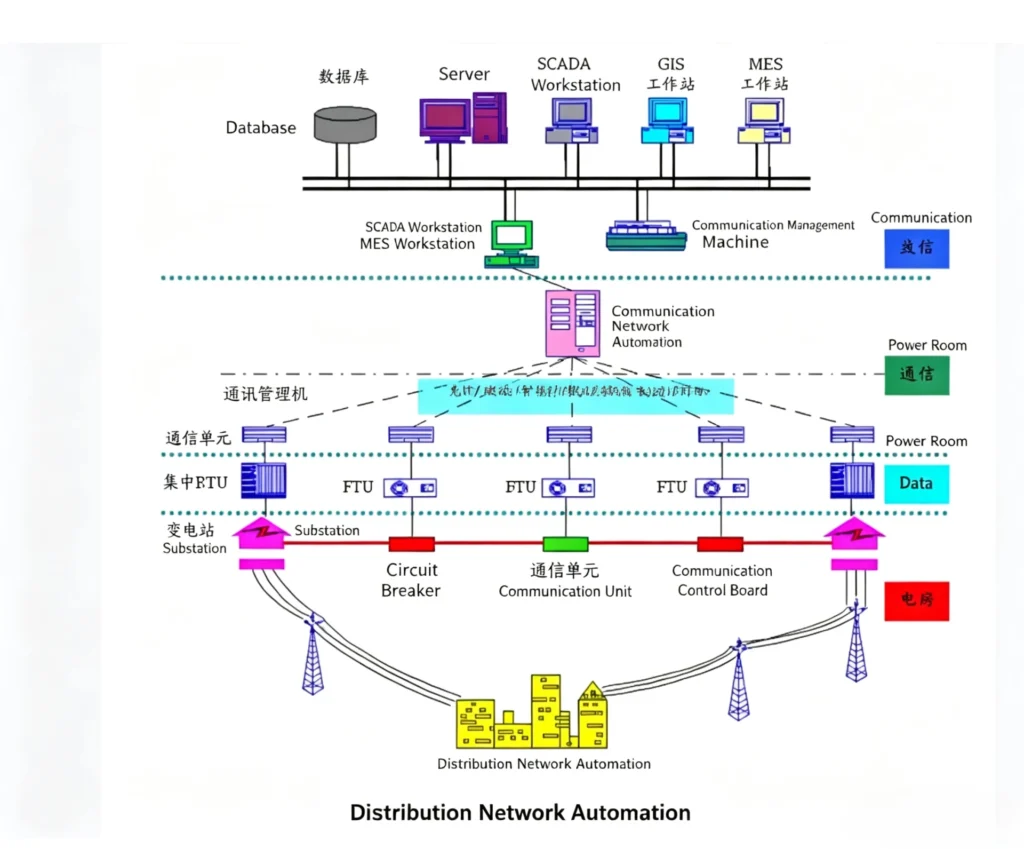
Distribution Automation System is built on primary grid infrastructure and equipment. It integrates information and communication technologies with application systems for real-time monitoring, control, and rapid fault isolation.
Distribution Automation provides real-time data support for the Distribution Management System (DMS). Its primary objectives are to improve power supply reliability through rapid fault processing, and to enhance power quality, grid operational efficiency, and economic benefits by optimizing operational modes.
Functions of Distribution Network Management Automation
Equipment Management
Based on a Geographic Information System (GIS) platform, this function utilizes automated mapping tools to render network diagrams, user locations, distribution equipment, and attribute data against a geographic background with multi-layer display capabilities. It supports computer-aided retrieval and access of equipment records, as well as queries and statistics for equipment quantity, load, and power consumption within specific areas.
Maintenance Management
Building upon equipment record management, this function facilitates the formulation of scientific maintenance plans. It provides computerized management for maintenance work tickets, switching operation tickets, and the overall maintenance process, thereby enhancing maintenance standards and operational efficiency.
Outage Management
This function manages the handling processes for fault-related outages, customer complaints, and planned outages. It aims to minimize the scope of outages, shorten restoration times, and improve the quality of power supply services.
Planning and Design Management
The Distribution Automation System provides centralized storage and management of geographic, economic, and load data required for network planning. By offering tools such as load forecasting, network topology analysis, andshort-circuit current calculation, it not only accelerates the design process but also ensures that the final design schemes are economical, efficient, and minimize energy loss.
Power Consumption Management (Billing & Customer Service)
This function provides computerized management of user information, service applications, and electricity bill payments. It is designed to enhance business processing efficiency and the overall quality of customer service.
Core List of Secondary Equipment for Distribution Automation (DA)
Overcurrent, overvoltage, and unbalance protection for capacitor banks
4
Protection
Automatic Transfer Switch (ATS)
Automatic backup power switching for ring main units (RMU)
5
Control & Monitoring
Feeder Terminal Unit (FTU)
Remote monitoring and control of pole-mounted switches / reclosers
6
Control & Monitoring
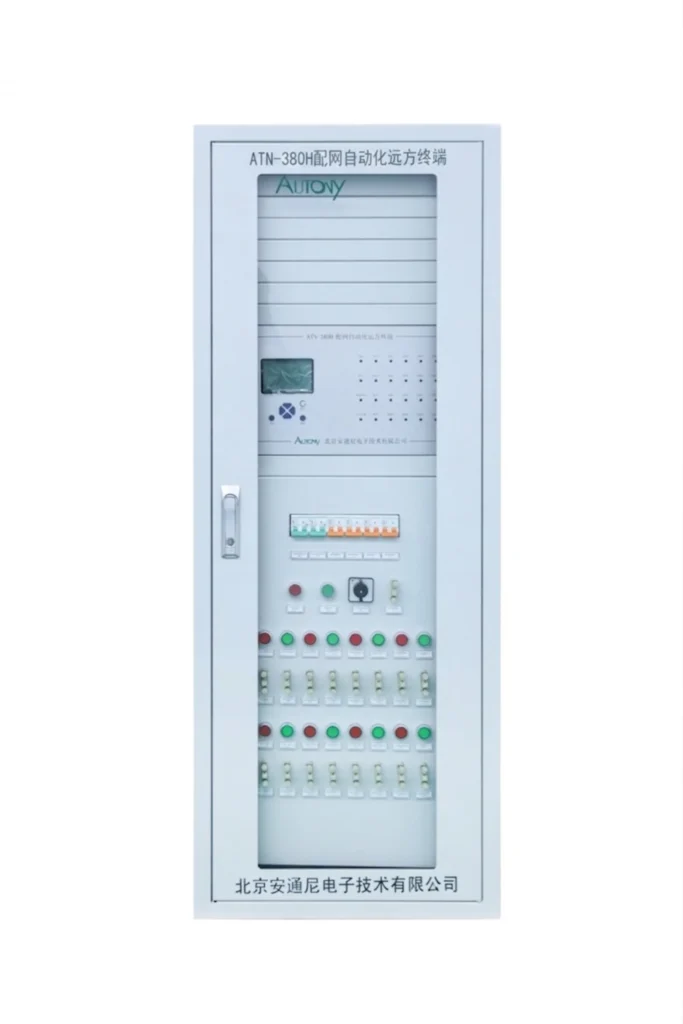
Remote Terminal Unit (RTU)
Data acquisition and control for distribution substations
7
Control & Monitoring
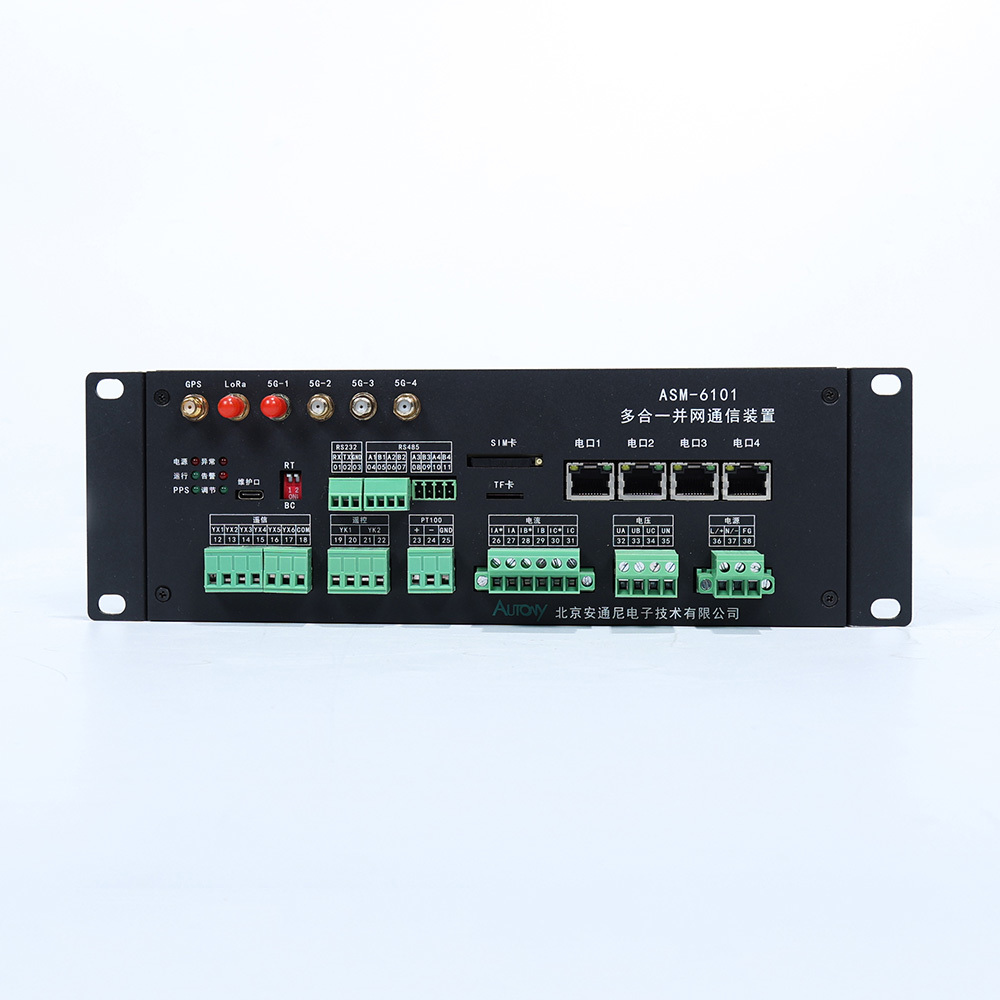
Data Communication Gateway
Protocol conversion and data exchange with SCADA / master station
8
Communication
Industrial Ethernet Switch
Ring network (RSTP) or fiber optic communication for DA network
9
Communication
Protocol Converter
Converts between IEC 60870-5-101/104, DNP3, Modbus, and IEC 61850
10
Communication
Fiber Optic Terminal Box
Connects and protects fiber optic cables for long-distance DA links
11
Power Supply
DC/DC Power Converter
Provides stable DC power for FTU, RTU, and communication devices
12
Power Supply
Battery Backup Unit (BBU)
Backup power for FTU/RTU during primary power loss
13
Metering
Smart Meter
Energy metering for distribution line monitoring
14
Auxiliary
Fault Indicator (FI)
Detects and indicates fault location on overhead lines or cables
Distribution automation is widely applied in various power grid construction and operation projects. It is primarily used in urban and rural distribution network renovation, smart grid construction, and new residential area power supply projects.
It also applies to industrial park power distribution, urban central grid upgrading, and rural power grid reconstruction projects.
In addition, it is adopted in new energy access projects such as distributed photovoltaic and wind power integration, as well as emergency power guarantee and power grid intelligent scheduling projects.
By deploying distribution automation systems, these projects realize real-time grid monitoring, remote control and quick fault isolation, improving power supply stability, reducing manual maintenance costs, and supporting safe, efficient and intelligent operation of the whole power distribution system.
About Author
Hello, I'm Leno Zhang. I have 15 years of experience in the power relay protection industry with extensive pre-sales and after-sales project experience. Our company specializes in various complete sets of relay protection and automation equipment. I can assist customers in solving all practical on-site project challenges and provide optimal integrated solutions.
Tell Us Your Requirement
High Quality
Stable performance, reliable design, ensuring safe operation for power system protection and grid stability.
Fast Delivery
Timely delivery to support your urgent orders and project schedules efficiently and professionally at any time.
Best Warranty
Professional Warranty: Reliable after-sales support for stable relay protection and long-term customer satisfaction.