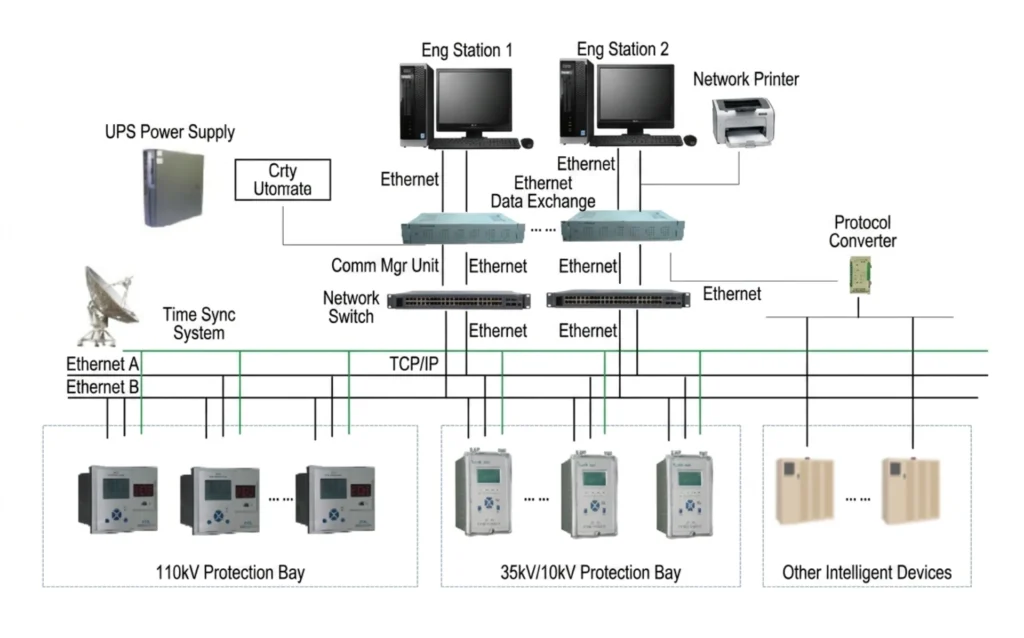
Substation Automation System is a comprehensive system that applies microprocessor, communication, and computer technologies to restructure and optimize the functions of secondary equipment. Utilizing a hierarchical distributed architecture, it achieves an integrated design of protection, measurement, control, and communication.
Substation Automation System features Remote Signaling (YX), Remote Metering (YC), Remote Control (YK), and Remote Regulation (YT) capabilities and strictly adheres to the IEC 61850 standard.
As a Substation Automation System (SAS), it integrates equipment monitoring, control, measurement and coordination functions to support unmanned operation. Adopting a three-layer architecture of Station Level, Bay Level and Process Level, the SAS is applicable to substations with voltage levels ranging from 10kV to 110kV.
Substation Automation System architecture
Substation Automation System Functions
As a vital component of the Dispatching Automation System, SAS extensively employs computer technology to monitor and control the power system, serving as a reliable means of achieving grid dispatch automation. The primary prerequisite for grid dispatch automation is the collection of real-time data to monitor and control the grid, which is fulfilled through the following four functions:
Remote Signaling (YX)
Remote signaling refers to the collection of status information, including relay protection operations, the status of circuit breakers and disconnector switches, and various alarm signals. To meet the requirements of grid safety, equipment stability, and production management, centralized control centers must grasp the operational status and incident reports of unmanned substations in real-time. This necessitates comprehensive and real-time monitoring of all station signals.
Remote Metering (YC)
Remote metering involves the collection of real-time operational parameters of the power system. This includes measurement data such as generator output, busbar voltage, power flow, active and reactive power loads, line current, and energy consumption (electric quantity).
Remote Control (YK)
Remote control refers to control commands issued from the centralized control center to execute operations such as the opening and closing of circuit breakers, disconnectors, and earthing switches, as well as signal resets and the enabling/disabling of specific functions.
Remote Regulation (YT)
Remote regulation refers to control commands issued from the centralized control center to adjust variables such as reactive power and voltage within the power system.
Provides uninterrupted AC power for monitoring system
18
Communication & Time Sync
Optical Terminal Unit
Fiber optic communication transmission
19
Communication & Time Sync
Protocol Converter
Communication protocol conversion
20
Communication & Time Sync
GPS/BeiDou Time Synchronization Device
Station-wide equipment time synchronization
21
Auxiliary System
Video Surveillance System
Station video monitoring
22
Auxiliary System
Fire Alarm System
Fire detection and alarm
cyber-security in substation automation systems
Substation cybersecurity adopts measures including firewalls, end-to-end encryption and intrusion detection to safeguard substation automation systems and power monitoring systems against cyberattacks, ensuring the safe and stable operation of the power grid.
Introduction to SCADA Systems
SCADA (Supervisory Control and Data Acquisition), as a SCADA system for distribution and substation automation, is applied to the remote monitoring and control of distributed industrial equipment. It realizes data acquisition, equipment control, measurement, regulation and alarm management, and further achieves substation automation.
Contact our protection relay engineering team for single‑line diagram templates, bay configuration files, or a firm price for your next 110kV or 35kV substation project.
About Author
Hello, I'm Leno Zhang. I have 15 years of experience in the power relay protection industry with extensive pre-sales and after-sales project experience. Our company specializes in various complete sets of relay protection and automation equipment. I can assist customers in solving all practical on-site project challenges and provide optimal integrated solutions.
Tell Us Your Requirement
High Quality
Stable performance, reliable design, ensuring safe operation for power system protection and grid stability.
Fast Delivery
Timely delivery to support your urgent orders and project schedules efficiently and professionally at any time.
Best Warranty
Professional Warranty: Reliable after-sales support for stable relay protection and long-term customer satisfaction.