

-
Leon Zhang sales consultant
-
Email: zxl635973785@gmail.com
-
Phone/WhatsApp: +86 13655813266
Blog
Industry insights, product updates and technical guides on power relay protection & automation
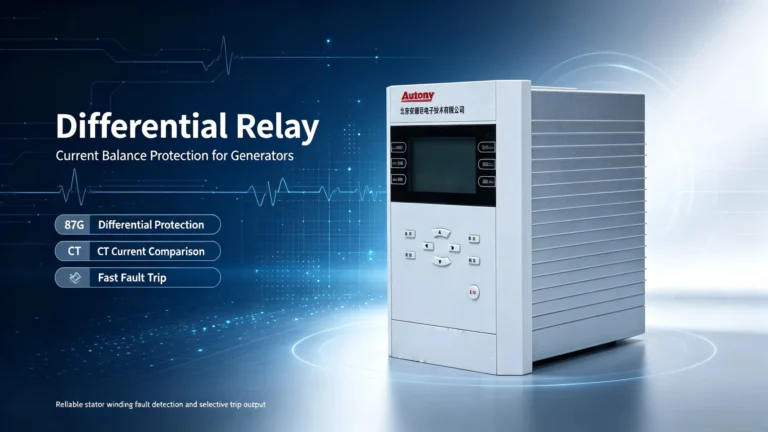
Differential Relay: Working Principle, Diagram, Types and Applications
A differential relay (ANSI 87) is a unit protection device that compares current at every boundary of a defined zone and trips only when that comparison shows a fault inside the zone. Because the zone is fixed by CT location rather…
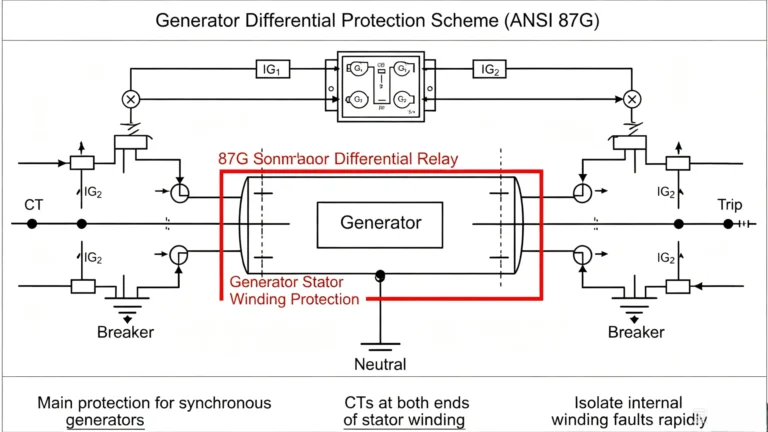
Generator Differential Protection Scheme: Configuration, CT Arrangement and Operation
A generator differential protection scheme is the core zoning and wiring configuration that uses dual-boundary current transformers (CTs) and an 87G differential relay to monitor current balance within a defined generator protection zone. Unlike general protection principles, this engineering-focused scheme defines where…
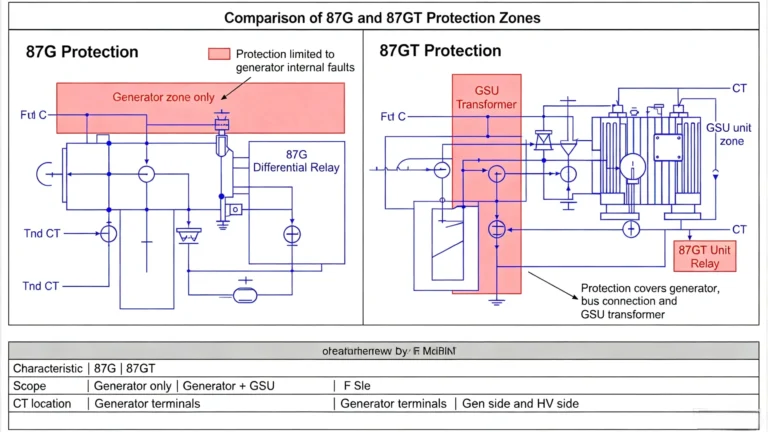
87G vs 87GT: What Is the Difference?
Why 87G and 87GT Are Often Confused 87G vs 87GT is a comparison of two ANSI differential designations used in generator protection. 87G covers the generator stator; 87GT extends the differential zone across the generator and its step-up transformer as…
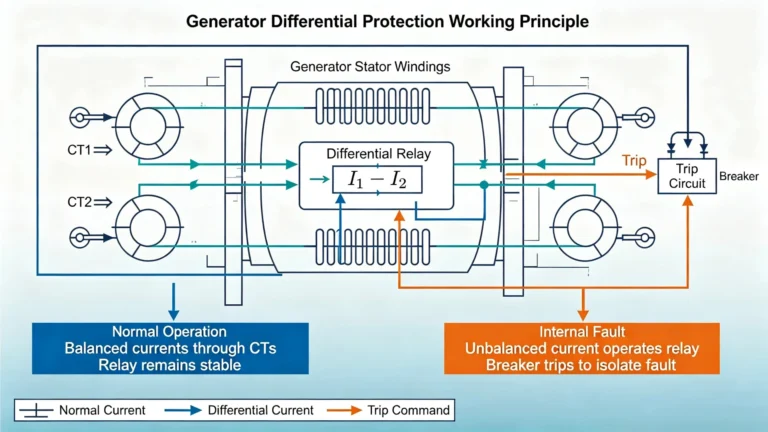
How Generator Differential Protection Works: 87G Operating Principle
How generator differential protection works, in one sentence: two matched CT sets — one at the generator terminal, one at the neutral end — feed the relay, and the relay trips when the vector difference between them exceeds a threshold that…
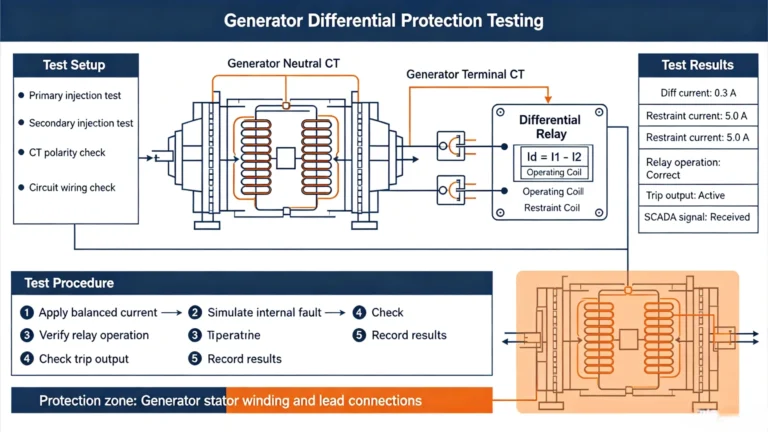
Generator Differential Protection Testing: Methods, Procedures and Test Cases
What Is Generator Differential Protection Testing? Generator differential protection testing is the core commissioning and maintenance procedure to verify the full functionality of the 87G generator differential protection system. It validates that the differential relay, CT secondary circuits, protection logic, alarm modules, and…
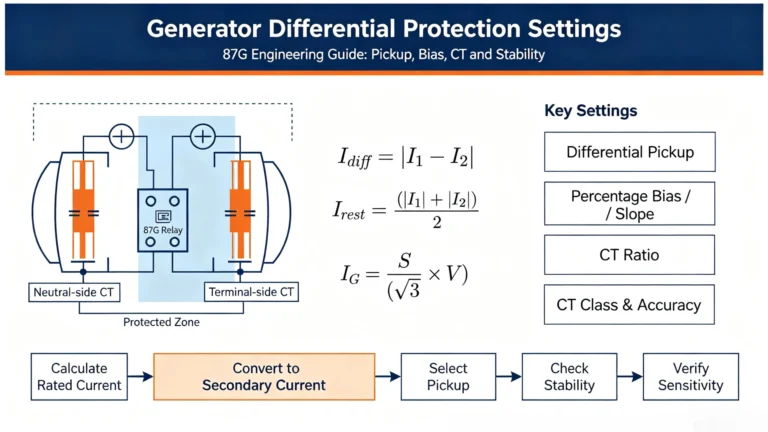
Generator Differential Protection Settings: Pickup, Bias, CT and Stability
What Generator Differential Protection Settings Cover Generator differential protection settings (ANSI 87G) define how the relay detects stator faults and stays stable on external faults. The sections below cover pickup, bias, and CT data. Written by Leon Zhang, Protection Application…
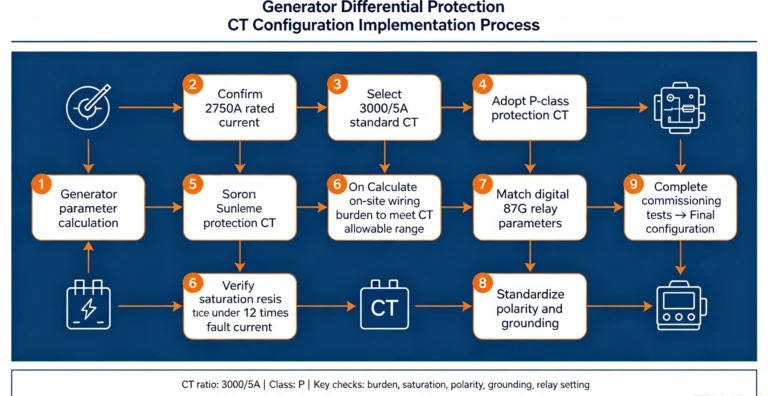
Generator Differential Protection CT Configuration: Ratio, Polarity, Class and Wiring
Generator differential protection CT configuration (87G) is the primary stator protection for industrial and utility synchronous generators. Its accuracy, stability, and fault detection capability do not rely solely on the protective relay itself — the entire performance of 87G protection…
High Quality
Stable performance, reliable design, ensuring safe operation for power system protection and grid stability.
Fast Delivery
Timely delivery to support your urgent orders and project schedules efficiently and professionally at any time.
Best Warranty
Professional Warranty: Reliable after-sales support for stable relay protection and long-term customer satisfaction.