

-
Leon Zhang sales consultant
-
Email: zxl635973785@gmail.com
-
Phone/WhatsApp: +86 13655813266

Blog
Industry insights, product updates and technical guides on power relay protection & automation
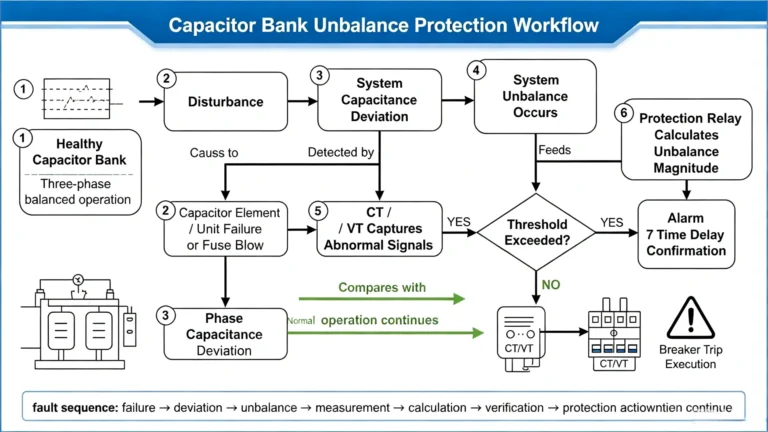
Capacitor Bank Unbalance Protection: Working Principle, Schemes and Relay Settings
Capacitor bank unbalance protection is the ANSI 46, 47 or 64N function defined by ANSI/IEEE C37.2 and applied under IEEE C37.99-2012: it detects a failed capacitor element or a blown fuse by measuring the negative-sequence current or the neutral displacement…
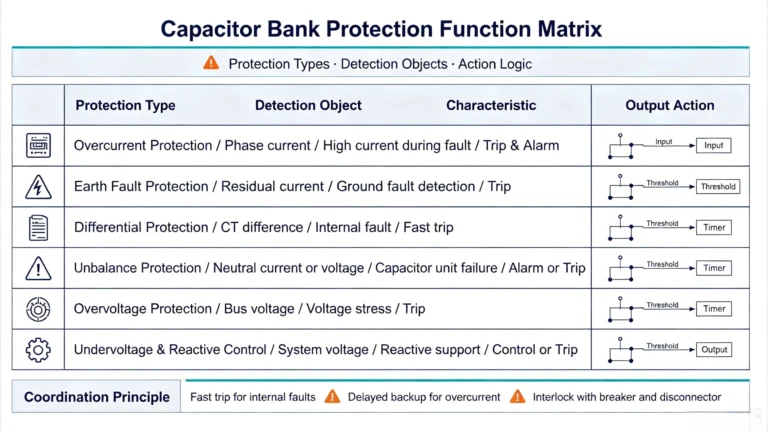
Capacitor Bank Protection: Methods, Relays and Applications
Capacitor bank protection is the set of ANSI-numbered functions that watch a shunt capacitor bank and act before one failed element drags the rest of the bank down. A bank is carried by unbalance detection (ANSI 46 / 47), overcurrent (ANSI…
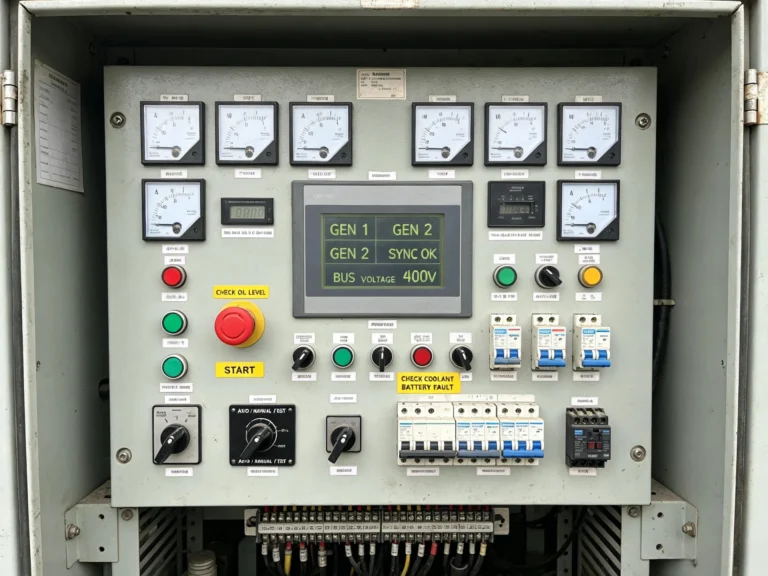
Emergency Generator Panel: Components, Functions and Protection
An emergency generator panel is the assembly that starts a standby genset, hands critical loads over from the utility and holds basic electrical protection while the outage lasts. It carries the control, transfer and distribution logic in one scheme, and…
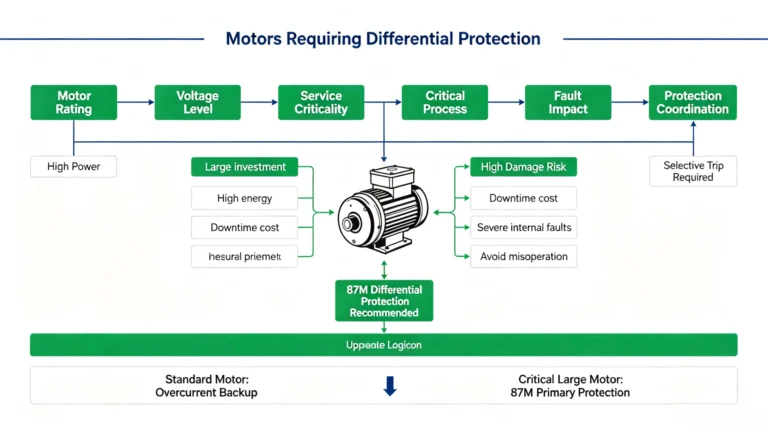
Which Motors Need Differential Protection? 87M Application Guide
Which motors need differential protection comes down to three inputs: rating, voltage and what an unplanned stop costs. In practice 87M is specified on MV and HV motors, and on any LV motor whose failure would halt a process. Written…
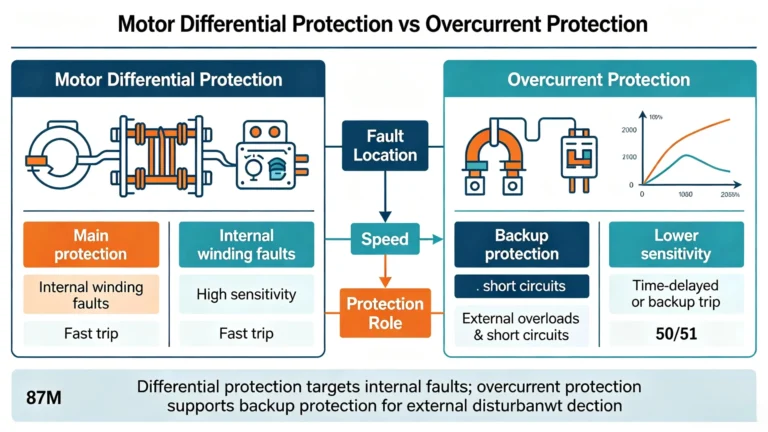
Motor Differential Protection vs Overcurrent Protection: What Is the Difference?
Motor differential protection vs overcurrent protection is not an either-or choice. 87M compares the current entering the winding with the current leaving it and trips in about 20–40 ms. 50/51 waits for the current to pass a pickup and stay…
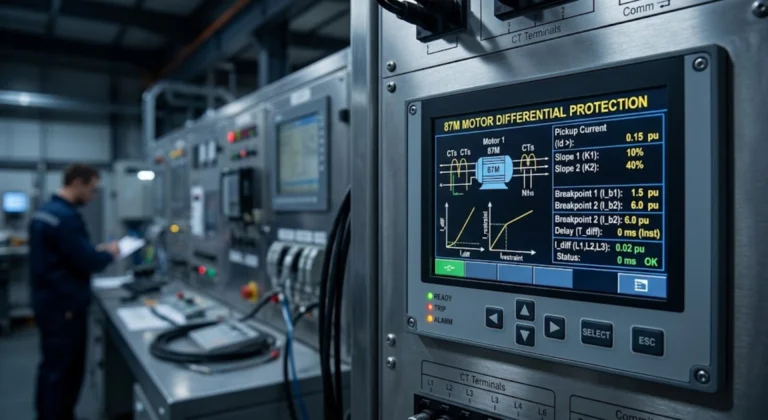
87M Motor Differential Protection Settings: Pickup, Bias and CT Parameters
87M protection settings are the parameters that decide when a motor protection relay trips: differential pickup, bias slope, CT ratio and class, high-set value and trip delay. Motor differential protection differs from overcurrent protection because the element compares two currents that ought to cancel. A…
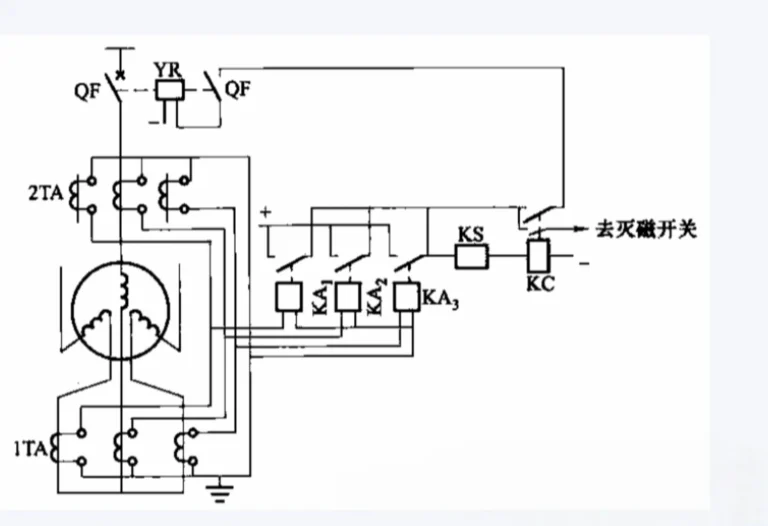
Motor Differential Protection CT Wiring: 6-CT and Self-Balancing Schemes
Motor differential protection CT wiring is the secondary circuit behind ANSI 87M, the most selective form of motor differential protection for internal stator winding faults in large industrial motors. Unlike general overcurrent and thermal protection, 87M relies entirely on an accurate current…
High Quality
Stable performance, reliable design, ensuring safe operation for power system protection and grid stability.
Fast Delivery
Timely delivery to support your urgent orders and project schedules efficiently and professionally at any time.
Best Warranty
Professional Warranty: Reliable after-sales support for stable relay protection and long-term customer satisfaction.