

-
Leon Zhang sales consultant
-
Email: zxl635973785@gmail.com
-
Phone/WhatsApp: +86 13655813266
Differential Relay Protection: ANSI 87 Types, Working Principle and Applications
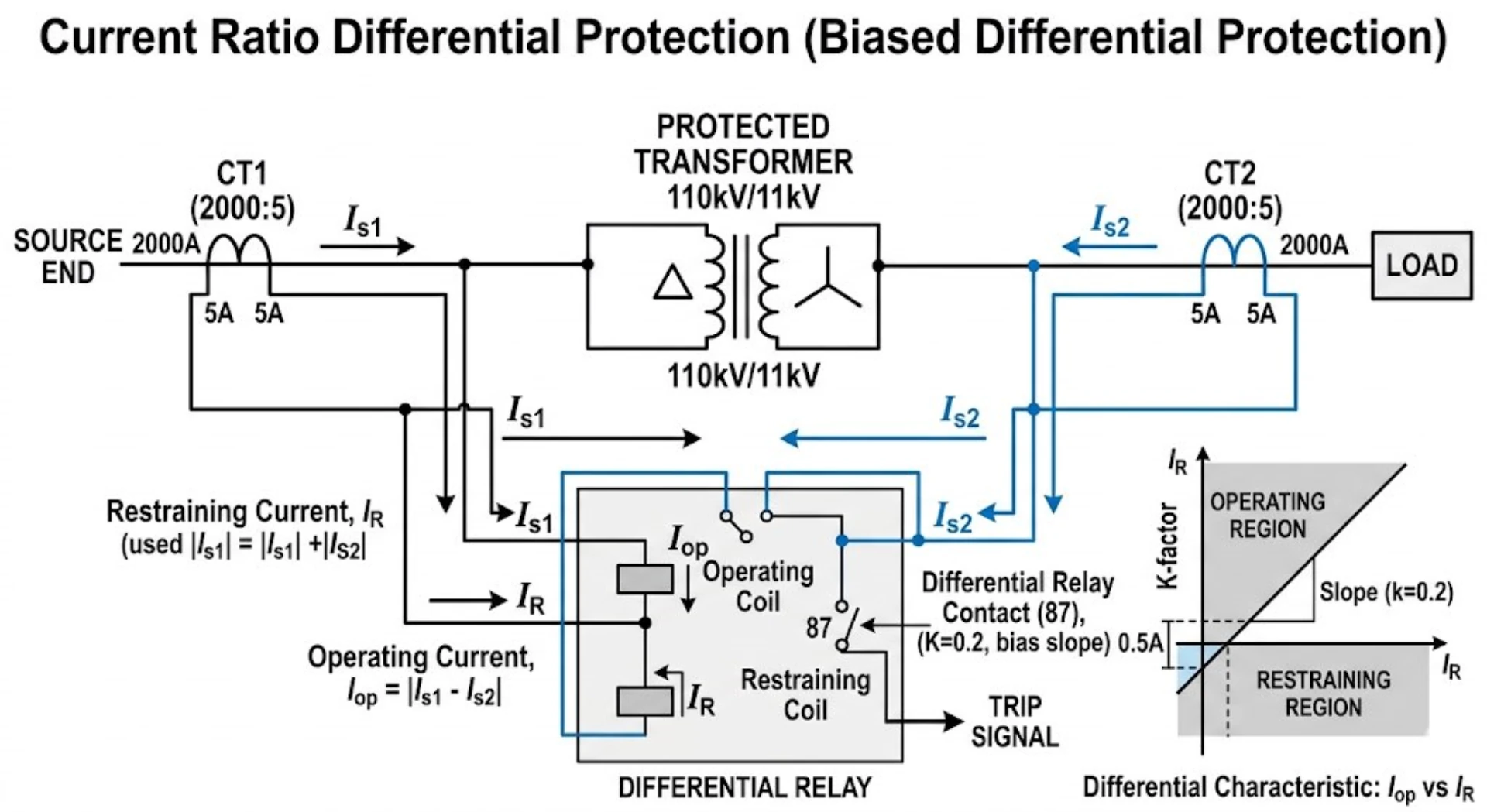
Differential relay protection (ANSI 87) is a unit protection scheme that compares current at every boundary of a defined protection zone and trips only when that comparison shows a fault inside the zone. Under normal load and through external faults the current entering the zone equals the current leaving it, so differential current stays close to zero. An internal fault breaks that balance, differential current rises above the pickup threshold, and the relay trips.
The suffix letter after ANSI 87 names the protected equipment: 87T transformer, 87L line, 87G generator, 87B busbar, 87M motor. This guide covers how differential relay protection works, the ANSI 87 types, the CT requirements that decide whether a scheme stays stable, typical applications, and how 87 differs from 50/51 overcurrent protection.
Written by Leon Zhang, Protection Application Engineer · Technical review by Li Ming, Electrical Engineer · Last reviewed September 2026
What Is Differential Relay Protection?
Differential relay protection is a unit protection scheme that compares electrical quantities at the boundaries of a defined protection zone to detect internal faults. This protection method is commonly known as differential protection and is identified by ANSI device number 87.
For the device-level view — relay types, operating characteristics and selection — see our differential relay overview.
What Does ANSI 87 Mean?
The ANSI device number 87 refers to differential protection. It is part of the ANSI/IEC standard device numbering system for protection relays. The number 87 is followed by a letter to indicate the specific application:
- 87T – Transformer differential protection
- 87L – Line differential protection
- 87G – Generator differential protection
- 87B – Busbar differential protection
- 87M – Motor differential protection
How Does Differential Relay Protection Work?
The working principle of differential protection is based on comparing electrical quantities at the boundaries of a defined protection zone.The relay measures current from CTs installed at the boundaries of the protected zone. Under normal conditions and external faults, the current entering the zone is equal to the current leaving the zone (within CT error limits), so the differential current is near zero. When a fault occurs inside the zone, the balance is disrupted and the differential current becomes significant, causing the relay to trip.
What Is the Protection Zone?
The protection zone of a differential relay is defined by CT locations, covering the area between the CTs. The relay detects faults within this zone but ignores external faults, giving the protection inherent selectivity.
Why Is Differential Protection Selective?
Selectivity is achieved because the relay only responds to currents that originate within its defined zone. Faults outside the zone are cleared by other protection devices, while the 87 relay remains stable. This zone-based principle provides fast, secure, and precise fault discrimination without unnecessary tripping of healthy equipment.
Types of Differential Relay Protection
Differential relay protection can be applied to different types of power system equipment, with differential protection functions commonly identified by ANSI device number 87.
| ANSI Code | Protection Type | Typical Application |
|---|---|---|
| 87T | Transformer Differential | Power transformers |
| 87L | Line Differential | Transmission/distribution lines |
| 87G | Generator Differential | Generator stator protection |
| 87B | Busbar Differential | Substation busbars |
| 87M | Motor Differential | Large motors |
| 87S | Selective / special differential applications | Scheme dependent |
Differential Relay Protection Working Principle
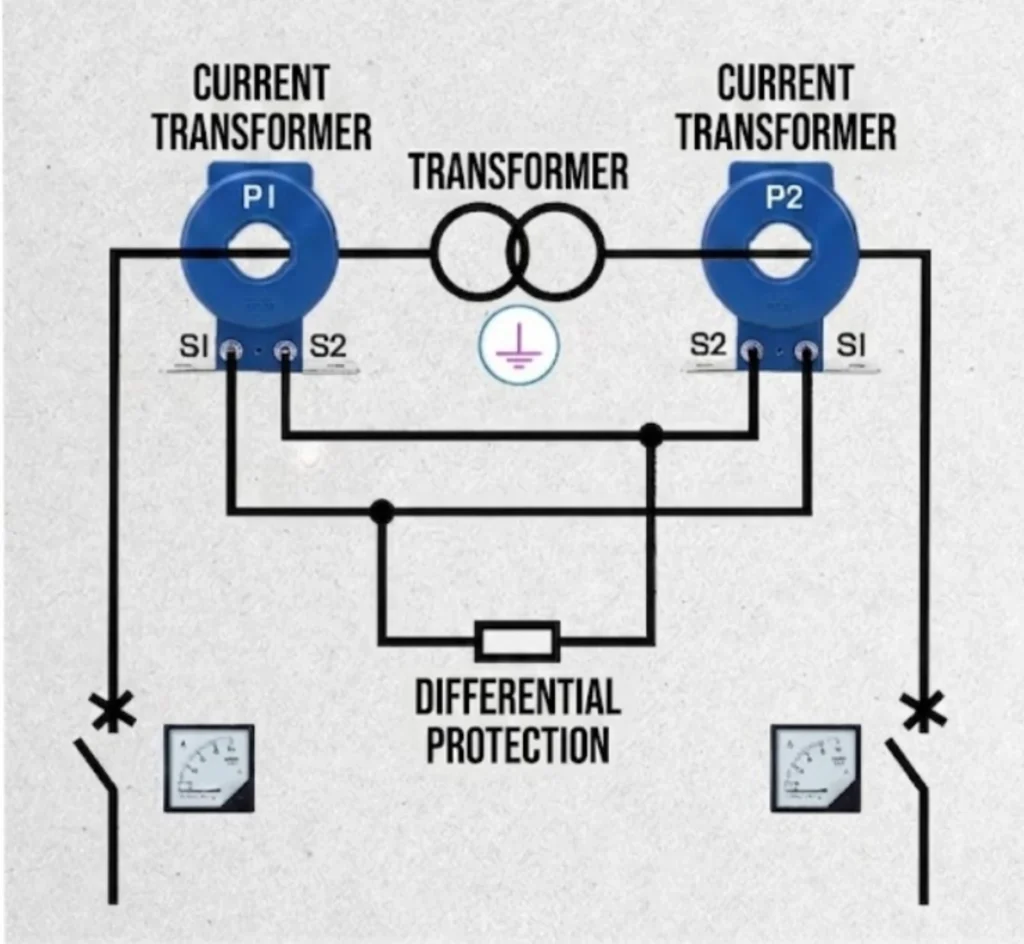
The working principle of differential protection is based on comparing electrical quantities at two or more points within a defined protection zone. In a differential relay protection scheme, the relay operates when the measured differential quantity indicates an internal fault.
Normal Load Condition
Under normal load, currents entering and leaving the zone are balanced. The differential current is near zero and the relay remains stable.
External Fault
During an external fault, fault current flows through the zone but the fault is outside. Incoming and outgoing currents remain balanced. The relay remains stable and does not trip.
Internal Fault
When a fault occurs inside the zone, the current balance is disrupted. The differential current increases and, when it exceeds the operating threshold, the relay trips.
Key Principle
The relay trips only when the differential current exceeds the threshold, providing fast, selective protection for faults within the defined zone.
Differential Protection Diagram
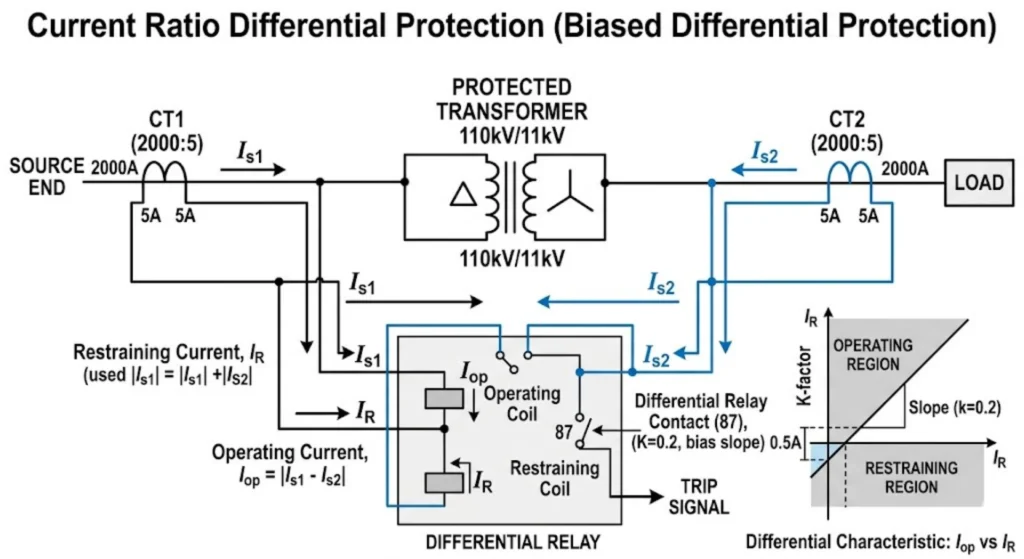
Taking transformer differential protection as an example
What Are the Technical Requirements for Differential Protection CTs?
In differential relay protection, CT performance directly affects protection stability and sensitivity.
Accuracy Class and Type
For equipment of 110kV and below, differential protection adopts 5P20 and 5P30 protective CTs with a composite error less than 5% under 20 or 30 times rated current. For high-voltage equipment of 220kV and above, generators and main transformers, TPY and TPE transient CTs are required to suppress DC saturation with a remanence coefficient below 10%. 0.2S and 0.5S measuring CTs are prohibited to prevent protection maloperation.
Ratio and Polarity Requirements
For the 87 protection relay, CT polarity for differential protection requires uniform ratio and polarity for all CTs on each side of the differential protection system. Mismatched CT ratios can be calibrated through software adjustment or intermediate converters to eliminate unbalanced current. The secondary rated current is normally set to 5A, whereas 1A is applied in long cable scenarios to effectively reduce circuit voltage drop.
Saturation Characteristics and Limit Requirements
Protective CTs shall have an accuracy limit factor (ALF) of no less than 20 and comply with the 10% error curve criterion to avoid maloperation caused by CT saturation during external faults. TP-class CTs adopt air-gap iron cores for excellent transient performance, while 5P-class CTs must be of the same model and consistent characteristics.
Secondary Load and Wiring Specifications
The differential protection relay 87 requires the CT secondary circuit to be dedicated solely to differential protection with no external loads connected, ensuring symmetrical and light burden conditions. The cable length discrepancy between the two sides must not exceed 50 meters, and single-point grounding is implemented for the secondary circuit to prevent electromagnetic interference and phase shift errors.
Matching and Consistency Requirements
CTs in the same differential loop shall be identical in model, batch and accuracy class with matched volt-ampere characteristics and a matching error within 0.5%. The secondary windings are independently dedicated to differential protection without sharing metering or measuring functions.
ANSI Code for Differential Protection
87
How Does a Differential Relay Operate?
A differential relay is the operating element of a differential relay protection scheme. It compares the electrical quantities measured by CTs at the boundaries of the protected zone and determines whether the difference indicates an internal fault.
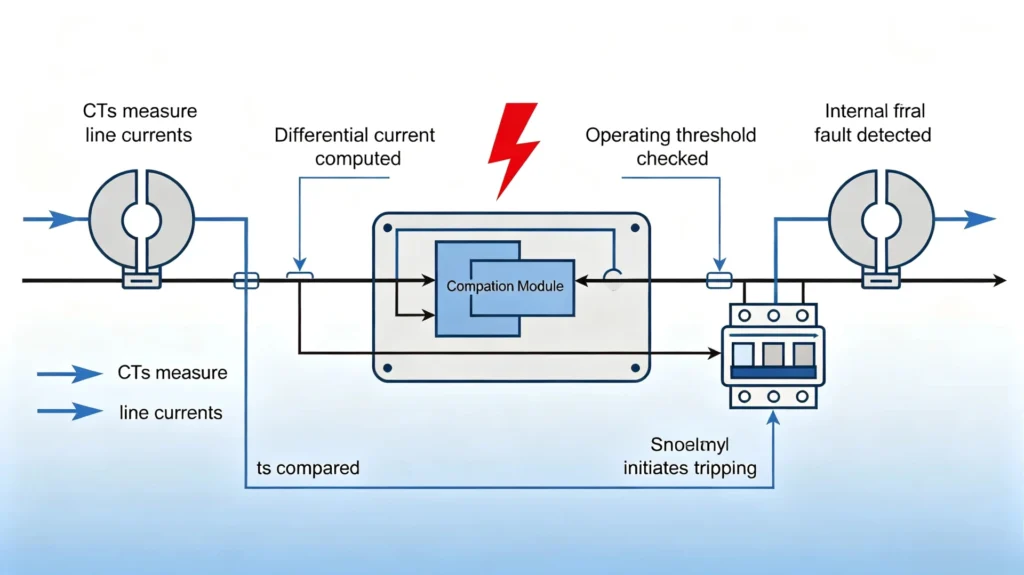
- CTs Measure Current
- Relay Compares Currents
- Differential Current Is Calculated
- Relay Checks the Operating
- Threshold Relay Trips for an Internal Fault
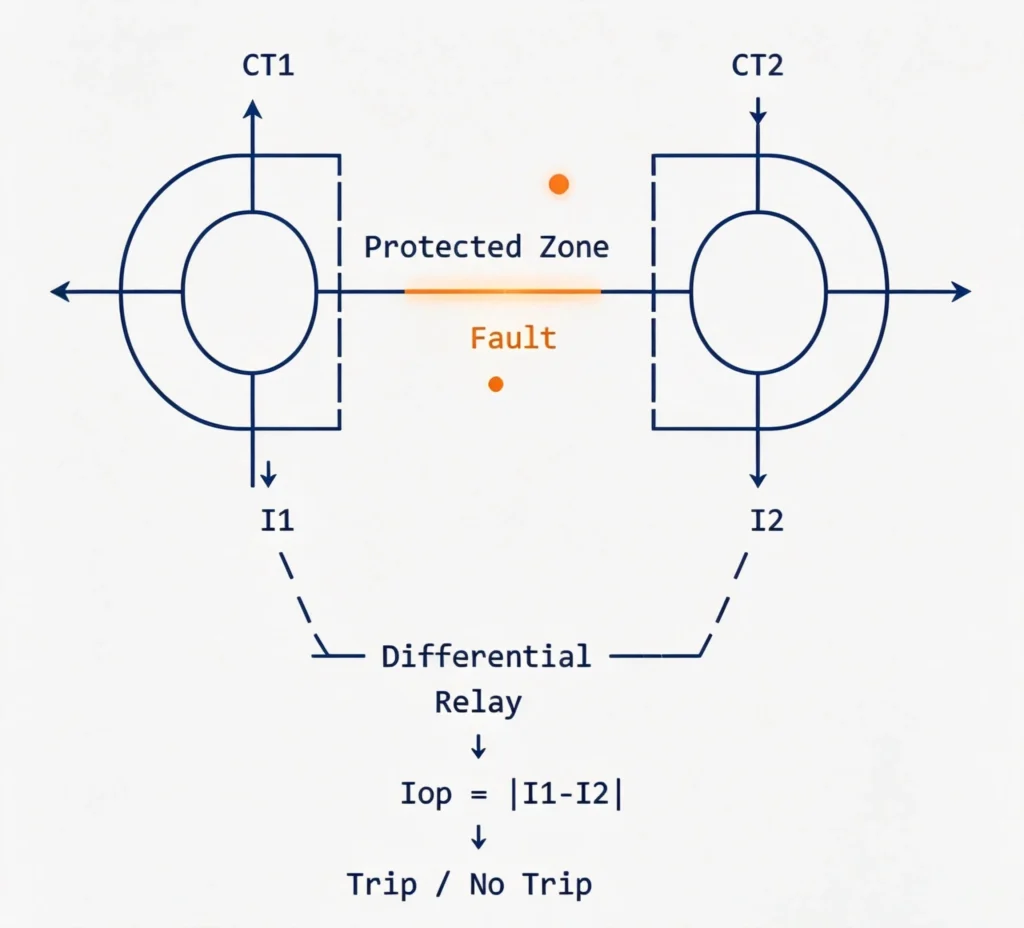
The differential current is defined by the formula:Idiff = |I₁ − I₂|
Under normal load conditions, I₁ is approximately equal to I₂, resulting in a small differential current and no relay tripping. During external faults, the currents from the two CTs stay largely balanced, so the relay remains stable without operation. When an internal fault occurs, I₁ and I₂ become unbalanced. The differential current rises above the operating threshold, triggering relay operation and opening the circuit breaker.
Differential Relay Operation Under Different Fault Conditions
| Operating Condition | Current Relationship | Differential Current | Relay Operation |
|---|---|---|---|
| Normal load | Balanced | Very low | No trip |
| External fault | Approximately balanced | Low/controlled | No trip |
| Internal fault | Unbalanced | High | Trip |
| CT saturation | May become unbalanced | Can increase | Restraint/stability required |
| CT wiring error | Incorrect current comparison | Abnormal | Possible misoperation |
Operating Current and Restraining Current in Differential Relays
Operating current (Iₒₚ) :It determines whether the differential current is sufficient to trigger relay operation.
Restraining current (Iᵣₑₛₜ) It helps the relay remain stable during heavy external faults, CT measurement errors and CT saturation.
Simplified formulas:
Iop = |I1 − I2|
Irest ≈ (|I1| + |I2|) / 2
A differential relay operates when the operating current exceeds the relay’s characteristic or pickup requirement relative to the restraint current.
For the pickup, bias slope and stability formulas used to set those thresholds, see differential protection setting calculation.
Differential Relay Operating Characteristic
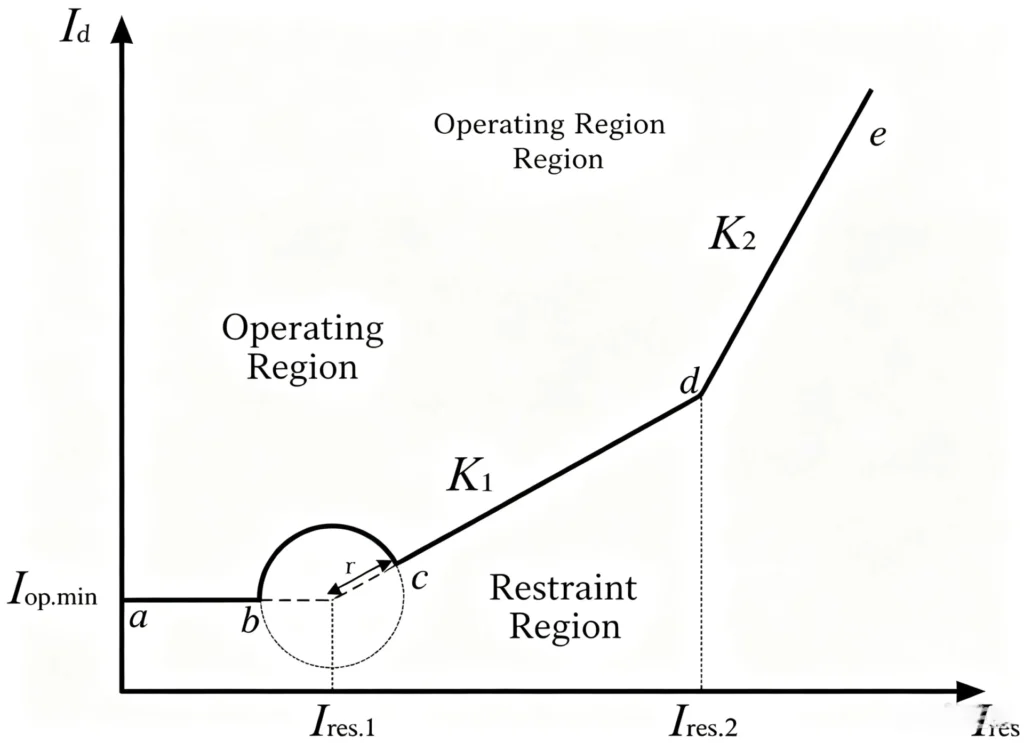
Differential relay protection relies on key parameters including pickup current and bias/restraint slope to define the operating region and restraint region on its characteristic curve. With these settings, the relay can accurately distinguish between internal faults, which trigger tripping, and external faults, where stable restraint is maintained to prevent misoperation.
How CT Saturation Affects Differential Relay Operation
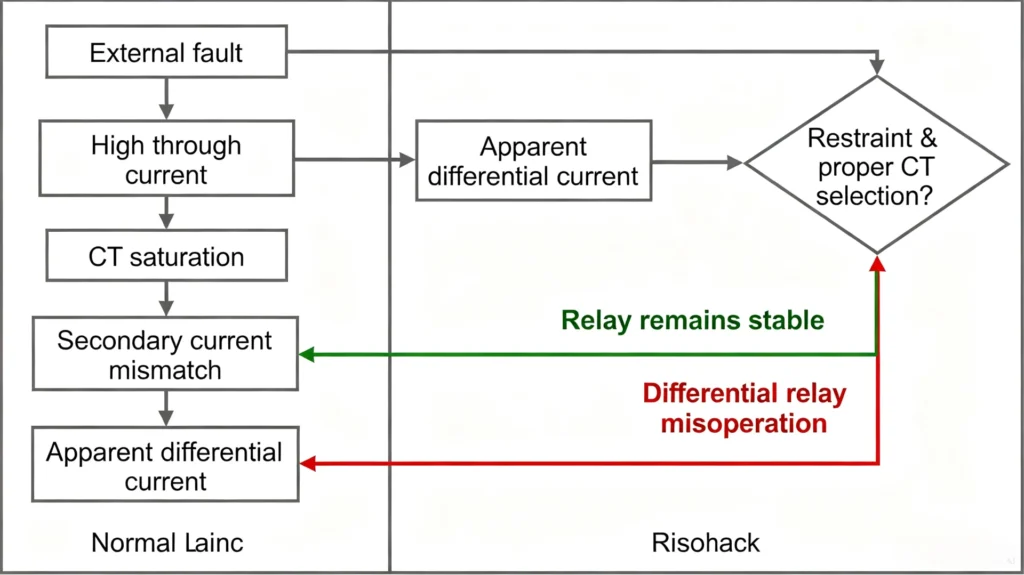
During an external fault, a high through-current leads to CT saturation. This distorts secondary currents and creates secondary current mismatch, generating apparent differential current. Without restraint characteristics or properly selected CTs, this phenomenon may result in unwanted differential relay operation, also known as differential relay misoperation or false operation. This explains why differential relay operation during external faults is closely linked to CT saturation in differential protection systems.
Differential Relay Operation Diagram
Differential Relay Operation vs Overcurrent Relay Operation
| Feature | Differential Relay | Overcurrent Relay |
|---|---|---|
| Main principle | Current comparison | Current magnitude |
| Protection zone | Defined by CT locations | Usually broader/system coordinated |
| Main fault type | Internal faults | Overcurrent/short circuit |
| Selectivity | Very high | Depends on coordination |
| Typical ANSI | 87 | 50/51 |
Main Applications of Differential Relay Protection
Transformer Differential Protection (87T)
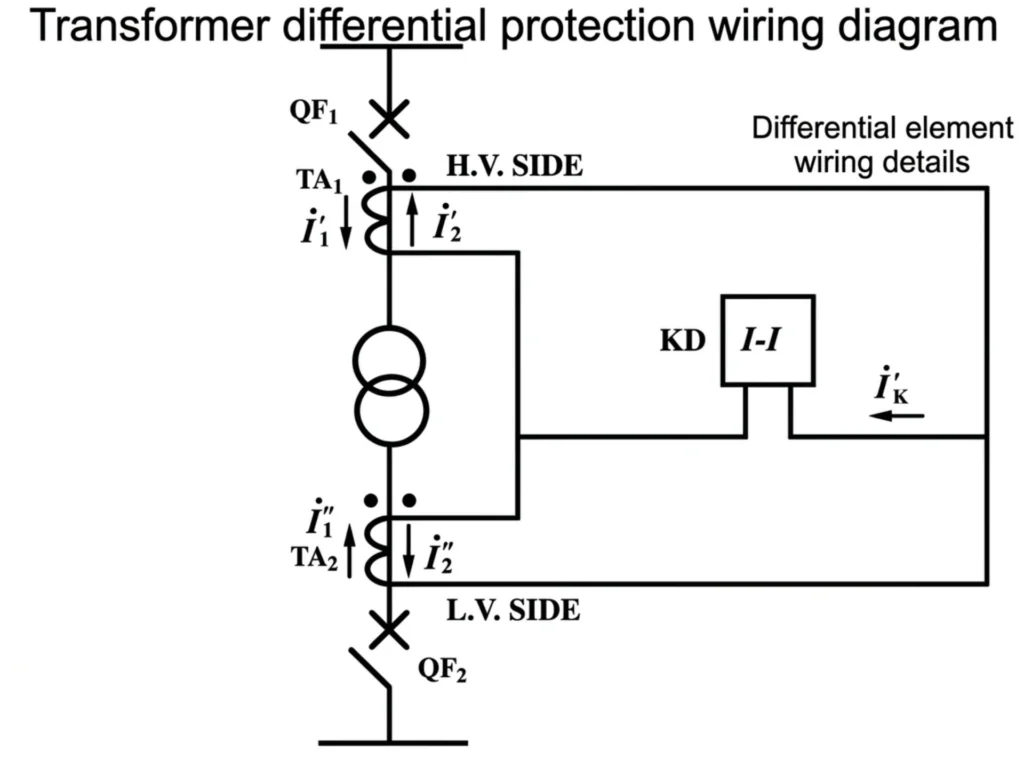
87T differential protection is used to protect power transformers against internal winding faults. The protection zone is defined by the CTs installed on the HV and LV sides. The relay compares currents entering and leaving the transformer, applying ratio compensation to account for CT differences, and vector group compensation to correct phase displacement. Percentage bias ensures stability during external faults, while harmonic restraint prevents false tripping during transformer energization.
For a complete explanation, read our Transformer Differential Protection Working Principle guide.
Line Differential Protection (87L)
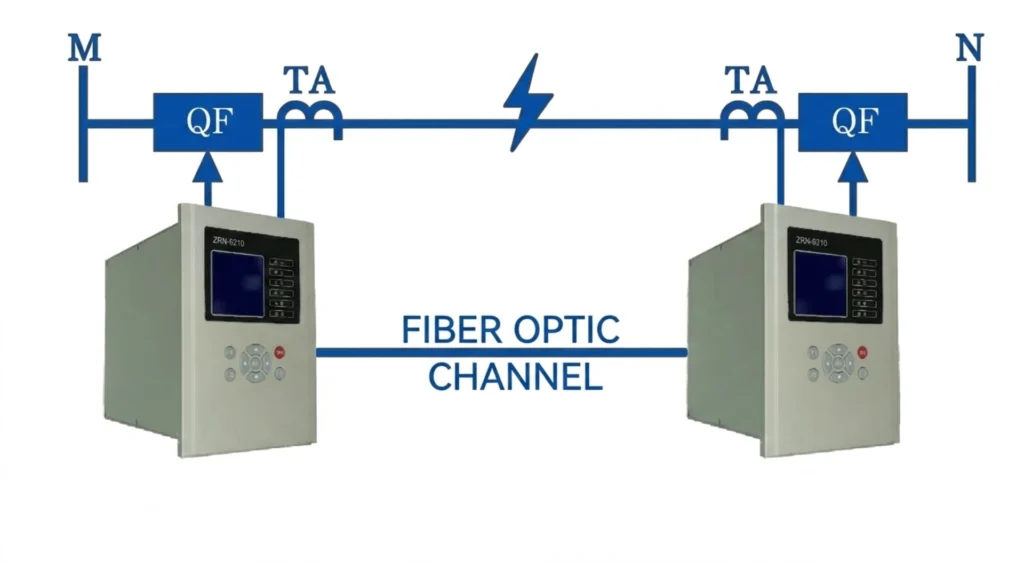
87L differential protection is used for overhead lines and cables. It compares currents measured by CTs at both ends of the protected line, using a communication channel (typically fiber optic) to exchange current data between the line ends. The relay calculates the differential current and determines whether a fault is internal or external to the protected line.
For detailed application guidance, see our Line Differential Protection page.
Generator Differential Protection (87G)
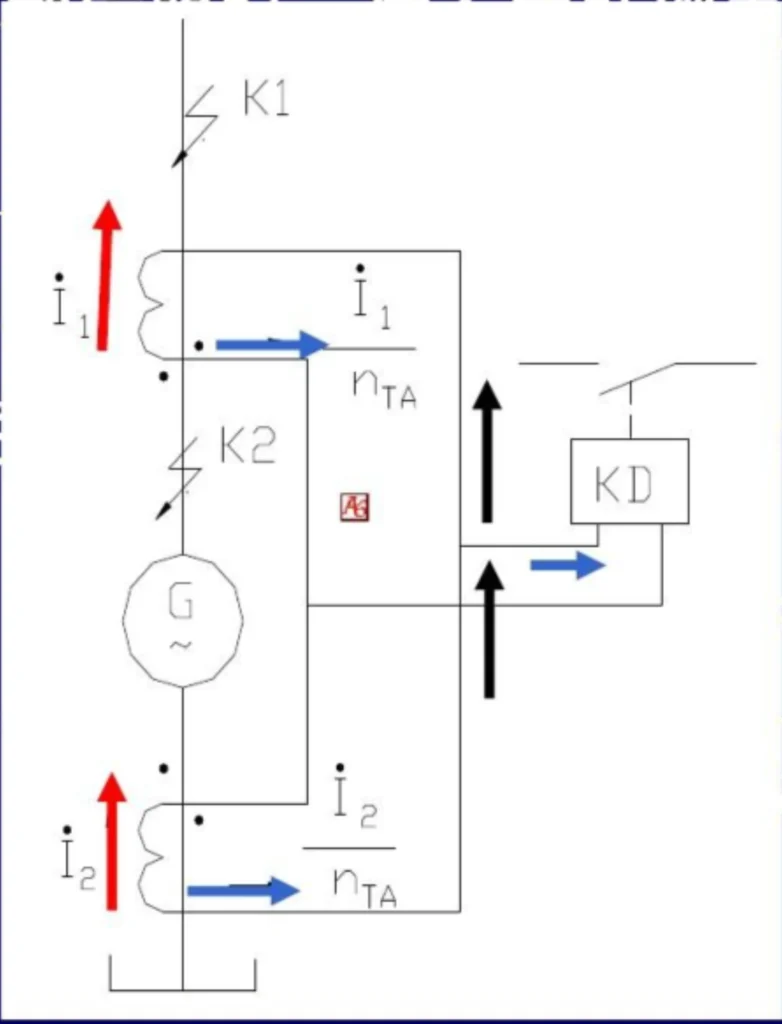
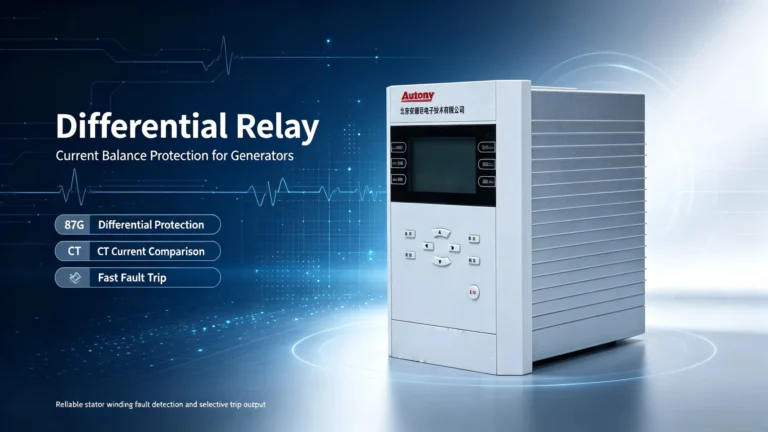
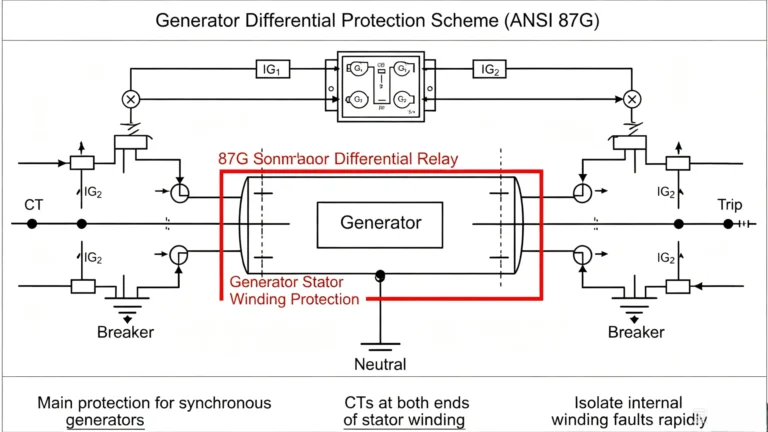
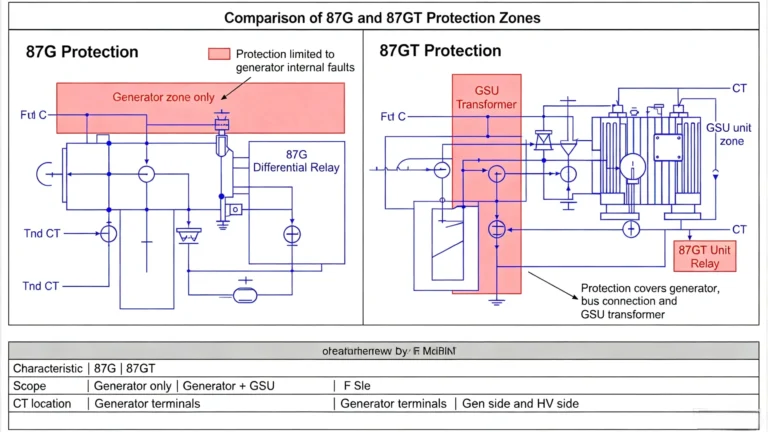
87G differential protection is used to detect phase-to-phase and phase-to-ground faults within the generator stator winding. CTs are installed at the generator neutral and terminal sides, defining the protection zone. The relay compares currents from both sides and trips when a differential current indicates an internal stator fault.
Busbar Differential Protection (87B)
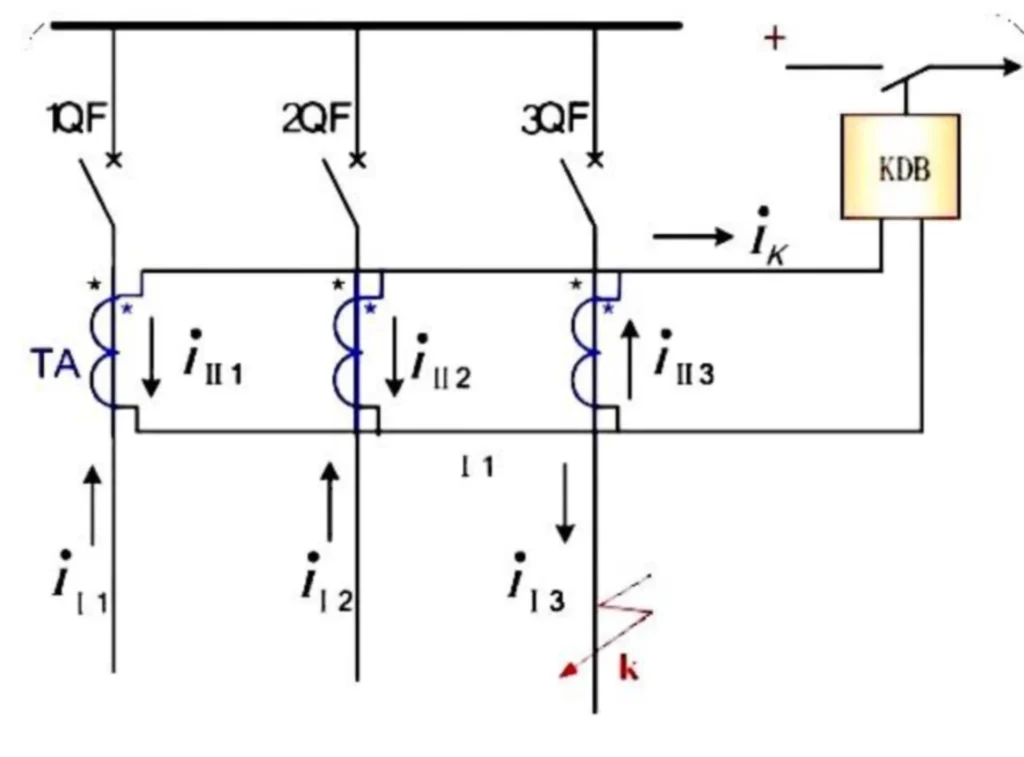
87B differential protection is used to protect busbars by comparing currents from all connected feeder CTs. The busbar defines the protection zone. During normal and external fault conditions, the sum of currents entering and leaving the bus is near zero. When a bus fault occurs, the current balance is disrupted and the relay trips to clear the fault quickly. Stability is ensured through CT saturation detection and security algorithms.
Motor Differential Protection (87M)
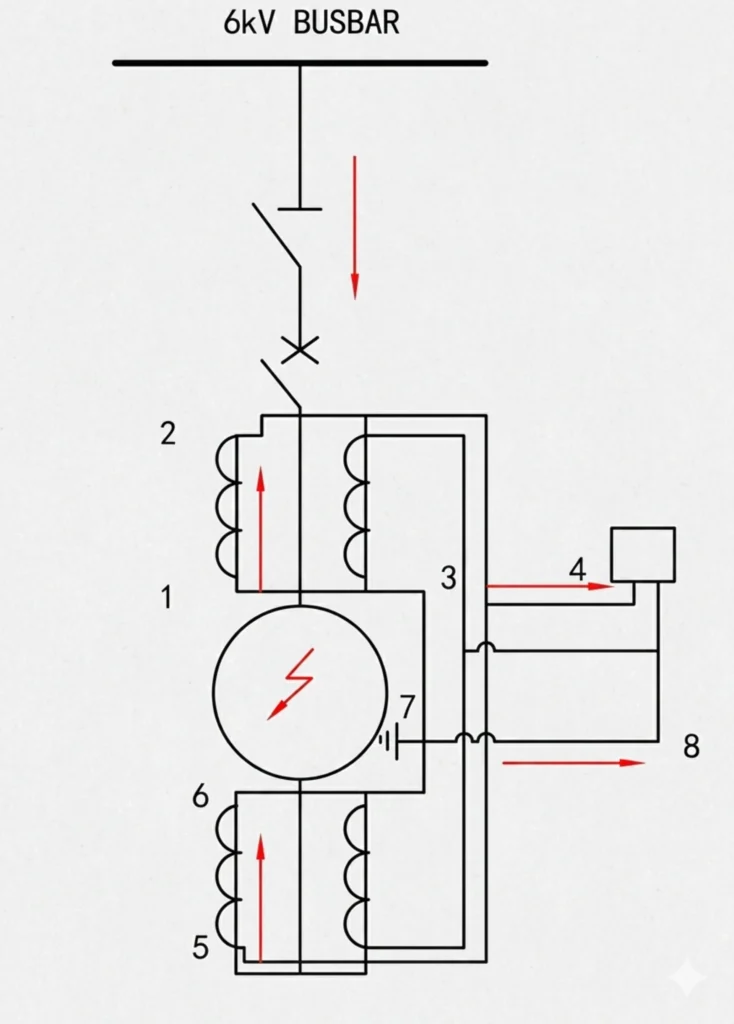
87M differential protection is used to protect large or high-value motors against stator winding faults and internal phase faults. CTs are installed at both ends of the motor winding, defining the protection zone. The relay compares currents and trips when an internal fault is detected.
Differential protection is commonly considered for large or critical motors where the required sensitivity and selectivity justify a dedicated differential scheme.
Differential Relay Protection vs 50/51 Overcurrent Protection
| Feature | ANSI 87 | ANSI 50/51 |
|---|---|---|
| Principle | Current comparison | Overcurrent |
| Main target | Internal faults | Overcurrent / backup faults |
| Selectivity | Protection-zone based | Coordination based |
| Speed | Generally fast | Instantaneous or time delayed |
| CT arrangement | Multiple boundary CTs | Usually one measurement point |
| Communication | Required for some schemes such as 87L | Usually not required |
| Typical role | Main protection | Main or backup depending on application |
Differential protection compares currents at multiple points to detect faults within a defined zone, providing fast and selective protection. ANSI 50/51 overcurrent protection responds to excessive current magnitude and can be applied as instantaneous (50) or time-delayed (51) protection. It does not require communication and is generally simpler to implement.
The selection between 87 and 50/51 depends on the application, system configuration, and protection requirements. 50/51 may serve as primary or backup protection depending on the application.
How Differential Relay Protection Distinguishes Internal and External Faults
Differential protection distinguishes internal faults from external faults by comparing electrical quantities entering and leaving the protected zone.
| Condition | Differential Current | Expected Action |
|---|---|---|
| Normal load | Low | No trip |
| External fault | Ideally low, but CT errors may increase it | Restraint / stability |
| Internal fault | High | Trip |
| CT saturation during external fault | May increase apparent differential current | Bias / stabilization |
Differential Relay Protection Testing
Differential relay protection testing verifies whether the protection scheme operates correctly for internal faults while remaining stable during normal operating conditions and external faults.
- Secondary injection – Verifies relay pickup, slope characteristic, and operating time against the relay settings
- CT polarity – Confirms correct phase and polarity alignment of all CT inputs
- Differential characteristic – Tests the bias slope and differential pickup across the characteristic curve
- Trip logic – Confirms trip output, alarm signals, and blocking logic operate as configured
- Binary I/O – Verifies correct mapping and response of binary inputs and outputs
- Communication (where applicable) – Checks protocol operation and data exchange with SCADA or substation automation systems
For 87T transformer differential protection, see our Transformer Differential Protection Testing guide. General commissioning sequences are covered in protection relay testing and commissioning.
Key Takeaways
- Differential relay protection is zone-based: it compares current at the zone boundaries and trips only for faults between the CTs.
- ANSI 87 is the device number; the suffix letter (87T, 87L, 87G, 87B, 87M) names the protected equipment, not a different operating principle.
- CT selection decides whether a scheme stays stable. Ratio and polarity errors, saturation under through-fault current, and unequal secondary burden are the usual sources of false differential current.
- Percentage bias restraint raises the operating threshold as through-current rises, which is what keeps the relay stable on external faults without losing sensitivity for internal ones.
- 87 gives zone selectivity independent of downstream coordination; 50/51 overcurrent is magnitude-based and remains the usual backup.
Differential Relay Protection – Frequently Asked Questions
Q1. What is differential relay protection?
Differential relay protection detects internal faults in a defined zone by comparing electrical quantities at its boundaries. Under normal and external fault conditions, current in equals current out, so differential current is near zero. During an internal fault, this balance is disrupted, differential current rises, and the relay trips. ANSI 87 applies to transformers (87T), generators (87G), lines (87L), busbars (87B) and motors (87M).
Q2. What does ANSI 87 mean in relay protection?
ANSI 87 is the standard device number for differential protection. It refers to protection schemes that compare currents entering and leaving a defined zone to detect faults within that zone.
Q3. What is the working principle of differential protection?
Differential protection works by comparing currents at the boundaries of a defined protection zone. Under normal and external fault conditions, the currents balance and differential current is near zero. When an internal fault occurs, the balance is disrupted and the relay trips.
Q4. What are the main types of differential protection?
The main types include 87T (transformer), 87L (line), 87G (generator), 87B (busbar), and 87M (motor). The letter following 87 indicates the application.
Q5. How Do the ANSI 87 Types Differ From One Another?
The difference lies in the protected equipment:
- 87T – Transformer
- 87L – Transmission line or cable
- 87G – Generator stator
- 87B – Busbar
- 87M – Motor
Each applies the same differential principle to a different protection zone.
Q6. Why are CTs important in differential protection?
CTs provide the current measurements that the relay uses for comparison. CT ratio accuracy, polarity, and saturation performance directly affect the relay’s ability to detect faults and remain stable during external faults.
Q7. What is percentage-restrained differential protection?
Percentage-restrained differential protection uses a bias characteristic that raises the operating threshold as through-current increases. This ensures stability during external faults while maintaining sensitivity for internal faults. It may be implemented as single-slope or dual-slope.
Q8. What is the difference between ANSI 87 and 50/51 protection?
ANSI 87 uses current comparison across multiple CTs to detect faults within a defined zone. ANSI 50/51 overcurrent protection responds to current magnitude and does not require comparison. 87 provides zone-based selectivity; 50/51 provides coordination-based protection and may serve as primary or backup protection depending on the application.
Q9. Why can CT saturation cause differential protection instability?
CT saturation distorts secondary current waveforms, introducing measurement errors that can produce apparent differential current during external faults. Percentage bias and saturation detection algorithms help maintain stability under saturated conditions.
Q10. How is ANSI 87 differential protection tested?
Testing typically includes secondary injection tests for pickup and slope, CT polarity verification, trip logic checks, binary I/O verification, and communication testing where applicable. For complete procedures, refer to dedicated testing guides for each application.
Q11. Can One Numerical Relay Provide Several ANSI 87 Functions?
Yes. Many numerical relays support multiple differential protection functions in a single device, allowing protection of transformers, lines, generators, busbars, or motors with appropriate configuration and CT inputs.
Differential Relays for ANSI 87 Applications
Autony supplies numerical differential relays for 87T, 87G, 87M and 87B schemes, with CT arrangement review and setting support for EPC contractors and owner-engineer teams. Start from the generator differential protection relay 87G or the motor differential protection 87M device pages, or send your single-line diagram for a scheme review.
Reference & Technical Sources
| Source | What it covers in this article | Type | Edition |
|---|---|---|---|
| IEEE Std C37.2 | Device function numbers: definition of device 87 and its suffix letters (T, L, G, B, M) | International standard | C37.2-2008 |
| IEC 61869-2 | Protective current transformer classes (5P, 10P, TP classes) and accuracy limit factor | International standard | IEC 61869-2:2012 |
| IEEE Std C37.91 | Transformer protection practice: 87T application, ratio and vector compensation, inrush restraint | IEEE guide | C37.91-2008 |
| IEEE Std C37.102 | AC generator protection: 87G zone definition and CT arrangement | IEEE guide | C37.102-2006 |
| IEEE Std C37.96 | AC motor protection: when 87M is justified over 50/51 | IEEE guide | C37.96-2012 |
| IEEE Std C37.234 | Bus protection: high-impedance and low-impedance 87B schemes, CT saturation behaviour | IEEE guide | C37.234-2009 |
| IEC 61850 series | Station and line communication used to exchange current data for 87L | International standard | Current edition |
| Project specification | ALF ≥ 20, 10% error curve criterion, secondary cable length balance, 0.5% CT matching error — typical project limits, confirm against the project specification | Engineering practice | — |
Edition years are those commonly referenced in protection practice; confirm the current edition before citing in a project document. Values marked as engineering practice are typical project limits, not standard-mandated values.
Related reading: differential relay · transformer differential protection working principle · generator differential protection 87G · bus differential protection · motor differential protection
About Author

Hello, I'm Leno Zhang. I have 15 years of experience in the power relay protection industry with extensive pre-sales and after-sales project experience. Our company specializes in various complete sets of relay protection and automation equipment. I can assist customers in solving all practical on-site project challenges and provide optimal integrated solutions.
Tell Us Your Requirement
High Quality
Stable performance, reliable design, ensuring safe operation for power system protection and grid stability.
Fast Delivery
Timely delivery to support your urgent orders and project schedules efficiently and professionally at any time.
Best Warranty
Professional Warranty: Reliable after-sales support for stable relay protection and long-term customer satisfaction.