

-
Leon Zhang sales consultant
-
Email: zxl635973785@gmail.com
-
Phone/WhatsApp: +86 13655813266
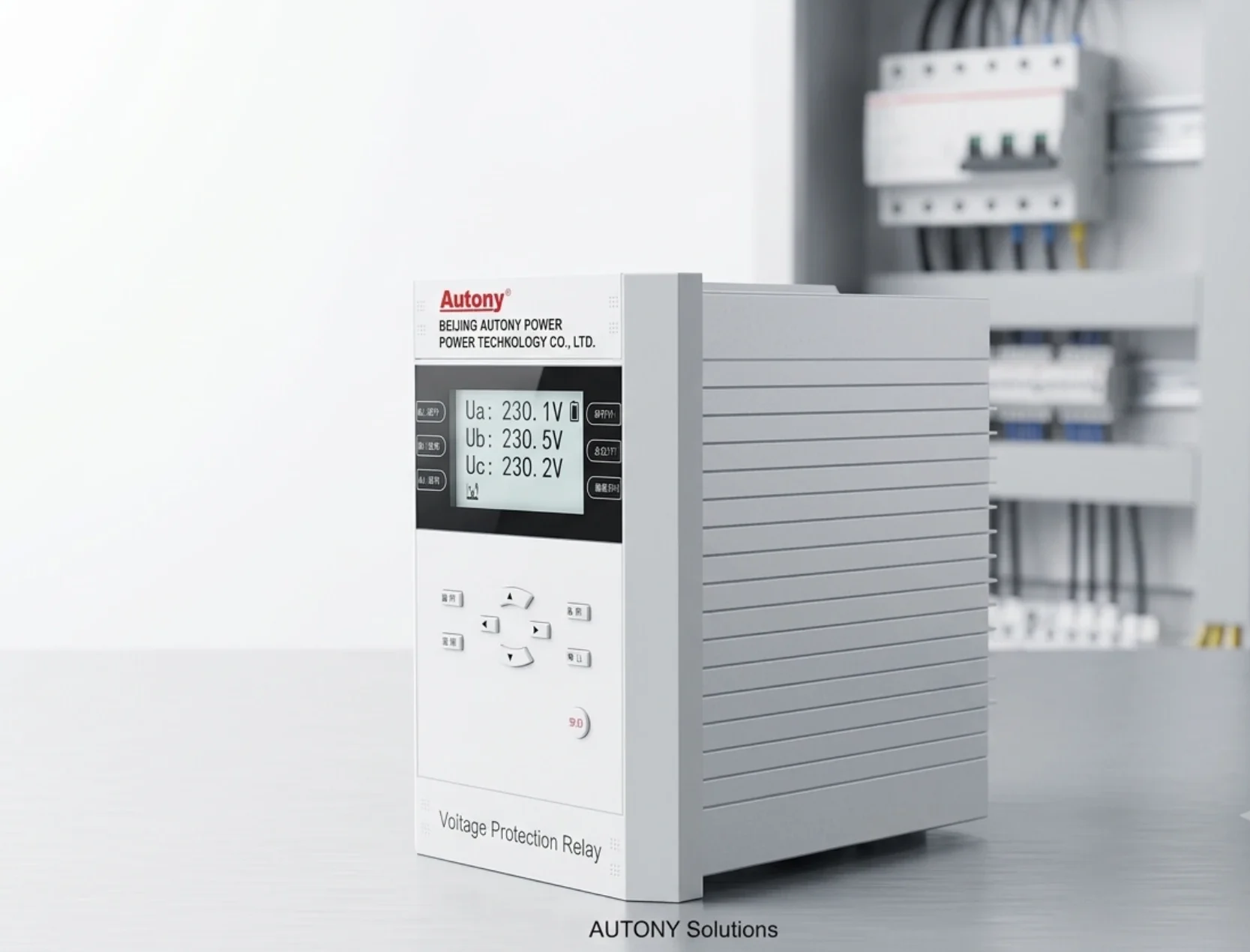
Voltage Protection Relay | Complete Voltage Protection for Power Systems
What Is Voltage Protection Relay in a Protection Relay?
Voltage protection is an indispensable core part of modern protective relay systems. A reliable Voltage Protection Relay continuously monitors system voltage and triggers corresponding actions once voltage deviates from the normal operating range.
It integrates multiple dedicated protection functions compliant with international ANSI standards, each targeting distinct abnormal operating conditions.
| Protection Function | ANSI Code | Description |
|---|---|---|
| Overvoltage Protection | 59 | Activates when the system voltage rises above the predefined threshold value. |
| Undervoltage Protection | 27 | Operates when the system voltage drops below the set operating level. |
| Residual Voltage Protection | 59N | Monitors residual zero-sequence voltage to assist in ground fault detection. |
| Overexcitation Protection | 24 | Primarily deployed for the safe operation of generators and power transformers. |
| Voltage Unbalance Protection | 47 | Detects unbalanced three-phase voltage, a common hidden hazard in three-phase power systems. |
Why Is Voltage Protection Important?
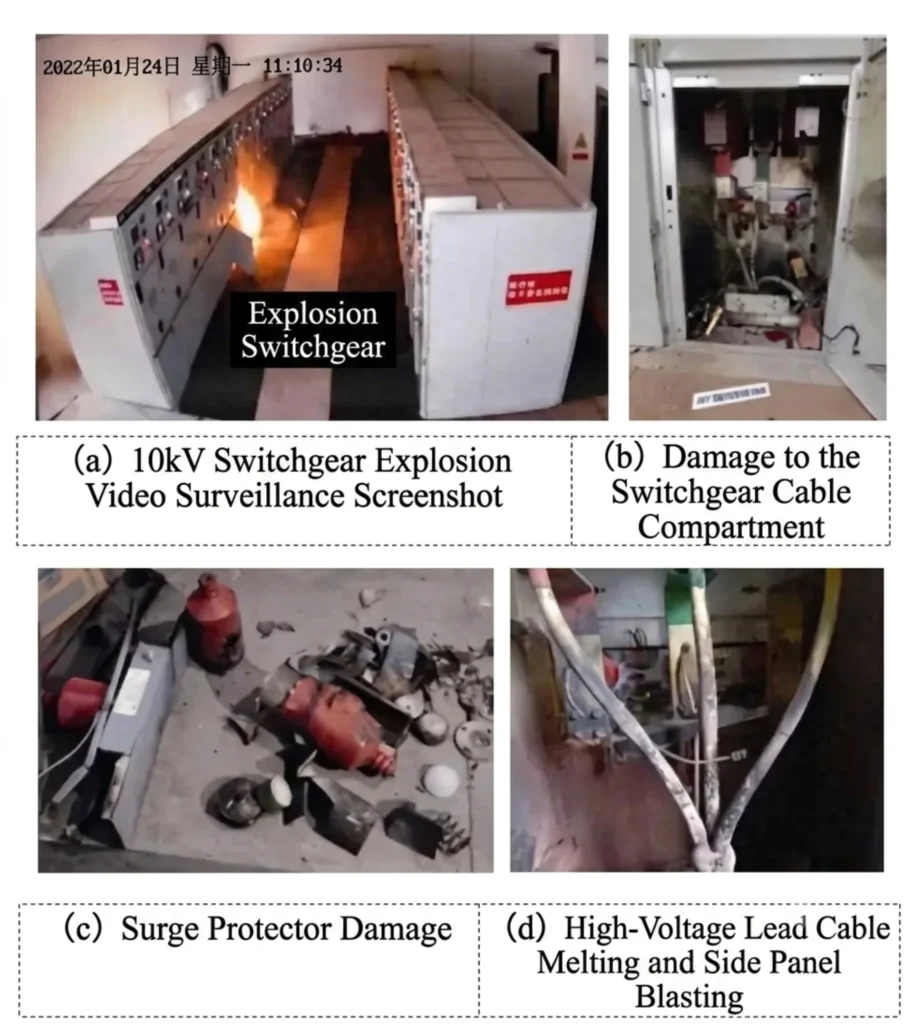
Uncontrolled voltage fluctuations will trigger a chain of adverse impacts on power equipment and production operations. The table below outlines common voltage-related problems and their direct consequences for power systems and industrial sites:
| Problem | Potential Consequence |
|---|---|
| Grid voltage surge | Transformer insulation damage and accelerated aging |
| Voltage sag | Motor stalling, abnormal operation and shutdown |
| Renewable power fluctuation | Frequent inverter shutdown and unstable power output |
| Utility grid disturbances | Forced production interruption and economic loss |
| Generator excitation failure | Severe damage to generation units and auxiliary equipment |
Common Voltage Protection Functions and Their Applications
Overvoltage Protection Relay (ANSI 59)
As one of the most widely used protection modules, overvoltage protection is extensively applied to transformers, generators, capacitor banks, solar farms and wind farms.
A frequent question from field operators is: Why does my transformer experience overvoltage trips?
The main triggers include sudden load rejection, frequent switching operations, lightning surges and unreasonable relay parameter configurations.
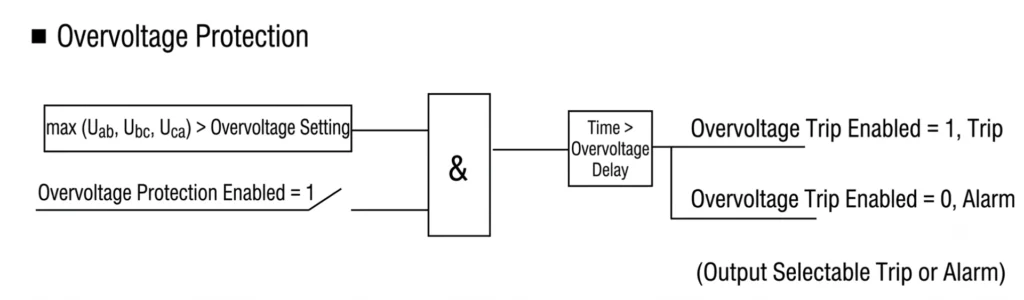
Overvoltage Protection (ANSI 59) Settings
Pickup Voltage: 110%–120% Un, typical value 115% Un
Trip Delay: 1–3 s for distribution systems; 2–5 s for generators & transformers
| Protected Equipment | Pickup Voltage | Trip Delay |
|---|---|---|
| Busbar & Feeder | 115% Un | 1–2 s |
| Capacitor Bank | 110% Un | 0.5–1 s |
| Transformer | 115%–120% Un | 2–3 s |
| Generator | 110%–115% Un | 2–5 s |
| LV Motor & VFD | 110%–115% Un | 0.5–3 s |
Key Notes
- Set pickup above 110% Un to avoid nuisance tripping from normal voltage fluctuation.
- Time delay shall cover transients caused by switching, lightning and equipment startup.
Under Voltage Protection relay (ANSI 27)
This 3 phase under voltage protection relay delivers an essential function for motors, water pumps, industrial feeders and backup power systems.Many industrial users face the issue: Why does my motor stop during voltage dips?
Weak grid power quality, large inrush current generated during the startup of high-power motors and excessively long feeder lines will all cause voltage sags.
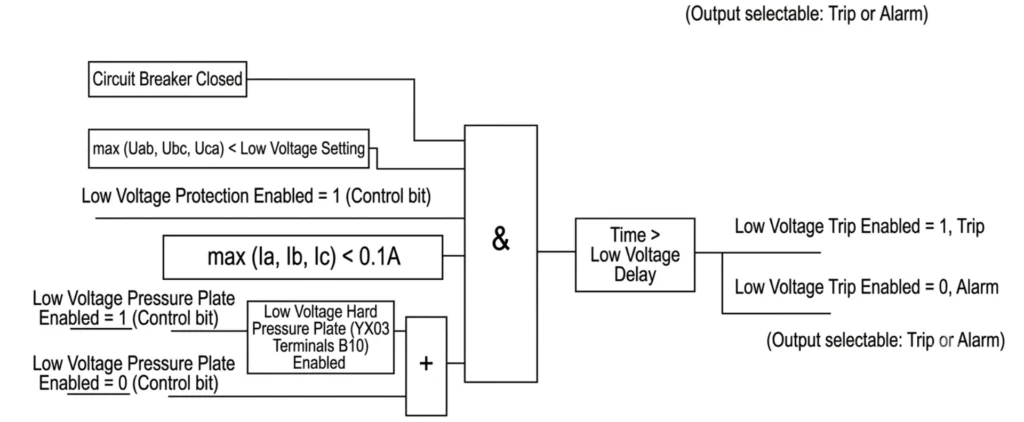
Under Voltage Protection Relay setting
Pickup Voltage: 80%–90% Un, typical value 85% Un
Trip Delay: 0.5–2 s for distribution & general loads; 2–5 s for critical motors & backup power
| Protected Equipment | Pickup Voltage | Trip Delay |
|---|---|---|
| Busbar & Feeder | 85% Un | 1–2 s |
| General Industrial Motor | 80%–85% Un | 1–3 s |
| Large Motor & Pump | 85%–90% Un | 2–5 s |
| Backup Power Transfer | 80% Un | 0.5–1 s |
| Renewable Energy Grid Connection | 80%–85% Un | 1–2 s |
Key Notes
- Keep pickup below 90% Un to balance equipment protection and anti-nuisance tripping.
- Time delay shall withstand transients from motor starting and temporary voltage dips.
Voltage Unbalance Protection (ANSI 47)
A 3 phase overvoltage protection relay helps address a typical troubleshooting issue for electrical engineers: Why are motors overheating even when current levels seem normal?
The culprit is three-phase voltage unbalance. Data shows that merely 3% of voltage unbalance can lead to more than 15% of current unbalance. Long-term operation in this state will cause severe motor overheating, coil aging and even burnout.
Voltage Unbalance Protection (ANSI 47) Settings
Unbalance Threshold: 2%–5%, typical value 3%
Trip Delay: 1–3 s
| Protected Equipment | Unbalance Threshold | Trip Delay |
|---|---|---|
| General 3-phase Motor | 3% | 1–2 s |
| Large & Precision Motor | 2%–3% | 2–3 s |
| Busbar & Feeder | 3%–4% | 1–2 s |
| Generator | 2%–3% | 2–3 s |
Key Notes
- 3% is the standard setting; use lower threshold for sensitive loads.
- Time delay prevents nuisance tripping caused by temporary voltage fluctuations.
Residual Overvoltage Protection (59N)
This overvoltage relay protection function is mainly used for ground fault detection in ungrounded power systems and resonant grounded systems. Operators of isolated networks often struggle with a problem: Why is earth fault detection difficult in isolated networks?
Traditional detection methods are ineffective in such systems, while residual overvoltage protection (59N) accurately captures zero-sequence voltage signals generated by ground faults, realizing reliable fault identification and isolation, and greatly improving the safety of medium and low voltage distribution networks.
Residual Overvoltage Protection (ANSI 59N) Settings
Pickup Voltage: 10%–20% Un, typical value 15% Un
Trip Delay: 0.5–1 s
| Protected System | Pickup Voltage | Trip Delay |
|---|---|---|
| Ungrounded System | 15% Un | 0.5–1 s |
| Resonant Grounded System | 10%–15% Un | 0.5–1 s |
| Medium Voltage Distribution Line | 15%–20% Un | 0.5–1 s |
Key Notes
- Adjust threshold according to grounding mode; adopt lower value for resonant grounded systems.
- Short delay ensures fast ground fault detection and avoids response to normal zero-sequence voltage deviation.
Most Common Voltage Protection Problems Faced by Utilities and Industrial Plants
Problem 1: Frequent Nuisance Tripping
Frequent false tripping is a top complaint, with related search queries including relay keeps tripping and false relay operation. The main causes are improper voltage relay settings, potential transformer (PT) ratio errors and instantaneous voltage spikes on the grid.
To fix this issue, recheck and optimize protection thresholds and time delay parameters, calibrate PT equipment, and select a high-performance voltage monitoring relay with anti-interference capability to filter transient voltage disturbances.
Problem 2: Relay Fails to Trip During Voltage Faults
This is the most concerning risk for power station and substation operators. When overvoltage or undervoltage faults occur but the relay does not act, equipment will face irreversible damage.
Common reasons include incorrect current transformer (CT) and PT wiring, unreasonable pickup values and firmware configuration errors. Conduct comprehensive wiring inspection, recalculate and verify all protection parameters, and complete full function testing before putting the relay into formal operation.
Problem 3: Solar Plant Voltage Fluctuation
With the rapid development of renewable energy, voltage instability in photovoltaic power plants has become a hot issue. After connecting PV systems to the grid, sites often suffer from voltage rise, continuous voltage fluctuation and frequent inverter shutdown.
Leveraging the integrated ANSI 27 and ANSI 59 functions of digital protection relays to realize real-time protection relay voltage monitoring is the ideal solution. It keeps grid voltage within the safe range and ensures the stable grid-connected operation of solar power facilities.
Problem 4: Generator Overvoltage During Load Rejection
The issue commonly occurs on diesel generators, gas generators and hydro generators. When the load is suddenly cut off, the generator terminal voltage will rise sharply in a short time. Without timely overvoltage protection, the generator body and connected electrical equipment will be damaged instantly. Reasonable configuration of generator overvoltage protection can effectively handle voltage surges caused by load rejection.
Voltage Protection in Modern Digital Protection Relays
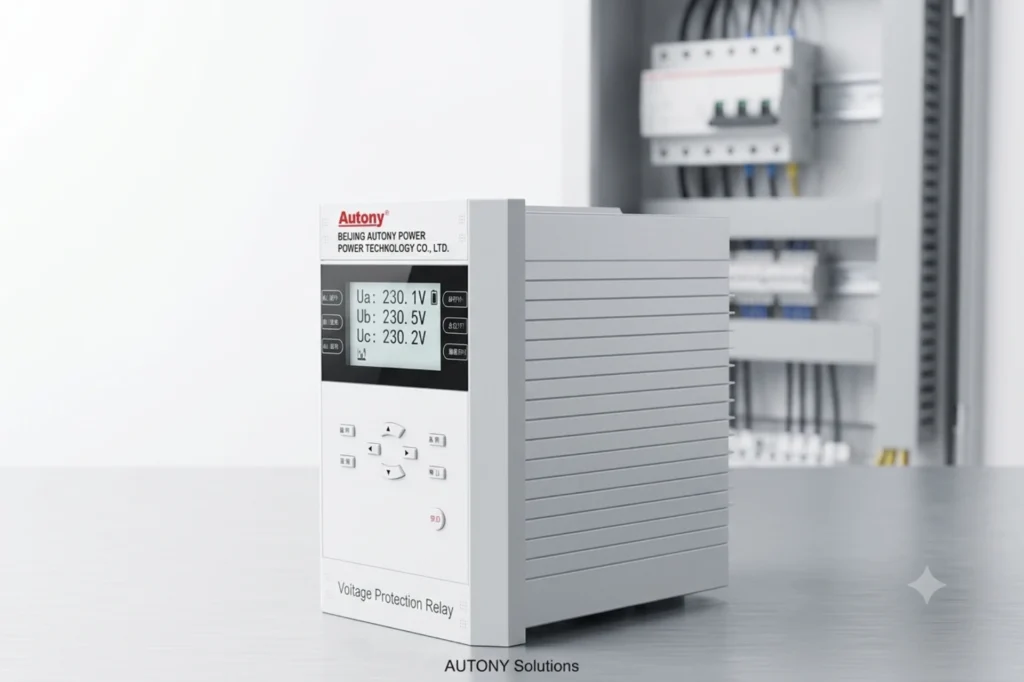
Traditional electromagnetic relays can no longer meet the demands of complex modern power systems. The new generation of digital protection relays integrates all voltage protection functions and brings multiple technical advantages:
- Real-Time Voltage Monitoring: Tracks three-phase voltage, residual voltage and unbalance degree continuously and precisely.
- Event Recording & Disturbance Analysis: Automatically record fault time, voltage data and action logs for post-fault troubleshooting.
- Rich Communication Protocols: Fully compatible with mainstream industrial protocols including IEC 61850, Modbus and DNP3, supporting seamless connection with SCADA systems to realize remote monitoring and control.
How Digital Voltage Protection Relays Improve Power System Reliability
Our dedicated 3 phase voltage protection relay is tailor-made for utilities, EPC contractors, industrial users and renewable energy plants, solving various voltage-related pain points comprehensively.
Key Features
- High-precision voltage measurement to ensure accurate fault judgment
- Integrated full-range voltage protection functions (ANSI 27, 59, 47, 59N, 24)
- Fast fault response speed to cut off faults in milliseconds
- Wide and flexible setting ranges, adaptable to various voltage levels
- Standard IEC 61850 communication interface for smart grid access
- Complete event and fault recording function for easy operation and maintenance
Typical Applications
- Utility substations and power distribution networks
- Large-scale industrial power systems and manufacturing plants
- Solar farms, wind farms and other renewable energy stations
- Data centers, oil & gas facilities and other high-reliability scenarios
Frequently Asked Questions (FAQ)
What is the difference between overvoltage and undervoltage protection?
Overvoltage protection (ANSI 59) responds to voltage higher than the normal range to prevent insulation breakdown; undervoltage protection (ANSI 27) acts when voltage drops below the standard value to protect motors and power loads. They target opposite voltage anomalies and complement each other for full-range voltage protection.
What causes an overvoltage relay to trip?
Main causes include load rejection, grid switching operations, lightning surges, wrong relay settings and abnormal generator excitation.
How do I calculate voltage relay settings?
Take the system nominal voltage as the benchmark. Set overvoltage pickup at 110%~120% Un and undervoltage pickup at 80%~90% Un, then match proper time delay based on load characteristics and grid operating conditions.
Can one protection relay provide both 27 and 59 functions?
Yes. Modern digital voltage protection relays integrate ANSI 27 undervoltage and ANSI 59 overvoltage protection in one device, realizing all-round voltage protection with a single unit.
What voltage protection is required for transformers?
Transformers mainly require ANSI 59 overvoltage protection, ANSI 24 overexcitation protection and ANSI 47 voltage unbalance protection to guard against insulation damage and abnormal operating conditions.
Why does my relay trip even when voltage appears normal?
It is usually caused by PT wiring errors, incorrect ratio configuration, transient voltage spikes or unreasonable time delay settings. Conduct wiring inspection, equipment calibration and parameter re-optimization for troubleshooting.
Is voltage protection necessary in solar power plants?
Absolutely necessary. PV grid connection easily triggers voltage rise and fluctuation. Voltage protection relays can stabilize grid voltage, avoid inverter shutdown and ensure safe and stable operation of solar power systems.
Are you a professional China voltage protection relay supplier?
Yes. We are a professional Chinese supplier of voltage protection relays. Our devices are widely used in substations, industrial plants, pump stations, renewable energy stations and overseas EPC power distribution projects.
Conclusion
As a China voltage protection relay factory, we provide reliable products at competitive prices. Our product line covers high voltage protection relay, low voltage protection relay and over and under voltage protection relay.
These devices monitor voltage steadily, protect equipment from voltage anomalies and ensure stable operation of power systems.
About Author

Hello, I'm Leno Zhang. I have 15 years of experience in the power relay protection industry with extensive pre-sales and after-sales project experience. Our company specializes in various complete sets of relay protection and automation equipment. I can assist customers in solving all practical on-site project challenges and provide optimal integrated solutions.
Tell Us Your Requirement
High Quality
Stable performance, reliable design, ensuring safe operation for power system protection and grid stability.
Fast Delivery
Timely delivery to support your urgent orders and project schedules efficiently and professionally at any time.
Best Warranty
Professional Warranty: Reliable after-sales support for stable relay protection and long-term customer satisfaction.