

-
Leon Zhang sales consultant
-
Email: zxl635973785@gmail.com
-
Phone/WhatsApp: +86 13655813266
Phase Protection Relay: Working Principle, Types, Applications and Selection Guide
What Is a Phase Protection Relay?
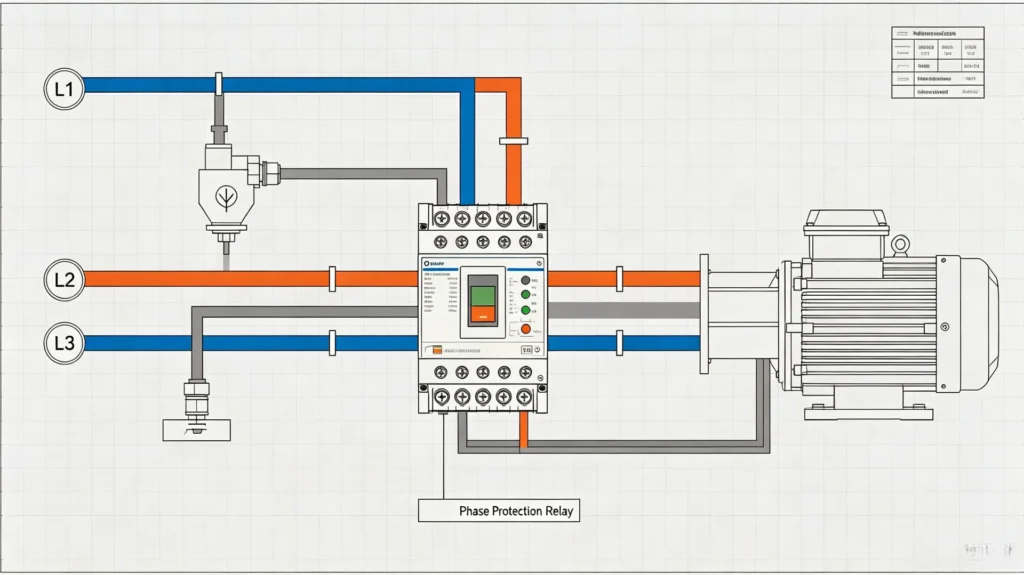
A phase protection relay, also known as a phase monitoring relay, is a dedicated electrical protection device designed for three-phase AC power systems. It continuously monitors real-time voltage status, phase sequence, phase angle and balance degree of L1, L2, L3 three-phase circuits, and triggers protection actions once abnormal phase conditions occur.
This device targets four core three-phase power faults that frequently occur in industrial substations, EPC projects and motor control systems:
- Phase failure (phase loss): Single or two-phase voltage dropout
- Phase sequence error/phase reversal: Abnormal phase order of power supply
- Phase imbalance: Unbalanced voltage/current among three phases
- Overvoltage/undervoltage: Exceeding or falling below rated operating voltage
As a core auxiliary protection device for industrial power distribution, the phase rotation protection relay effectively avoids motor burnout, equipment reverse operation, system overheating and unplanned downtime, greatly improving the operational stability of power systems for manufacturing, energy and petrochemical projects.
Why Is Phase Protection Important in Three-Phase Electrical Systems?
Most industrial equipment (three-phase motors, pumps, compressors, generators) relies on balanced and correct three-phase power supply. Minor phase abnormalities will gradually damage electrical equipment, while severe faults will cause immediate equipment failure and project shutdown.
A 3 phase power protection relay serves as the critical safeguard against such risks. The core hazards of unprotected phase faults are summarized as follows:
Phase Loss Causes Permanent Motor Damage
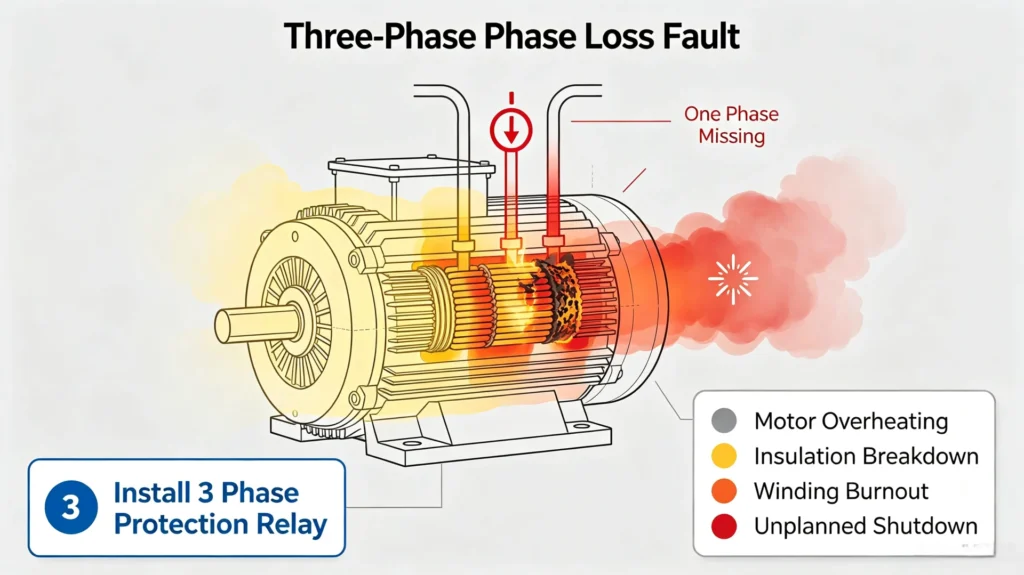
When single-phase power loss occurs in a running three-phase system, the remaining two phases will bear full load current, resulting in 1.5–2 times overcurrent. Long-term operation will cause rapid overheating of motor windings, insulation aging and permanent burnout. This fault is the leading cause of motor damage in water pump stations, HVAC systems and production line equipment.
Phase Reversal Leads to Mechanical Operation Faults
Wrong phase sequence (ACB instead of standard ABC) will reverse the rotation direction of three-phase motors. For pumps, elevators and conveyor equipment, reverse operation will cause pipeline backflow, mechanical collision and equipment abrasion, bringing safety risks and production losses to industrial and EPC projects.
Phase Imbalance Shortens Equipment Service Life
Voltage or current imbalance will generate negative sequence current inside the equipment, causing continuous temperature rise, increased vibration and reduced operating efficiency. Long-term unbalanced operation will shorten the service life of motors, transformers and switchgears by 30%–50%, increasing project operation and maintenance costs.
How Does a Phase Protection Relay Work?
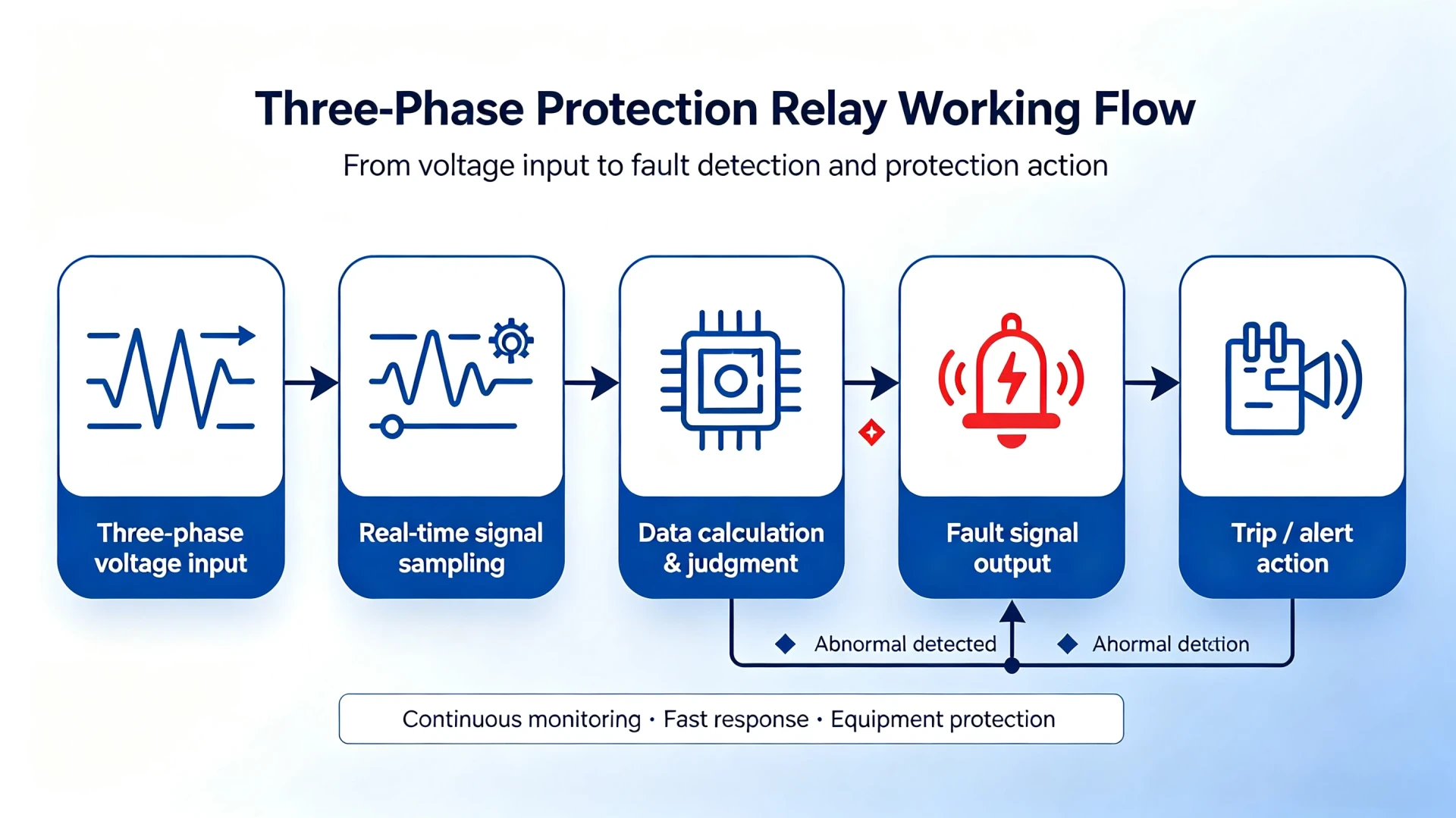
The working logic of a phase protection relay is based on real-time sampling, signal analysis and threshold judgment. It operates without relying on load current and can monitor power supply abnormalities in no-load and loaded states. The complete working process is as follows:
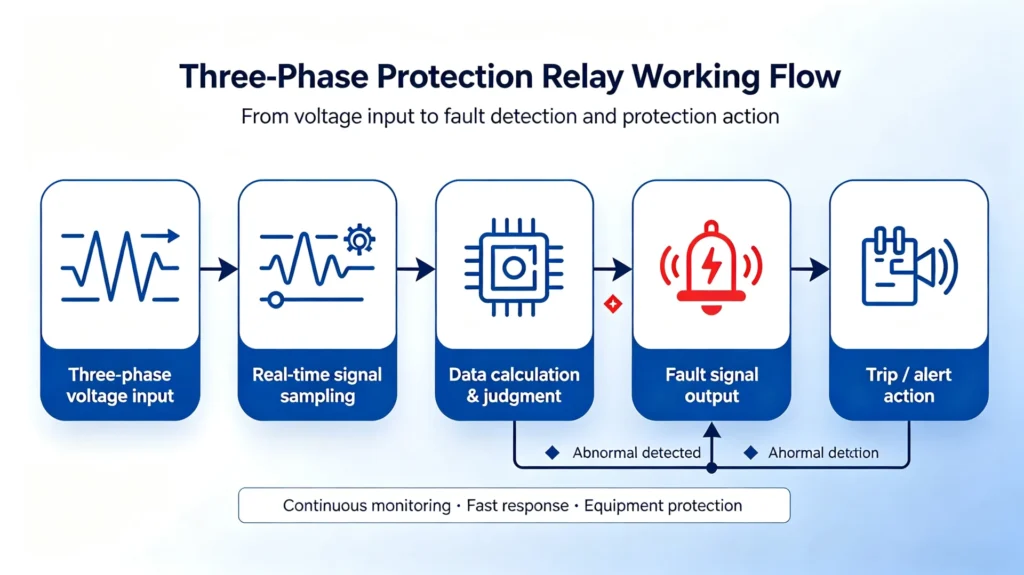
Real-Time Voltage and Parameter Measurement
The relay collects real-time data of three-phase voltage, phase angle and power frequency, and calculates the average voltage and voltage deviation of each phase to provide basic data for subsequent fault judgment.
Phase Sequence Detection
The system identifies the standard ABC positive sequence of three-phase power supply. Once the phase order is reversed to ACB or other abnormal sequences, it immediately locks the fault state.
Phase Failure Judgment
When the voltage of any phase drops below the preset threshold or completely disappears, the relay confirms a phase loss fault and starts the protection delay program.
Phase Imbalance Calculation
The relay calculates the three-phase voltage imbalance rate through professional formulas to judge whether the system is abnormal:

When the imbalance rate exceeds the factory or customized setting value, the relay outputs a fault signal to cut off the power supply or send an alarm.
Main Types of Phase Protection Relays
According to core protection functions and application scenarios, phase protection relays are divided into four mainstream types, covering all conventional needs of industrial projects and EPC power distribution systems:
Phase Failure Relay
Core function: Real-time detection of single-phase or multi-phase power loss. It is the most basic phase protection device, focusing on preventing motor burnout caused by phase loss.
Typical applications: Motor control panels, factory production lines, HVAC equipment, water pump and fan systems
Phase Sequence Relay
Core function: Monitor three-phase power sequence and prevent phase reversal. It only acts on wrong phase sequence faults and avoids mechanical reverse operation of equipment.
Typical applications: Elevators, water supply and drainage pumps, compressors, lifting equipment
Phase Imbalance Protection Relay
Core function: Precisely monitor three-phase voltage and current imbalance, and provide overheating protection for heavy-load equipment.
Typical applications: Large industrial motors, frequency conversion drive systems, factory heavy equipment
Multifunction Phase Protection Relay
Integrate all core functions: phase loss, phase reversal, phase imbalance, overvoltage and undervoltage protection, with adjustable delay parameters. It is the most widely used model in modern industrial power distribution.
Typical applications: Industrial automation systems, complete switchgear, EPC project power distribution cabinets, renewable energy power stations.
Phase Protection Relay vs Overload Relay: Core Differences
EPC engineers and procurement personnel often confuse phase protection relays with overload relays. In fact, the two are complementary rather than alternative devices, with completely different protection targets and working mechanisms:
| Comparison Item | Phase Protection Relay | Overload Relay |
|---|---|---|
| Core Protection Target | Three-phase power quality abnormalities | Motor overcurrent and thermal overload |
| Main Detection Objects | Phase loss, phase reversal, phase imbalance, abnormal voltage | Load overcurrent and long-term overload operation |
| Working Principle | Real-time voltage signal sampling and electrical judgment | Thermal accumulation and bimetallic strip sensing |
| Response Speed | Fast electrical protection (millisecond level) | Delayed thermal protection (second/minute level) |
| Application Orientation | Power system power quality protection | Motor overload safety protection |
Engineering Suggestion: For standard industrial motor projects, the matching use of cheap phase protection relay + overload relay can achieve full-cycle safety protection of power supply and load.
Industrial Applications of Phase Protection Relays
Phase protection relays are standard configuration for three-phase power systems, widely used in global industrial, energy and EPC general contracting projects:
Three-Phase Motor Protection
Protect core power equipment such as industrial motors, water pumps, fans and compressors from phase faults, and reduce equipment failure rate in continuous production scenarios.
Generator and Power Station Protection
Applied to wind power, solar energy, hydropower and thermal power projects, monitor phase balance of generator output voltage, and ensure stable grid-connected operation of power stations.
Industrial Control & MCC Panels
Installed in motor control centers (MCC), ATS automatic switching systems and automation control cabinets to provide overall power quality protection for the whole plant system.
HVAC and Building Electrical Systems
Protect central air conditioning chillers, large ventilation motors and building electromechanical equipment to meet the safety operation specifications of commercial and industrial buildings.
Key Parameters for Phase Protection Relay Selection
For EPC project procurement and electrical engineering design, the following core parameters must be confirmed to avoid model mismatch and project rework:
| Key Parameter | Selection Description & Common Specifications |
|---|---|
| Rated Working Voltage | AC 220V/380V/400V/480V (adapt to global regional power grids) |
| Power Frequency | 50Hz/60Hz switchable, suitable for European, American and Southeast Asian projects |
| Monitoring Mode | Full three-phase voltage real-time monitoring, no load current limitation |
| Protection Functions | Optional single function or integrated multi-function (loss/reversal/imbalance/over/under voltage) |
| Setting Range | Adjustable voltage threshold and trip delay to adapt to different project working conditions |
| Output Contact | Normally open/normally closed relay output, matching cabinet control logic |
| Installation Method | Standard DIN rail mounting, suitable for standard switchgear cabinets |
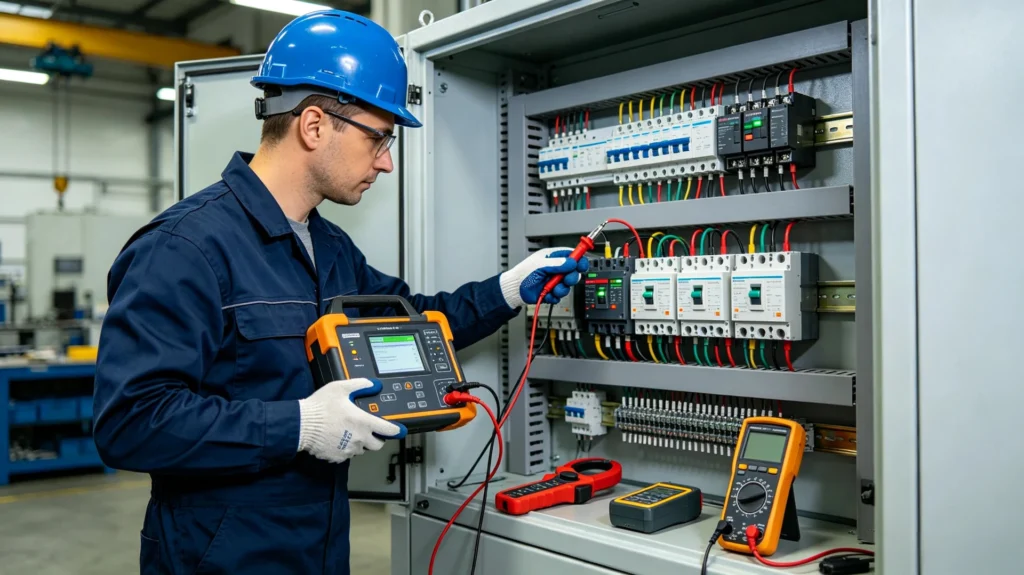
Standard Installation and Testing Procedures
Standardized installation and testing are the key to ensure the stable operation of phase protection relays, complying with IEC industrial electrical construction specifications:
Installation Steps
- Verify the relay rated voltage and frequency to match the on-site power grid parameters
- Connect three-phase power supply L1/L2/L3 and grounding wire correctly
- Access the control loop through relay output contacts
- Set customized protection threshold and delay parameters according to project requirements
- Power on and perform full-function test before official operation
Conventional Testing Items
- Phase loss simulation test
- Phase reversal switching test
- Three-phase voltage imbalance test
- Overvoltage and undervoltage trip test
- Protection delay accuracy verification
Common Problems & Troubleshooting
Why does the phase protection relay trip frequently?
Common causes: On-site grid voltage fluctuation, unreasonable parameter setting, loose wiring terminals, long-term slight phase imbalance of the system.
Solutions: Calibrate protection parameters, check wiring firmness, and eliminate grid voltage instability factors.
How to complete professional testing of a phase failure relay?
Use a three-phase voltage simulator or special relay test instrument to simulate phase loss, reversal and imbalance faults, and verify the relay’s action accuracy and response delay.
Can phase protection relays independently protect motors from burnout?
It can prevent motor damage caused by phase abnormalities, but cannot resist equipment damage caused by overload and overcurrent. It must be used with overload relays and motor protection relays to form a complete protection system.
How to Choose a Reliable Phase Protection Relay Supplier
For cross-border EPC projects and long-term bulk procurement, product stability, technical support and export service capability are more important than unit price. As a professional China phase protection relay supplier, we provide project-oriented full-link services.
- Professional Technical Support: Provide model selection guidance, parameter customization, wiring diagrams and remote technical docking for overseas projects
- Strict Quality Control: All products comply with IEC international standards, with full factory testing records to ensure stable operation in complex industrial environments
- Mature Export Service: Support bulk OEM supporting for switchgear manufacturers, complete export documents, fast global delivery and after-sales guarantee
We offer China phase protection relay wholesale. Our phase protection relays are widely applied in overseas urban substation renovation, industrial EPC contracting, new energy power generation and petrochemical heavy industry projects, featuring stable delivery and reliable field operation feedback.
FAQ About Phase Protection Relay
Q1: What is a China phase protection relay for sale mainly used for?
Our phase protection relay monitors three-phase power conditions including phase loss, phase unbalance, phase sequence error, overvoltage and undervoltage. It protects three-phase motors, pumps, compressors and generators against destructive phase faults, widely adopted in EPC, new energy, petrochemical and substation projects.
Q2: What causes phase failure in three-phase systems?
Common causes include aging line breakage, poor contact of switchgear terminals, fuse burnout, equipment maintenance misoperation and temporary grid power supply failure.
Q3: What is the difference between phase sequence and phase reversal?
Phase sequence refers to the normal ABC power supply order; phase reversal means the power supply order is reversed (ACB), which is an abnormal fault state that needs to be identified and blocked by a phase sequence relay.
Q4: Can a phase protection relay protect motors from burning?
It can effectively avoid motor burnout caused by phase faults, but it needs to cooperate with overload protection devices to achieve full-range motor safety protection.
Q5: What is a single phase voltage protection relay?
A single phase voltage protection relay monitors single-phase AC supply in real time. It triggers alarm or trip output when overvoltage, undervoltage or voltage fluctuation occurs, protecting single-phase motors, pumps, HVAC and other electrical loads from voltage anomalies.
Q6: How to wire a phase protection relay correctly?
Connect L1/L2/L3 three-phase input lines according to the official wiring diagram, match the output contacts with the equipment control loop, and complete parameter setting and function testing before operation.
Q7: What is a single phase protection relay used for?
A single phase protection relay monitors single-phase AC power parameters, including overvoltage, undervoltage, overcurrent and phase fault conditions. It safeguards single-phase motors, pumps, lighting loads and household & commercial electrical equipment to avoid burnout caused by abnormal power supply.
Q8: Are you a professional phase protection relay factory in China?
Yes, we are a professional phase protection relay factory in China integrating R&D, production and export. We manufacture three-phase and single-phase protection relays for overseas EPC, new energy, petrochemical and substation projects, and support bulk export orders.
Conclusion
Phase protection relays are indispensable basic protection devices for three-phase industrial power systems. Different types of relays target phase loss, phase reversal and imbalance faults respectively, effectively protecting motors, generators and switchgear equipment, reducing project maintenance costs and improving power system reliability.
Reasonable model selection, standardized installation and regular testing are prerequisites to fully exert the protection performance of the device. For EPC projects, industrial supporting facilities and overseas power distribution projects, customized and matched cheap price phase protection relay solutions can maximize project operational safety.
CTA: Contact us to obtain customized selection solutions and technical support for your industrial, power distribution and EPC projects, and get factory price phase protection relay.
Reference & Technical Standards
- IEC 60255-1:2022, Measuring relays and protection equipment – Part 1: Common requirements
- IEC 60204-1, Clause 7: Industrial machine phase loss protection specification
- IEC 60255-26:2013, EMC requirements for protection relays and measuring equipment
- IEC 60255-187-1:2021, Functional requirements for motor and generator protection relays
About Author

Hello, I'm Leno Zhang. I have 15 years of experience in the power relay protection industry with extensive pre-sales and after-sales project experience. Our company specializes in various complete sets of relay protection and automation equipment. I can assist customers in solving all practical on-site project challenges and provide optimal integrated solutions.
Tell Us Your Requirement
High Quality
Stable performance, reliable design, ensuring safe operation for power system protection and grid stability.
Fast Delivery
Timely delivery to support your urgent orders and project schedules efficiently and professionally at any time.
Best Warranty
Professional Warranty: Reliable after-sales support for stable relay protection and long-term customer satisfaction.