
-
Leon Zhang Sales Manager
-
Email: sale@relayprotect.com
-
Phone/WhatsApp: +86 13655813266
3 Phase Protection Relay: Models, ANSI 46/47 and Selection
What does a three-phase protection relay detect?
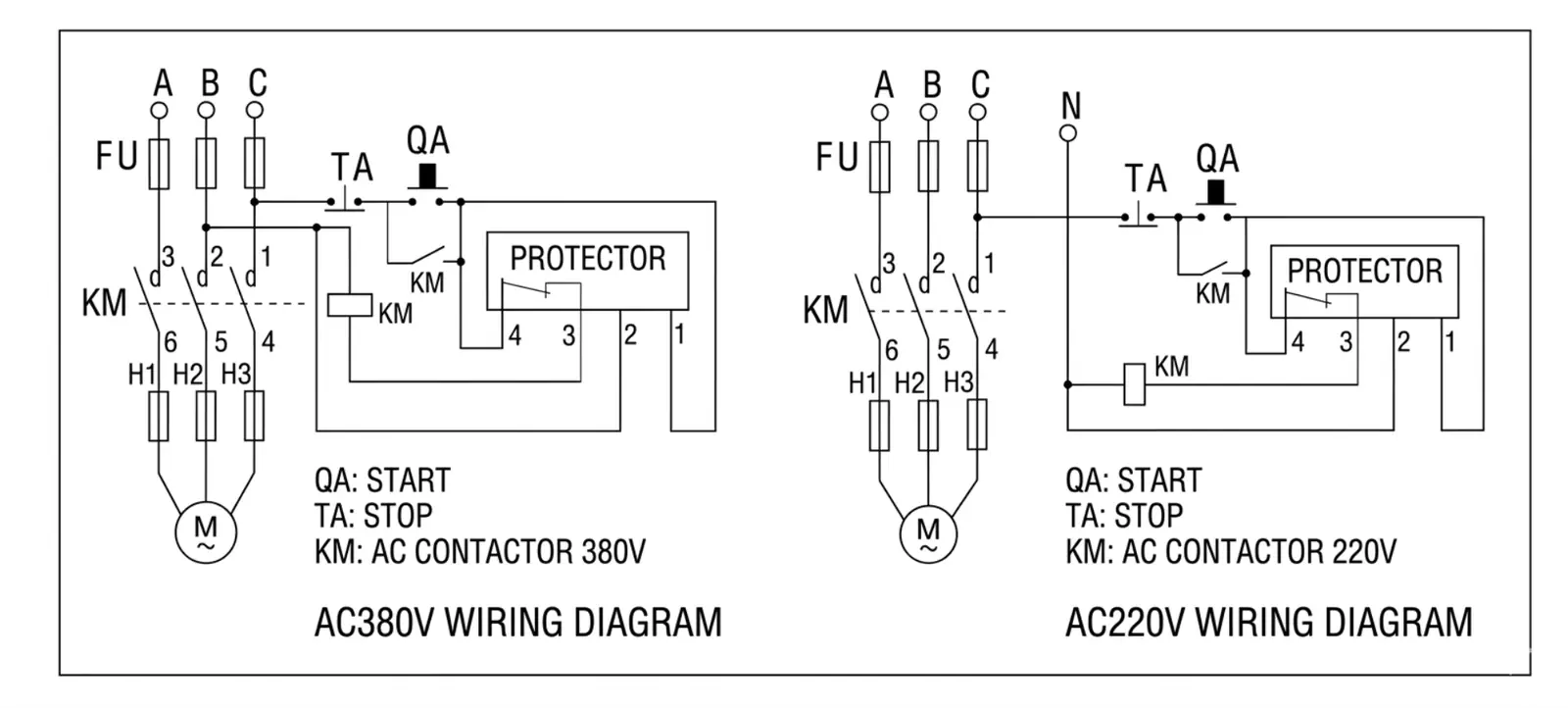
A three-phase supply fails in three ways that never look like an overload: one phase goes open, two phases swap places, or the three voltages drift apart under load. A 3 phase protection relay watches voltage instead of load current, so it catches all three whether the feeder is running or idle. Phase loss and phase reversal are voltage conditions covered by ANSI 47; current unbalance on a loaded motor is a negative-sequence condition covered by ANSI 46. A relay carrying both numbers protects a motor on light load and a feeder with nothing connected. On a pump or fan, losing a phase removes mechanical load and current can fall rather than rise, so a plain overload element never picks up – voltage detection catches that case while current unbalance catches the opposite one. A 400 V motor on a contactor-fed MCC uses a low-voltage relay with Modbus; medium-voltage switchgear uses an ASD-441H. Setting review and quotation within 12 hours, MOQ 1, 7-15 working days.
A three-phase supply fails in three ways that never look like an overload: one phase goes open, two phases swap places, or the three voltages drift apart under load. A 3 phase protection relay watches voltage instead of load current, so it catches all three whether the feeder is running or idle. This page covers the models we supply for that job, how they differ, and how to order one. The measurement side, meaning how loss, reversal and unbalance are detected and how the settings are calculated, is on the phase protection relay guide.
What has to be watched on a three-phase supply
Three conditions matter, and they map to two ANSI numbers. Phase loss and phase reversal are voltage conditions, covered by ANSI 47, phase-sequence and phase-voltage supervision. Current unbalance on a loaded motor is a negative-sequence condition, covered by ANSI 46. A relay that carries both numbers can protect a motor on light load as well as a feeder with nothing connected to it.
Voltage unbalance is the one that gets missed. The motor keeps running, the current in one winding rises, and nothing trips until the winding has already been cooked. That is why current-based overload protection alone is not enough on a three-phase motor, and why the ANSI 46 element is worth insisting on when you specify the relay.
The three models and what each one does
| Model | Scope | Phase protection | Best for |
|---|---|---|---|
| ASD-441H comprehensive motor protection relay | Medium and high voltage motors | Phase loss, phase reversal, current imbalance, voltage imbalance, with ANSI 46 negative sequence and ANSI 47 phase sequence | Plant motors and MV switchgear where phase protection is one function in a full protection set |
| Low voltage motor protection relay | Three-phase AC motors at low voltage | Phase loss protection and phase unbalance protection, alongside overload, locked rotor, short circuit and earth fault | MCC panels and 400 V motors where the relay also has to run the starter logic |
| 27L current monitoring device | Low voltage measurement, no tripping | Three-phase voltage and current measurement with unbalance and power quality monitoring, plus waveform recording | Panels that need the numbers recorded and reported, with protection handled elsewhere |
Two of the three trip. The 27L measures and records, which is the right choice when the switchgear already has protection and what is missing is the record of what happened.
Choosing by what the relay has to do
Start from the motor, not from the relay. A 400 V motor on a contactor-fed MCC wants the low voltage motor protection relay: it sits in the panel, reads three-phase current and voltage, and combines phase protection with the overload and locked rotor elements that the starter needs anyway. Communication is RS-485 or Modbus, which is usually what the plant SCADA expects.
A motor on medium voltage switchgear wants the ASD-441H. There, phase protection is one element among differential, overcurrent, thermal and voltage functions, and the relay has to fit a scheme that already has CTs and a trip circuit. Selecting it means matching the CT secondary and the rated voltage, not ordering the largest unit in the range.
Selecting a relay for a live project?
Send the system voltage, CT ratio and tripping scheme. Our engineers confirm the model and reply within 12 hours.
If the panel only has to measure, the 27L does that without pretending to protect anything: three-phase voltage, three-phase current, zero-sequence current, power quality and waveform capture, stored for the communication platform to collect.
Why not just a phase failure relay
A phase failure relay is a voltage-only device: three voltage inputs, an output contact and a threshold. On a small pump starter whose only requirement is to drop the contactor when a phase is lost, it does exactly that job for very little money, and there is no reason to replace it.
What it cannot do is tell you the negative-sequence current, keep a record of the event, or be graded against the protection upstream. Where the motor is large, where one panel feeds several motors, or where somebody will ask next week why the plant tripped, a numerical relay carrying 46 and 47 is the cheaper answer over the life of the installation.
Application notes: pumps, fans and MCC feeders
On a pump or a fan, losing a phase also removes much of the mechanical load, so the current can fall rather than rise and a plain overload element never picks up. Voltage-based phase loss detection catches that case. Current-based unbalance catches the opposite one, where the load stays on and one winding carries the extra current. That is the practical argument for specifying 46 and 47 together instead of either alone.
On an MCC feeder the relay has to tolerate the starter as well as the motor. A star-delta transition, a soft starter ramp or a contactor chatter all produce a short voltage dip that a phase-loss element with a very short delay will read as a fault. The delay has to be set longer than the transition, and the wiring has to take the voltage reference from the line side of the starter rather than the motor terminals.
Where the same panel supplies a mix of motors, it is worth deciding early whether phase protection is per motor or per busbar. Per motor gives a trip that names the faulted feeder. Per busbar is one relay for the incomer, which is cheaper and tells you less.
What to send with an enquiry
A model recommendation only needs six numbers, and with them the quotation comes back as one model instead of the whole catalogue:
- System voltage and frequency
- Motor rating in kW and the full-load current from the nameplate
- CT ratio, if current-based protection is required
- Whether the output drives a trip coil, an alarm or both
- Communication protocol the plant or SCADA expects
- Panel mounting constraint, meaning DIN rail, flush or rack
Wiring and settings that decide whether it works
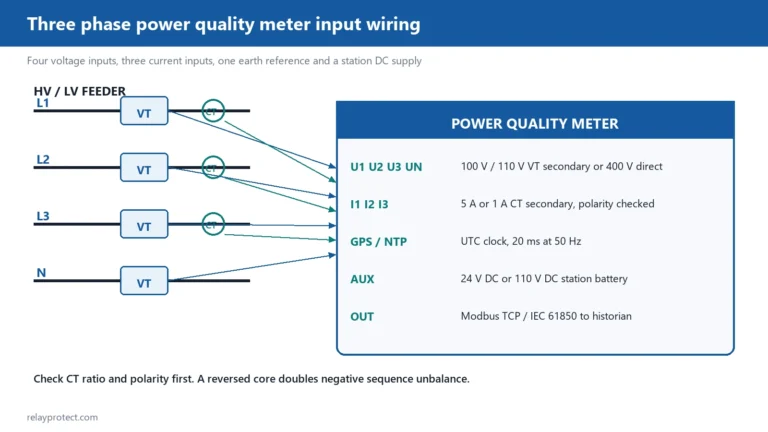
Three things cause most of the field problems. The voltage sensing is taken from one phase and a neutral instead of all three phases, so phase loss cannot be seen. The CT ratio is chosen from the cable size rather than the motor full-load current, so the unbalance element sits at the wrong point on the curve. And the trip delay is left at the factory default, which on a motor with a long start is short enough to trip on a normal start.
Settings for the 46 and 47 elements, the pickup percentages and the grading margins are worked through in the phase protection relay guide, together with the test steps used to prove them on site.
Ordering, delivery and customization
Minimum order is one unit for samples, so a single relay can be bought to test on a panel before a batch order. Bulk orders ship in 7 to 15 working days. Prices are quoted EXW, FOB, CIF or DDU depending on how you want the shipment handled, and payment is by T/T, L/C, Western Union or PayPal. Warranty is 12 months. The relays carry CE marking. OEM and ODM are both available, meaning label, firmware defaults and the terminal arrangement can be set for a panel builder or a distributor. Send the rated voltage, the CT ratios and the protection functions you need, and the quotation comes back matched to a model rather than to the whole catalogue.
Questions buyers ask before ordering
Which model fits a 400 V three-phase motor?
The low voltage motor protection relay. It is built for three-phase AC motors at low voltage and takes the phase protection functions together with overload and locked rotor.
Which model fits a motor on MV switchgear?
The ASD-441H. It is specified for medium and high voltage motors and carries the phase functions as elements inside a full numerical protection set.
Can one relay cover phase protection and overload?
Yes, on both protection models listed above. The 27L is the exception: it measures and records but does not trip, so overload protection has to come from the switchgear it is monitoring.
What is the minimum order and the lead time?
One unit for samples. Bulk orders ship in 7 to 15 working days after the order is confirmed.
Is OEM or ODM possible?
Yes. Labels, firmware defaults and terminal arrangements can be set for panel builders and distributors. Send the requirement with the enquiry.
Related pages
The full range sits under motor protection relays. For the theory behind the settings, read the phase protection relay guide. For how ordering, payment and shipping work, see how to order. To send an application for a model recommendation, use the contact form.
About Author

Hello, I'm Leon Zhang. I have 15 years of experience in the power relay protection industry with extensive pre-sales and after-sales project experience. Our company specializes in various complete sets of relay protection and automation equipment. I can assist customers in solving all practical on-site project challenges and provide optimal integrated solutions.
Tell Us Your Requirement
High Quality
Stable performance, reliable design, ensuring safe operation for power system protection and grid stability.
Fast Delivery
Timely delivery to support your urgent orders and project schedules efficiently and professionally at any time.
Best Warranty
Professional Warranty: Reliable after-sales support for stable relay protection and long-term customer satisfaction.