

-
Leon Zhang sales consultant
-
Email: zxl635973785@gmail.com
-
Phone/WhatsApp: +86 13655813266
What Are Protective Relays?
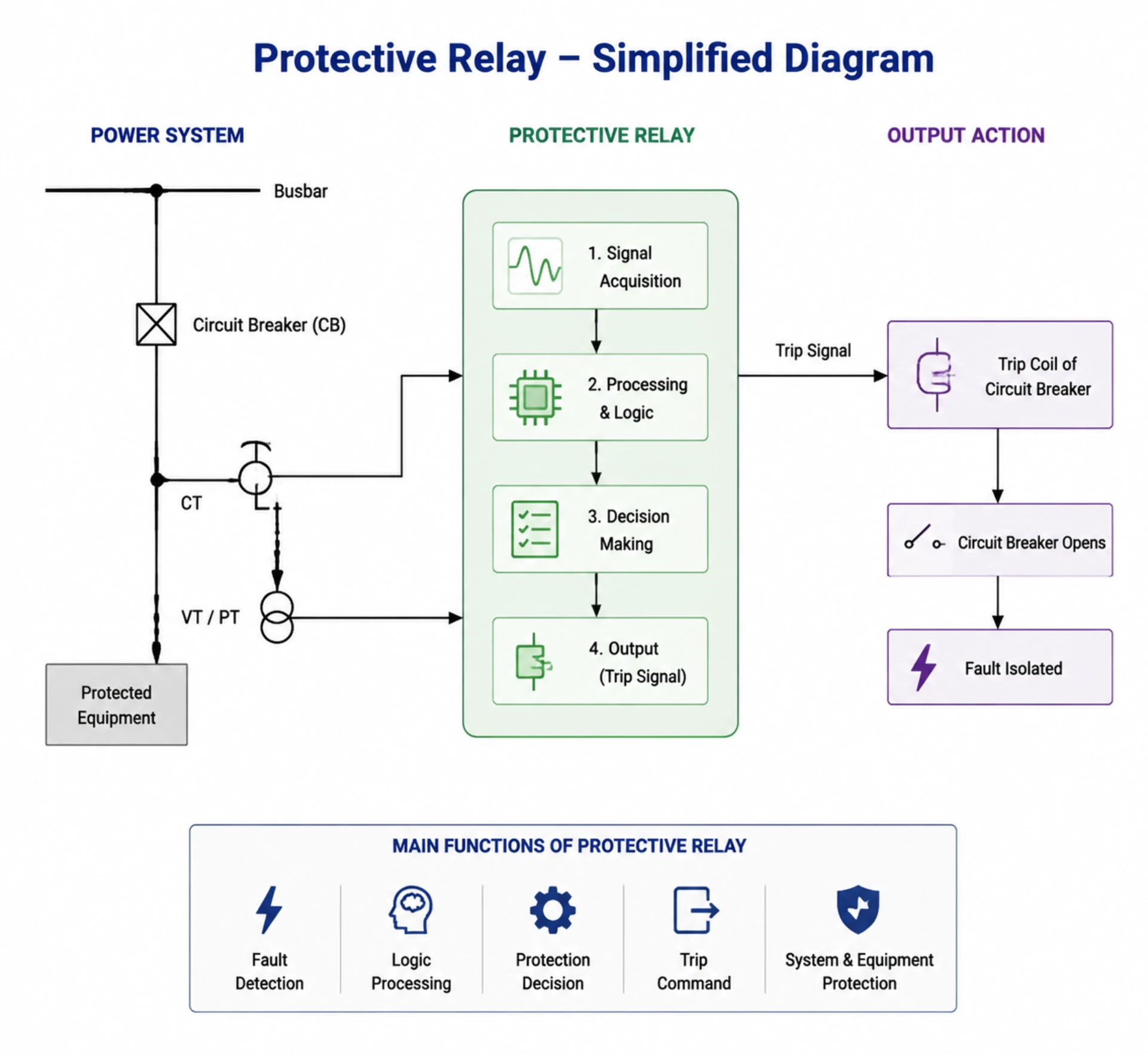
Protective relays in electric utility market are essential safety control devices widely adopted throughout power systems. They monitor real-time operating parameters of power equipment, automatically detect short circuits, earth faults and abnormal operating conditions, and swiftly send trip signals to circuit breakers to isolate faulty sections. Featuring stable performance, powerful anti-interference capacity and comprehensive protection functions, these devices safeguard the safe and stable operation of power generation, transmission, distribution and substation systems.
Why Are Protective Relays Critical for Power Systems?
Modern power grids, renewable energy stations, and industrial power distribution systems cannot operate safely without qualified protective relays. Their core values cover equipment protection, system reliability, and personnel safety.
Prevent Costly Electrical Equipment Damage
Electrical faults such as short circuits and overcurrent can generate instantaneous high temperature and high current, burning out transformers, generators, motors and switchgear. Protective relays cut off faulty circuits within milliseconds to avoid permanent equipment failure and huge replacement and maintenance costs.
Improve Power System Reliability & Reduce Outage Losses
Relays accurately locate and isolate local faults, preventing fault diffusion from affecting the entire grid. This drastically reduces unplanned outage time, guarantees continuous power supply for industrial production, commercial facilities and residential areas, and lowers economic losses caused by power failures.
Ensure On-Site Personnel Operational Safety
Ground faults, arc faults and abnormal overvoltage easily trigger electric shock and arc explosion accidents. Professional protective relays match multiple safety protection logics to eliminate potential safety hazards and protect construction and operation personnel.
How Do Protective Relays Work? (Complete Working Process)
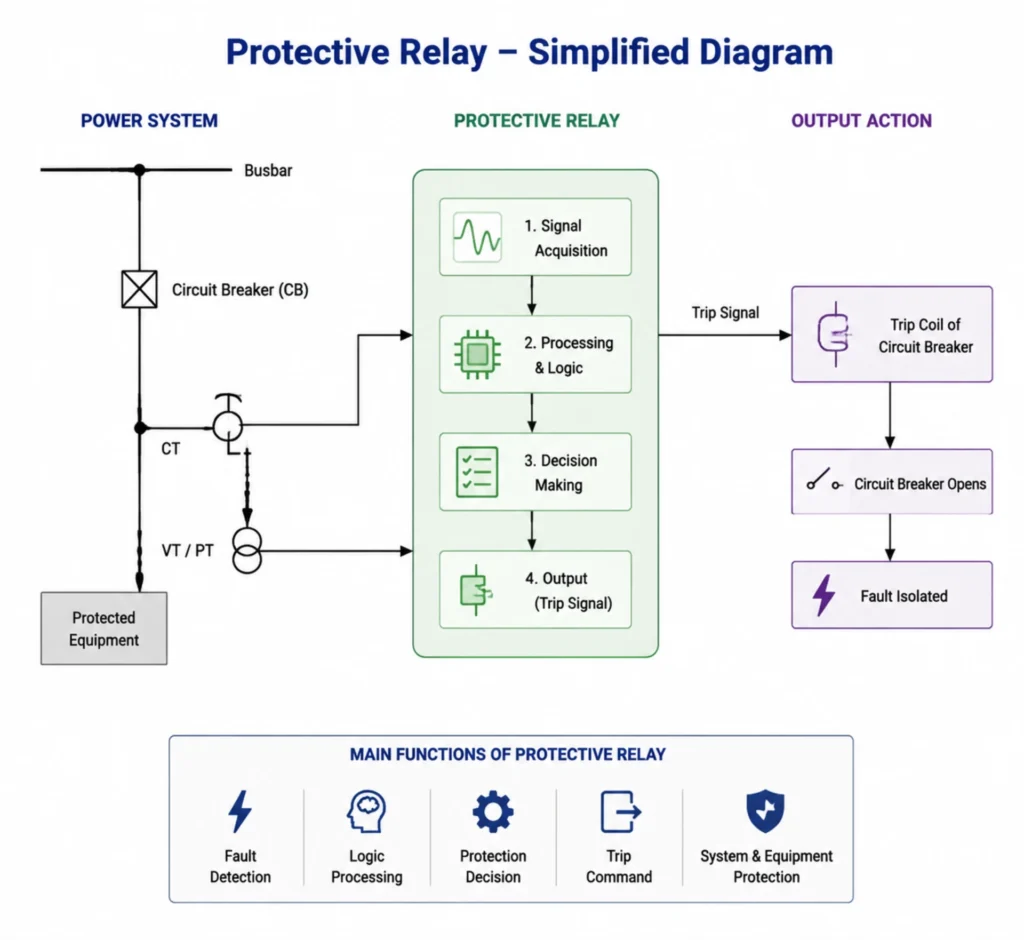
All industrial-grade protective relays follow a standardized four-step working logic, fully compliant with IEC and IEEE power system protection standards.
Real-Time Parameter Monitoring
Relays collect real-time operating data of the power system through matched CT and PT, including current, voltage, frequency, phase angle and active/reactive power, to grasp the operating status of electrical equipment in real time.
Abnormal Fault Identification
The built-in program automatically compares real-time monitored data with preset threshold values to identify common faults: overcurrent, short circuit, earth fault, overvoltage, undervoltage and frequency deviation.
Intelligent Protection Decision-Making
According to pre-set pickup values, time delay parameters and protection curves, the relay judges the fault type and severity, and confirms whether to trigger protection actions to avoid misoperation and refusal operation.
Execute Trip & Isolation Commands
Once a valid fault is confirmed, the relay instantly outputs a trip signal to the circuit breaker. The breaker opens the faulty circuit to isolate the fault area, ensuring the normal operation of the rest of the power system.
Fault Response Flow
Fault Occurs → Relay Captures Abnormal Data → Compare with Setting Parameters → Output Trip Command → Circuit Breaker Opens → Fault Isolated
Different Types of protection relays
Different power equipment and scenarios require matched dedicated protective relays. The mainstream types widely used in global EPC projects, substations and power plants are as follows:
Protection Relay 50 51
Divided into instantaneous overcurrent (ANSI 50) and time-delay overcurrent (ANSI 51). It is the most basic and widely used protection type, mainly used for distribution network feeders, low and medium voltage motors, and terminal power distribution circuits to cope with overload and short-circuit faults.
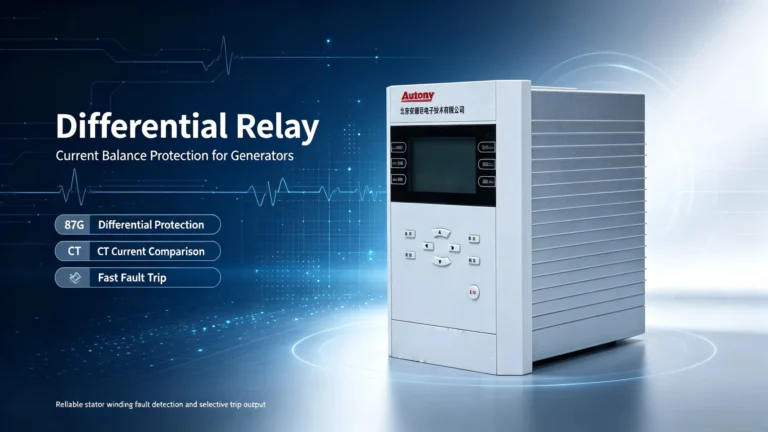
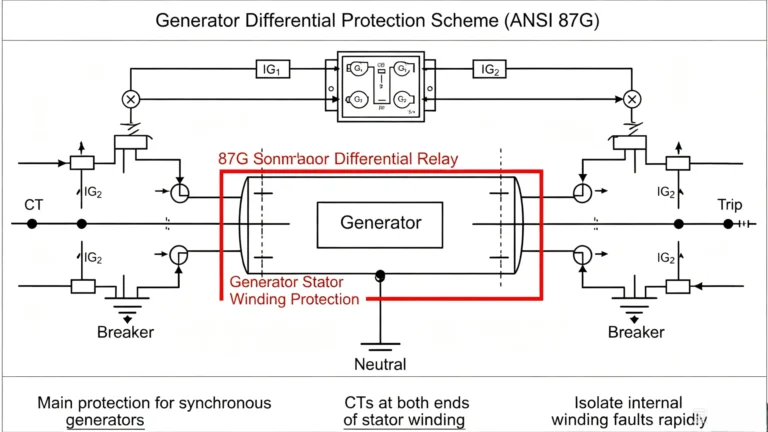
Differential Protection Relay (ANSI 87)
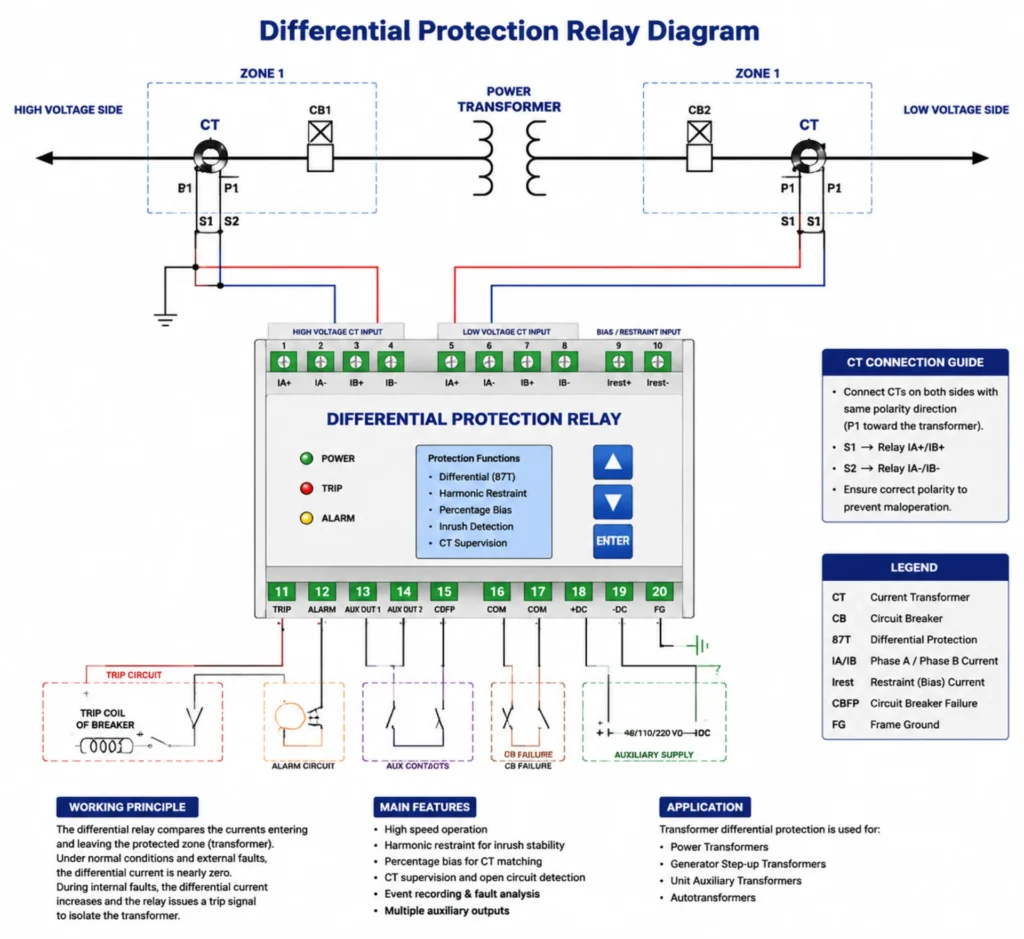
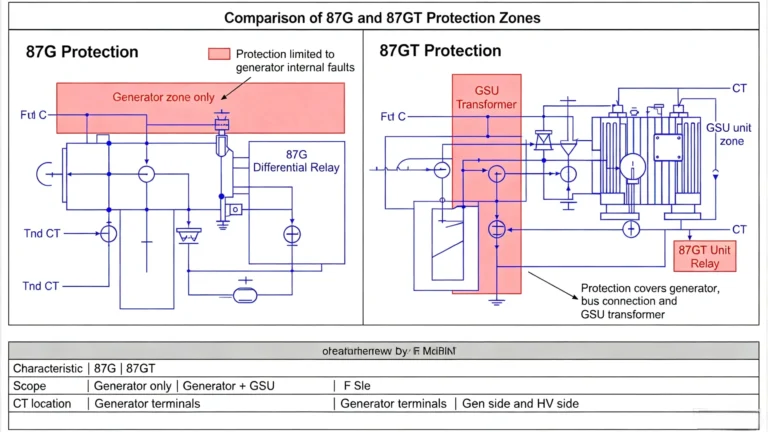
Judge faults by detecting the current difference between the two ends of equipment. It features high sensitivity and strong anti-interference ability, and is dedicated to key core equipment: power transformers, generators and busbars, serving as primary protection for main station equipment.
Distance Protection Relay (ANSI 21)
Distance protection relays locate fault points by measuring line impedance. They serve as the standard protection for high-voltage transmission lines, which can rapidly calculate fault distances and implement sectionalized protection so as to guarantee the stable operation of long-distance power transmission.
Earth Fault Protection Relay
Specialized in monitoring system grounding faults and leakage current anomalies. It is widely used in medium-voltage power systems and industrial power grids to prevent equipment aging and safety accidents caused by long-term ungrounded faults.
Dedicated Motor Protection Relay
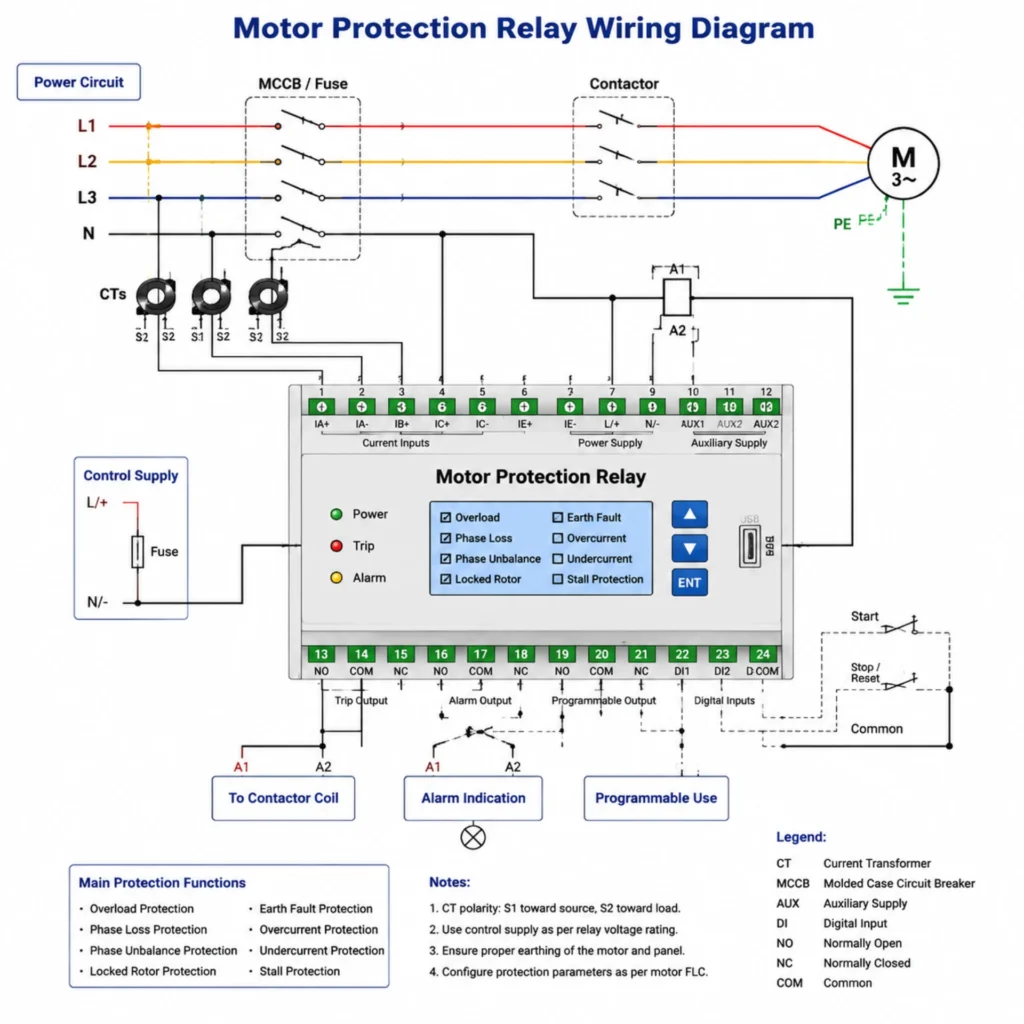
Integrate multiple protection functions including overload, locked rotor, phase loss, phase imbalance and short circuit. It is tailored for industrial motors such as pumps, compressors and production line drive motors, adapting to complex industrial operating conditions.
Generator & Transformer Dedicated Relays
It supports exclusive protection logics including generator reverse power protection, loss of excitation protection, as well as transformer temperature protection and buchholz relay for transformer protection. Designed specifically for main power plant equipment and transformers deployed in large-scale substations.
Circuit Breaker Failure Protection Relay
Circuit Breaker Failure Protection Relay monitors the closing and tripping status of circuit breakers continuously. If a breaker fails to open upon receiving a trip command during system faults, this relay will quickly initiate backup tripping of adjacent circuit breakers to cut off fault currents thoroughly. It effectively prevents fault expansion caused by breaker malfunction, greatly improving the safety and reliability of substations and high-voltage power grids.
Three Generations of Protective Relays: Technology Evolution
Protective relay technology has evolved from traditional mechanical type to intelligent numerical type, which is the mainstream configuration of modern smart substations and new energy projects.
Electromechanical Relays
Early traditional equipment with mechanical moving parts, single protection function, slow response speed and poor anti-interference ability. It is basically phased out in new global projects and only retained in old equipment maintenance scenarios.
Static Relays
Based on semiconductor electronic components, without mechanical wear, faster response than electromechanical products. However, it has single function and no data communication and recording capability, which cannot meet the needs of intelligent power grids.
Numerical Protective Relays (Mainstream Modern Type)
The standard configuration of current global EPC projects, smart substations and new energy power stations. It integrates multiple protection functions, supports IEC 61850, Modbus and other communication protocols, and has fault recording, event logging and remote monitoring functions, meeting the intelligent operation and maintenance requirements of modern power systems.
Protective Relay Diagram
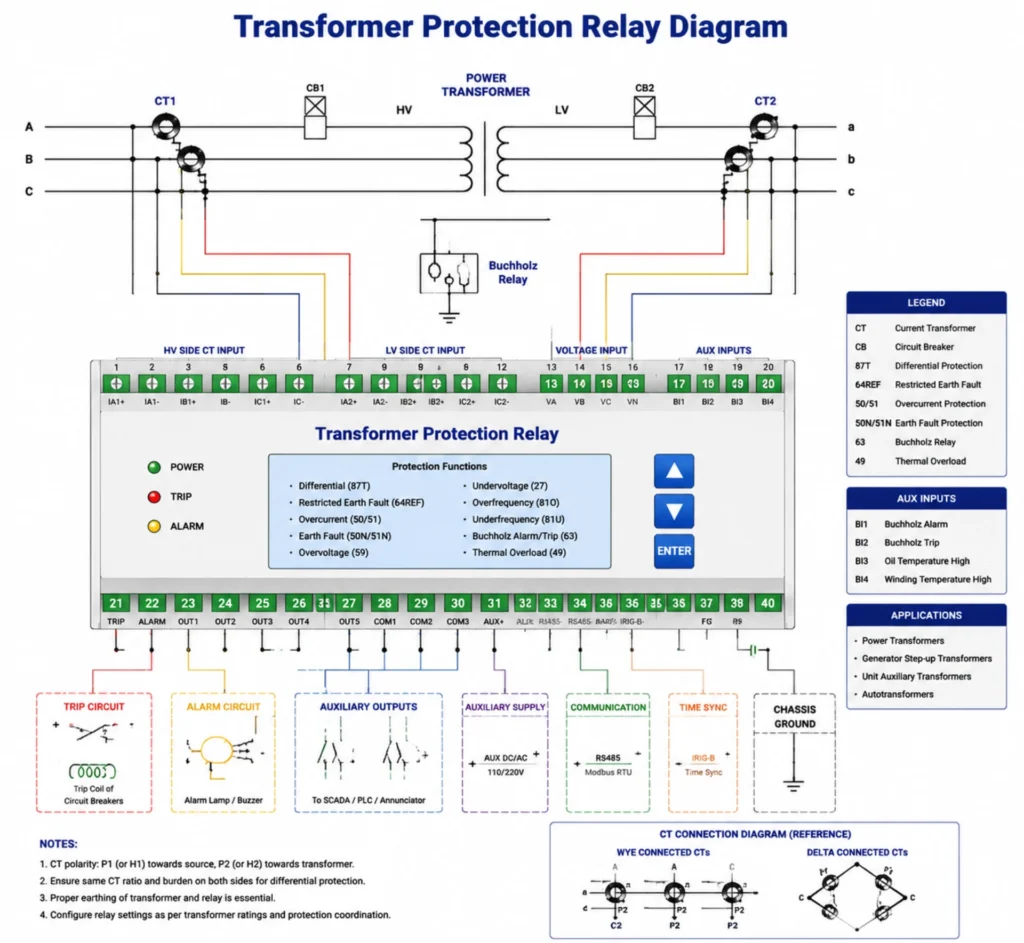
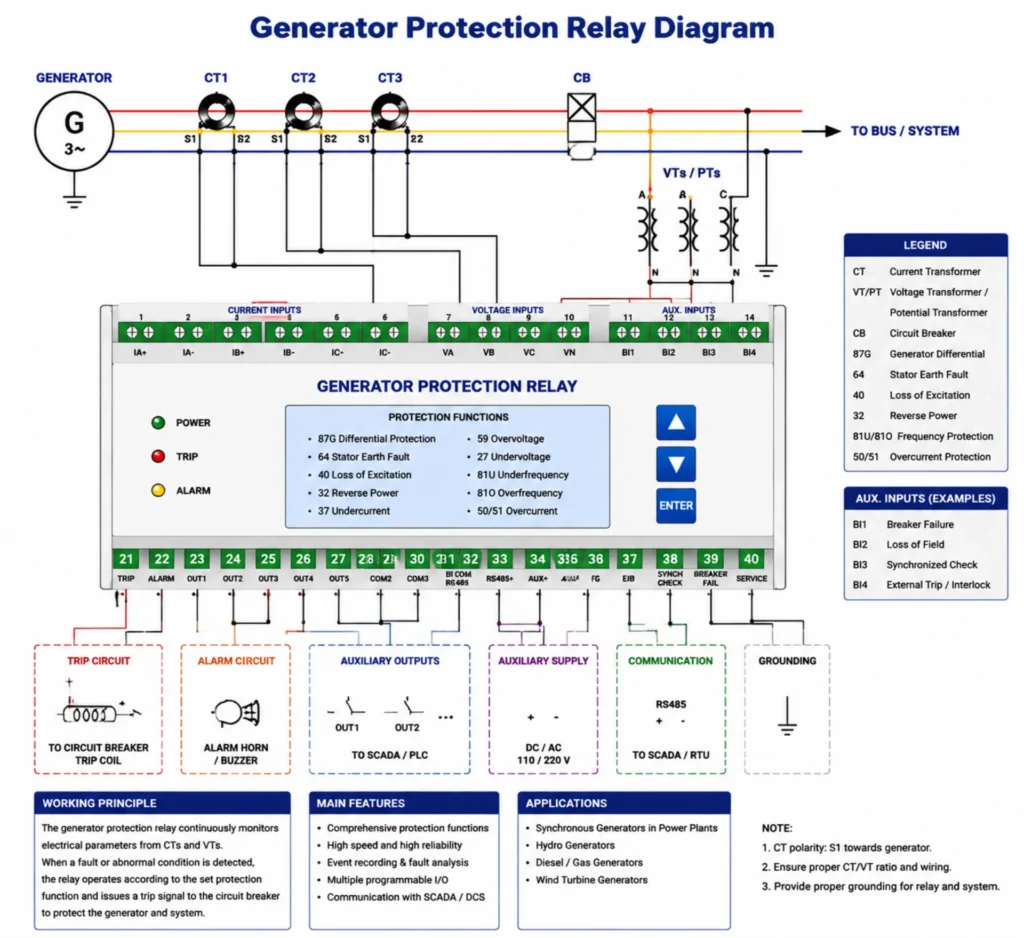
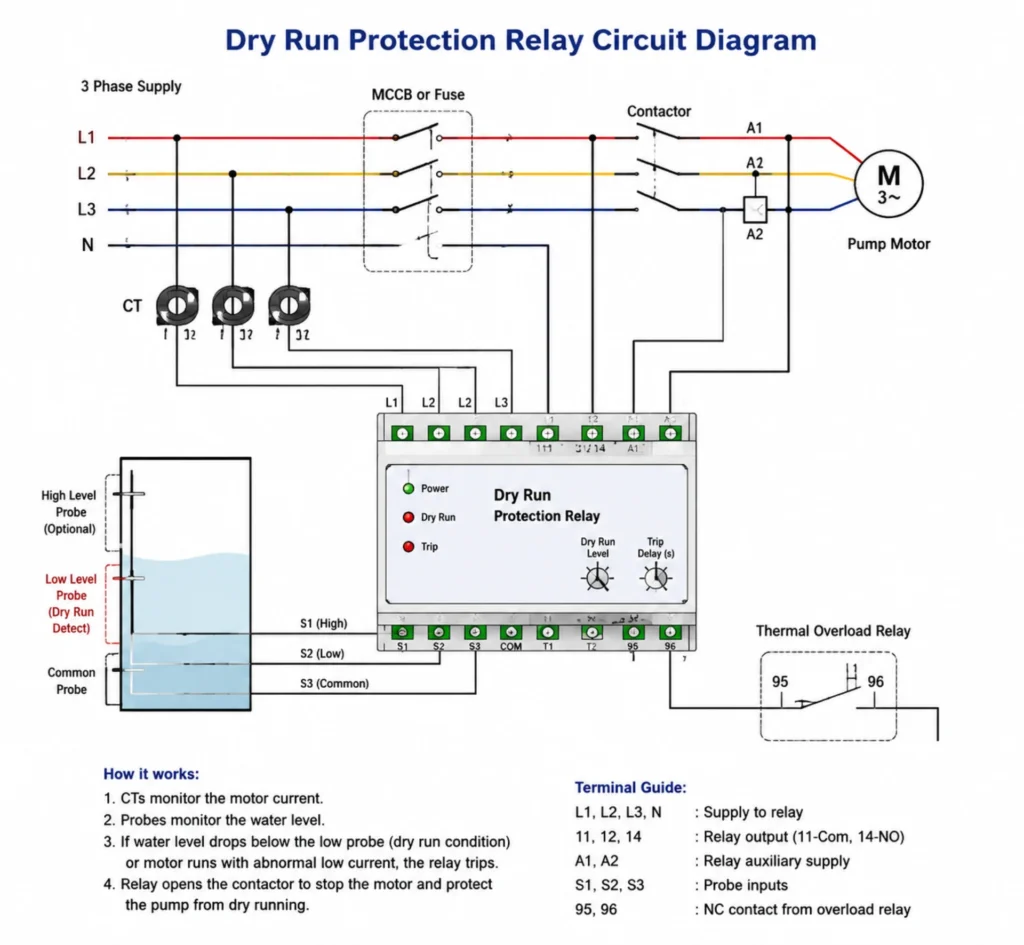
The protection relay wiring diagram details secondary circuit connections between the relay, CT, VT, breakers and power loops. It guides on-site wiring, inspection, commissioning and troubleshooting to ensure accurate fault detection and reliable tripping.
Motor Protection Relay wiring diagram
Differential Protection Relay diagram
Transformer Protection Relay diagram
Generator Protection Relay diagram
Dry Run Protection Relay circuit diagram
Common ANSI Electrical Protection Relay Codes
ANSI code is the universal unified standard for global power system protection configuration, and is a necessary reference for EPC engineering design, relay setting and project commissioning.
| ANSI Code | Protection Function |
|---|---|
| 21 | Distance Protection |
| 27 | Undervoltage Protection |
| 50 | Instantaneous Overcurrent Protection |
| 51 | Time Overcurrent Protection |
| 59 | Overvoltage Protection |
| 67 | Directional Overcurrent Protection |
| 81 | Frequency Protection |
| 87 | Differential Protection |
Industrial & Power System Applications of Protective Relays
Substation Protection
Cover transformer main protection, feeder line protection and busbar protection, applicable to high, medium and low voltage substations of all levels, ensuring the safe and stable operation of power transmission and distribution links.
Traditional Power Plant Protection
Provide full protection for generators, auxiliary power systems and power transmission equipment of thermal power and hydropower plants, avoiding unit shutdown accidents caused by electrical faults.
New Energy Power Station Protection
Adapt to the grid-connected protection requirements of solar power plants, wind farms and battery energy storage systems, solve the problem of fluctuating output of new energy power generation, and meet grid-connected access standards of various countries.
Industrial Field Protection
Widely used in oil & gas, mining, chemical industry and manufacturing plants, providing reliable power protection for high-power industrial equipment and ensuring continuous and stable industrial production.
How to Select Qualified Protective Relays for EPC & Industrial Projects?
Reasonable relay selection directly determines project safety, operation stability and later maintenance cost. For EPC contractors, power station owners and industrial project purchasers, follow the 5 core selection criteria:
Match System Voltage Level
Select low/medium/high voltage dedicated relays according to project voltage parameters to ensure device withstand voltage and protection accuracy meet system requirements.
Confirm Target Protection Objects
Select dedicated relays according to protection objects: transformer differential relay for transformers, motor protection relay for industrial motors, and distance relay for transmission lines to avoid mismatched protection functions.
Support Standard Communication Protocols
Priority to products supporting IEC 61850, Modbus and IEC 60870-5-103 protocols, which is convenient for system networking, remote monitoring and intelligent operation and maintenance of smart substations.
Comply with International Industry Standards
The product must pass IEC 60255 general standard certification and meet IEEE power protection specifications, with qualified EMC electromagnetic compatibility performance to adapt to complex on-site electrical environments.
Verify Supplier Engineering Service Capability
Priority to manufacturers with complete technical support capabilities, including pre-sales scheme customization, relay setting guidance, on-site commissioning and after-sales technical support, to solve on-site engineering problems efficiently.
Protective Relay Testing & Commissioning Standards
All protective relays must complete standardized testing and commissioning before project operation to ensure 100% reliable protection action.
Common Testing Methods
- Secondary injection test (mainstream routine test)
- Primary injection test
- Protection function full test
- Communication protocol compatibility test
Standard Commissioning Process
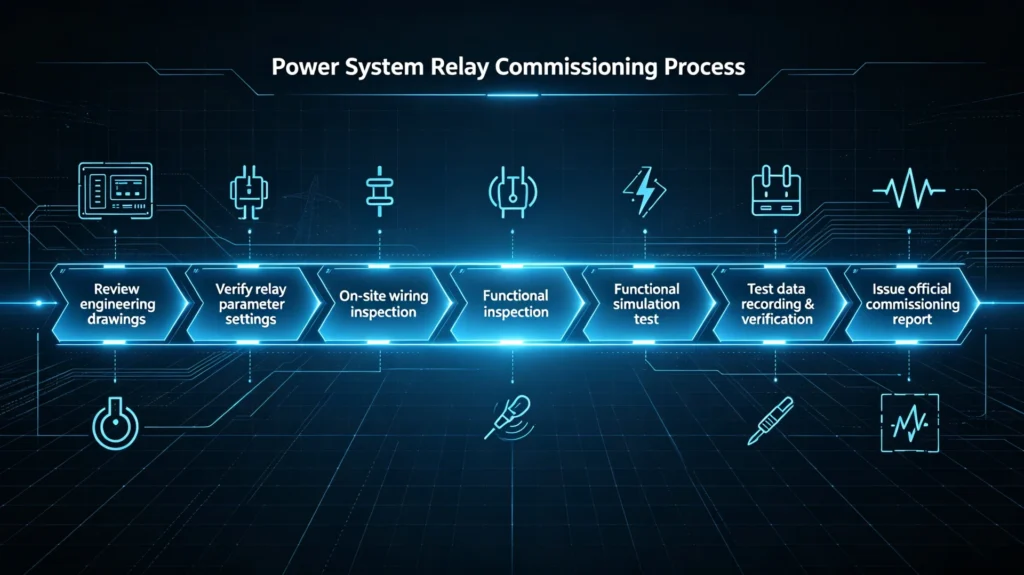
Review engineering drawings → Verify relay parameter settings → On-site wiring inspection → Functional simulation test → Test data recording & verification → Issue official commissioning report
FAQ About Protective Relays
What is the main purpose of a protective relay?
Its core purpose is to detect power system electrical faults in real time, quickly isolate faulty equipment and circuits, protect power assets, ensure personnel safety, and maintain the overall stability of the power grid.
How does a protective relay detect faults?
It collects system current and voltage data through CT/PT, compares real-time operating values with preset standard thresholds, and identifies abnormal faults through built-in protection logic programs.
How often should protective relays be tested?
According to IEC and power industry operation specifications, routine calibration and testing are required every 1–2 years; full performance testing is mandatory after equipment overhaul, fault occurrence and project reconstruction.
How to Choose a Reliable Protective Relay Manufacturer & Supplier?
For cross-border EPC projects, overseas power station construction and industrial power transformation projects, selecting professional IEC 61850 protection relays suppliers is the key to long-term safe operation of projects. We recommend focusing on the following core strengths of suppliers:
- Complete product portfolio: Cover full-series numerical protective relays for substation, power plant and industrial scenarios, supporting one-stop procurement
- Strict standard compliance: All products comply with IEC 60255, IEEE and IEC 61850 international standards, with complete certification documents
- Professional engineering team: Provide pre-sales scheme customization, parameter setting guidance, on-site commissioning and after-sales full-cycle technical support
- Flexible customization capability: Support OEM/ODM personalized development to meet the differentiated needs of different national grid standards and project scenarios
- Rich overseas project experience: Familiar with global EPC project processes and overseas grid access specifications, able to solve various on-site technical problems efficiently
Conclusion
Protective relays are indispensable core safety equipment for modern power systems, covering the whole protection of power generation, transmission, distribution and industrial power consumption. From traditional electromechanical products to intelligent numerical relays, technological upgrading has greatly improved the safety, stability and intelligent level of power system protection.
For EPC contractors, power utility owners and industrial enterprise purchasers, accurate type selection, standardized commissioning and reliable supplier cooperation are crucial to project safety construction and long-term stable operation. High-quality protective relays can effectively reduce project failure risks, save operation and maintenance costs, and ensure the sustainable and safe operation of power systems.
Reference & Technical Sources
- IEC 60255-1:2023 Measuring relays and protection equipment – General requirements
- IEC 60255-26:2013 Electromagnetic compatibility requirements for protective relays
- IEEE C37.100-2018 Standard for Power System Protection Relays
- IEC 61850 Ed.2 Communication networks and systems for power utility automation
- ANSI/IEEE Standard Device Numbers for Power System Protection
- IEC 61508 Functional safety of electrical/electronic/programmable electronic systems
About Author

Hello, I'm Leno Zhang. I have 15 years of experience in the power relay protection industry with extensive pre-sales and after-sales project experience. Our company specializes in various complete sets of relay protection and automation equipment. I can assist customers in solving all practical on-site project challenges and provide optimal integrated solutions.
Tell Us Your Requirement
High Quality
Stable performance, reliable design, ensuring safe operation for power system protection and grid stability.
Fast Delivery
Timely delivery to support your urgent orders and project schedules efficiently and professionally at any time.
Best Warranty
Professional Warranty: Reliable after-sales support for stable relay protection and long-term customer satisfaction.