

-
Leon Zhang sales consultant
-
Email: zxl635973785@gmail.com
-
Phone/WhatsApp: +86 13655813266
Case Study: Mudra Building Materials Self-Use Power Generation Project, Nigeria
Self-use power generation project case study from Nigeria: Mudra Building Materials runs a 3000 kW captive generator set on a generator protection cabinet and a separate synchronizing panel, with 87G differential, 64R rotor earth fault and ANSI 25 synchronism check.
The plant sits on an unstable utility supply, so the set carries production load rather than standby duty. That changes the protection work: a machine that parallels and carries load every day cannot run on factory default differential values, which is what tripped this unit during commissioning.
The fix was a setting calculation.
At a Glance
- Project: Mudra Building Materials, a self-use power generation project case study in Nigeria
- Machine: one 3000 kW captive generator set carrying plant production load
- Supplied: generator protection and control cabinet (VIP-9000FDJP) plus synchronizing panel (VIP-9000TQP)
- Generator protection: 87G differential with a high-set element, 46, 49, 59 and 64R
- Synchronizing: 25 synchronism check (DT-1/200) and 25A automatic synchronizing (PTQ2000A1)
- Commissioning fault: nuisance 87G tripping traced to settings, not to a machine fault
- Fix: pickup and bias recalculated from recorded currents, then verified on load
- Status: passed final site acceptance and running on plant load
Device numbers follow ANSI/IEEE C37.2-2022. Relay requirements and testing follow IEC 60255-1:2022, and generator protection application guidance comes from IEEE C37.102-2023.
Project Overview
The plant is a cement and building materials factory in Nigeria. Its 3000 kW captive generator set runs against an unstable local utility supply, so protection and synchronising are production equipment, not standby equipment: a nuisance trip stops the line. Shandong Jun Industrial Co., Ltd. was secondary equipment EPC contractor, and commissioning support was handled from remote.
| Item | Details |
|---|---|
| Project Name | Mudra Building Materials Self-Use Captive Power Generation Project |
| Location | Nigeria |
| Secondary Equipment EPC Contractor | Shandong Jun Industrial Co., Ltd. (China) |
| Generator Capacity | 3000 kW captive generator set |
| Supplied Equipment | Generator Protection Panel; Generator Synchronizing Panel |
Equipment Functional Scope
Generator Protection Panel
Covers complete generator protection functions:
- Generator differential protection (87G), biased differential for internal faults
- Differential instantaneous overcurrent protection, the high-set element of 87G for heavy internal faults
- Negative sequence overcurrent protection (46), against unbalanced loading and open-phase conditions
- Overvoltage protection (59), covering over-excitation and load rejection
- Thermal protection (49), tracking stator winding heating
- Excitation inter-tripping logic, a trip output to the AVR rather than a numbered ANSI function
- Generator rotor earth fault protection (64R)
Generator Synchronizing Panel
Realizes automatic/manual synchronisation for safe generator paralleling and grid connection.
The cement & building material factory relies on this genset to stabilise power supply against unstable local utility grid in Nigeria. Reliable generator protection and controlled synchronisation are critical to avoid unplanned production shutdowns.
ANSI Device Numbers Used on This Project
The generator panel functions above map to five ANSI device numbers, and the synchronizing panel adds two more. The excitation inter-trip is a trip output to the AVR, not a numbered function.
| ANSI device | Function | Where it is implemented |
|---|---|---|
| 87G | Generator differential, plus a high-set instantaneous element | VIP-96S98 main protection device |
| 46 | Negative sequence overcurrent | VIP-96S98 |
| 49 | Thermal overload | VIP-96S98 |
| 59 | Overvoltage | VIP-96S98 |
| 64R | Rotor earth fault | VIP-96S89 dedicated device |
| 25 | Synchronism check | DT-1/200 relay, synchronizing panel |
| 25A | Automatic precise synchronizing | PTQ2000A1 unit, synchronizing panel |
Two things were out of scope, and the boundary is worth stating: the excitation regulator and the governor were not part of this supply. The protection cabinet only exchanges signals with them, which is why the excitation inter-trip appears in the function list while the AVR itself does not.
Client Communication & Commercial Process
The project client is a Chinese contractor operating overseas, enabling smooth and efficient technical communication.
- We first provided complete datasheets and product manuals for the generator protection panel and synchronising panel.
- Client reviewed all technical specifications and confirmed function compliance.
- Commercial negotiation and pricing discussion followed technical confirmation.
- Formal sales contract signed; mass production commenced after deposit receipt.
Bill of Materials
The list is organised the way the panels are built: section I is the generator protection and control cabinet, section II the synchronizing panel. Quantities are for this project, not per panel.
| No. | Description | Specification & Model | Unit | Qty |
|---|---|---|---|---|
| I | Generator Protection & Control Cabinet | VIP-9000FDJP | Set | 1 |
| 1 | Main Generator Protection & Control Device | VIP-96S98 | Unit | 2 |
| 2 | Generator Backup Protection & Control Device | VIP-96S88, with 4~20mA analog output | Unit | 2 |
| 3 | Rotor Earth Fault Protection & Control Device | VIP-96S89, with 4~20mA analog output | Unit | 2 |
| 4 | Line Protection & Control Device | VIP-96S71 | Unit | 1 |
| 5 | Changeover Switch | LW12-16/5858.3 | Pc. | 3 |
| 6 | Power Surge Protector | KDM/MD220-20 | Unit | 1 |
| 7 | MCB | HG45Z-63 2P C3 | Pc. | 6 |
| 8 | MCB | HG45-63 3P C1 | Pc. | 2 |
| 9 | Power Socket | AC30-10530, 10A/250V, 5-hole | Pc. | 1 |
| 10 | Cabinet Internal Lighting | AC220V | Set | 1 |
| 11 | Control Cabinet & Accessories | 2260800600mm | Set | 1 |
| II | Synchronizing Panel | VIP-9000TQP | Set | 1 |
| 1 | CPU Module | 6ES7 288-1ST40-0AA1 | Piece | 1 |
| 2 | Frequency Meter | VIP-926-F/C900DL, AC0-100V, with RS485 communication, Power supply DC220V | Pc. | 2 |
| 3 | Voltmeter | VIP-926-V/C900DL, AC0-100V, with RS485 communication, Power supply DC220V | Pc. | 2 |
| 4 | Multi-function Digital Meter | VIP-926-E24/C900DL, AC100V 5A, with RS485 communication | Pc. | 2 |
| 5 | DC Voltmeter | VIP-926-V/C900DL, DC0-200V, with RS485 communication, Power supply DC220V | Pc. | 2 |
| 6 | DC Ammeter | VIP-926-I/C900DL, DC0-75mV, with RS485 communication, Power supply DC220V | Pc. | 2 |
| 7 | Rotor Ammeter | VIP-926-I3/C900DL, 5A, with RS485 communication, Power supply DC220V | Pc. | 2 |
| 8 | Synchroscope | MZ10, 100V | Pc. | 1 |
| 9 | Synchronism Check Relay | DT-1/200, 100V, Front-mounted wiring | Pc. | 1 |
| 10 | Automatic Precise Synchronization Unit | PTQ2000A1, 100V | Pc. | 1 |
| 11 | Switching Power Supply | MDR-100-24 | Pc. | 2 |
| 12 | Auxiliary Relay with Socket | MY4N-GS DC 24V | Set | 16 |
| 13 | Manual/Auto Changeover Switch | LAY50-22D-22X/K | Pc. | 1 |
| 14 | Active & Reactive Power Adjustment Switch | LAY50-22D-20CXS/FFU | Pc. | 2 |
| 15 | Synchronizing Switch | LW12-16/4.1366.4 | Pc. | 1 |
| 16 | Changeover Switch | LW12-16/5858.3 | Pc. | 1 |
| 17 | Push Button | LAY50-22D-20T/G | Pc. | 5 |
| 18 | Bicolor Indicator Lamp (Green / Red) | AD56-22DSS/RG23 | Pc. | 4 |
| 19 | Changeover Switch | LW12-16 Y/.6 | Pc. | 4 |
| 20 | AC MCB | HG45-63 2P C3 | Pc. | 2 |
| 21 | DC MCB | HG45Z-63 2P C3 | Pc. | 6 |
| 22 | Isolation Transformer | BK100VA, 100V/100V | Pc. | 2 |
| 23 | Power Socket | AC30-10530, 10A/250V, 5-hole | Pc. | 1 |
| 24 | Cabinet Internal Lighting | Not specified | Set | 1 |
| 25 | Control Panel & Accessories | 2260*800*600mm | Set | 1 |
Production & Delivery
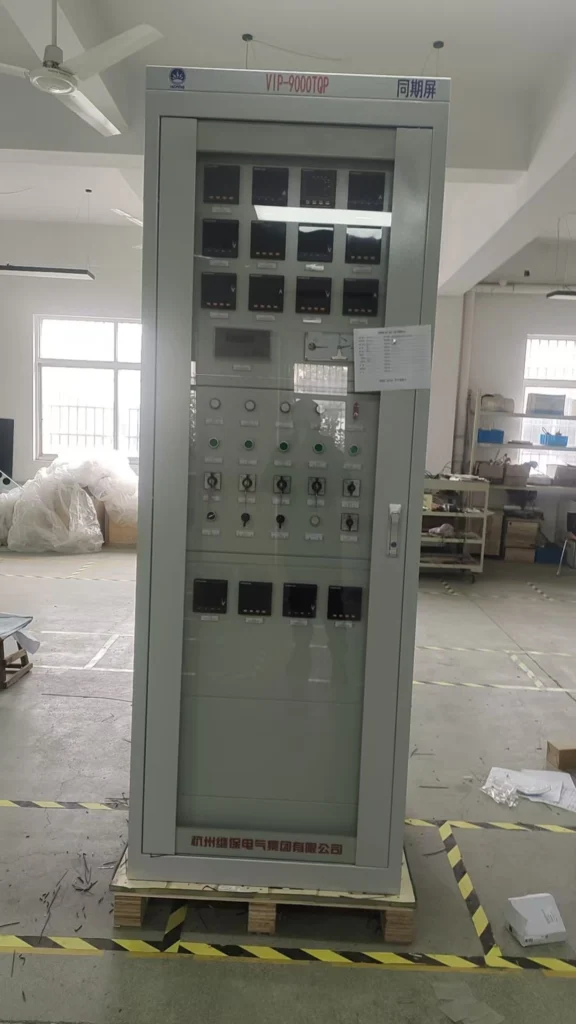
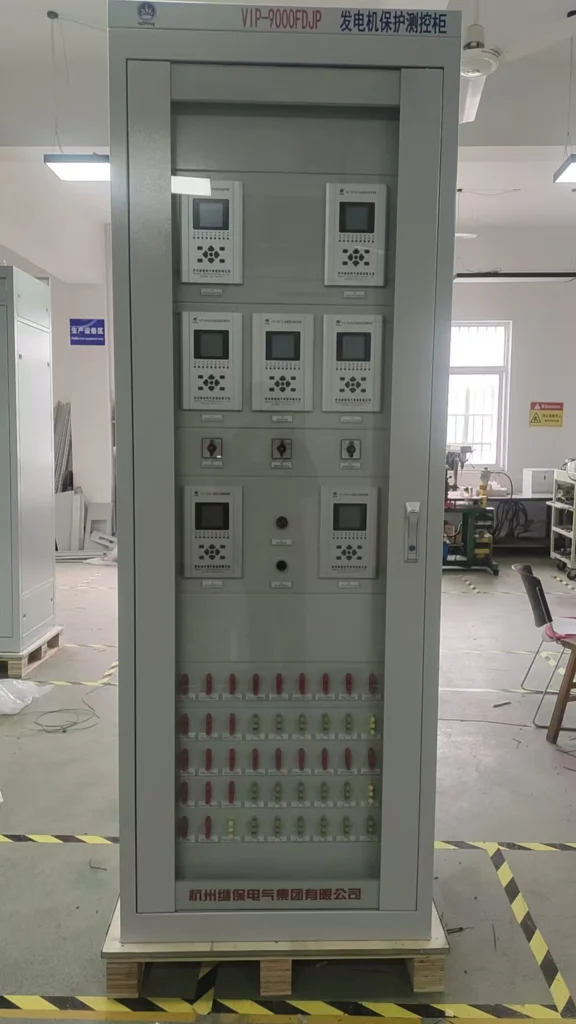
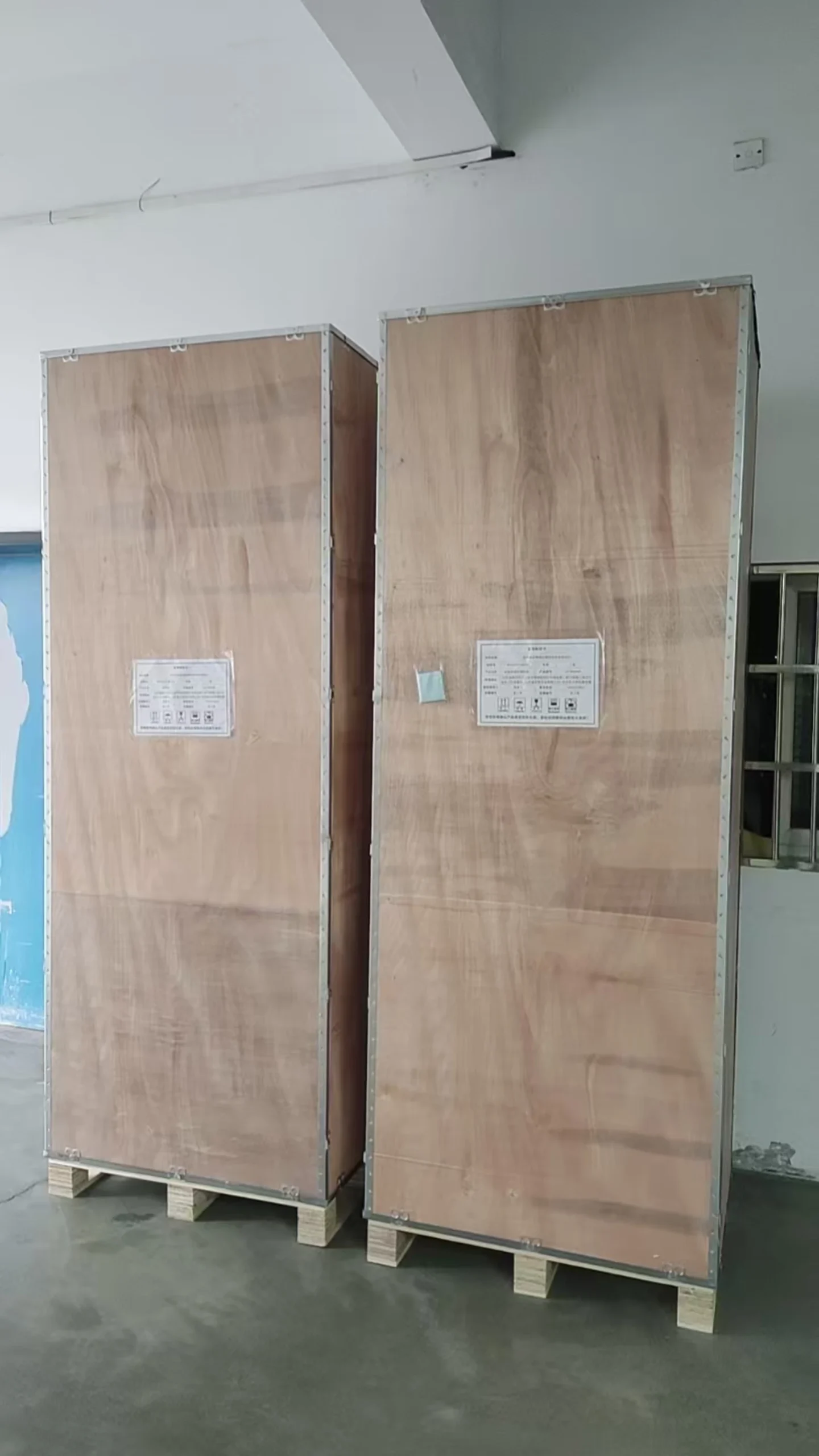
All panels underwent in-house wiring inspection, functional simulation testing before shipment.
Goods were packed according to overseas export standards and delivered to designated receiving address in Linyi City, China, as required by the EPC contractor for consolidated container loading towards Nigeria.
Site Commissioning & Technical Support
To facilitate smooth field commissioning in Nigeria, we compiled a dedicated commissioning manual containing wiring check procedures, protection setting guidance, synchronisation operation steps and typical fault troubleshooting.
During on-site testing, one critical issue occurred:
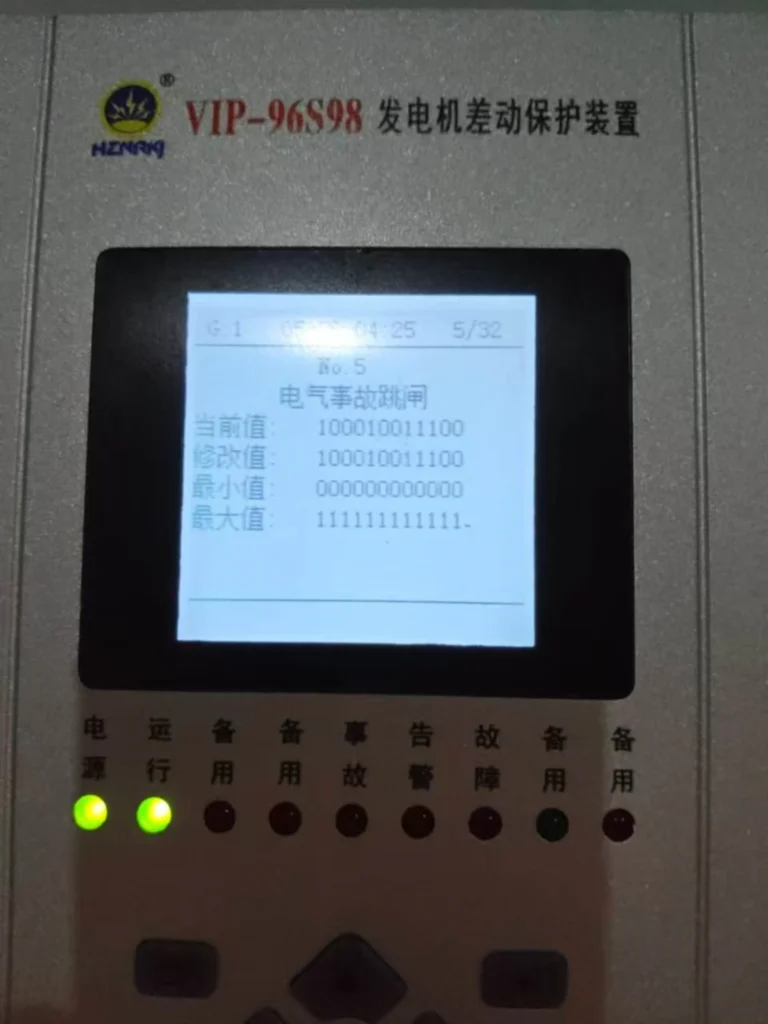
Fault Description: The generator differential protection triggered unintended nuisance tripping under normal operating conditions.
Root cause: Improper differential protection setting values mismatched actual generator operating parameters.
A differential element compares current entering and leaving the machine. Set the pickup below the standing mismatch current, or set the bias slope too flat for the CTs in use, and the element reads a fault that is not there. On the event record the trip then looks like a genuine internal fault until the two currents are plotted against each other.
In this self-use power generation project case study the element was re-set rather than replaced: pickup and slope came from the recorded currents, and the panel was re-verified on load before sign-off.
Our technical team carried out real-time remote technical guidance:
- Analysed fault recording data uploaded from site
- Recalculated differential pickup thresholds and bias characteristics
- Guided site engineers to update relay settings step by step
- Performed repeated on-load verification after parameter adjustment
Final Acceptance
After optimising protection settings and completing full sequence commissioning tests, all protection functions and synchronisation logic operated stably without abnormal tripping. The system passed final site acceptance and has been running continuously for the building material plant’s production load.
Acceptance rested on two things: every protection function and the synchronising logic ran through a full sequence test, and the set then held plant load without a repeat trip. Settings were handed over as a calculated setting sheet, not left at factory defaults.
Key Project Takeaways for EPC & Plant Engineers
Four findings from this self-use power generation project case study transfer to other captive plant relay protection work. None of them depend on the machine rating.
- Factory default relay settings cannot fully adapt to every on-site generator; differential protection parameters require project-specific calculation. Improper settings are a common cause of nuisance tripping.
- Pre-shipping documentation (commissioning manual, wiring drawings, setting template) reduces on-site trial-and-error time for overseas projects.
- Timely remote engineering support effectively resolves commissioning obstacles when local professional resources are limited in African sites.
- Separately configured generator protection panel + synchronising panel delivers clearer functional partitioning and easier maintenance compared with integrated single-panel solutions for 3 MW captive generators.
Frequently Asked Questions
What was supplied for the Mudra captive power project?
Two cabinets for one 3000 kW generator set. The generator protection and control cabinet (VIP-9000FDJP) holds the main generator protection relay (VIP-96S98), a backup device and a rotor earth fault device. The synchronizing panel (VIP-9000TQP) holds the synchroscope, the synchronism check relay and the automatic synchronizing unit. Both were wired and function tested before shipment.
Why a separate synchronizing panel instead of one combined panel?
Functional partitioning. Protection settings, trip outputs and test points stay in one cabinet; synchronising, metering and the manual/auto changeover stay in the other. On a 3 MW captive set that makes maintenance and fault finding easier than tracing both functions through a single panel.
Why did the generator differential protection trip during commissioning?
Settings, not hardware. The pickup and bias characteristics did not match the machine and CT data in use, so the element saw a standing differential current at healthy load and tripped. The recorded data was uploaded, pickup and slope were recalculated, and the settings were updated on site.
Can commissioning be supported without sending engineers to site?
This project was. A commissioning manual covering wiring checks, setting guidance, synchronising steps and typical fault troubleshooting shipped with the panels, and the rest was handled remotely: event records uploaded from site, settings recalculated, and on-load verification repeated by the site engineers.
How is captive plant protection different from standby generator protection?
Duty. A standby set may run a few hours a year, so default settings rarely get exercised. Captive power plant protection sees daily paralleling, load swings and long running hours, which is why the differential pickup, the bias slope and the thermal time constant have to be calculated from the actual machine and CT data instead of copying a template.
What documentation ships with the panels?
Datasheets and product manuals first, for technical review. Then, with the goods: a commissioning manual with wiring check procedures, protection setting guidance and synchronisation steps, plus wiring drawings and a setting template. That package is what keeps on-site trial and error short on overseas jobs.
Why Work With Us for Generator Secondary Control Equipment
- Standardised generator protection panels covering ANSI standard protection elements for medium/large captive gensets
- Independent synchronising panels supporting manual & automatic paralleling
- Complete pre-delivery testing, export-standard packaging
- Continuous remote commissioning support and relay setting consultation for global sites
- Customisable logic modification according to EPC project requirements
If you have ongoing captive power, industrial self-generation or generator paralleling projects in Africa and need generator protection & synchronisation solutions, contact our engineering team for technical proposal and quotation.
Conclusion
This self-use power generation project case study turned on one thing: the hardware was right and the settings were not. For captive power plant protection, the setting sheet is where projects are won or lost, and it has to be calculated from the machine and CT data on that specific site.
If you are scoping a similar captive or paralleling project, this Nigeria power generation case shows what speeds things up: send the single-line diagram, the generator nameplate, the CT ratios and the paralleling arrangement. That is enough for a function list and a setting basis; a price also needs panel quantity and enclosure specification.
Related Reading
If this self-use power generation project case study matches your scope, these pages go deeper:
- Generator protection relay: the device class at the centre of the protection cabinet
- Generator differential protection relay: 87G, the element that tripped here
- Differential relay protection: how pickup and bias are set
- Rotor earth fault protection for generators: 64R on the VIP-96S89
- Fault recorder: the event record used to find the cause
- Generator protection relay panel (ANSI 11): panel build for this machine class
- Generator synchronization panel (ANSI 25/25A/27/59/81): the synchronizing panel supplied here
- SCADA system ATN-400: plant-level supervision for captive generation
- Generator and transformer protection cabinets: a larger renovation scope
- Hydropower relay protection: the same functions on hydro units
- Protection and control panel: a substation panel case
- Hydropower plant upgrade solution for Vietnam: the same functions on a retrofit scope
- Pump station automation PLC control relays: where the panel also does sequencing
- Modbus and IEC 61850 substation communication protocols: how panel data reaches the SCADA layer
Technical References
| Standard | Title | Applies to |
|---|---|---|
| ANSI/IEEE C37.2-2022 | Standard Device Numbers in Electric Power Systems | Device numbers used on this page |
| IEC 60255-1:2022 | Measuring relays and protection equipment – Common requirements | Relay requirements and testing |
| IEC 60255-187-1:2021 | Functional requirements for differential protection | 87G element behaviour |
| IEEE C37.102-2023 | Guide for AC Generator Protection | Generator protection application |
| IEC 61869-2:2012 | Instrument transformers – Additional requirements for current transformers | CT accuracy at the differential boundary |
| IEC 61439-2:2020 | Low-voltage switchgear and controlgear assemblies – Power switchgear and controlgear assemblies | Panel assembly |
| IEC 60529:1989+AMD1:1999+AMD2:2013 | Degrees of protection provided by enclosures (IP code) | Cabinet enclosure rating |
Standard editions change. Check the current edition before you write a specification.
Related Posts
About Author

Hello, I'm Leno Zhang. I have 15 years of experience in the power relay protection industry with extensive pre-sales and after-sales project experience. Our company specializes in various complete sets of relay protection and automation equipment. I can assist customers in solving all practical on-site project challenges and provide optimal integrated solutions.
Tell Us Your Requirement
High Quality
Stable performance, reliable design, ensuring safe operation for power system protection and grid stability.
Fast Delivery
Timely delivery to support your urgent orders and project schedules efficiently and professionally at any time.
Best Warranty
Professional Warranty: Reliable after-sales support for stable relay protection and long-term customer satisfaction.