

-
Leon Zhang sales consultant
-
Email: zxl635973785@gmail.com
-
Phone/WhatsApp: +86 13655813266
64R Protection Relay: Working Principle, Protection Functions and Applications
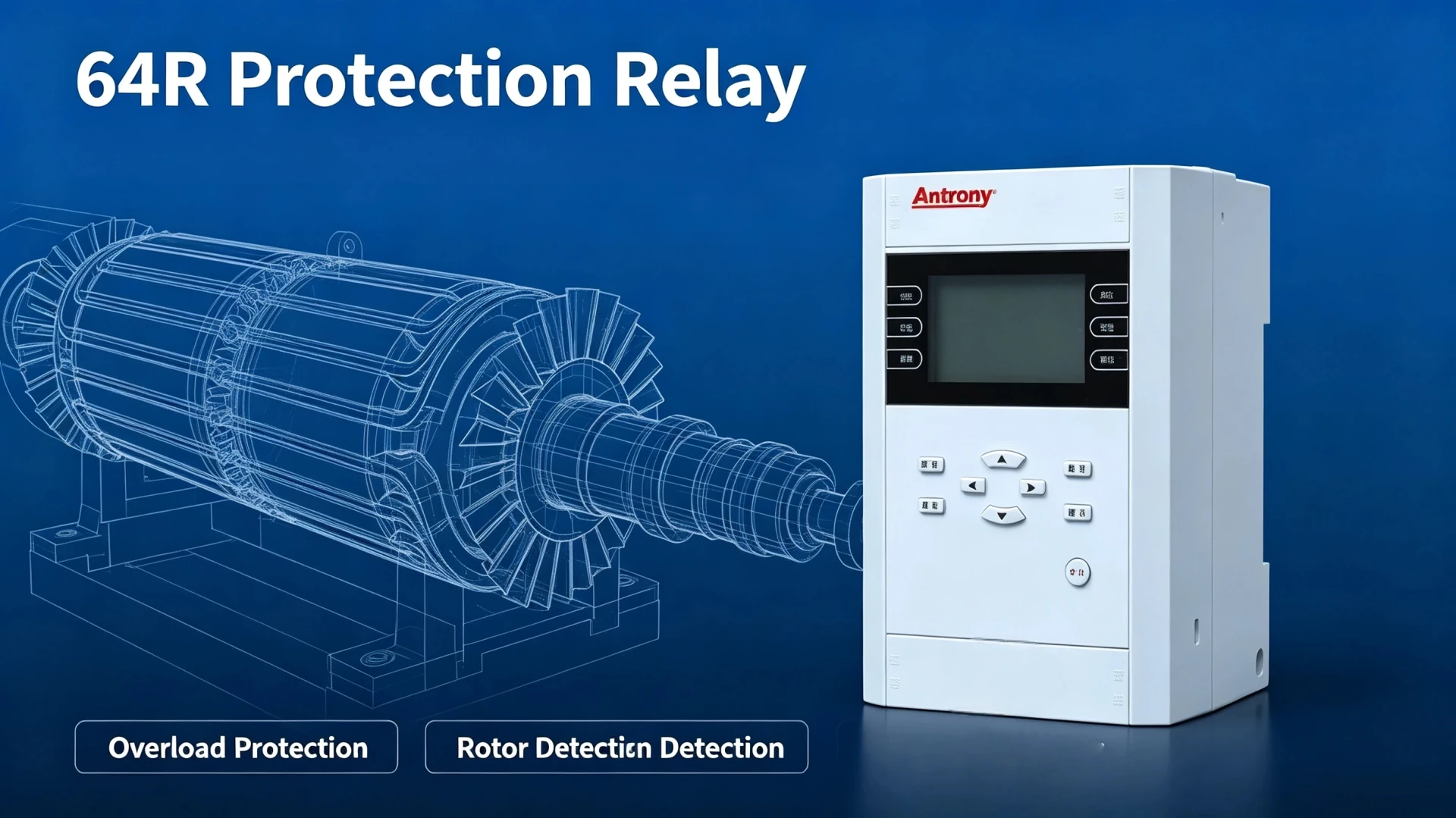
A 64R protection relay is a dedicated generator protection device designed to monitor rotor-to-ground insulation and detect earth faults in the rotor excitation circuit of synchronous generators and large synchronous motors. As a standard ANSI-coded protection device, the 64R relay protection solves the critical problem of invisible insulation degradation and latent ground faults in rotating excitation windings, which cannot be fully covered by stator differential or overcurrent protection.
For power plant operators, EPC engineers, and electrical maintenance teams, rotor earth faults are one of the most threatening hidden risks for generator long-term safe operation. A single rotor ground fault causes no immediate unit trip, but it creates preconditions for catastrophic two-point short-circuit faults. The 64R relay function provides continuous insulation monitoring, early fault warning and graded protection action, effectively avoiding rotor winding burnout, shaft magnetization and unit vibration failure.
This article systematically elaborates the definition, working principle, core functions, protection scheme, application scenarios, selection criteria and commissioning guidelines of the earth fault relay 64R, helping engineering teams accurately apply and select qualified 64R protection equipment for generator protection systems.
What Is a 64R Protection Relay?
What Does ANSI 64R Mean?
Per IEEE C37.2 standard definitions, ANSI 64 refers to general ground/earth fault protection for power equipment. The suffix R stands for Rotor, so ANSI 64R is uniquely defined as rotor earth fault protection, specially used for excitation circuit insulation monitoring and fault detection of synchronous generators.
It is necessary to distinguish 64R from stator ground protection: 64R targets the rotating rotor field winding and excitation circuit, while stator ground protection (ANSI 64G) targets the static stator winding. The two protect different core components of generators and cannot replace each other in power system configuration.
What Fault Does 64R Protection Detect?
The 64R protection relay focuses on all insulation and ground fault risks of generator rotor windings, covering three core abnormal conditions:
- Rotor insulation degradation: Aging, dampness, abrasion and partial discharge of rotor winding insulation, leading to decreased insulation
- Single-point rotor earth fault: Local contact between rotor winding and rotor shaft (ground potential), forming low-current latent fault
- Two-point rotor earth fault: Two grounding points appear at different positions of the rotor winding, forming a short-circuit loop and causing severe equipment damage
How Does a 64R Protection Relay Work?
Basic Principle of Rotor Earth Fault Detection
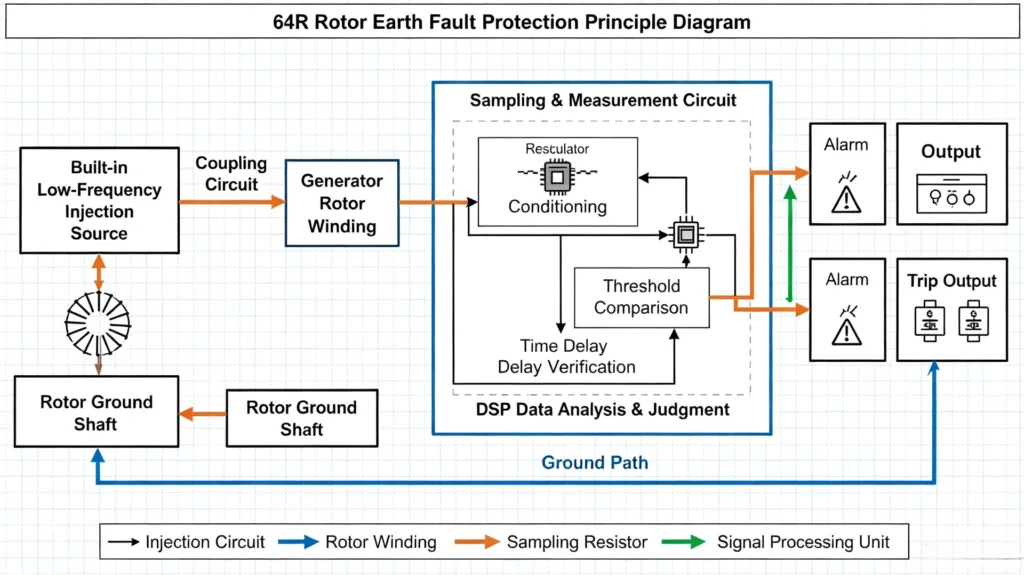
The mainstream technical solution of modern 64R relay protection is low-frequency voltage injection technology. Different from traditional passive protection, this active detection scheme realizes full-cycle monitoring independent of generator operating status and excitation voltage. The complete working loop is as follows:
Built-in low-frequency injection source of 64R relay → coupling circuit → generator rotor winding → rotor ground shaft → sampling measurement circuit → DSP data analysis and judgment → output alarm or trip signal
Why Is the Rotor Winding Normally Isolated from Ground?
Generator rotor windings adopt floating ground design during normal operation, with no direct electrical connection to the ground system. The whole excitation circuit relies on high insulation resistance to isolate the winding from the rotor shaft and ground.
This design makes single-point rotor earth fault unable to form a closed short-circuit loop, with almost no obvious fault current. Conventional current-type protection cannot capture such latent faults, which is the core reason why professional 64R insulation monitoring protection must be configured for generators.
How Does the Relay Detect Rotor Insulation Faults?
The 64R relay function realizes quantitative monitoring and fault judgment through real-time measurement of rotor-to-ground insulation parameters:
The relay continuously injects stable low-frequency AC test signals into the rotor circuit. When the rotor insulation is intact, the loop leakage current is extremely small, and the measured insulation resistance remains at a normal high level. When insulation ages or is damaged, the equivalent grounding resistance decreases, and the loop leakage current increases synchronously.
The high-performance DSP processor of the 64R relay calculates real-time insulation resistance, compares it with the preset threshold, and outputs corresponding protection actions. The biggest advantage of this scheme is that it can work normally with or without excitation voltage, realizing full-condition continuous monitoring.
64R Relay Function and Protection Features
Rotor Earth Fault Detection
As the core function of the 64R relay, it accurately identifies low-resistance and high-resistance earth faults of rotor windings, covering full winding fault positions without dead zones. It effectively captures hidden ground faults that cannot be detected by conventional overcurrent and differential protection.
Rotor Insulation Resistance Monitoring
The 64R protection relay supports 24/7 continuous monitoring of rotor-to-ground insulation resistance. It can track the gradual deterioration trend of insulation parameters in real time, rather than only responding to sudden faults. This trend monitoring provides reliable data support for predictive maintenance of generator excitation systems.
First Rotor Earth Fault Alarm
A single-point rotor earth fault will not form a short-circuit loop or produce destructive fault current, so the 64R relay adopts alarm-only strategy for the first fault. The purpose is to remind maintenance personnel of insulation failure risks, arrange planned maintenance in advance, and avoid unplanned outage of the unit.
Although the single-point fault does not affect short-term operation, it completely destroys the insulation safety margin. Once a second grounding point appears, the unit will face severe damage risks.
Second Rotor Earth Fault Protection
When a two-point rotor earth fault occurs, a partial short-circuit loop is formed in the rotor winding. The short-circuit current causes rotor magnetic field distortion, mechanical vibration overload, rotor shaft magnetization and local overheating burnout of windings.
For this dangerous fault, the 64R protection relay immediately outputs a trip command to cut off the generator operation and excitation power supply, avoiding permanent damage to core equipment.
64R Relay Protection Scheme
Typical 64R Protection Circuit
The standard voltage-injection 64R protection circuit consists of three core parts: signal injection unit, rotor detection loop and signal analysis output unit. The overall structure is simple, with strong anti-interference ability and stable operation, suitable for long-term online operation of power plant equipment.
64R Protection Relay Input and Output
The 64R relay completes full-process protection through standardized input and output interfaces, with clear functional division:
| Item | Typical Function |
|---|---|
| Rotor circuit | Protected core object (generator excitation winding) |
| Injection circuit | Provides stable low-frequency detection signal, independent of excitation voltage |
| Measuring circuit | Collects loop current and voltage signals to calculate insulation resistance |
| 64R relay main unit | Completes signal analysis, threshold judgment and logic operation |
| Alarm output | Early warning for single-point rotor earth fault and insulation degradation |
| Trip output | Emergency shutdown protection for two-point earth fault |
Alarm and Trip Logic of 64R Protection
The 64R protection adopts graded action logic to balance unit operation safety and power supply continuity:
Normal insulation status → gradual insulation deterioration → first rotor earth fault (alarm & record data) → continuous deterioration or second earth fault (immediate trip & shutdown)
Applications of 64R Protection Relay
64R Protection for Synchronous Generators
The 64R protection relay is a standard configuration for all large and medium-sized synchronous generators, widely applicable to turbo generators, hydro generators and diesel generator sets in thermal power plants, hydropower stations and industrial self-provided power plants.
64R Protection for Generator Rotor Windings
It is specially used for full-cycle insulation monitoring and fault protection of generator excitation windings and excitation circuits. It makes up for the protection blank of rotating winding latent faults and forms a complete generator protection system with stator protection, differential protection and overvoltage protection.
64R Protection for Synchronous Motors
For large-capacity industrial synchronous motors with excitation windings, the 64R relay can also be configured to monitor rotor insulation status, avoid motor vibration and winding burnout caused by rotor ground faults, and ensure the stable operation of key industrial equipment.
64R vs Other Generator Protection Functions
Generator protection system consists of multiple ANSI standard functions. The following table clearly distinguishes the application scenarios and protection objects of 64R and other common protections to avoid configuration confusion:
| ANSI Code | Protection Name | Core Protection Target |
|---|---|---|
| 64R | Rotor Earth Fault Protection | Rotor winding insulation and rotor ground fault |
| 64G | Stator Earth Fault Protection | Stator winding ground fault |
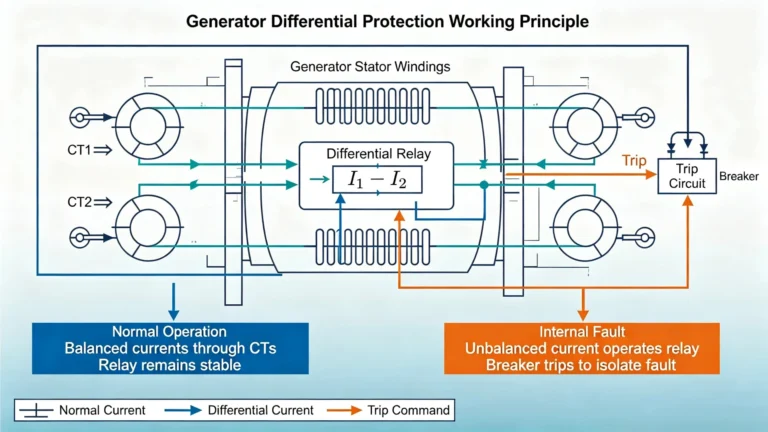
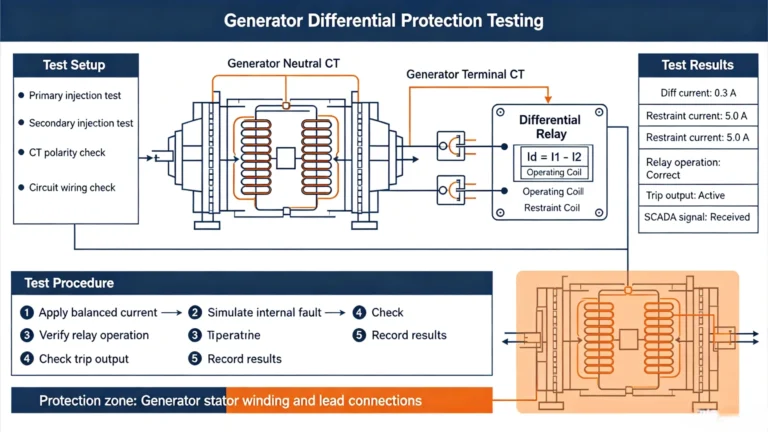
| 87G | Generator Differential Protection | Stator winding internal short circuit fault |
| 46 | Negative-Sequence Protection | Generator three-phase unbalance fault |
| 49 | Thermal Overload Protection | Generator overheating damage |
| 40 | Loss of Excitation Protection | Generator excitation loss fault |
| 32 | Reverse Power Protection | Generator reverse power operation |
64R vs 64G
This is the most easily confused group of protection functions in generator configuration.64R serves the rotor excitation system, focusing on rotating winding insulation and ground faults; 64G serves the stator power winding, focusing on static winding ground faults. The two are independent and complementary, and both need to be configured for large generators.
64R vs Generator Differential Protection (87G)
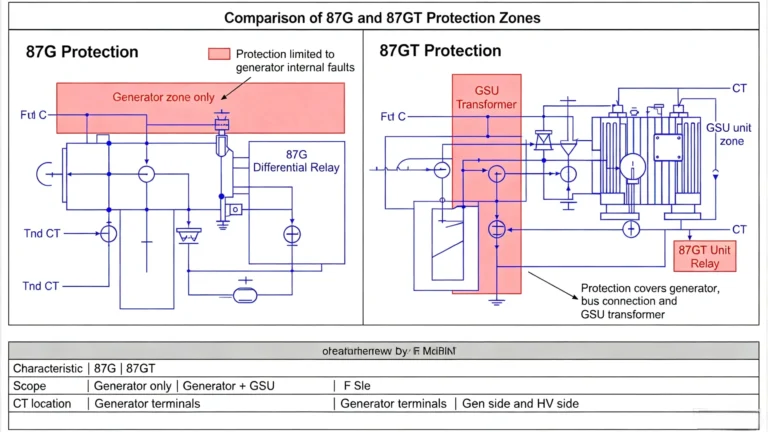
87G differential protection is used to detect internal short-circuit faults of stator windings, belonging to sudden fault protection with high action speed. 64R protection focuses on insulation deterioration and latent ground faults of rotor windings, belonging to early warning and latent fault protection. The two have different protection dimensions and cannot replace each other.
Why Is 64R Rotor Earth Fault Protection Important?
Preventing Rotor Winding Damage
Two-point rotor earth faults will cause local short circuit of rotor windings, produce high-temperature burnout and magnetic distortion, and even lead to rotor scrapping in severe cases. 64R protection cuts off faults in time to avoid permanent damage to expensive generator core components.
Detecting Insulation Deterioration Early
Most rotor faults evolve from slow insulation aging. The continuous monitoring capability of the 64R relay can capture tiny changes of insulation resistance in advance, realize early fault warning, and avoid minor faults evolving into major accidents.
Reducing the Risk of a Second Rotor Ground Fault
After the first single-point ground fault occurs, the 64R relay alarms in time to urge maintenance. Timely maintenance and repair can completely eliminate the hidden danger and prevent the occurrence of destructive two-point ground faults.
Improving Generator Protection Reliability
As the only professional protection for rotor insulation faults, 64R relay fills the gap of traditional protection blind areas, forms a full-coverage generator protection system, and greatly improves the overall operation safety and stability of the power plant unit.
How to Select a 64R Protection Relay
Rotor Ground Fault Detection Method
Priority should be given to low-frequency voltage injection type 64R relay. This scheme has no monitoring dead zone, can work without excitation voltage, and has stable detection performance, which is suitable for all types of excitation units (brush-excited and brushless excitation).
Rotor Insulation Resistance Range
Select the relay with matching insulation resistance measurement range and adjustable threshold. It is required to have high sensitivity for both high-resistance slight insulation deterioration and low-resistance severe ground faults, to ensure accurate judgment of various fault conditions.
Generator and Excitation System Compatibility
The selected 64R protection relay shall be compatible with the unit capacity, rotor voltage level and excitation mode of the generator. It needs to support adaptive monitoring of different rotor winding structures to avoid false operation or missing detection.
Alarm and Trip Outputs
Qualified 64R relays shall have independent alarm and trip contact outputs, and support standard Ethernet communication. It can upload fault data and insulation parameters to the power plant monitoring system to realize intelligent operation and maintenance management.
Installation and Commissioning Requirements
Prioritize products with simple wiring, convenient commissioning and complete testing functions. The relay should support on-site functional verification and threshold calibration, reducing the difficulty of on-site engineering implementation.
64R Protection Relay Setting and Commissioning
64R Alarm Setting
The alarm threshold is set according to the factory parameters of the generator and the insulation design standard of the excitation system. It is mainly used for early warning of insulation resistance decline, reserving sufficient maintenance cycle for on-site personnel.
Rotor Earth Fault Detection Threshold
The fault trip threshold needs to comprehensively consider the rotor winding parameters, operating environment and anti-interference requirements of the unit. It should ensure sensitive response to real faults and avoid false trip caused by environmental interference.
Functional Testing of 64R Protection
Before unit operation, complete injection circuit test, insulation resistance simulation test, alarm/trip logic test to verify the integrity and accuracy of 64R protection functions.
Commissioning Before Generator Operation
Complete parameter debugging, signal calibration and linkage test of the whole system to ensure that the 64R protection relay can respond accurately and act reliably under all working conditions.
Frequently Asked Questions About 64R Protection Relay
1. What is a 64R protection relay?
The 64R protection relay is an ANSI-standard rotor earth fault protection device, which adopts voltage injection technology to continuously monitor generator rotor winding insulation and detect rotor ground faults and insulation degradation.
2. What does 64R protect in a generator?
It protects the generator rotor winding and excitation circuit, preventing equipment damage caused by insulation aging, single-point latent faults and two-point short-circuit ground faults.
3. What is the function of a 64R relay?
The core 64R relay function includes real-time rotor insulation resistance monitoring, single-point earth fault alarm, two-point earth fault trip, and full-condition fault detection independent of excitation voltage.
4. What is an earth fault relay 64R?
The earth fault relay 64R is a special ground fault protection relay for generator rotor systems, which fills the monitoring blank of rotating winding latent faults that cannot be covered by conventional protection devices.
5. What is the difference between 64R and 64G protection?
64R is rotor earth fault protection for rotating excitation windings; 64G is stator earth fault protection for static power windings. The two have different protection objects and are configured complementarily.
6. Why is rotor earth fault protection important for generators?
It can early warn insulation faults, eliminate latent dangers through planned maintenance, and avoid severe equipment damage and economic losses caused by two-point rotor ground faults.
7. When should a 64R relay issue an alarm or trip?
It alarms for single-point rotor earth fault and continuous insulation deterioration; it trips immediately for two-point rotor earth fault and severe short-circuit faults.
Conclusion
The 64R protection relay is an indispensable core device in generator protection systems, with irreplaceable application value in rotor insulation monitoring and latent fault protection. Different from conventional protection that only responds to sudden faults, the 64R relay protection realizes whole-process monitoring from insulation deterioration to fault occurrence, effectively preventing rotor winding burnout, shaft magnetization and unit vibration failure.
Standard configuration of 64R protection can significantly improve the safety and reliability of generator operation, reduce unplanned outage risks and maintenance costs, and is a necessary protection scheme for large synchronous generators and key power generation units.
If you need to select a high-performance 64R protection relay matching your generator and excitation system, contact our professional protection engineers to obtain customized technical solutions and parameter configuration suggestions.
Technical References & Data Sources
- IEEE C37.2-2018, Standard for Electrical Power System Device Function Numbers, Acronyms, and Contact Designations
- Siemens SIPROTEC 7UM62 Functional Manual: Rotor Earth Fault Protection (ANSI 64R)
- IEC 60034-2-1, Rotating electrical machines – Rating and performance requirements for generators
- Power Plant Generator Protection System Design Specification, International Electrical Engineering Industry Standard
About Author

Hello, I'm Leno Zhang. I have 15 years of experience in the power relay protection industry with extensive pre-sales and after-sales project experience. Our company specializes in various complete sets of relay protection and automation equipment. I can assist customers in solving all practical on-site project challenges and provide optimal integrated solutions.
Tell Us Your Requirement
High Quality
Stable performance, reliable design, ensuring safe operation for power system protection and grid stability.
Fast Delivery
Timely delivery to support your urgent orders and project schedules efficiently and professionally at any time.
Best Warranty
Professional Warranty: Reliable after-sales support for stable relay protection and long-term customer satisfaction.