

-
Leon Zhang sales consultant
-
Email: zxl635973785@gmail.com
-
Phone/WhatsApp: +86 13655813266
Ping-Pong Rotor Earth Fault Protection: Working Principle and Applications
Generator rotor insulation integrity is the foundation of safe and stable operation for all synchronous power generation units. Rotor winding earth faults are one of the most common and destructive hidden failures in thermal, hydro, and industrial power plants. Unlike conventional stator faults, rotor earth faults develop gradually with insulation aging, often without obvious real-time operating abnormalities, making them difficult to capture by routine monitoring.
Ping-Pong rotor earth fault protection is a dedicated, high-sensitivity detection method designed specifically for generator rotor winding insulation monitoring and rotor earth fault identification. It adopts a unique bidirectional signal injection and response comparison logic to continuously track the insulation state between rotor windings and ground, filling the detection blind spots of traditional rotor grounding protection schemes.
For EPC engineers, power plant operation and maintenance teams, and generator protection designers, mastering the Ping-Pong detection scheme helps achieve early warning of rotor insulation deterioration, avoid secondary fault damage, and optimize the configuration of 64R rotor earth fault protection systems. This article systematically explains the definition, working principle, detection process, engineering advantages, application scenarios, and commissioning specifications of Ping-Pong rotor earth fault protection, providing standardized technical reference for new project configuration and old equipment renovation.
What Is Ping-Pong Rotor Earth Fault Protection?
What Does “Ping-Pong” Mean in Rotor Earth Fault Protection?
The term “Ping-Pong” in this protection scheme refers to its core bidirectional signal interaction mechanism between the protection device and the rotor circuit, simulating the back-and-forth hitting logic of table tennis.
Different from single-ended signal detection methods, the Ping-Pong protection scheme actively injects a stable low-amplitude detection signal into the generator rotor circuit (Ping process) in real time. The signal forms a complete loop through the rotor winding, insulation medium, and ground reference point. The protection device precisely collects and analyzes the feedback response signal returned from the rotor loop (Pong process). By comparing the amplitude, phase, and impedance characteristics of the injected signal and the feedback signal, it quantitatively judges the current insulation level of the rotor winding.
This back-and-forth signal measurement cycle is the core source of the name “Ping-Pong protection”. The whole process runs continuously during generator operation without interrupting unit power generation, realizing non-stop online monitoring of rotor insulation.
What Fault Does Ping-Pong Protection Detect?
Ping-Pong rotor earth fault protection is professionally oriented to rotor winding insulation abnormal state monitoring, with clear detection targets covering all common rotor grounding hidden dangers in engineering scenarios:
- Rotor-to-ground insulation deterioration: Slow insulation aging caused by long-term operation, including reduced insulation resistance and partial insulation damage
- Potential rotor earth fault: Micro grounding faults that cannot trigger conventional protection alarms
- Hard rotor earth fault: Direct grounding short circuit formed after complete breakdown of local rotor insulation
- Insulation abnormality caused by external interference: Insulation fluctuation caused by equipment vibration, moisture invasion, and dust contamination
It is worth emphasizing that this scheme focuses on rotor winding insulation health monitoring, which is different from stator earth fault protection and targets the excitation-side rotor circuit that is more prone to aging faults.
Where Is Ping-Pong Rotor Earth Fault Protection Used?
Due to its high sensitivity and continuous online monitoring capability, Ping-Pong rotor earth fault protection is widely applicable to mainstream large-scale power generation equipment and excitation systems, with core application objects including:
- Large and medium-sized synchronous generators for power plants
- Turbo-generators in thermal power and combined-cycle power plants
- Hydro generators in hydropower stations with long-term continuous operation
- Industrial self-provided generator sets and large motor excitation systems
- Old generator units requiring protection system renovation and upgrade
Why Is Rotor Earth Fault Protection Needed?
Rotor Winding Insulation Can Deteriorate Over Time
Generator rotor windings operate in high-temperature, high-vibration, and electromagnetic interference environments for a long time, and insulation performance will inevitably decline gradually. Multiple irreversible aging factors jointly cause insulation failure:
- Thermal stress: Long-term high-temperature operation of the rotor winding accelerates the aging and embrittlement of insulating materials, reducing dielectric strength.
- Mechanical vibration: High-speed rotation causes frequent mechanical vibration of the rotor, leading to insulation layer friction, cracking and peeling.
- Environmental factors: Internal moisture condensation, dust accumulation, and oil contamination of the unit corrode the insulation layer and reduce insulation resistance.
- Long-term aging: Fatigue damage of insulating materials after years of cyclic operation, forming latent insulation defects.
Most insulation deterioration processes are slow and hidden, with no obvious electrical characteristics in the early stage, which cannot be identified by conventional periodic inspection methods.
Why a Single Rotor Ground Fault Should Not Be Ignored
A single rotor earth fault refers to the first insulation breakdown point between the rotor winding and the ground. In most generator excitation system configurations, a single grounding fault will not form a short-circuit loop and will not cause immediate unit trip or equipment damage. For this reason, many on-site teams ignore single grounding alarms.
However, a single rotor ground fault is essentially a critical warning of insulation failure. It marks that the rotor insulation system has lost its complete protection margin, and the overall insulation performance of the winding has dropped to a dangerous threshold. At this time, the rotor circuit is in a vulnerable abnormal state, and any external disturbance will trigger secondary faults.
Risk of a Second Rotor Earth Fault
The superposition of the first and second rotor earth faults is the core hazard leading to major generator equipment accidents, and the risk evolution logic is clear and rigorous:
After the first rotor earth fault occurs, the potential distribution of the entire rotor winding is distorted, and the insulation pressure of non-fault windings increases significantly. Under continuous operation conditions, the aging speed of weak insulation parts is accelerated, and a second independent grounding point is easily formed.
Once two grounding points appear in the rotor winding, a closed short-circuit loop is formed inside the rotor. The short-circuit current will cause severe local overheating of the winding, burn the rotor copper bar and insulation layer, and even cause rotor deformation, shaft magnetization, and unit vibration exceeding the limit. In severe cases, it will lead to unplanned shutdown of the unit and huge economic losses of equipment maintenance and power generation loss.
How Does Ping-Pong Rotor Earth Fault Protection Work?
Basic Detection Principle
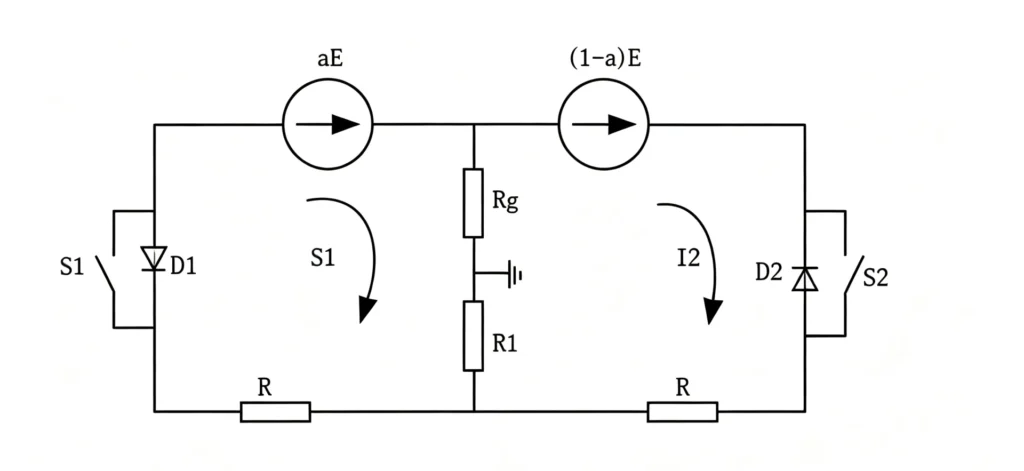
The core working principle of Ping-Pong rotor earth fault protection is active signal injection-circuit response comparison-insulation state judgment. The whole detection process relies on the closed-loop interaction between the protection device and the rotor circuit, without affecting the normal operation of the generator excitation system.
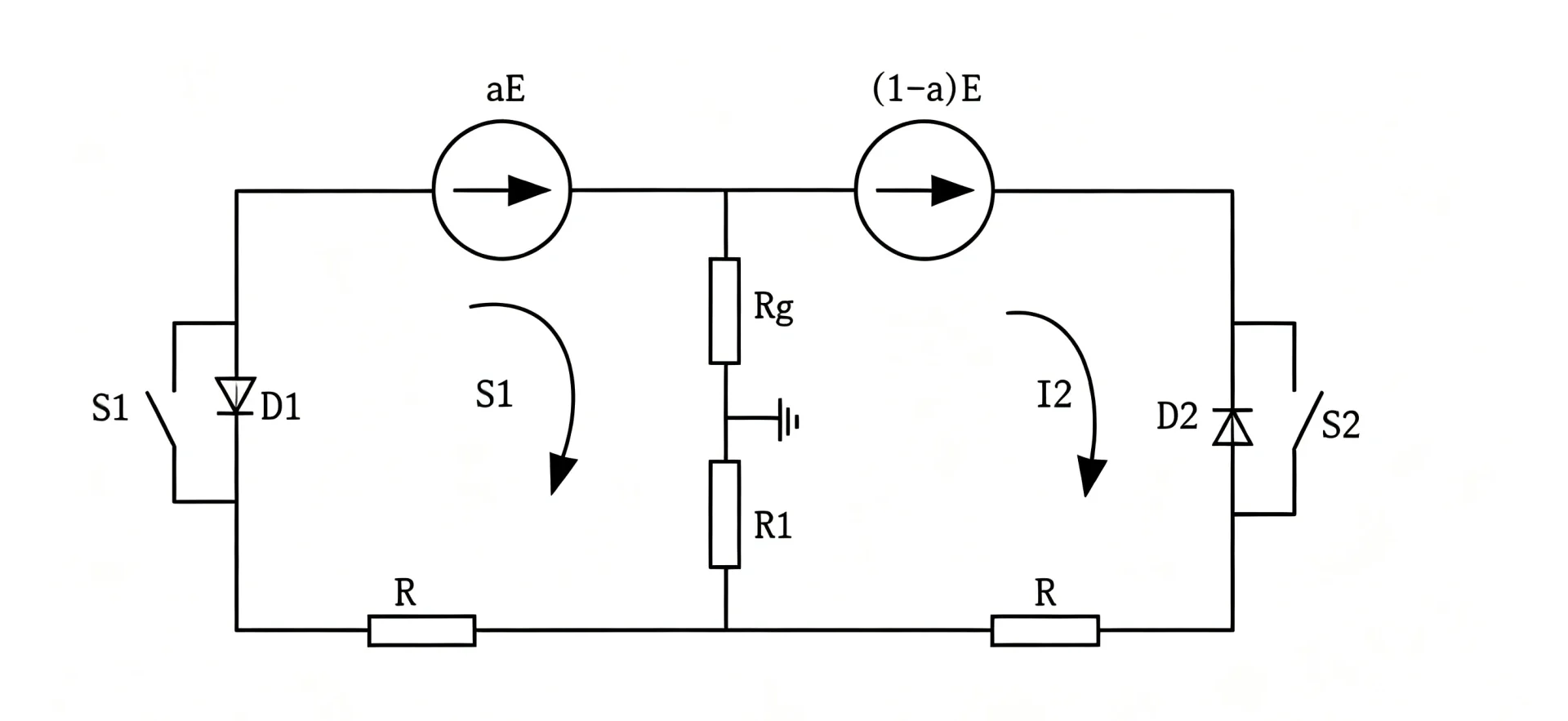
The standard detection structure is as follows: The Ping-Pong protection device actively outputs a fixed-frequency low-power detection signal and injects it into the generator rotor winding circuit. The signal penetrates the rotor insulation medium and connects to the system ground reference point to form a complete detection loop. The protection device collects the feedback response signal of the loop in real time, calculates the insulation impedance and resistance parameters of the rotor winding to ground, and compares them with the preset safe threshold to judge whether there is insulation deterioration or grounding fault.
The better the rotor insulation performance, the higher the loop impedance and the weaker the feedback signal; the worse the insulation performance, the lower the loop impedance and the stronger the feedback signal.
Ping-Pong Detection Cycle
The Ping-Pong detection system operates in a continuous cyclic working mode, and each complete detection cycle includes five standardized steps, with stable and repeatable logic:
- Step 1: Apply detection signal The protection device injects a stable standard detection signal into the rotor circuit, with fixed frequency and amplitude to ensure the consistency of each detection.
- Step 2: Monitor rotor circuit response The system continuously samples the feedback signal returned by the rotor-ground loop, recording real-time amplitude and phase data.
- Step 3: Compare with protection threshold The built-in algorithm of the relay compares the measured loop parameters with the factory-calibrated insulation safety threshold and fault threshold.
- Step 4: Determine insulation condition According to the comparison results, the system automatically judges three states: normal insulation, insulation deterioration, and rotor earth fault.
- Step 5: Output alarm or protection signal Corresponding remote alarm signal is output for abnormal insulation; graded protection instructions are triggered for serious grounding faults according to system configuration.
How Does a Rotor Earth Fault Change the Detection Signal?
Under normal operating conditions, the rotor winding has high insulation resistance to ground. The detection signal injected by the protection device is greatly attenuated in the insulation medium, and the feedback response signal is stable and weak, which is within the normal reference range of the system.
When rotor insulation deterioration or grounding fault occurs, the insulation impedance between the rotor winding and ground decreases sharply, the signal attenuation degree of the detection loop is reduced, and the amplitude and phase of the feedback signal change significantly. The Ping-Pong protection device captures this abnormal signal change in real time, locks the fault state accurately, and realizes early judgment of rotor grounding hidden dangers.
Ping-Pong Rotor Earth Fault Protection Scheme
Typical Generator Rotor Protection Arrangement
The complete Ping-Pong rotor earth fault protection system consists of four core parts, forming a standardized on-site protection configuration:
The generator rotor winding and excitation system are the protected objects; the Ping-Pong protection device is the core detection and judgment unit; the rotor ground detection circuit is the signal transmission carrier; and the alarm and protection output module is the execution terminal. During unit operation, the protection device monitors the rotor insulation state in real time through the detection circuit, and outputs alarm or linkage signals to the plant control system once abnormalities are detected.
Rotor-to-Ground Detection Path
The standard signal transmission path of the Ping-Pong detection scheme is fixed and clear:
Ping-Pong protection device → rotor winding → insulation medium → ground reference point → detection circuit → protection device measurement unit.
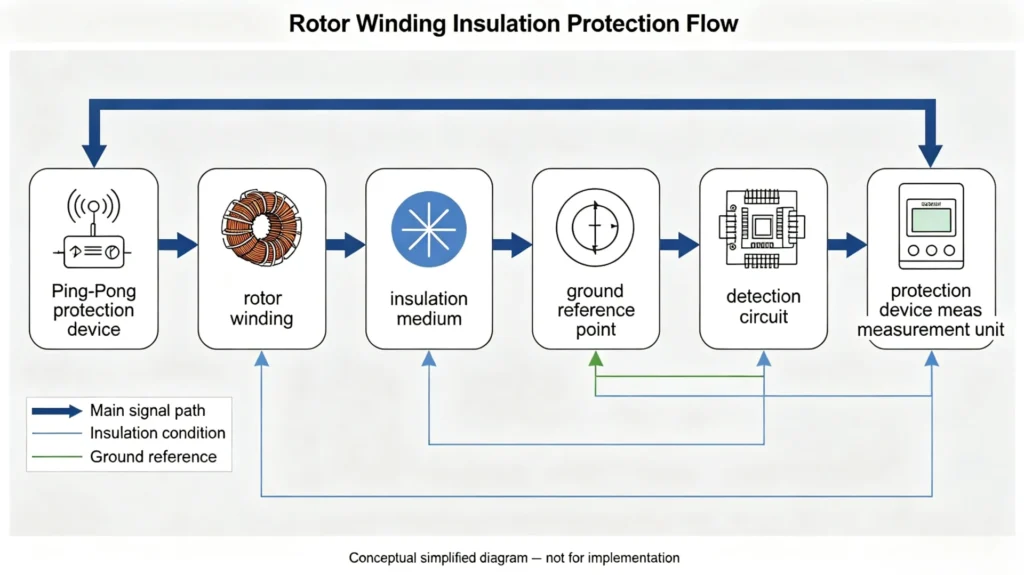
This closed-loop detection path covers the entire rotor winding insulation range, realizing full-coverage monitoring without detection blind areas, and can effectively capture local insulation defects and remote grounding faults of the rotor.
Alarm and Protection Output
Ping-Pong protection adopts graded output logic, which is more in line with on-site operation specifications and avoids excessive protection misoperation:
For slight rotor insulation deterioration, the system outputs an insulation deterioration alarm to remind the maintenance team of early inspection and maintenance. For confirmed rotor earth faults, the system outputs a rotor earth fault alarm and records fault data. For serious continuous grounding faults that endanger unit safety, the system can be configured with linkage trip output according to the excitation system and unit operation requirements to ensure equipment safety.
Ping-Pong Method vs Conventional Rotor Earth Fault Detection
Different from conventional single-signal injection and fixed-resistance detection schemes, Ping-Pong protection relies on bidirectional signal comparison logic, with obvious differences in detection accuracy and scene adaptability. The core parameter comparison is as follows:
| Feature | Ping-Pong Rotor Earth Fault Method | Conventional Rotor Earth Fault Methods |
|---|---|---|
| Detection Principle | Bidirectional signal injection and response comparison, cyclic measurement | Single-ended signal detection or fixed resistance judgment |
| Protected Object | Full-range generator rotor winding and excitation system | Partial rotor winding, easy to form blind areas |
| Core Advantage | High sensitivity, early deterioration warning, strong anti-interference | Simple structure, low cost, only effective for hard faults |
| Continuous Monitoring | Full-time online real-time monitoring | Intermittent detection or post-fault judgment |
| Application Scenarios | New high-precision protection projects and old unit renovations | Low-demand conventional generator units |
When Is the Ping-Pong Method Preferred?
No external injection, high-precision scenarios
Unlike square-wave injection rotor grounding protection, the ping-pong scheme operates fully on the generator’s native DC excitation voltage, no extra AC/square-wave signals needed. It avoids injection power instability and sampling interference, delivering stable, accurate grounding resistance readings for high-accuracy, no-disturbance excitation circuit scenarios.
Standard for mainstream generators
In China’s power industry, ping-pong protection is the standard configuration for 10MW+ hydro generators and 100MW+ steam turbines. Its mature principle and low misoperation rate fully satisfy the strict insulation monitoring requirements of these large units.
Note: The ping-pong scheme has a measurement dead zone when the grounding point is exactly at the rotor winding’s positive/negative terminal, requiring auxiliary monitoring for supplementary verification.
Applications of Ping-Pong Rotor Earth Fault Protection
Hydro Generator Rotor Protection
Hydro generators are characterized by long-term continuous operation, frequent start-stop adjustment, and complex on-site humidity environment, and rotor insulation is prone to moisture aging and vibration damage. The Ping-Pong protection scheme can realize 24-hour uninterrupted monitoring of hydro generator rotor insulation, accurately capture slow insulation deterioration caused by environmental humidity and mechanical fatigue, provide early warning for maintenance, and avoid grounding faults during peak power generation periods. It is widely used in large and medium-sized hydropower station synchronous generator protection systems.
Turbo Generator Rotor Protection
Thermal power turbo-generators operate in high-temperature and high-speed rotating environments for a long time, and rotor insulation is mainly damaged by thermal aging and high-speed vibration. The high-sensitivity detection capability of Ping-Pong protection can effectively identify insulation micro-defects caused by long-term thermal stress, realize early intervention before faults occur, and improve the operational safety and stability of thermal power units. It is the preferred rotor protection scheme for new large-capacity thermal power units.
Generator Retrofit and Modernization
Most old power plant units are equipped with conventional rotor earth fault protection, which has problems such as single detection function, large blind areas, and inability to monitor insulation deterioration. The Ping-Pong rotor earth fault protection scheme has good equipment compatibility and can be seamlessly integrated into the original generator protection system without large-scale transformation of the unit circuit. It is very suitable for old unit protection upgrade, obsolete relay replacement, and power plant intelligent renovation projects, helping enterprises improve equipment safety management levels with low transformation cost.
Ping-Pong Rotor Earth Fault Protection and 64R
Is Ping-Pong Protection a 64R Protection Function?
In strict accordance with ANSI power protection standards, 64R is the unified functional designation for rotor earth fault protection, representing the protection category and functional attribute; while Ping-Pong is a specific technical implementation method for 64R protection functions.
In short, 64R is the protection function definition, and Ping-Pong is one of the advanced detection schemes to realize 64R rotor earth fault protection. All Ping-Pong rotor earth fault protection devices belong to the category of 64R protection relays, but not all 64R relays adopt Ping-Pong detection technology.
Condensed Comparison: Ping-Pong vs. Injection-Type Rotor Earth Fault Protection
| Dimension | Ping-Pong | Injection-Type |
|---|---|---|
| Principle | Uses rotor DC excitation; switches positive/negative-to-ground circuits; solves equations. No external source. | Injects 1–3 Hz low-frequency square/AC signal; measures loop current/voltage to calculate insulation resistance and fault location. |
| Operating Conditions | Requires excitation voltage above threshold; cannot detect at shutdown/no excitation. | Full conditions: startup, shutdown, zero excitation, full load. |
| Dead Zone | Dead zone at positive/negative terminal ends. | No dead zone; full winding coverage. |
| Cost & Maintenance | Simple, low cost; minimal maintenance, stable. | Higher cost; needs precision signal generator; regular calibration, drift risk. |
| Typical Application | Standard for hydro >10 MW, turbo >100 MW; preferred for small/medium units. | Large hydro, million-kW thermal; or redundant backup to Ping-Pong. |
| Interference | No external injection; no excitation interference; immune to excitation voltage fluctuation. | Injection may slightly interfere; strict amplitude/frequency control; weaker anti-interference. |
This logical relationship clarifies the core positioning of the three, avoiding the confusion of concepts in engineering configuration and scheme selection, and forming a standardized topic cluster with conventional 64R protection relay technologies.
Advantages and Limitations of Ping-Pong Rotor Earth Fault Protection
Advantages
- Full-time continuous monitoring: Real-time online detection during generator operation, no need for shutdown inspection, covering all operating conditions
- Early fault warning capability: Can identify insulation deterioration in the early stage, realize preventive maintenance, and avoid major faults
- High detection accuracy: Bidirectional signal comparison effectively eliminates external interference and improves fault judgment accuracy
- Strong system compatibility: Adaptable to hydro, thermal power, and industrial generators, compatible with most excitation systems
- Convenient system integration: Can be seamlessly connected with generator protection systems, DCS and SCADA systems
Engineering Considerations and Limitations
- Excitation system matching requirements: Individual special excitation system configurations need parameter adaptation to ensure detection signal stability
- On-site interference control: Strong electromagnetic interference in the power plant may affect signal sampling, requiring standardized wiring and shielding measures
- Professional commissioning required: The algorithm threshold needs to be calibrated according to generator parameters, requiring professional engineering commissioning
- Fixed detection sensitivity range: Suitable for conventional large and medium-sized generators, not applicable for ultra-small special generator sets
How to Apply Ping-Pong Rotor Earth Fault Protection
Check Generator and Excitation System Configuration
Before scheme deployment, confirm the basic parameters of the protected equipment: generator type (hydro/turbo/synchronous generator), rotor winding structure, excitation system type, rated operating voltage, and original protection scheme configuration. Verify the matching degree between the equipment and the Ping-Pong detection scheme to ensure no adaptation risks.
Check Detection and Measurement Requirements
Set standardized detection parameters according to unit operating requirements: confirm insulation resistance detection range, fault detection sensitivity, insulation deterioration alarm threshold, fault response time, and grading protection logic. Complete parameter calibration according to IEEE industry standards to ensure detection accuracy meets engineering specifications.
Integration With Generator Protection System
Realize signal docking and logic coordination with the on-site system: connect the alarm and protection output signals to the generator protection relay and plant DCS/SCADA system, complete remote signal transmission and on-site display configuration, and match the trip circuit logic with the unit safety protection system to ensure linkage reliability.
Testing and Commissioning of Ping-Pong Rotor Earth Fault Protection
Functional Test
Complete the basic function test of the protection device after installation, including signal injection function verification, loop communication test, and parameter setting test, to ensure the device operates normally and the signal transmission is stable.
Rotor Earth Fault Simulation
Simulate rotor insulation deterioration and grounding fault states through professional test equipment, verify the detection and judgment capability of the Ping-Pong scheme for different fault degrees, and confirm the accuracy of fault identification.
Alarm and Output Verification
Test the insulation deterioration alarm and fault alarm output functions respectively, check the consistency of on-site indication and remote transmission signals, and verify the reliability of protection linkage output.
Commissioning Before Generator Operation
Complete full-scale commissioning before unit startup, record test data, calibrate abnormal thresholds, and form standardized commissioning reports to ensure the protection system meets long-term stable operation requirements.
Frequently Asked Questions
1. What is Ping-Pong rotor earth fault protection?
Ping-Pong rotor earth fault protection is an advanced 64R rotor earth fault detection scheme that adopts bidirectional signal injection and response comparison logic to realize continuous online monitoring of generator rotor winding insulation and accurate identification of rotor earth faults and insulation deterioration.
2. How does the Ping-Pong method detect a rotor earth fault?
It injects a stable detection signal into the rotor circuit, collects the loop feedback signal in real time, compares the signal changes with the standard threshold, and judges the rotor insulation state and grounding fault according to the impedance difference of the detection loop.
3. What is the difference between Ping-Pong protection and 64R protection?
64R is the ANSI standard functional definition of rotor earth fault protection, while Ping-Pong is a high-precision technical method to realize 64R protection functions. Ping-Pong protection is a branch of 64R protection schemes.
4. Where is Ping-Pong rotor earth fault protection used?
It is mainly used for insulation monitoring and fault protection of hydro generators, turbo-generators, and large synchronous generators, and is widely applicable to new projects and old unit protection renovation scenarios of power plants.
5. Why is rotor earth fault protection important for generators?
Rotor insulation aging will lead to single or multiple grounding faults. Secondary grounding faults will cause short-circuit damage to rotor windings, resulting in equipment failure and unplanned shutdown. Reliable protection can realize early warning and avoid major economic losses.
6. Can Ping-Pong protection be used for existing generators?
Yes. The scheme has strong compatibility and can be seamlessly upgraded and deployed on most existing generator and excitation systems without large-scale circuit transformation, which is the preferred scheme for old power plant protection modernization.
7. How do you test a Ping-Pong rotor earth fault protection system?
The test includes functional self-check, fault simulation test, alarm output verification, and pre-operation commissioning. Professional test equipment is used to simulate different insulation states to verify detection accuracy and protection reliability.
Conclusion
Ping-Pong rotor earth fault protection is an optimized and high-reliability implementation scheme of generator 64R rotor earth fault protection. Different from conventional single detection methods, its unique bidirectional signal cyclic detection logic solves the pain points of insufficient early warning capability and low accuracy of traditional protection, and realizes full-time and full-coverage monitoring of rotor winding insulation health status.
As a professional technical solution for generator rotor protection, it is widely used in thermal power, hydropower, and industrial generator units, especially suitable for equipment renovation and high-standard protection configuration scenarios. For power plant new projects and protection upgrade projects, engineers should select the appropriate rotor earth fault detection scheme according to the actual generator rotor circuit structure, excitation system configuration, and operation and maintenance requirements.
To learn more about industry-standard protection technologies, please refer to our professional articles on 64R Protection Relay and Rotor Earth Fault Protection Relay to form a complete generator protection technical system.
Technical References & Data Sources
- IEEE C37.102-2023, IEEE Guide for AC Generator Protection
- IEEE C37.101-2006, IEEE Guide for Generator Ground Protection
- IEEE 43-2013, Recommended Practice for Testing Insulation Resistance of Rotating Machinery
- IEC 60034-27, Rotating electrical machines – Rotor insulation monitoring specifications
- Power Plant Generator Protection System Engineering Technical Specification
About Author

Hello, I'm Leno Zhang. I have 15 years of experience in the power relay protection industry with extensive pre-sales and after-sales project experience. Our company specializes in various complete sets of relay protection and automation equipment. I can assist customers in solving all practical on-site project challenges and provide optimal integrated solutions.
Tell Us Your Requirement
High Quality
Stable performance, reliable design, ensuring safe operation for power system protection and grid stability.
Fast Delivery
Timely delivery to support your urgent orders and project schedules efficiently and professionally at any time.
Best Warranty
Professional Warranty: Reliable after-sales support for stable relay protection and long-term customer satisfaction.