

-
Leon Zhang sales consultant
-
Email: zxl635973785@gmail.com
-
Phone/WhatsApp: +86 13655813266
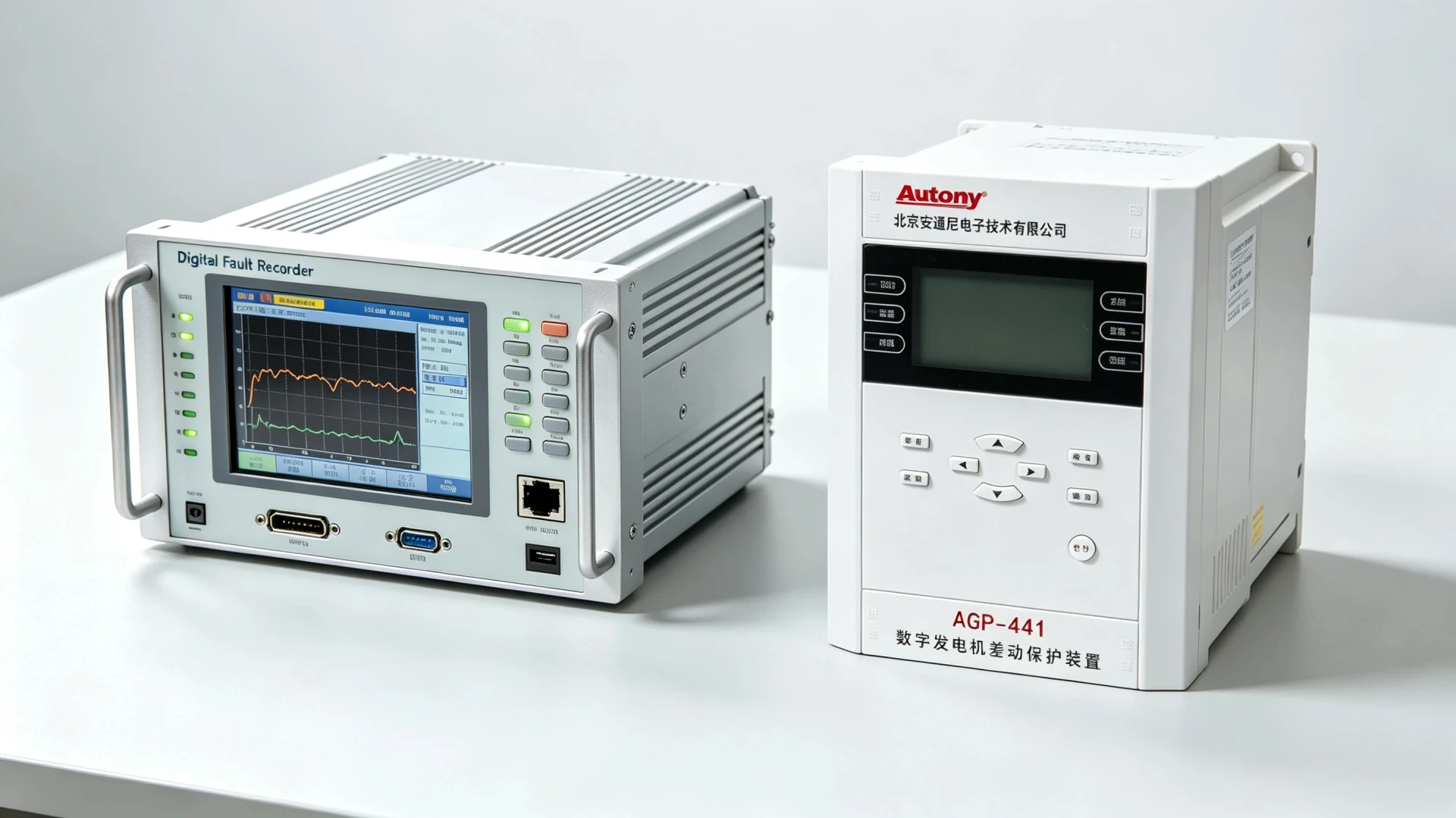
Digital Fault Recorder vs Protection Relay: What Is the Difference?
Digital fault recorder vs protection relay: one device clears the fault, the other keeps the record. A protection relay compares current and voltage with set thresholds and trips a breaker in tens of milliseconds. A digital fault recorder (DFR) samples CT and VT secondaries, freezes a window around the trigger, and writes a COMTRADE file per IEC 60255-24:2013.
The fault recorder vs protection relay argument usually starts when a relay datasheet advertises disturbance recording. It does record, on the channels it protects, over a short window, at the rate its own logic needs. A dedicated recorder keeps the whole bay in one file. The functions a relay carries are numbered in ANSI/IEEE C37.2-2022; the recorder only logs which of them operated.
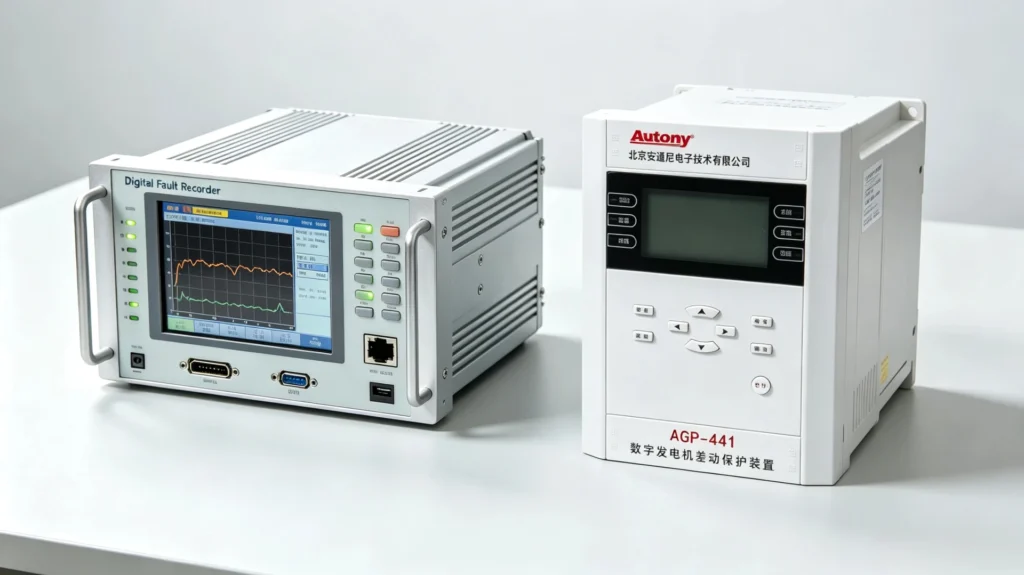
Eight rows carry most of the comparison.
Digital Fault Recorder vs Protection Relay at a Glance
| Attribute | Digital Fault Recorder | Protection Relay |
|---|---|---|
| Job | Records and reproduces the disturbance | Detects the fault and isolates it |
| Trip output | None, no protection logic and no trip contact | Trip contact drives the breaker |
| Analog channels | 16 to 64, wired across the station | The CT and VT of the bay it protects |
| Sampling rate | 1 kHz to 10 kHz per channel | 4 to 64 samples per cycle, set by the algorithm |
| Record length | Two or three pre-fault cycles plus 2 s to 10 s after the trigger | A few cycles around the trip, model dependent |
| Record format | COMTRADE per IEC 60255-24:2013 | Proprietary event report, COMTRADE export on some models |
| Time source | GPS, IRIG-B or PTP, within ±1 µs | IRIG-B or PTP where the scheme needs it |
| Fitted at | Station level, one unit per voltage level | Bay level, one per protected element |
Both devices answer to the same standards family, just to different parts of it: protection equipment is specified under IEC 60255-1:2022, the record format under IEC 60255-24:2013, and the station time base under IEC/IEEE 61850-9-3:2016. Those three decide what each device has to deliver.
DFR and relay roles split cleanly from there: one acts on the power system, the other keeps the evidence. Engineers, EPC contractors and station operators ask the same three questions about them, whether a relay can replace a DFR, whether a DFR trips anything, and why large substations specify both. Each is answered below.
What Is a Digital Fault Recorder?
It is the device that writes the event down. Nothing inside a DFR decides whether to trip.
Main Purpose of a DFR
A digital fault recorder (DFR) is a disturbance monitoring device that records abnormal events across a whole station. It reproduces the fault afterwards; it does not intervene while the fault is happening. ANSI/IEEE C37.2-2022 supplies the device numbers used to label the trip contacts and alarms wired into its digital inputs.
On site the device usually arrives as a complete fault recorder panel, wired once and left to run.
A DFR runs on a cyclic buffer with trigger detection: it samples continuously, holds the last few seconds in memory, and overwrites them until a trigger fires. The common triggers are overcurrent, voltage excursion and frequency deviation. How the buffer and trigger are set up is a separate subject, covered under digital fault recorder working principles. What it records comes down to these signals:
- Multi-channel voltage and current transient waveforms
- Grid frequency and phase change data
- Circuit breaker opening/closing status signals
- Protection device trip and alarm signals
- Other analog and digital auxiliary signals of the power system
Every record is written as a COMTRADE file per IEC 60255-24:2013, so any analysis package can open it. IEEE C37.111 covered the same format until IEEE withdrew it in 2024, which is why current specifications name the IEC edition.
What Is a Protection Relay?
It is the device that decides when part of the power system has to be disconnected. The relay types and the schemes they sit in are set out under what protective relays are.
Main Purpose of a Protection Relay
A protection relay is the device that decides when part of the power system has to be disconnected. It measures current and voltage, judges them against set thresholds, and issues a trip in milliseconds so the faulty element is separated before the fault spreads. Its performance is specified in the IEC 60255 series, with IEC 60255-1:2022 carrying the common requirements.
Modern digital relays carry several protection functions in one box and select the right one from the measured values: overcurrent (50, 51), earth fault (51N, 51G), differential (87), distance (21), under and over voltage (27, 59), under and over frequency (81), and reverse power (32). Those numbers come from ANSI/IEEE C37.2-2022, and between them they cover generators, transformers and transmission lines.
A relay keeps only what it needed to reach its decision, and once the trip is out that buffer is free for the next event. Long, high-precision records are not part of the job.
Digital Fault Recorder vs Protection Relay: How Do Their Functions Differ?
Protection Relay Detects and Acts
A protection relay runs a closed loop: measure, judge, apply logic, act.
During grid operation, the relay collects real-time current and voltage data through CT/PT, compares the monitored electrical parameters with the preset protection threshold, and triggers corresponding protection actions once abnormal conditions are confirmed. For example, a feeder protection relay will instantly identify excessive fault current, verify the fault zone through internal logic, and send a trip command to the circuit breaker to cut off the faulty line, limiting the fault impact range in the shortest time. A 50 or 51 element works from magnitude and time; a 21 element works from the impedance it measures.
Speed is what a relay is bought for. The quicker it separates the fault from the rest of the system, the less damage that fault does.
DFR Records and Preserves the Event
A DFR runs a one-way chain: monitor, trigger, capture, store, analyse.
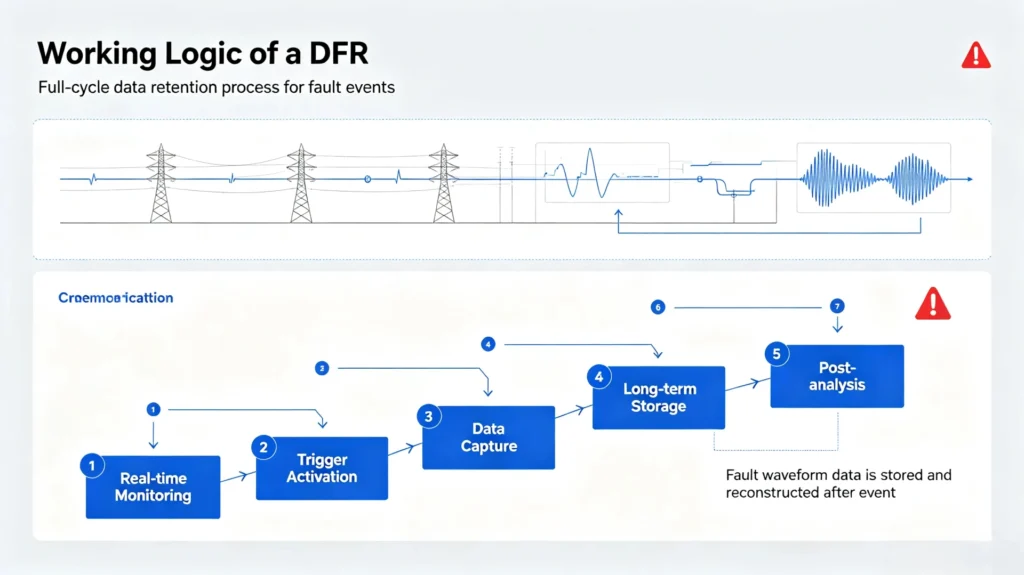
A DFR takes no part in protection and issues no trip command. During normal operation it buffers full-precision data in a ring; when a fault meets the trigger condition it locks the pre-fault steady state, the fault transient and the post-fault recovery into one record.
The record is what pays for the device. Once the fault is cleared, engineers read the waveforms to work out what kind of fault it was, when it started, whether the protection behaved as it was set to, and what the disturbance looked like elsewhere in the station.
Can a Protection Relay Record Faults?
Yes. Most digital relays on the market today include a disturbance recorder, and it covers event lists, trip logs and a short oscillography. It is built to check the relay’s own logic, not to carry a station’s fault analysis.
Protection Relay Fault Recording
The relay’s own record is there to prove its logic ran correctly: few channels, seconds of data, and the sampling rate its algorithms use anyway. It answers whether the relay did what it was set to do, and not much more than that.
That record is a maintenance tool. It is not what an investigation runs on.
Dedicated DFR Recording
A dedicated recorder is built for that one job, and the gap shows up in numbers: 16 to 64 analog channels against a handful, 1 kHz to 10 kHz sampling against 4 to 64 samples per cycle, and a window measured in seconds against a few cycles. Every channel carries the same time stamp, so a whole station can be read from one file.
DFR vs Protection Relay: What Data Do They Record?
The DFR vs relay difference is widest in what each one keeps. The table below puts them side by side.
| Recording Data Type | DFR | Protection Relay |
|---|---|---|
| Current Waveform | Complete high-precision transient waveform | Available, model-dependent with limited precision |
| Voltage Waveform | Full-process continuous recording | Available, model-dependent with partial missing data |
| Frequency Data | High-resolution real-time tracking | Basic frequency value recording, no transient change details |
| Breaker Status Signal | Full-time synchronous recording | Only record action events, no continuous status monitoring |
| Protection Trip Signal | Synchronous recording of internal and external trip signals | Only record self-generated trip events |
| Multi-device Associated Signals | Strong, supports system-wide multi-point signal correlation | Weak, only limited to its own protection zone signals |
| Pre-fault & Post-fault Waveform | Standard full-cycle recording | Partial models support, incomplete data |
Pre-fault data is the part a relay cannot give back.
DFR vs Protection Relay: What Happens During a Fault?
On a real system the two devices meet the same fault from different ends. A short circuit on a transmission line runs like this:
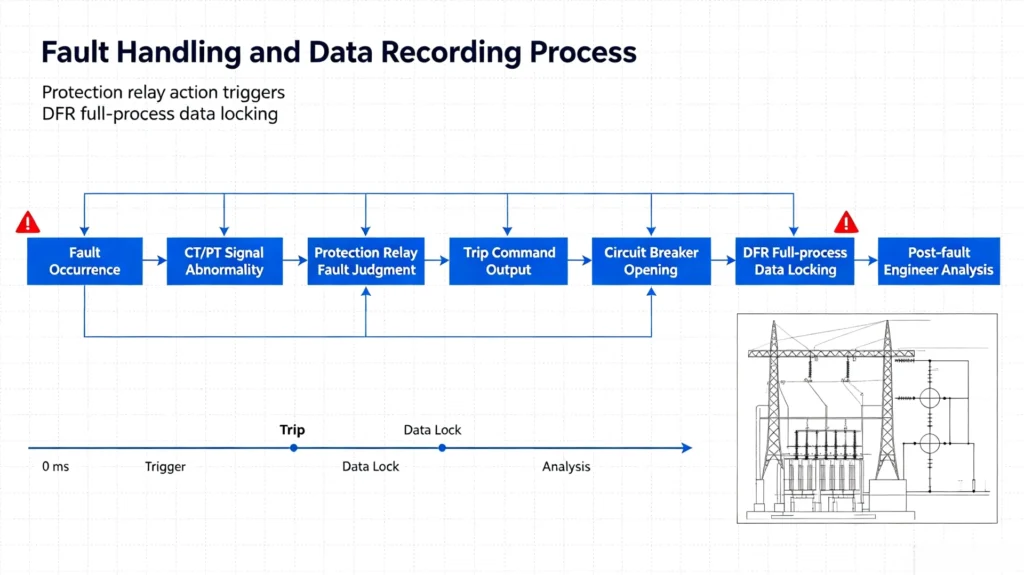
Fault Occurrence → CT/PT Signal Abnormality → Protection Relay Fault Judgment → Trip Command Output → Circuit Breaker Opening → DFR Full-process Data Locking → Post-fault Engineer Analysis
The relay works in milliseconds. The recorder works in seconds.
In this process, the protection relay undertakes the “rescue” role: it quickly identifies the fault and cuts off the faulty line to prevent equipment burnout and grid collapse. The DFR undertakes the “recorder” role: it faithfully records all data changes throughout the fault process, retaining complete technical clues for subsequent fault cause analysis, protection action verification, and system optimization.
Can a DFR Replace a Protection Relay?
No, DFRs cannot replace protection relays in any power system scenario.
A DFR has no protection logic and no trip circuit; it records, and that is all it does. Without a relay nothing isolates the fault, and a fault left on the system burns equipment and can take the wider network with it.
The two jobs do not overlap: the relay keeps the system safe while the fault is live, the recorder makes the fault readable after it is over.
Can a Protection Relay Replace a DFR?
Only applicable to small-scale simple power systems; not recommended for medium and large substations and transmission systems.
On a small industrial system, or a single protection zone where nobody expects detailed fault analysis, the recording built into a good relay covers the basics and a separate recorder can wait.
Past that point the relay’s own record runs out. Installations that need a dedicated recorder include large and medium substations, thermal and renewable generation, long transmission lines, and any system where several protection schemes have to be read together. Where a project connects inside a North American interconnection, NERC PRC-002-5 sets the floor: at least two cycles of pre-trigger data, a record of at least 30 cycles, and no fewer than 16 samples per cycle. A relay event report will not meet those numbers, whatever its sampling rate.
When Should You Use a Digital Fault Recorder?
Specify a recorder where the fault has to be traced precisely, or where system performance is reviewed against data:
Large and Medium-Sized Substations
A substation carries many feeders, transformers and relays whose signals interact. Multi-channel synchronous recording catches what each device did at the same instant, which is how a complicated disturbance gets pinned down.
The panel arrangement for a station that size is set out under substation digital fault recorder.
Power Generation Plants
Power plant equipment such as generators, transformers, and busbars has high operation safety requirements. DFRs record the full-process operating state of generating units and auxiliary systems, which is conducive to analyzing fault propagation paths and verifying the rationality of unit protection settings.
Transmission Systems
Long-distance transmission lines are prone to external faults and transient disturbances. DFRs accurately record line fault waveforms, breaker action time, and fault clearing duration, providing accurate data support for line fault location and transmission system stability optimization.
Complex Industrial Power Systems
Key industrial power systems have high requirements for power quality and fault traceability. DFRs can record voltage flicker, frequency fluctuation, and transient disturbance data, assisting enterprises in troubleshooting power quality problems and reducing production losses caused by grid abnormalities.
Power quality complaints usually start here.
When Is a Protection Relay Enough?
Where the system is simple and nobody is asking for disturbance analysis, the relay’s own record is enough and a separate recorder is not warranted:
- Small single protection zone power distribution systems
- Medium and small industrial power systems with few electrical devices and simple grid structures
- Projects that only need basic fault event records without high-precision waveform analysis requirements
- On-site scenarios where post-fault analysis frequency is low and operation and maintenance requirements are simple
The test is short: how hard is the disturbance analysis going to be. That answer decides whether a dedicated recorder is needed.
Why Are DFRs and Protection Relays Often Used Together?
Standard substation and power plant practice is to fit both. Real-time protection, a full record, and a review afterwards is how the loop gets closed, and it is what most specifications ask for.
In actual operation, CT/PT collects grid analog signals and transmits them to protection relays and DFRs simultaneously. The protection relay completes real-time fault judgment and trip isolation to ensure system safety; the DFR synchronously records all protection action signals, breaker status, and grid waveform data throughout the whole process.
Neither device does the other’s job. The relay handles the fault that is happening; the recorder handles the fault that already happened, and the setting changes that stop it coming back. Engineers use the records to check coordination, revise settings and find weaknesses before they cause an outage.
DFR vs Protection Relay: Which One Do You Need?
Match the project requirement to the device and the choice usually makes itself. The digital fault recorder vs protection relay question behind the table is really one thing: does anyone have to analyse the fault afterwards?
| Project Functional Requirement | Recommended Equipment |
|---|---|
| Real-time fault detection and circuit breaker tripping protection | Protection Relay |
| High-precision fault waveform recording and disturbance playback | DFR |
| Multi-channel system-wide disturbance synchronous recording | DFR |
| Basic fault protection + simple event recording | Protection Relay |
| Professional post-fault root cause analysis and protection performance evaluation | DFR |
| Grid safety protection + full-cycle fault data traceability | Both DFR & Protection Relay |
Most stations end up specifying both.
In short: safety protection calls for a relay, fault analysis calls for a recorder, and any critical installation is better off with both. Sizing a unit for a particular bay count is a separate job, covered under digital fault recorder selection.
FAQ
1. What is the core difference between a DFR and a protection relay?
The core difference lies in functional positioning. Protection relays focus on active fault detection and isolation to ensure real-time system safety; DFRs focus on passive full-process data recording and post-fault analysis to support grid operation optimization.
2. Is a DFR a type of protection relay?
No. A DFR is disturbance monitoring equipment, judged on what it records; a protection relay is protection equipment, judged on how fast and how reliably it trips. The two are specified against different parts of IEC 60255 and bought for different reasons.
3. Can a protection relay record complete fault waveforms?
Most modern relays support basic waveform recording, but the recording channel quantity, sampling precision, and pre/post-fault recording duration are limited, which cannot meet the detailed analysis requirements of complex grid disturbances.
4. Can a DFR trip a circuit breaker?
No. A DFR has no protection logic and no trip output circuit, so it cannot operate a breaker. Recording is the whole job.
5. Is it necessary to install a DFR if the project is equipped with protection relays?
On large substations, power plants and transmission projects, yes. On a small distribution project it can wait. What the recorder adds is the part the relay throws away: the seconds before the fault, every bay at once, at a sampling rate high enough to read the transient.
6. What is protection relay fault recording?
It refers to the built-in auxiliary recording function of digital protection relays, which records fault time, fault type, protection action sequence and simple waveform data, used for basic on-site fault troubleshooting.
7. Why do power plants and substations need both devices?
The two devices are complementary and non-substitutable. Relays ensure real-time safety protection of the grid, and DFRs retain complete fault data, helping engineers summarize operation experience and optimize system protection strategies.
8. Do a DFR and a protection relay need the same time base?
They should share one. If the two records carry different clocks, the relay operation cannot be placed against the waveform and the sequence of the event stays in dispute. IEC/IEEE 61850-9-3:2016 gives the PTP profile used in substations, with GPS or IRIG-B as the usual alternative. Either way both devices land within ±1 µs.
Conclusion
A digital fault recorder vs protection relay decision is not either-or. The relay is the “safety guard”: it isolates the fault and protects the equipment. The DFR is the “system analyst”: it keeps the full record, reproduces the event and feeds the next round of setting changes. The boundary between them is clear, and each one covers what the other cannot.
Small, simple systems can run on the relay’s own record. Medium and large installations cannot: protection, recording, cause analysis and setting revision only close into a loop when both devices are there. One fault recorder panel covers a station; how many channels it needs is a sizing question.
Technical Reference Sources
| Source | Edition | What it fixes here |
|---|---|---|
| IEC 60255-1:2022, measuring relays and protection equipment, common requirements | 2022 | The requirement set protection relays are built and tested against |
| IEC 60255-24:2013, common format for transient data exchange (COMTRADE) | 2013 | The file format a DFR writes, and the one every analysis package opens |
| IEC/IEEE 61850-9-3:2016, precision time protocol profile for power utility automation | 2016 | The PTP profile that keeps recorder and relay on one clock |
| ANSI/IEEE C37.2-2022, electrical power system device function numbers, acronyms and contact designations | 2022 | The 50, 51, 51N, 87, 21, 27, 59, 81 and 32 numbers used above |
| IEEE C37.90.1-2024, surge withstand capability (SWC) and electrical fast transient (EFT) requirements and tests | 2024 | Immunity tests for relay and recorder hardware |
| IEEE C37.95-2026, guide for protective relaying of utility-consumer interconnections | 2026 | Relay application practice at the interconnection |
| NERC PRC-002-5, disturbance monitoring and reporting requirements | Effective 1 April 2025 | Fault recording floor for North American interconnections: 2 cycles of pre-trigger data, 30 cycles of record, 16 samples per cycle |
| IEEE C37.111-2013, common format for transient data exchange (COMTRADE) | Withdrawn 21 March 2024 | The superseded US designation for COMTRADE, listed only for traceability |
About Author

Hello, I'm Leno Zhang. I have 15 years of experience in the power relay protection industry with extensive pre-sales and after-sales project experience. Our company specializes in various complete sets of relay protection and automation equipment. I can assist customers in solving all practical on-site project challenges and provide optimal integrated solutions.
Tell Us Your Requirement
High Quality
Stable performance, reliable design, ensuring safe operation for power system protection and grid stability.
Fast Delivery
Timely delivery to support your urgent orders and project schedules efficiently and professionally at any time.
Best Warranty
Professional Warranty: Reliable after-sales support for stable relay protection and long-term customer satisfaction.