

-
Leon Zhang sales consultant
-
Email: zxl635973785@gmail.com
-
Phone/WhatsApp: +86 13655813266
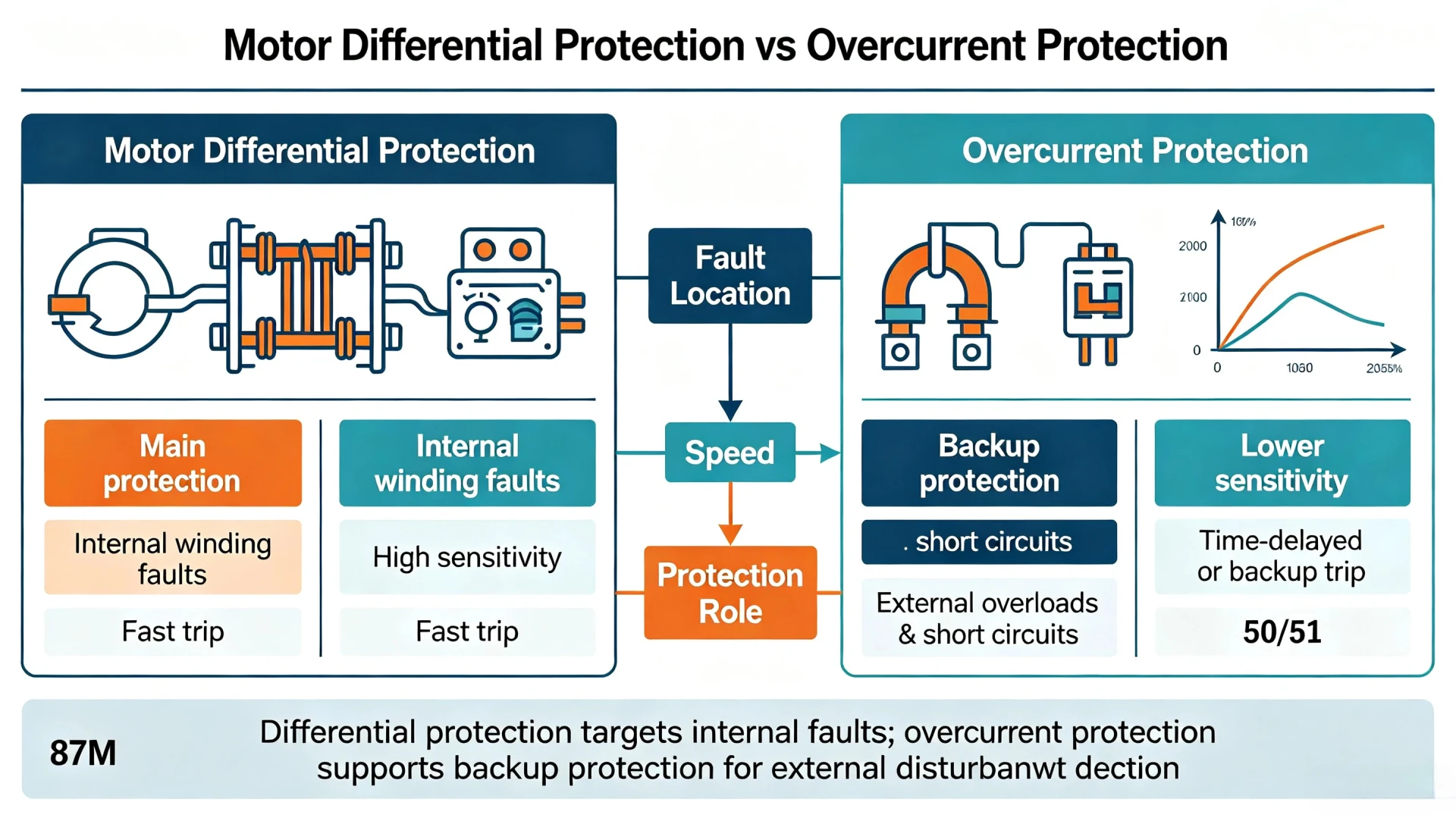
Motor Differential Protection vs Overcurrent Protection: What Is the Difference?
Introduction
Motor differential protection (87M) and 50/51 overcurrent protection are two core protection schemes for industrial MV/HV motors, serving distinct fault detection logic and engineering application scenarios in power system protection. Many EPC engineers, plant operators, and protection designers confuse the two technologies and struggle with reasonable configuration selection for motor protection systems.
Core Conclusion for Quick Reference: 87M provides selective, high-speed protection for internal motor faults, while 50/51 primarily handles motor overcurrent conditions and acts as a universal backup protection for motor and system faults. The two solutions are not mutually exclusive; most industrial critical motor protection schemes adopt a complementary configuration based on motor voltage level, capacity and operational importance.
Motor Differential Protection vs Overcurrent Protection compares two core protection schemes and elaborates on the working principles, protection coverage, performance differences and engineering selection criteria of 87M and 50/51 protection, helping electrical engineers make accurate, cost‑effective motor protection design decisions.
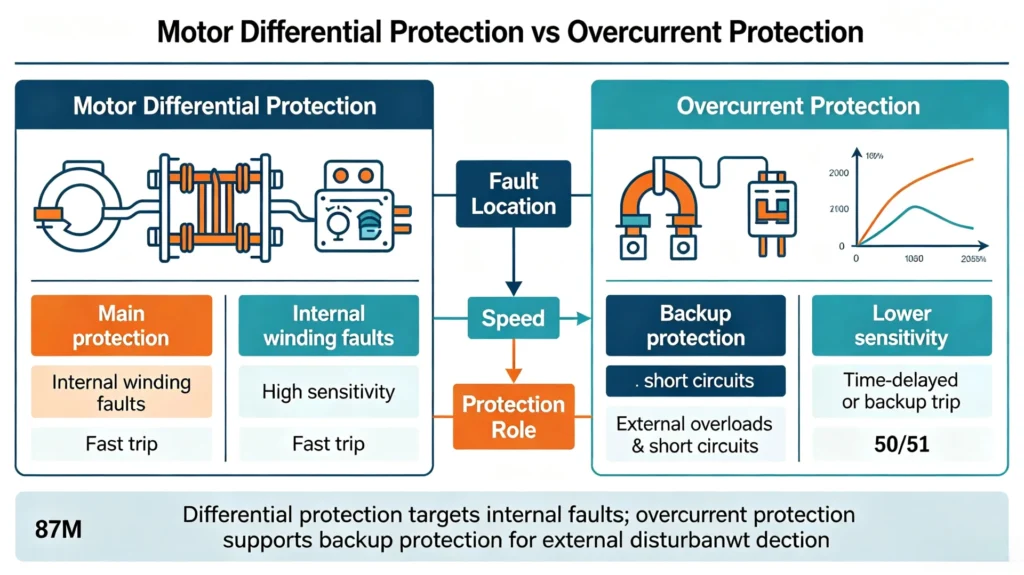
What Is 87M Motor Differential Protection?
Working Principle of 87M Differential Protection
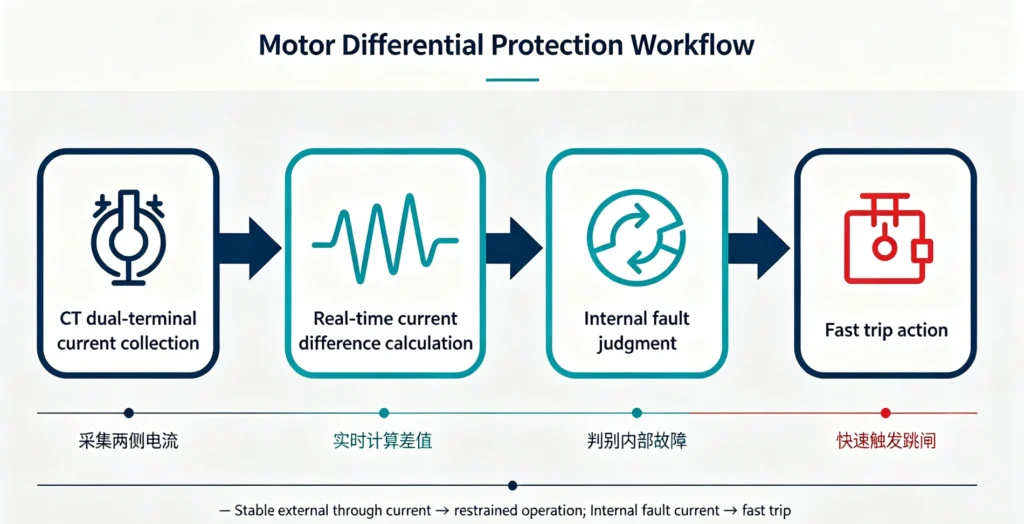
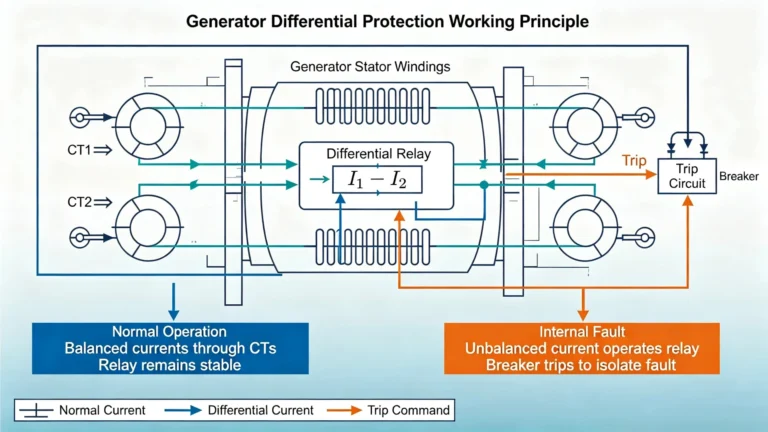
87M motor differential protection is a zone-selective protection technology based on current comparison, specifically designed for stator internal fault protection of rotating motors. Its core configuration requires current transformers (CTs) installed at both the motor line terminal and neutral terminal.
87M Protection Logic Flow: CT dual-terminal current collection → Real-time current difference calculation → Internal fault judgment → Fast trip action
Faults Detected by 87M Protection
87M focuses on motor internal fault protection with precise zone selectivity, covering all typical faults inside the motor differential protection zone:
- Stator winding inter-phase short circuits
- Phase-to-ground faults in motor windings
- Local winding turn-to-turn short circuits
- Internal metal short-circuit faults of MV/HV motors
A key technical feature of 87M protection is that its fault judgment is not dependent on excessive current magnitude. It can identify minor internal winding faults that do not produce large overcurrent, realizing early and accurate fault isolation.
What Is 50/51 Overcurrent Protection for Motors?
Working Principle of 50/51 Protection
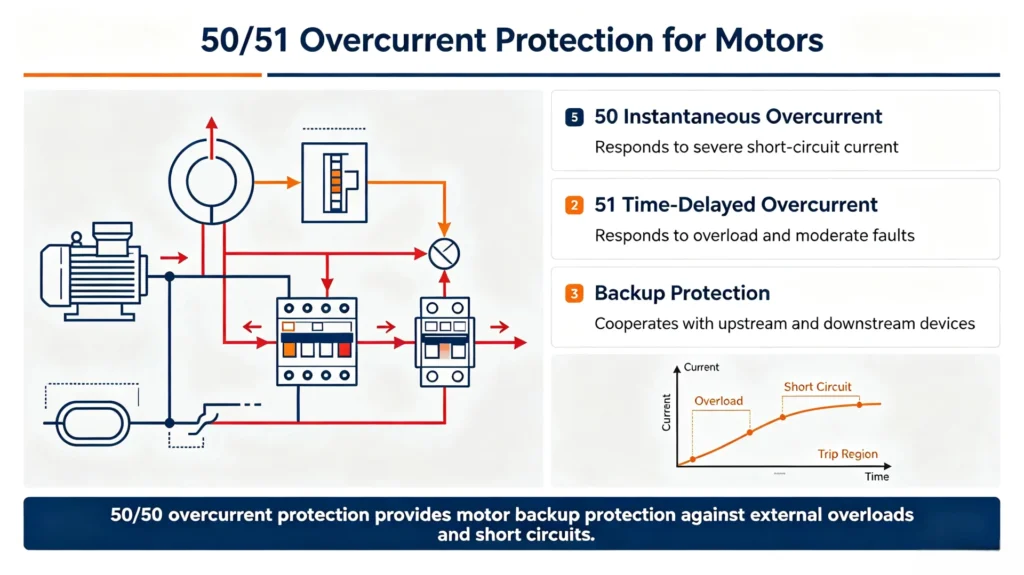
ANSI 50 (instantaneous overcurrent) and ANSI 51 (time-delayed overcurrent) are conventional current-based protection schemes widely used in motor systems. Different from the current comparison logic of 87M, 50/51 protection judges faults solely based on current amplitude and duration.
The relay monitors real-time operating current of the motor. When the current exceeds the preset pickup value:
- ANSI 50: Triggers instantaneous tripping for high-magnitude short-circuit overcurrent
- ANSI 51: Executes delayed tripping following fixed time-current curve (TCC) for mild or sustained overcurrent
Faults Detected by 50/51 Protection
50/51 protection serves as the basic overcurrent and backup protection for motors, with wide coverage but no fixed protection zone:
- Motor overload overcurrent faults
- Locked rotor and motor stalling faults during startup and operation
- Large-current internal short-circuit faults of motors
- External line short-circuit faults of the motor branch
- Backup protection for upper and lower system faults
Core Differences: Motor Differential Protection vs Overcurrent Protection
The essential distinction between 87M and 50/51 lies in protection principle and positioning. It is inappropriate to simply define one as “better” than the other. The two technologies apply to different protection scenarios and form a complementary motor protection system. The detailed comparison is shown in the table below:
| Protection Dimension | 87M Motor Differential Protection | 50/51 Overcurrent Protection |
|---|---|---|
| ANSI Standard Function | 87M (Motor Differential) | 50 (Instantaneous Overcurrent) / 51 (Time Overcurrent) |
| Core Working Principle | Real-time current comparison between motor two ends | Fault judgment based on current magnitude and duration |
| Main Protection Purpose | Selective protection for motor internal faults | Motor overcurrent protection and system backup protection |
| Fault Selectivity | High (fixed differential protection zone) | Low (no independent protection zone) |
| Internal Fault Adaptability | Excellent (detects minor internal winding faults) | Limited (only detects large-current internal faults) |
| External Fault Performance | Stable, no misoperation through external faults | May operate depending on system coordination settings |
| CT Configuration Requirement | Dual-terminal matched CTs required | Single-side current measurement sufficient |
| Cost & Complexity | Higher (strict CT matching and wiring requirements) | Lower (simple configuration and easy commissioning) |
| Typical Application | Medium/high-voltage, large, critical industrial motors | All types of motors, basic and backup protection |
Internal Motor Fault Protection Performance Comparison
87M: Professional Internal Fault Protection Solution
Motor stator winding faults are the most common and destructive hidden dangers of MV/HV motors. 87M protection forms an independent closed protection zone through dual-terminal CT configuration. It can capture tiny current imbalance caused by winding local short circuits, realizing high-sensitivity and selective fault clearing without being affected by load current and system operation conditions.
For large synchronous motors and medium-voltage induction motors in key processes, 87M is the most reliable technical means to avoid motor winding burnout and unplanned shutdowns.
Limitations of 50/51 for Internal Fault Protection
It is a common engineering misunderstanding that “50/51 cannot protect motor internal faults”. In fact, 50/51 can detect internal faults with obvious overcurrent characteristics, but it has inherent technical limitations:
- No zone identification capability: It cannot distinguish whether the fault occurs inside the motor or in the external line
- Low sensitivity: Minor winding short-circuit faults without significant overcurrent cannot be identified
- Restricted clearing speed: Tripping time is affected by system coordination and time-delay settings
Tripping Speed: 87M vs 50/51
Fault clearing speed directly determines the damage degree of motor equipment and the scope of power system impact.
87M Protection Speed: As a dedicated main protection for internal faults, 87M does not need to coordinate with upstream protection devices. It can complete fault judgment and tripping within milliseconds, realizing fast isolation of internal faults and minimizing winding insulation damage.
50/51 Protection Speed: ANSI 50 instantaneous overcurrent acts fast for severe short circuits, but ANSI 51 time overcurrent requires fixed delay settings to meet system coordination requirements. For mild overcurrent and small internal faults, the clearing time is significantly longer than 87M.
Engineering Conclusion: 87M has absolute advantages in high-speed selective clearing of motor internal faults.
Can 87M and 50/51 Be Used Together?
Definite Answer: Yes, and it is the standard optimal configuration for MV/HV critical motors.
87M and 50/51 have no functional overlap or conflict; they undertake main protection and backup protection tasks respectively in the motor protection system, building a layered and comprehensive protection barrier.
Core Role of 87M
Serve as the primary internal fault protection of the motor, responsible for fast and selective isolation of all faults inside the motor differential zone, solving the pain point of low sensitivity of traditional overcurrent protection for internal winding faults.
Core Role of 50/51
Serve as the universal backup protection, covering motor overload, locked rotor, external line faults, and providing backup tripping when 87M protection fails or refuses to operate, ensuring no blind spots in motor protection.
Standard 87M + 50/51 Motor Protection Scheme
The combined protection scheme is widely adopted in power plants, chemical industry, metallurgy and other industrial scenarios with high motor operation reliability requirements. The standard protection logic is as follows:
Motor Equipment → Dual-terminal Matching CTs → 87M Differential Primary Protection → 50/51 Overcurrent Backup Protection → Circuit Breaker Trip Output
In this scheme, 87M precisely targets motor internal faults to avoid equipment burnout, while 50/51 undertakes daily overcurrent protection and system backup protection. The two complement each other to meet IEC and IEEE industrial motor protection standards.
When Is 87M Differential Protection Mandatory?
In engineering design, 87M is not required for all motors, but it is a necessary configuration for the following scenarios summarized by industrial protection design specifications:
- Medium/High-Voltage Large Motors: MV/HV induction motors and synchronous motors with large capacity, whose winding repair and replacement costs are extremely high
- Critical Process Motors: Core equipment such as plant water supply pumps, air compressors, industrial fans, and grinding mills, whose failure will cause full process shutdown
- High-Reliability Scenarios: Power plant auxiliary motors and continuous production industrial motors that require ultra-fast fault clearing and zero misoperation
When Is 50/51 Protection Sufficient?
For low-power, non-critical industrial and civil motors, 50/51 overcurrent protection can fully meet operational protection requirements, with higher cost performance and simpler maintenance:
- Small-capacity low-voltage motors with low equipment value
- Non-critical auxiliary motors that will not affect the overall production process after failure
- Cost-sensitive projects with low protection accuracy requirements
- Scenarios where dual-terminal CT wiring and matching cannot be implemented
Engineering Selection Decision Table: 87M or 50/51
This decision table provides direct and operable selection basis for EPC design engineers and project owners:
| Motor Operation & Project Conditions | Recommended Protection Configuration |
|---|---|
| Small-capacity, non-critical low-voltage motors | 50/51 Overcurrent Protection |
| Conventional medium-voltage general motors | Evaluate 87M configuration according to project budget |
| Large-capacity HV/MV core motors | 87M Differential Protection (Strongly Recommended) |
| Critical process motors requiring zero downtime | 87M + 50/51 Combined Protection |
| Scenarios requiring high internal fault sensitivity | 87M Differential Protection |
| Projects needing system backup protection | 50/51 Overcurrent Protection |
| Cost-limited, low-protection-standard projects | 50/51 Overcurrent Protection |
Click to Read This Article on Motor Protection Relay Selection
Basic Relay Setting Overview
Reasonable parameter setting is the key to ensure the stable operation of motor protection relays. This section introduces core setting items (no redundant detailed values, avoiding content overlap with professional setting documents).
Core Settings for 87M Relay
Differential pickup value, restraint bias coefficient, CT ratio matching, CT saturation compensation, and differential characteristic curve calibration. The core setting principle is to avoid misoperation caused by load current imbalance and ensure sensitivity to minor internal faults.
Core Settings for 50/51 Relay
Overcurrent pickup current, instantaneous overcurrent threshold, time-current curve selection, time delay multiplier, and upstream and downstream protection coordination parameters. The key is to balance protection sensitivity and system coordination stability.
Common Engineering Misunderstandings
Misunderstanding 1: 50/51 Cannot Detect Motor Internal Faults
Fact: 50/51 can identify internal faults with large overcurrent characteristics, but cannot sense minor winding faults and has no fault zone selectivity, so it cannot replace 87M as internal fault main protection.
Misunderstanding 2: 87M Can Replace All Motor Protection Functions
Fact: 87M only targets internal differential zone faults. It cannot cover motor overload, locked rotor, thermal aging, negative sequence and earth faults, which need to be matched with 50/51 and other auxiliary protection functions.
Misunderstanding 3: Ignore CT Matching for 87M
Fact: CT ratio inconsistency, insufficient CT level and wiring errors will directly cause 87M protection misoperation or refusal to operate. Dual-terminal CT parameter matching is a prerequisite for 87M normal operation.
FAQ
Q1: What is the essential difference between 87M and 50/51 motor protection?
87M is a zone-selective internal fault main protection based on dual-terminal current comparison; 50/51 is a universal overcurrent and backup protection based on current magnitude and time characteristics.
Q2: Is 87M better than 50/51 for motor protection?
No absolute superiority. 87M is more professional and sensitive for internal motor faults, while 50/51 is more versatile and cost-effective for conventional overcurrent and backup protection. The selection depends on motor application scenarios.
Q3: Can 50/51 protection cover motor internal faults?
It can cover internal faults that produce obvious overcurrent, but cannot detect minor winding short-circuit faults, and cannot distinguish internal and external fault locations.
Q4: Do industrial motors need both 87M and 50/51 protection?
Large MV/HV and critical process motors require dual configuration; small non-critical motors only need 50/51 protection to meet operational requirements.
Q5: What are the CT requirements for 87M differential protection?
It is necessary to install matched CTs with consistent ratio and precision at both the motor line side and neutral terminal, with strict wiring and saturation performance requirements.
Conclusion
87M motor differential protection and 50/51 overcurrent protection are complementary rather than alternative technologies in industrial motor protection systems. 87M undertakes high-precision and high-speed protection for motor internal winding faults, solving the core pain point of insufficient sensitivity of traditional protection; 50/51 provides basic overcurrent protection and system backup protection to ensure full coverage of motor fault scenarios.
For medium and high-voltage, large-scale, and process-critical motors, the combined 87M + 50/51 protection scheme is the most reliable engineering solution, which can effectively reduce motor equipment damage, avoid unplanned production shutdowns, and improve the overall stability of industrial power systems.
If you are looking for a high-performance 87M motor differential protection relay for your MV/HV motor projects, check our product page for detailed technical parameters, functional features and engineering application cases.
Reference & Technical Sources
- IEEE C37.20-2021: Standard for Motor Protection System Design
- IEC 60255-151:2020: Measuring relays and protection equipment – Differential protection principles
- ANSI/IEEE C37.112-2018: Time-Overcurrent Relay Characteristics
- Industrial Motor Protection Engineering Design Manual (Power Industry Standard)
- IEC 61850: Substation Automation System Protection Specification
About Author

Hello, I'm Leno Zhang. I have 15 years of experience in the power relay protection industry with extensive pre-sales and after-sales project experience. Our company specializes in various complete sets of relay protection and automation equipment. I can assist customers in solving all practical on-site project challenges and provide optimal integrated solutions.
Tell Us Your Requirement
High Quality
Stable performance, reliable design, ensuring safe operation for power system protection and grid stability.
Fast Delivery
Timely delivery to support your urgent orders and project schedules efficiently and professionally at any time.
Best Warranty
Professional Warranty: Reliable after-sales support for stable relay protection and long-term customer satisfaction.