

-
Leon Zhang sales consultant
-
Email: zxl635973785@gmail.com
-
Phone/WhatsApp: +86 13655813266
Motor Differential Protection: Working Principle, 87M Scheme and Applications
Introduction
Motor differential protection is a fast, selective primary protection technology that compares the inbound and outbound currents of a defined motor protection zone to detect internal stator winding faults. Classified as ANSI 87M in standard power system protection nomenclature, it is the most reliable protection solution for medium and large critical industrial motors.
Unlike overcurrent protection (50/51) that responds to system-wide abnormal current, 87M motor differential protection targets only internal motor faults, delivering instantaneous tripping and minimal equipment damage. It is widely adopted in EPC projects, power plants, mining facilities and process industrial systems.
This article systematically explains the motor differential protection principle, standard 87M protection definition, mainstream motor differential protection scheme, detectable fault types, engineering application scenarios, limitations and relay selection guidelines to help power and protection engineers complete accurate scheme design and equipment configuration.
What Is Motor Differential Protection?
What Does Motor Differential Protection Protect?
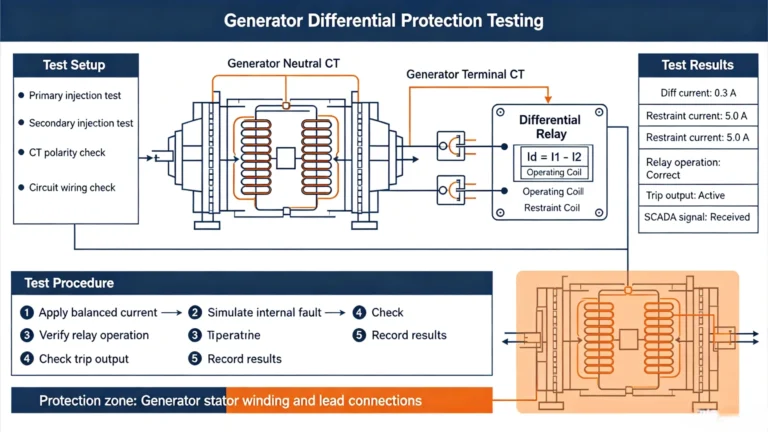
Motor differential protection forms a closed protection zone through line-side CTs and neutral-side CTs installed at the motor inlet and outlet terminals. The core protection scope covers the entire motor stator winding and internal terminal leads within the CT boundary, excluding external cable faults and system-side failures.
It is designed to capture low-magnitude internal winding faults that cannot be identified by conventional overcurrent protection, ensuring precise fault positioning and selective tripping.
What Is ANSI 87M Protection?
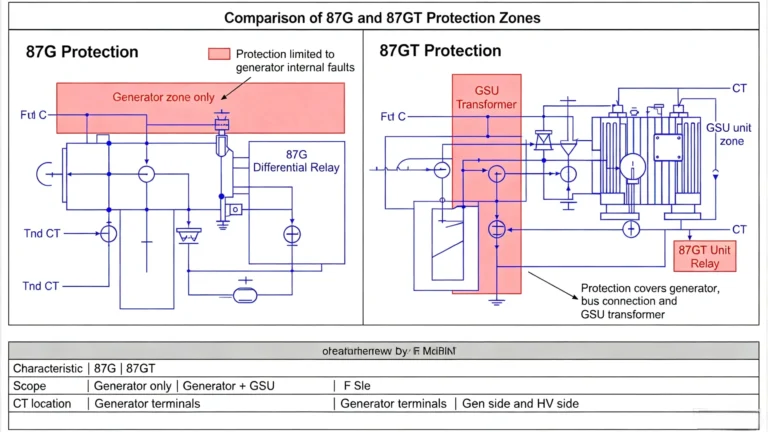
Per IEEE C37.2 standard device numbering, ANSI 87 refers to differential protection, while the suffix M specifically denotes motor differential protection, distinguishing it from 87T (transformer differential) and 87G (generator differential) .
Modern 87M protection relays adopt percentage restrained differential algorithms. They calculate real-time differential current through dual-side CT sampling and implement stable anti-interference protection during motor startup and external system faults, which is the core technical standard of industrial motor primary protection .
Motor Differential Protection Principle
How Does Motor Differential Protection Work?
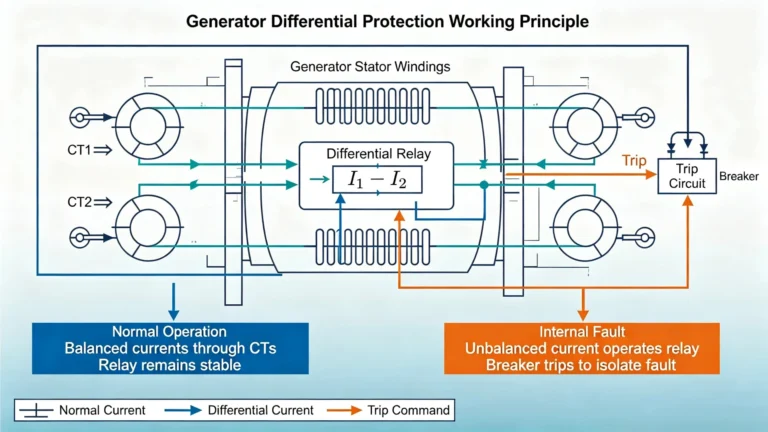
Motor differential protection operates based on Kirchhoff’s Current Law (KCL). In a stable operating state, the total current entering the motor protection zone is equal to the total current leaving the zone .
The core calculation formula is as follows:
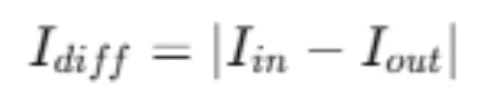
- Normal operation: the relay remains stable without tripping
- Internal motor fault: Stator winding short circuit or grounding breaks the current balance, Idiff rises rapidly and exceeds the protection threshold, triggering trip output
The protection zone is completely defined by CT installation positions, realizing absolute selective protection for internal motor faults .
Differential Current vs Restraining Current
To avoid false tripping caused by CT saturation and through-current during external faults, 87M protection introduces a percentage restraint mechanism, involving two core current parameters:
- Differential Current (Idiff): The unbalanced current generated by internal faults, the action basis of protection
- Restraining Current (Irest): The through-current flowing through the motor zone during normal operation or external faults, used to suppress false action
The percentage restraint characteristic ensures the protection remains locked and stable under external fault impact and large motor startup current, and only acts sensitively on real internal winding faults .
Motor Differential Protection Scheme
Conventional Motor Differential Protection Scheme
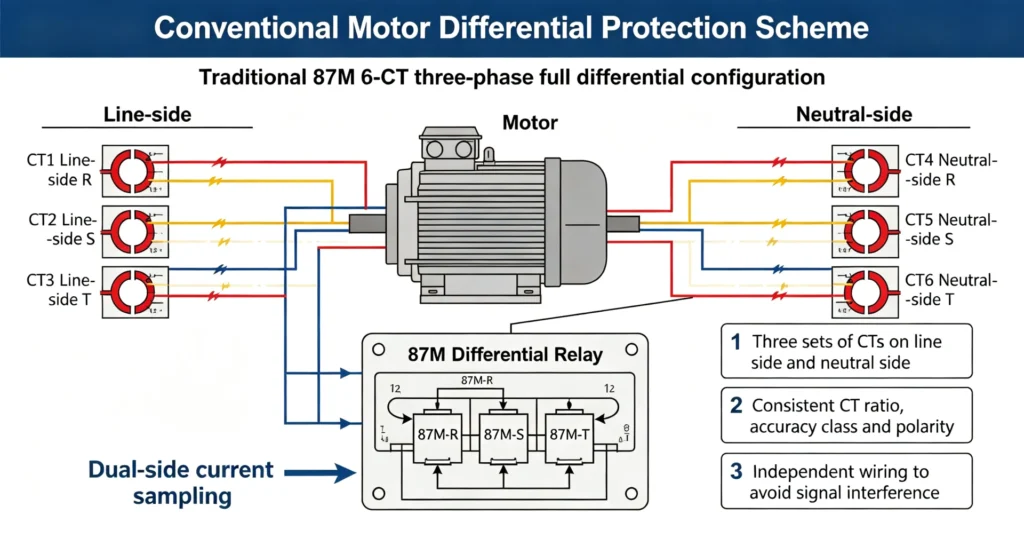
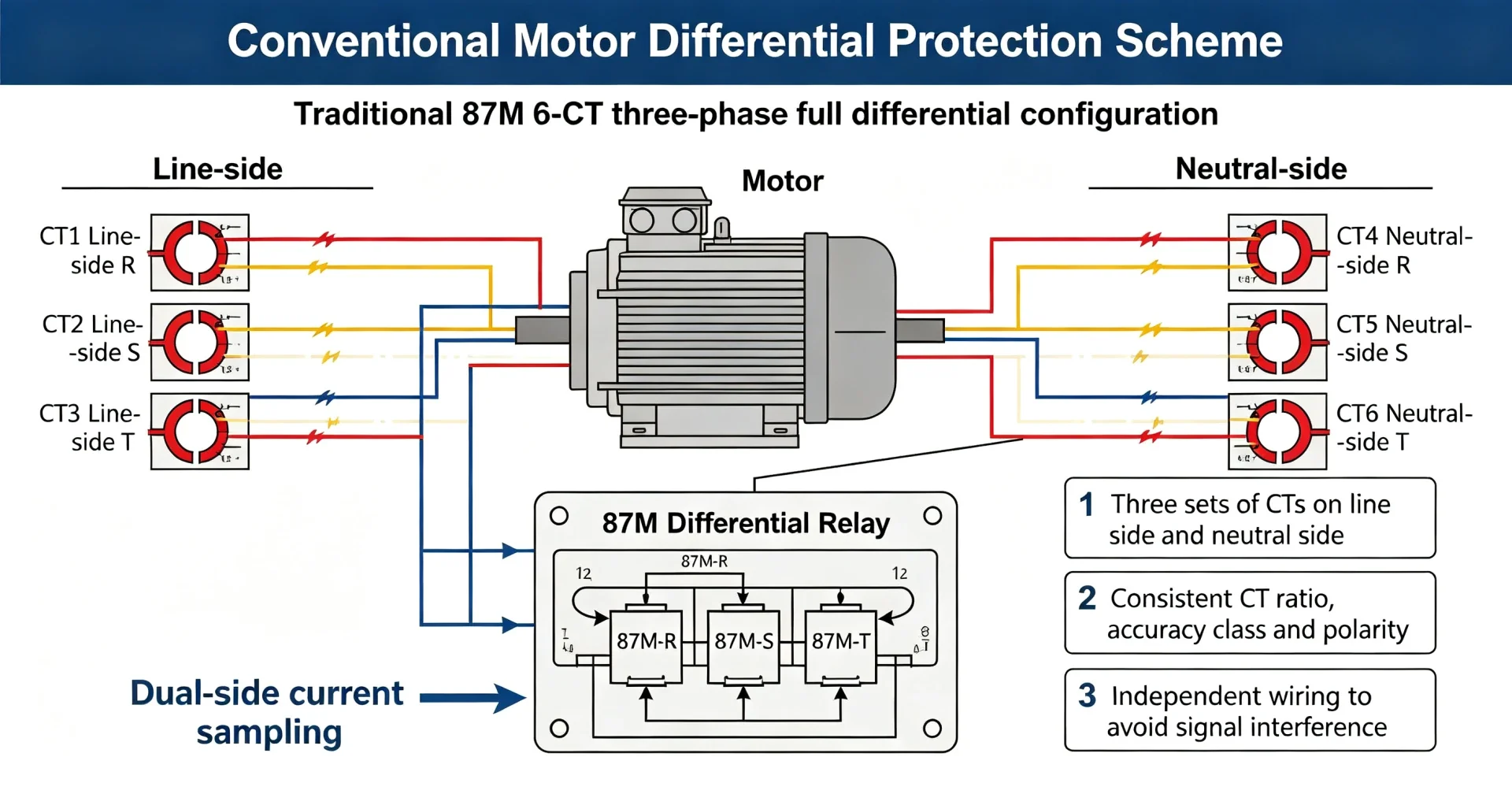
The traditional 87M scheme adopts a 6-CT three-phase full differential configuration, which is the most widely used standard solution for medium and high-voltage motors.
Key configuration requirements:
- Three sets of CTs installed on the line side and neutral side of the motor respectively
- Strict consistency of CT ratio, accuracy level and polarity
- Independent wiring for dual-side current sampling to avoid signal interference
This scheme features high stability and complete phase fault coverage, suitable for most large industrial motor protection scenarios.
Self-Balancing Motor Differential Protection Scheme
The self-balancing differential scheme is an optimized upgrade solution based on magnetic balance principle, simplifying the traditional dual-side CT wiring structure.
Core advantages:
- Simplified on-site wiring, reduced construction cost and wiring failure risks
- Built-in magnetic balance design, no manual ratio matching required
- Strong anti-saturation ability, improved protection stability
It is widely used in compact industrial motor rooms and EPC projects with high requirements for construction efficiency. For detailed technical parameters and application cases, refer to Self-Balancing Differential Protection.
How Does an 87M Relay Identify an Internal Motor Fault?
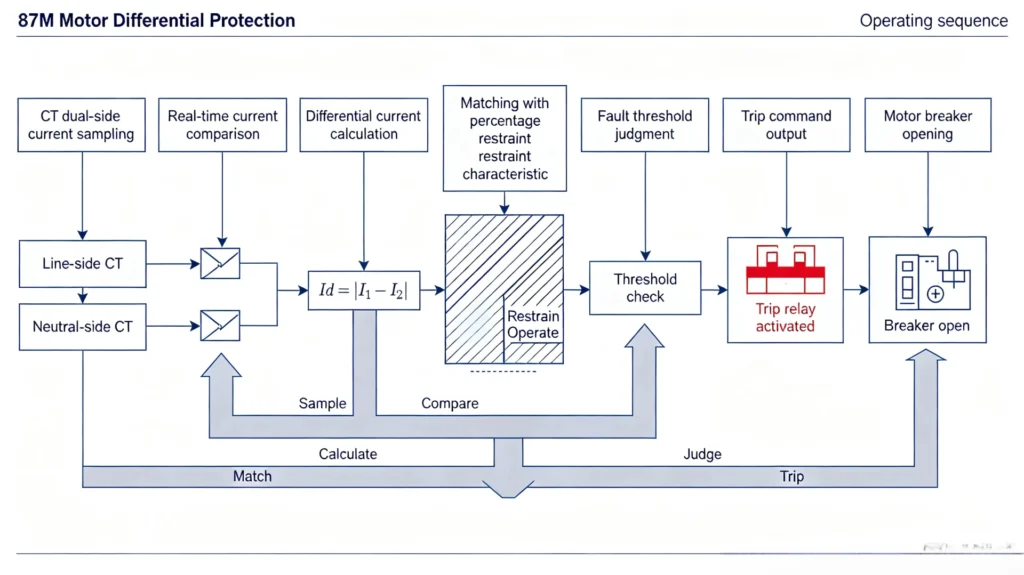
The 87M relay completes fault judgment and action through a standardized closed-loop logic:
CT dual-side current sampling → Real-time current comparison → Differential current calculation → Matching with percentage restraint characteristic → Fault threshold judgment → Trip command output → Motor breaker opening
What Faults Can Motor Differential Protection Detect?
87M protection is a dedicated internal motor fault protection, with clear response characteristics to various motor faults. The detailed performance is shown in the table below:
| Motor Fault Type | 87M Protection Response | Remarks |
|---|---|---|
| Phase-to-phase fault | High-sensitivity instantaneous tripping | Core protected fault |
| Phase-to-ground fault | Conditional response | Depends on system grounding mode and CT configuration |
| Stator winding internal fault | Precise and rapid action | Primary application scenario of 87M |
| Inter-turn fault | Limited detection capability | Affected by fault turn ratio and protection scheme |
| External system fault | Stable locking, no tripping | Guaranteed by percentage restraint |
| CT saturation | Anti-interference operation | Reliable with qualified CT selection |
Key Note: 87M protection is dedicated to internal faults within the CT-defined zone and cannot replace overload, negative sequence and external grounding protection functions .
Why Use 87M Protection for Motors?
Fast Internal Fault Detection
87M differential protection realizes millisecond-level fault tripping, far faster than conventional 50/51 overcurrent protection. It can quickly cut off internal winding short circuits, avoiding winding burnout, insulation breakdown and even motor scrapping caused by long-term fault current impact.
High Sensitivity
It can identify low-magnitude internal faults that are insensitive to overcurrent protection, effectively covering minor winding damage risks in the early stage of faults, and reducing hidden dangers of equipment failure expansion.
Selective Protection
The protection zone is clear and independent. External faults will not trigger mis-tripping, ensuring the continuous and stable operation of other equipment in the system, improving the overall power supply reliability of industrial plants.
Protection for Large and Critical Motors
For medium-voltage, high-voltage and large-power critical motors in process industries, power plants and mining projects, 87M protection is a mandatory primary protection measure to reduce major equipment loss and production shutdown risks.
Motor Differential Protection vs Overcurrent Protection
Most engineering faults occur due to confusion between 87M differential protection and 50/51 overcurrent protection. The two are complementary rather than interchangeable, with clear functional boundaries:
| Protection Function | ANSI Code | Core Function | Protection Zone | Engineering Positioning |
|---|---|---|---|---|
| Motor Differential Protection | 87M | Internal stator winding fault protection | Motor internal CT defined zone | Primary selective protection |
| Overcurrent Protection | 50/51 | System overcurrent and external fault protection | Whole motor branch circuit | Main and backup protection |
| Thermal Overload Protection | 49 | Motor overheating and overload protection | Motor thermal state | Long-term overload protection |
| Earth Fault Protection | 50N/51N | System grounding fault protection | Branch grounding loop | Auxiliary fault protection |
Engineering Conclusion: 87M undertakes precise internal fault protection, while 50/51 and other functions undertake system and thermal protection. The combination forms a complete motor protection system .
When Is Motor Differential Protection Required?
Large Motors
Motors with rated power greater than 200kW are recommended to be equipped with 87M differential protection due to high equipment value and high fault loss risk.
Medium-Voltage and High-Voltage Motors
All 6kV/10kV medium and high-voltage industrial motors must be configured with 87M primary differential protection in accordance with power industry standards.
Critical Process Motors
Motors supporting continuous production processes, including power plant auxiliary motors, water treatment pump motors, industrial compressor motors and mining main drive motors, require 87M protection to avoid production shutdown losses caused by single motor failure.
When May 87M Not Be Necessary?
Small low-voltage motors below 100kW and non-critical standby motors with low operation frequency and negligible fault loss can rely on overcurrent and overload protection alone without configuring 87M differential protection, which optimizes project cost allocation.
CT Requirements for Motor Differential Protection
CT configuration is the key factor determining 87M protection accuracy and stability. Unstandardized CT settings will directly cause protection misoperation or refusal to operate.
CT Configuration
Dual-side CTs must be installed at the motor line side and neutral side respectively to form a closed protection zone, with no missing phase or missing point installation.
CT Ratio and Polarity
Line-side and neutral-side CTs must adopt completely consistent transformation ratio and standard polarity wiring to avoid inherent unbalanced current caused by parameter mismatch.
CT Accuracy and Saturation
Core-level CTs with anti-saturation performance must be selected to ensure accurate current sampling under external fault through-current and motor startup impulse current, preventing protection false tripping .
Motor Differential Protection Operating Example
Normal Operation
The motor runs stably, line-side current and neutral-side current are balanced, differential current is close to zero, and the 87M relay keeps standby without action.
Internal Fault
Stator winding phase-to-phase short circuit occurs inside the motor, current balance is broken, differential current rises above the pickup value, the relay judges an internal fault and immediately trips the motor breaker to isolate the fault.
External Fault
Short circuit occurs on the system line side, large through-current flows through the motor zone, dual-side CT currents remain balanced, the percentage restraint mechanism takes effect, and 87M protection is locked without mis-tripping.
Motor Differential Protection Applications
87M motor differential protection is widely used in high-reliability industrial power scenarios, with typical applications as follows:
| Application Scenario | Core Application Value |
|---|---|
| Power Plant Auxiliary Motors | Protect key auxiliary equipment, ensure stable power generation |
| Water Treatment Pump Motors | Avoid water supply system shutdown caused by motor faults |
| Industrial Compressor Motors | Fast fault clearing, reduce production line shutdown loss |
| Mining Large Drive Motors | Adapt to harsh working conditions, improve equipment operation safety |
| Chemical Process Motors | Ensure continuous and stable operation of continuous production processes |
Limitations and Application Considerations of 87M Protection
CT Installation Dependence
The protection range is completely limited by CT installation positions. Blind areas will exist if CT installation is not standardized, resulting in unprotected local winding faults.
Limited Inter-Turn Fault Detection
For minor inter-turn faults with small turn difference, the unbalanced current is too small to trigger protection, which needs to be matched with negative sequence protection for comprehensive monitoring.
CT Saturation Risk
Extreme external faults may cause CT saturation and generate false differential current, which requires high-quality anti-saturation CTs and reasonable restraint setting matching.
Complementary Protection Required
87M cannot replace overload, negative sequence and external grounding protection. It must be used as a part of the complete motor protection scheme to realize full-condition equipment protection.
87M Protection Functions in a Motor Protection Relay
Modern integrated motor protection relays take 87M differential protection as the core and match multiple auxiliary protection functions to form a full-set protection solution:
- Core: 87M motor differential protection (internal fault primary protection)
- Current protection: 50/51 overcurrent protection, 50N/51N earth fault protection
- Thermal and unbalance protection: 49 thermal overload protection, 46 negative sequence protection
- Working condition protection: 48 motor starting/stalling protection
- Auxiliary protection: 27/59 voltage protection, 81 frequency protection
How to Select a Motor Differential Protection Relay
When selecting an 87M relay for engineering projects, focus on 6 core factors to match actual application scenarios:
Motor Voltage and Rated Current
Select relay models and sampling ranges according to motor voltage level (LV/MV/HV) and rated current to ensure matching sampling accuracy.
Motor Power and Criticality
Large power and critical process motors need high-precision percentage restraint differential relays; non-critical equipment can adopt conventional economical models.
CT Configuration Conditions
Select conventional differential or self-balancing differential relays according to on-site CT wiring conditions and installation space.
Required Protection Functions
Select integrated relays with matching protection combinations according to project protection design specifications to meet full-scenario protection requirements.
Communication and Integration
Support standard industrial communication protocols to realize seamless docking with SCADA and power monitoring systems for remote monitoring and fault recording.
Protection Setting and Coordination
The relay shall support flexible parameter setting and stage coordination to match system protection grading and avoid protection misoperation and refusal to operate.
For medium and high-voltage critical motor protection projects requiring stable and reliable 87M differential protection, please check our Motor Differential Protection Relay for detailed function configuration and engineering application parameters.
Motor Differential Protection FAQ
1. What is motor differential protection?
Motor differential protection (ANSI 87M) is a primary selective protection that judges internal motor faults by comparing the current difference between the line side and neutral side of the motor, featuring fast action and high sensitivity.
2. What is ANSI 87M protection?
ANSI 87M is the standard device number for motor differential protection defined by IEEE C37.2, dedicated to internal stator winding fault protection of industrial motors .
3. How does motor differential protection work?
Based on Kirchhoff’s Current Law, it samples dual-side CT currents in real time, calculates differential current, and triggers tripping when the internal fault causes the current difference to exceed the threshold, while remaining stable during external faults .
4. What is a motor differential protection scheme?
It is a standardized protection configuration scheme including CT installation, wiring mode and relay algorithm, mainly divided into conventional 6-CT differential scheme and optimized self-balancing differential scheme.
5. What faults does 87M protection detect?
87M mainly detects internal stator winding phase-to-phase faults, grounding faults and winding short-circuit faults within the protection zone, with limited detection capability for minor inter-turn faults.
6. Do all motors need differential protection?
No. Medium and high-voltage, large-power and critical process motors must be equipped with 87M protection; small low-voltage non-critical motors can rely on overcurrent protection to meet requirements.
Conclusion
Motor differential protection (ANSI 87M) is the most reliable primary protection technology for internal faults of medium and large industrial motors. It realizes fast and selective fault isolation through real-time comparison of dual-side CT currents and percentage restraint algorithm, making up for the insensitivity of traditional overcurrent protection to internal winding faults.
As a dedicated protection scheme for critical motor equipment, 87M protection is not a standalone protection function but needs to be coordinated with overcurrent, thermal overload and negative sequence protection to form a complete motor protection system. It is a standard configuration for EPC projects, power plants, mining and process industrial power systems.
If you are selecting a professional 87M differential protection solution for medium and high-voltage motor projects, refer to our 87M Motor Differential Protection Relay for professional configuration and engineering technical support.
Technical References & Data Sources
- IEEE C37.2-2008, Standard for Electrical Power System Device Function Numbers, Acronyms, and Contact Designations
- IEC 60255-187-1:2021, Measuring relays and protection equipment – Functional requirements for differential protection
- GB/T 14598.187-202X, Functional Requirements for Differential Protection of Relays and Protection Devices
- IEEE Technology Navigator, Relay Protection Technical Specification
- Siemens Siprotec 7UM62 Professional Relay Operation Manual
- Industrial Power System Motor Protection Engineering Design Specification
About Author

Hello, I'm Leno Zhang. I have 15 years of experience in the power relay protection industry with extensive pre-sales and after-sales project experience. Our company specializes in various complete sets of relay protection and automation equipment. I can assist customers in solving all practical on-site project challenges and provide optimal integrated solutions.
Tell Us Your Requirement
High Quality
Stable performance, reliable design, ensuring safe operation for power system protection and grid stability.
Fast Delivery
Timely delivery to support your urgent orders and project schedules efficiently and professionally at any time.
Best Warranty
Professional Warranty: Reliable after-sales support for stable relay protection and long-term customer satisfaction.