

-
Leon Zhang sales consultant
-
Email: zxl635973785@gmail.com
-
Phone/WhatsApp: +86 13655813266
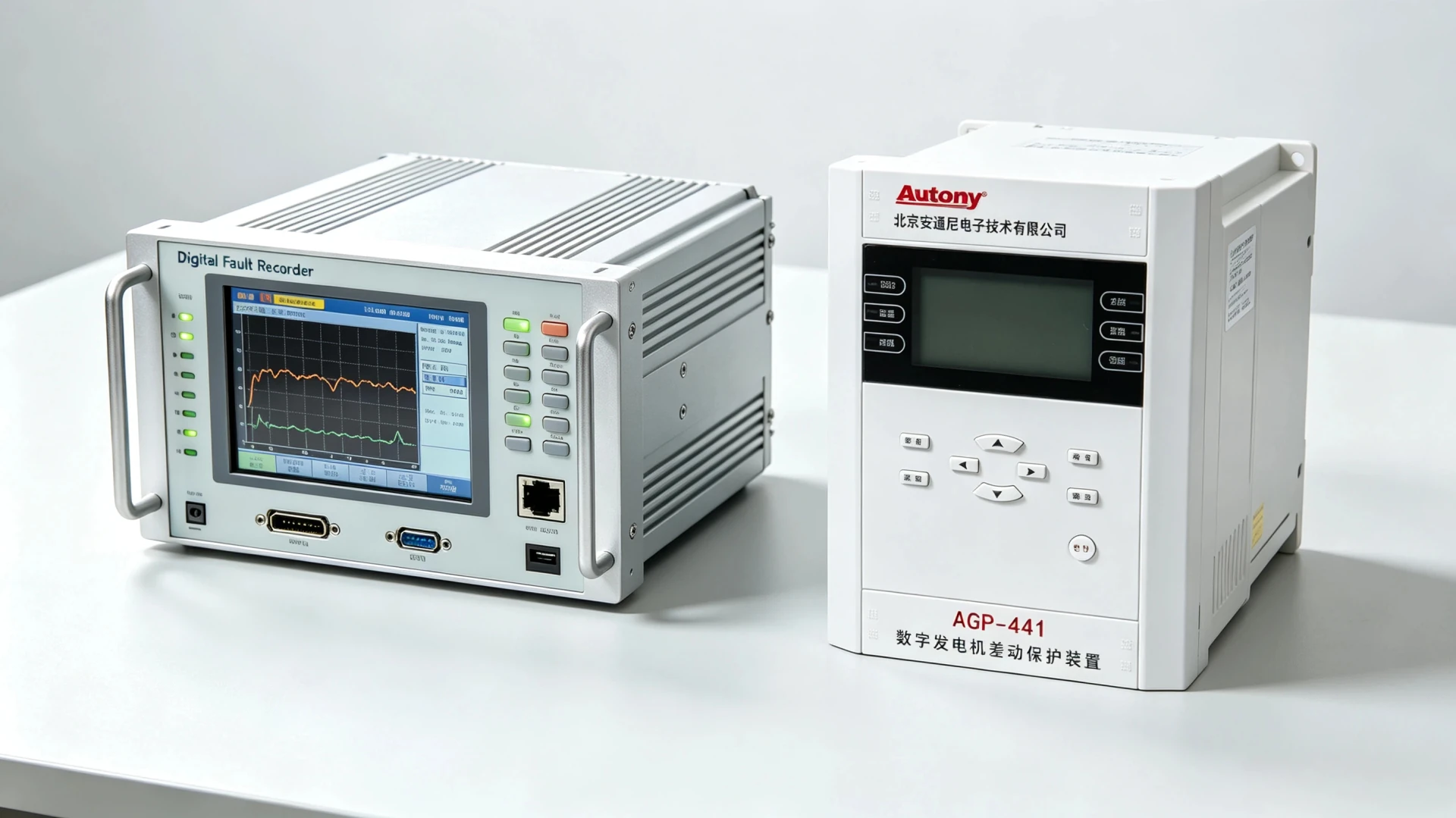
Digital Fault Recorder vs Protection Relay: What Is the Difference?
Introduction
Digital Fault Recorders (DFRs) and protection relays are core monitoring and control devices for modern power systems. Both continuously track grid operating status and respond to electrical abnormalities, yet they feature fundamentally different core positioning, working logic, and application values.
A protection relay is a protective execution device that identifies grid faults in real time and triggers circuit breaker tripping to isolate faulty equipment and prevent system damage. A DFR is a professional data recording and analysis device that captures complete pre-fault, in-fault, and post-fault waveform data and event records, focusing on fault reproduction, root cause analysis, and protection performance verification rather than active grid protection .
Power system engineers, EPC contractors, and substation operators often face confusion: whether protection relays can replace DFRs, whether DFRs have protective functions, and why large and medium-sized substations need both devices simultaneously. This article conducts a comprehensive comparison of DFRs and protection relays from multiple dimensions including core functions, working mechanisms, data recording capabilities, fault response logic, and application scenarios, providing clear technical basis and selection guidance for engineering design and project implementation.
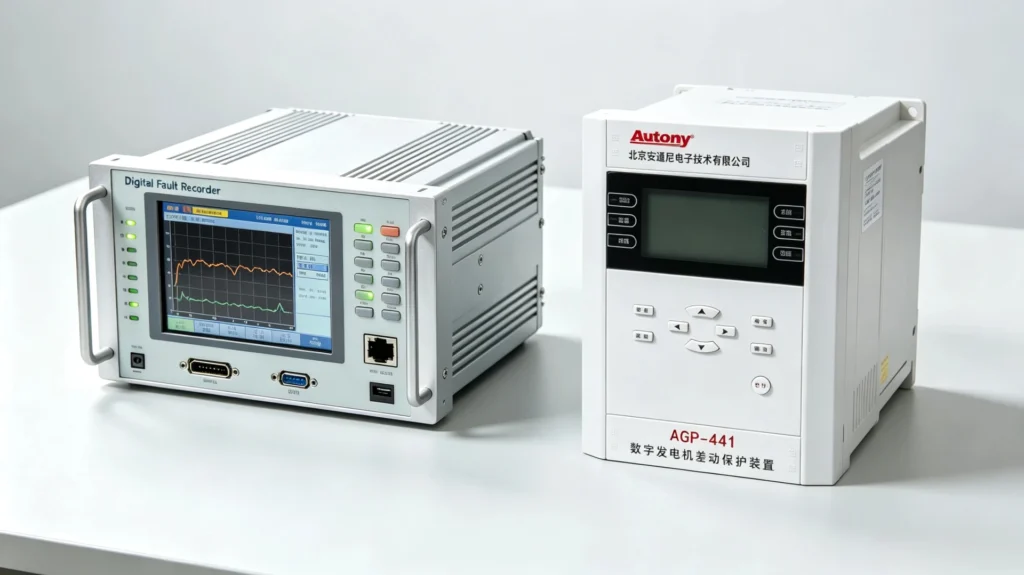
Digital Fault Recorder vs Protection Relay at a Glance
The following core comparison table intuitively presents the key differences between DFRs and protection relays, covering core indicators concerned by engineering practitioners, which helps quickly clarify device positioning and functional boundaries:
What Is a Digital Fault Recorder?
Main Purpose of a DFR
Defined by IEEE C37.2 standard, a Digital Fault Recorder (DFR) is a dedicated power system disturbance monitoring device designed for full-cycle recording of grid abnormal events. Its core positioning is recording and reproducing faults, not intervening in grid operation.
In practical substation sites, the device is mostly deployed in the form of complete fault recorder panel.
DFRs operate based on cyclic buffering and trigger detection mechanisms, continuously sampling and storing grid operating data in real time. Once detecting electrical abnormalities such as overcurrent, voltage fluctuation, or frequency deviation, the device locks the pre-fault, in-fault, and post-fault full-process data to avoid data loss. It mainly records the following core signals:
- Multi-channel voltage and current transient waveforms
- Grid frequency and phase change data
- Circuit breaker opening/closing status signals
- Protection device trip and alarm signals
- Other analog and digital auxiliary signals of the power system
All recorded data complies with IEEE C37.111 COMTRADE standard, supporting unified data exchange and professional waveform analysis by mainstream grid analysis software .
What Is a Protection Relay?
Main Purpose of a Protection Relay
A protection relay is the core safety protection device of the power system, compliant with IEEE C37 series protection standards . Its core positioning is real-time judgment and active protection, with the fundamental goal of isolating faulty equipment within milliseconds to prevent fault expansion and protect personnel and equipment safety.
Modern digital protection relays integrate multiple protection logics and can automatically identify various grid faults. Common core protection functions include overcurrent protection, earth fault protection, differential protection, distance protection, over/under voltage protection, over/under frequency protection, and reverse power protection, covering the protection requirements of generators, transformers, transmission lines, and other equipment .
Different from DFRs, protection relays focus on action execution efficiency. After verifying that the fault meets the protection threshold, they immediately output trip commands to drive the circuit breaker to operate, with no need to retain massive high-precision waveform data.
Digital Fault Recorder vs Protection Relay: How Do Their Functions Differ?
Protection Relay Detects and Acts
The working logic of a protection relay is a closed-loop execution process of Measurement → Judgment → Logic Operation → Action.
During grid operation, the relay collects real-time current and voltage data through CT/PT, compares the monitored electrical parameters with the preset protection threshold, and triggers corresponding protection actions once abnormal conditions are confirmed. For example, a feeder protection relay will instantly identify excessive fault current, verify the fault zone through internal logic, and send a trip command to the circuit breaker to cut off the faulty line, limiting the fault impact range in the shortest time.
The core advantage of protection relays is high-speed response and accurate isolation, which is the key guarantee for power system safe operation.
DFR Records and Preserves the Event
The working logic of a DFR is a full-cycle data retention process of Real-time Monitoring → Trigger Activation → Data Capture → Long-term Storage → Post-analysis.
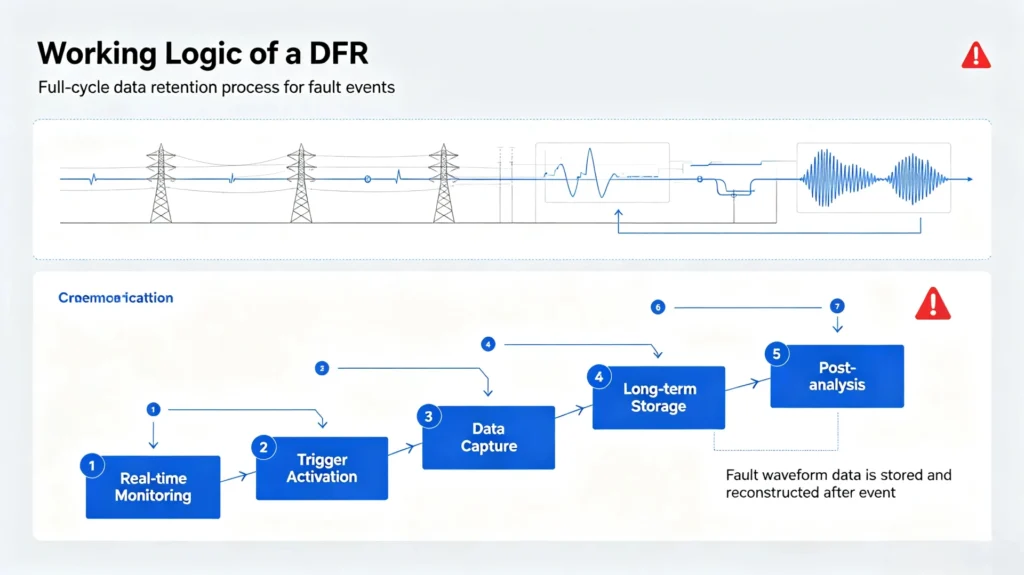
DFRs do not participate in grid protection and will not issue any trip commands. It continuously buffers full-precision grid data in a cyclic manner during normal operation. When a grid fault triggers the recording condition, the device locks the complete data of the pre-fault steady state, fault transient process, and post-fault system recovery process.
Its core value lies in fault reproduction and cause tracing. After the fault is cleared, engineers can rely on DFR’s high-precision waveform data to analyze fault types, fault occurrence time, protection action rationality, and grid disturbance characteristics, providing basis for system optimization and fault prevention.
Can a Protection Relay Record Faults?
Yes. Most modern digital protection relays are equipped with built-in fault recording functions, supporting basic event recording, trip log recording, and simple oscillography . However, the recording capability of protection relays is essentially different from dedicated DFRs and cannot replace professional disturbance recording equipment.
Protection Relay Fault Recording
The built-in recording function of relays is auxiliary, mainly serving their own protection logic verification. It only records key fault parameters and action logs, with limited sampling channels, short effective recording time, and low waveform precision. It is only suitable for simple fault event review and basic on-site troubleshooting.
Dedicated DFR Recording
As a professional disturbance monitoring device, DFRs have exclusive advantages in full-scene recording: more synchronous sampling channels, longer pre/post-fault recording duration, higher sampling accuracy, support for multi-device signal synchronous acquisition, and complete system-wide disturbance data correlation analysis. It can meet the detailed fault investigation and grid performance evaluation requirements of large substations and complex power systems.
DFR vs Protection Relay: What Data Do They Record?
There are obvious differences in data recording range and precision between the two devices. The following table details the recording capability differences of core grid operating data:
| Recording Data Type | DFR | Protection Relay |
|---|---|---|
| Current Waveform | Complete high-precision transient waveform | Available, model-dependent with limited precision |
| Voltage Waveform | Full-process continuous recording | Available, model-dependent with partial missing data |
| Frequency Data | High-resolution real-time tracking | Basic frequency value recording, no transient change details |
| Breaker Status Signal | Full-time synchronous recording | Only record action events, no continuous status monitoring |
| Protection Trip Signal | Synchronous recording of internal and external trip signals | Only record self-generated trip events |
| Multi-device Associated Signals | Strong, supports system-wide multi-point signal correlation | Weak, only limited to its own protection zone signals |
| Pre-fault & Post-fault Waveform | Standard full-cycle recording | Partial models support, incomplete data |
DFR vs Protection Relay: What Happens During a Fault?
The two devices form a complete fault handling closed loop in actual grid operation, with clear division of labor and complementary functions. The following takes a transmission line short-circuit fault as an example to sort out the collaborative working process:
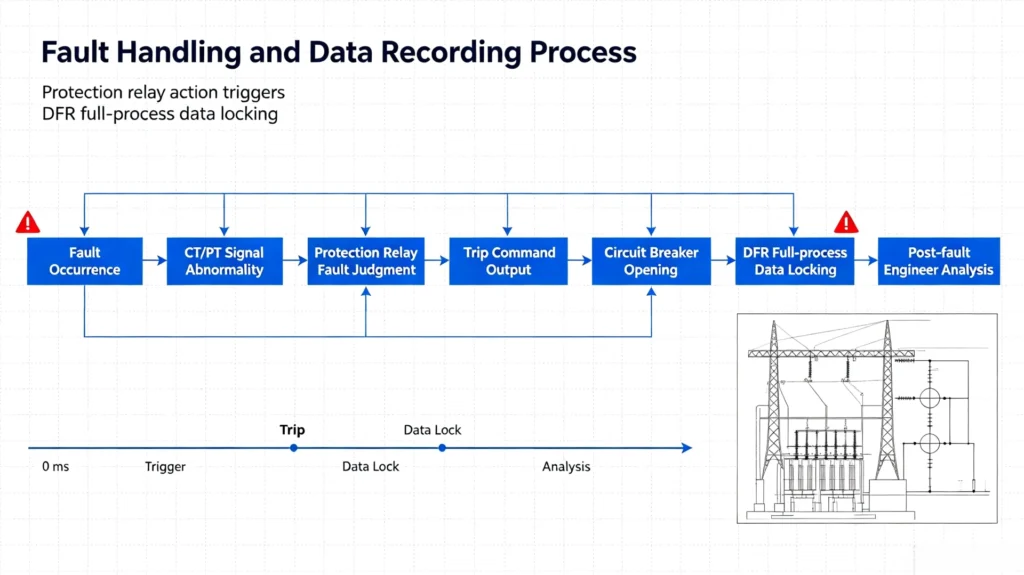
Fault Occurrence → CT/PT Signal Abnormality → Protection Relay Fault Judgment → Trip Command Output → Circuit Breaker Opening → DFR Full-process Data Locking → Post-fault Engineer Analysis
In this process, the protection relay undertakes the “rescue” role: it quickly identifies the fault and cuts off the faulty line to prevent equipment burnout and grid collapse. The DFR undertakes the “recorder” role: it faithfully records all data changes throughout the fault process, retaining complete technical clues for subsequent fault cause analysis, protection action verification, and system optimization.
Can a DFR Replace a Protection Relay?
No, DFRs cannot replace protection relays in any power system scenario.
DFRs have no protection logic judgment and trip execution functions. They can only passively record data and cannot actively respond to grid faults. Without protection relays, faults cannot be isolated in time, which will lead to fault expansion, damage to power equipment, and even large-scale grid outages.
The core responsibilities of the two devices are completely independent: protection relays ensure the safety and stability of real-time grid operation, while DFRs ensure the traceability and analyzability of post-fault events.
Can a Protection Relay Replace a DFR?
Only applicable to small-scale simple power systems; not recommended for medium and large substations and transmission systems.
For small industrial power systems, single protection zone projects, and scenarios with low fault analysis requirements, modern high-end protection relays with complete recording functions can meet basic event recording needs and temporarily replace independent DFRs.
However, in professional power engineering scenarios, relay recording functions have obvious limitations and cannot replace dedicated DFRs. The scenarios where DFRs are mandatory include: large and medium-sized substations, thermal power/renewable energy power plants, long-distance transmission systems, and power systems with complex protection schemes and multi-device collaborative operation.
When Should You Use a Digital Fault Recorder?
DFRs are standard professional equipment for high-standard power system operation and maintenance, suitable for scenarios requiring precise fault tracing and system performance evaluation:
Large and Medium-Sized Substations
Substations have numerous feeders, transformers, and protection devices with complex signal correlations. DFRs support multi-channel synchronous recording, which can accurately capture the linkage state of each device during faults and solve the problem of difficult positioning of complex disturbance faults.
Learn more about substation fault recorder panel, click here for details
Power Generation Plants
Power plant equipment such as generators, transformers, and busbars has high operation safety requirements. DFRs record the full-process operating state of generating units and auxiliary systems, which is conducive to analyzing fault propagation paths and verifying the rationality of unit protection settings.
Transmission Systems
Long-distance transmission lines are prone to external faults and transient disturbances. DFRs accurately record line fault waveforms, breaker action time, and fault clearing duration, providing accurate data support for line fault location and transmission system stability optimization.
Complex Industrial Power Systems
Key industrial power systems have high requirements for power quality and fault traceability. DFRs can record voltage flicker, frequency fluctuation, and transient disturbance data, assisting enterprises in troubleshooting power quality problems and reducing production losses caused by grid abnormalities.
When Is a Protection Relay Enough?
For simple power system projects with single functional requirements and low disturbance analysis standards, the built-in recording function of protection relays can fully meet project needs, and independent DFR deployment is not required:
- Small single protection zone power distribution systems
- Medium and small industrial power systems with few electrical devices and simple grid structures
- Projects that only need basic fault event records without high-precision waveform analysis requirements
- On-site scenarios where post-fault analysis frequency is low and operation and maintenance requirements are simple
The core selection principle is: the complexity of system disturbance analysis requirements determines whether a dedicated DFR is needed.
Why Are DFRs and Protection Relays Often Used Together?
In standard substation and power plant engineering, DFRs and protection relays are deployed in a collaborative manner, forming a perfect closed loop of real-time protection + full-cycle recording + post-event optimization, which is the industry-standard power system configuration scheme.
In actual operation, CT/PT collects grid analog signals and transmits them to protection relays and DFRs simultaneously. The protection relay completes real-time fault judgment and trip isolation to ensure system safety; the DFR synchronously records all protection action signals, breaker status, and grid waveform data throughout the whole process.
The collaborative value of the two is irreplaceable: protection relays solve the immediate safety problem of faults, while DFRs solve the long-term optimization problem of fault recurrence. Through data analysis, engineers can verify protection coordination performance, optimize protection setting values, and eliminate potential hidden dangers of grid operation.
DFR vs Protection Relay: Which One Do You Need?
The following decision guide helps engineers quickly select equipment according to project functional requirements:
| Project Functional Requirement | Recommended Equipment |
|---|---|
| Real-time fault detection and circuit breaker tripping protection | Protection Relay |
| High-precision fault waveform recording and disturbance playback | DFR |
| Multi-channel system-wide disturbance synchronous recording | DFR |
| Basic fault protection + simple event recording | Protection Relay |
| Professional post-fault root cause analysis and protection performance evaluation | DFR |
| Grid safety protection + full-cycle fault data traceability | Both DFR & Protection Relay |
Core selection conclusion: If the core demand is power system safety protection, configure a protection relay; if the core demand is fault analysis and grid operation optimization, configure a DFR; for all critical power infrastructure projects, dual-device collaborative configuration is the most reliable solution.
FAQ
1. What is the core difference between a DFR and a protection relay?
The core difference lies in functional positioning. Protection relays focus on active fault detection and isolation to ensure real-time system safety; DFRs focus on passive full-process data recording and post-fault analysis to support grid operation optimization.
2. Is a DFR a type of protection relay?
No. DFRs and protection relays are two independent power devices with different IEEE standard definitions, functional mechanisms, and application scenarios. DFRs belong to disturbance monitoring equipment, while protection relays belong to system protection control equipment .
3. Can a protection relay record complete fault waveforms?
Most modern relays support basic waveform recording, but the recording channel quantity, sampling precision, and pre/post-fault recording duration are limited, which cannot meet the detailed analysis requirements of complex grid disturbances.
4. Can a DFR trip a circuit breaker?
No. DFRs have no protection logic and trip output circuits, and cannot control circuit breakers to act. They only undertake data recording tasks.
5. Is it necessary to install a DFR if the project is equipped with protection relays?
It is necessary for large substations, power plants and transmission projects; optional for small simple power distribution projects. DFRs make up for the insufficient recording capability of relays and provide professional data support for fault analysis.
6. What is protection relay fault recording?
It refers to the built-in auxiliary recording function of digital protection relays, which records fault time, fault type, protection action sequence and simple waveform data, used for basic on-site fault troubleshooting.
7. Why do power plants and substations need both devices?
The two devices are complementary and non-substitutable. Relays ensure real-time safety protection of the grid, and DFRs retain complete fault data, helping engineers summarize operation experience and optimize system protection strategies.
Conclusion
Digital Fault Recorders and protection relays are indispensable core devices of modern power systems, with clear functional boundaries and complementary advantages. A protection relay is the “safety guard” of the power system, responsible for rapid fault isolation and equipment protection; a DFR is the “system analyst”, responsible for full-cycle fault data recording, event reproduction and operation optimization.
There is no absolute substitution relationship between the two devices. Small and simple power systems can rely on the built-in recording function of protection relays to meet basic operation and maintenance needs, while medium and large-scale power infrastructure must adopt a collaborative configuration of DFRs and protection relays to realize the closed-loop management of fault protection, data recording, cause analysis, and system optimization, ensuring the long-term stable and safe operation of the power grid.
Technical Reference Sources
- IEEE C37.2-2022, IEEE Standard for Electrical Power System Device Function Numbers, Acronyms, and Contact Designations
- IEEE C37.111, IEEE Standard Common Format for Transient Data Exchange (COMTRADE) for Power Systems
- IEEE C37.90.1-2024, Standard for Surge Withstand Capability (SWC) Tests for Protective Relays and Relay Systems
- IEEE C37.95-2026, IEEE Guide for Protective Relaying of Utility-Consumer Interconnections
- IEEE PES PSRC Technical Report, Terms Used by Power System Protection Engineers
- IEC 61850-7-4, Communication Networks and Systems for Power Utility Automation
About Author

Hello, I'm Leno Zhang. I have 15 years of experience in the power relay protection industry with extensive pre-sales and after-sales project experience. Our company specializes in various complete sets of relay protection and automation equipment. I can assist customers in solving all practical on-site project challenges and provide optimal integrated solutions.
Tell Us Your Requirement
High Quality
Stable performance, reliable design, ensuring safe operation for power system protection and grid stability.
Fast Delivery
Timely delivery to support your urgent orders and project schedules efficiently and professionally at any time.
Best Warranty
Professional Warranty: Reliable after-sales support for stable relay protection and long-term customer satisfaction.