

-
Leon Zhang sales consultant
-
Email: zxl635973785@gmail.com
-
Phone/WhatsApp: +86 13655813266
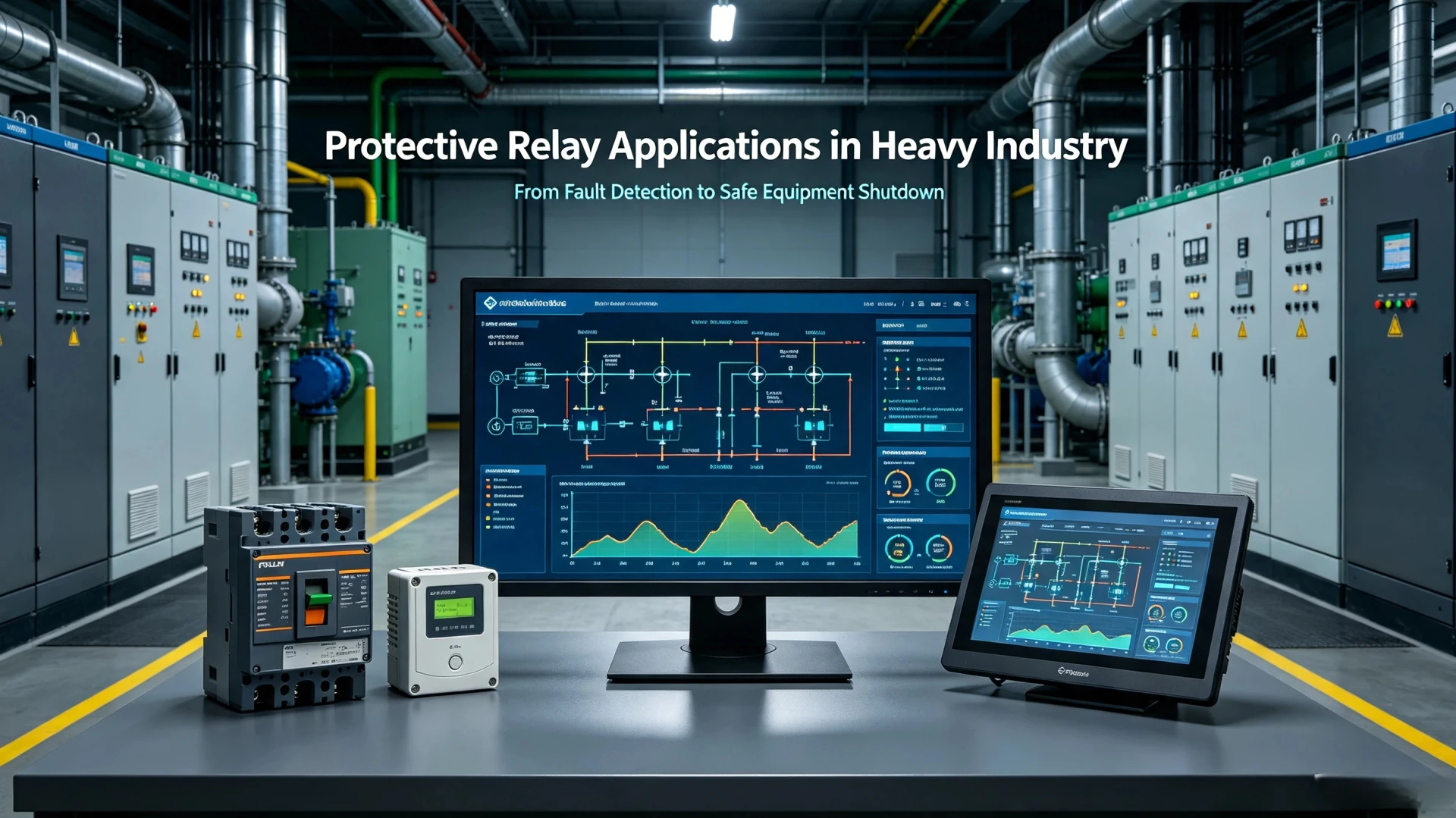
Protective Relays in Heavy Industry Applications: Mitigate Electrical Fault Risks for Continuous Production
Why Protective Relays Matter in Heavy Industry
Protective relays in heavy industry applications serve as the core safety and stability guarantee for high-power electrical systems in mining, oil and gas, steel, cement, chemical, and large-scale manufacturing plants. Unlike commercial and light industrial power systems, heavy industry electrical infrastructure features high voltage, large load current, high short-circuit capacity, and continuous 24/7 operation. A single unisolated electrical fault can lead to equipment burnout, production shutdowns, arc flash accidents, and even personnel casualties.
Heavy industrial power systems frequently face predictable electrical risks, including short circuits, overcurrent and overload, ground faults, motor stall failures, voltage and frequency deviations, and transformer/generator internal faults. High-quality protective relays detect abnormal electrical signals in milliseconds, trigger selective tripping, isolate faulty equipment, and retain normal operation of healthy circuits. This effectively minimizes equipment damage, cuts unplanned downtime costs, and complies with global industrial electrical safety specifications.
What is Protective Relay in power system?
A protective relay is a core sensing and control device for power system protection. Its basic function is to monitor real-time electrical parameters (current, voltage, frequency, phase sequence) of power equipment, identify abnormal and fault states, and output trip or alarm signals to circuit breakers and industrial control systems.
Many EPC engineers and on-site project teams confuse protective relays with circuit breakers. The two devices work collaboratively but undertake distinct roles: protective relays judge faults and issue commands, while circuit breakers execute current interruption.
In standard industrial protection schemes, protective relays work with Current Transformers (CTs) and Voltage Transformers (VTs) to collect real-time system data, then interact with breakers and SCADA systems to form a closed-loop protection system.
Three generations of protective relays are widely used in heavy industry:
- Electromechanical relays: Mature, low-cost, suitable for simple low-end industrial distribution systems
- Static relays: Solid-state design, improved anti-interference performance, no mechanical wear
- Numerical relays: Intelligent multi-functional devices with fault recording, oscillography, remote communication, and self-diagnosis functions, becoming the mainstream for modern heavy industrial projects
Why Heavy Industry Needs Professional Electrical Protection
1. High-Power Core Electrical Equipment
Heavy industry relies on large-scale power equipment including high-power industrial motors, distribution and power transformers, synchronous generators, medium and high-voltage switchgear, and industrial substations. These devices carry system-level loads; unprotected faults will trigger cascading failures across the entire plant power grid.
2. Extreme Short-Circuit Fault Risks
Industrial substations and high-power equipment generate extremely high short-circuit fault currents during failures. Uncontrolled fault currents cause severe arc flash, burn switchgear contacts, damage winding insulation, and expand fault scope. Fast-acting protective relays ensure instantaneous fault isolation to reduce equipment loss and safety hazards.
3. Zero-Tolerance for Unplanned Shutdowns
Heavy industrial production is continuous and process-bound. Unplanned power outages lead to batch product scrapping, production line restart costs, and delayed project delivery. Scientific protection coordination ensures only faulty branches trip, maximizing power system availability and production continuity.
4. Harsh On-Site Operating Environments
Industrial sites feature heavy dust, mechanical vibration, high temperature and humidity, corrosive gas, and strong electromagnetic interference from frequency converters and high-power equipment. Ordinary civil protection devices are prone to nuisance tripping or failure. Industrial-grade protective relays pass strict EMC and environmental adaptation tests to ensure long-term stable operation.
Common Types of Protective Relays Used in Heavy Industry
The industry universally adopts ANSI standard function codes to define relay protection functions, facilitating unified design, debugging, and operation for EPC projects worldwide. Below are the mainstream protective relay types for heavy‑industrial scenarios:
| Relay Type | ANSI Function | Typical Industrial Application |
|---|---|---|
| Overcurrent Relay | 50/51 | Medium/high-voltage feeders, large motors, distribution transformers |
| Earth Fault Relay | 50N/51N | System ground fault protection for all industrial power loops |
| Differential Protection Relay | 87 | Key protection for main transformers, generators, large industrial motors |
| Motor Protection Relay | 49, 46, 48, 50/51 | Integrated protection for process-driven large motors |
| Under/Overvoltage Relay | 27/59 | Busbar, feeder, and motor voltage anomaly protection |
| Under/Overfrequency Relay | 81U/81O | Island operation and grid-connected industrial power systems |
| Reverse Power Relay | 32 | Prevent generator reverse power feeding and unit damage |
| Distance Relay | 21 | Long-distance industrial transmission line fault protection |
| Thermal Overload Relay | 49 | Thermal accumulation protection for motors and transformers |
| Phase Sequence Relay | 47 | Prevent three-phase motor reverse rotation and equipment failure |
| Negative Sequence Relay | 46 | Motor and generator phase loss and unbalanced load protection |
Protective Relay Applications in Heavy Industry
1. Industrial Large Motors
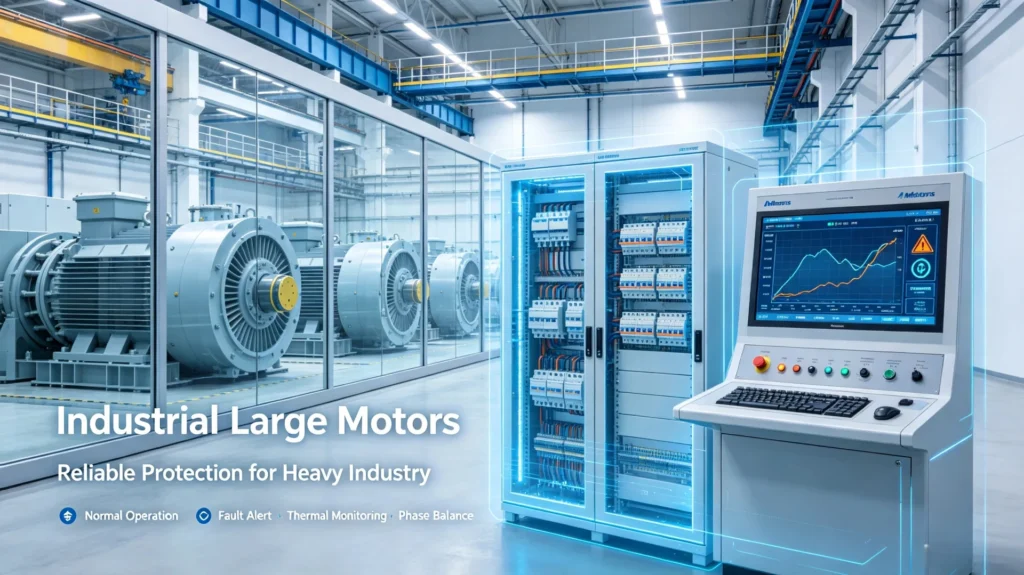
Motors are the most widely used core equipment in heavy industry, facing frequent starting impact, load fluctuation, and harsh operating conditions. Professional motor protection relays provide full-scenario protection including overload, short circuit, locked-rotor, phase loss, negative sequence unbalance, and thermal overheating. This protection scheme is standard for steel mills, cement plants, mining sites, oil and gas facilities, and chemical processing plants.
2. Industrial Transformers
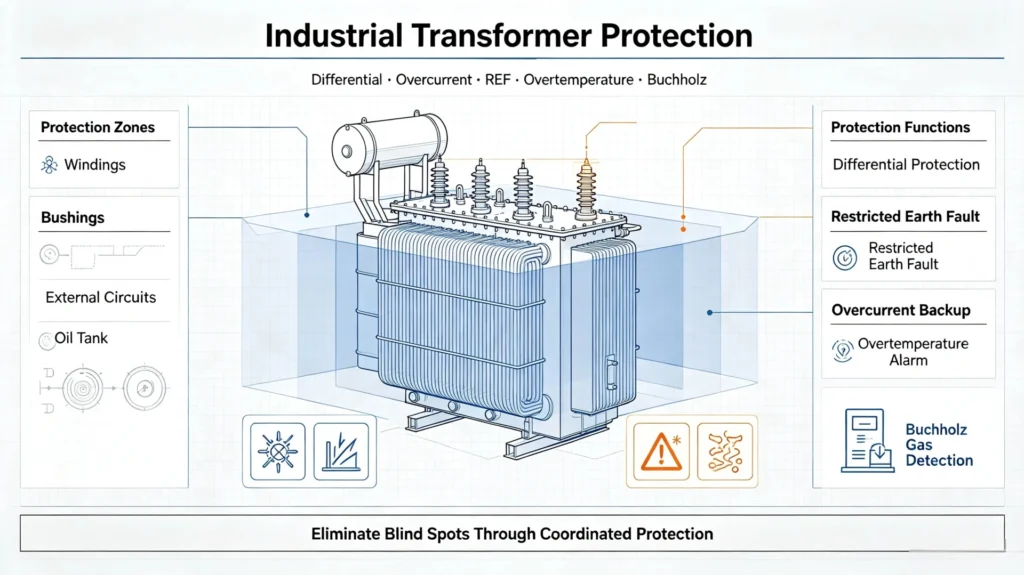
Transformers are the power conversion core of industrial substations. The standard protection configuration includes differential protection (main protection), overcurrent and restricted earth fault protection (backup protection), overtemperature protection, and Buchholz gas protection for oil-immersed transformers. Reasonable protection coordination eliminates blind spots for internal and external transformer faults.
3. Industrial Generators
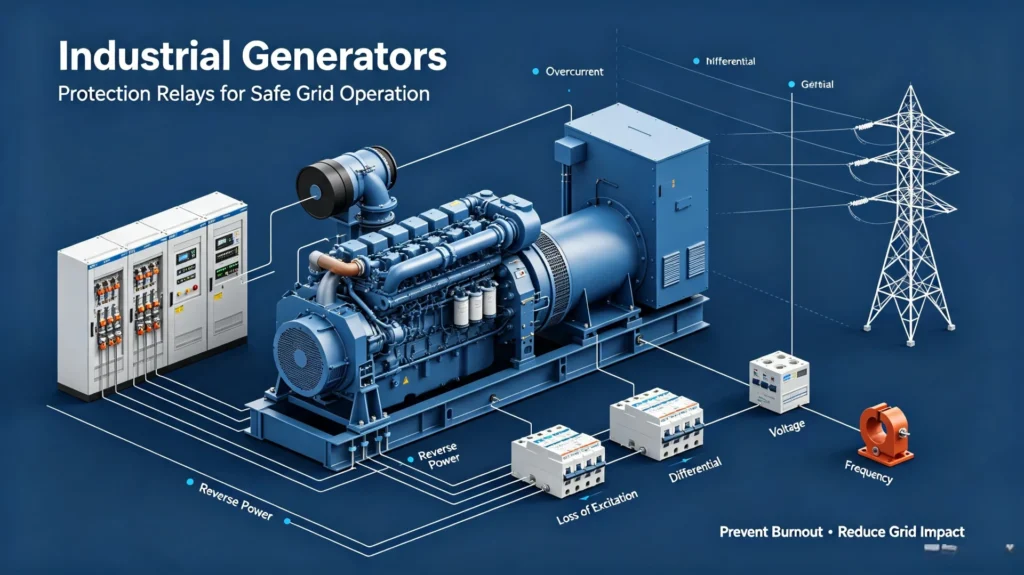
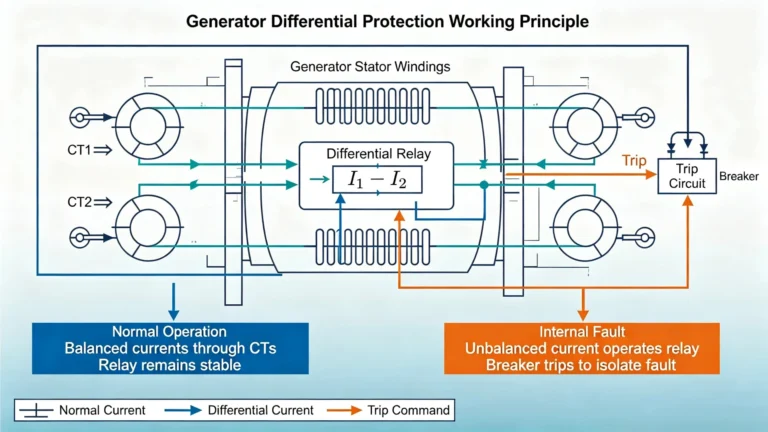
For self-provided generator sets in factories and grid-connected distributed power stations, relays provide overcurrent, reverse power, loss-of-excitation, differential, voltage, and frequency protection. These functions avoid generator burnout and grid impact caused by abnormal operating conditions.
4. Switchgear and Feeders
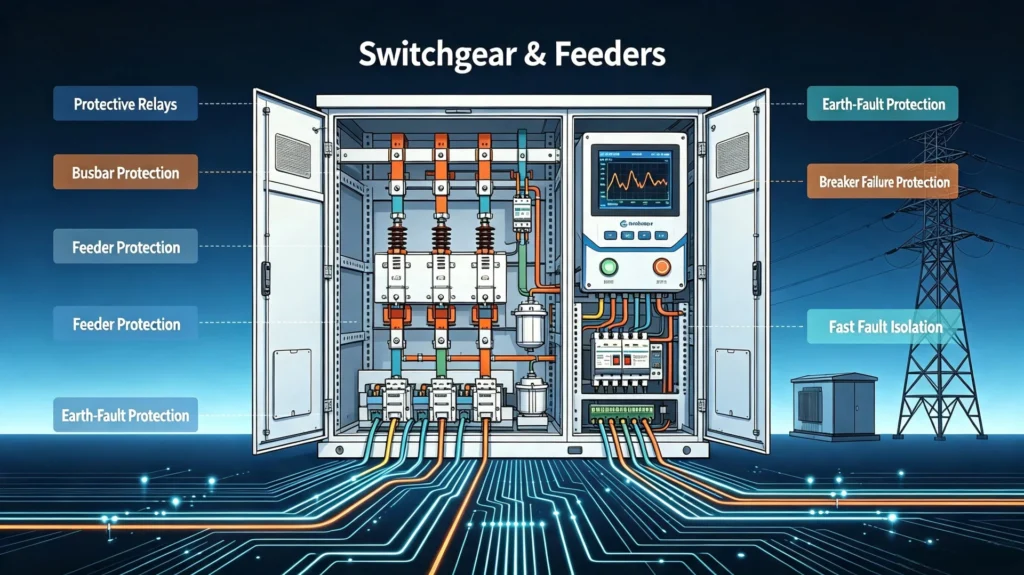
Medium‑ and high‑voltage switchgears and outgoing feeders undertake power‑distribution tasks. Protective relays in power systems provide short‑circuit, earth‑fault, busbar, feeder, and breaker‑failure protection to ensure rapid isolation of distribution‑network faults and prevent power‑supply paralysis.
5. Industrial Substations
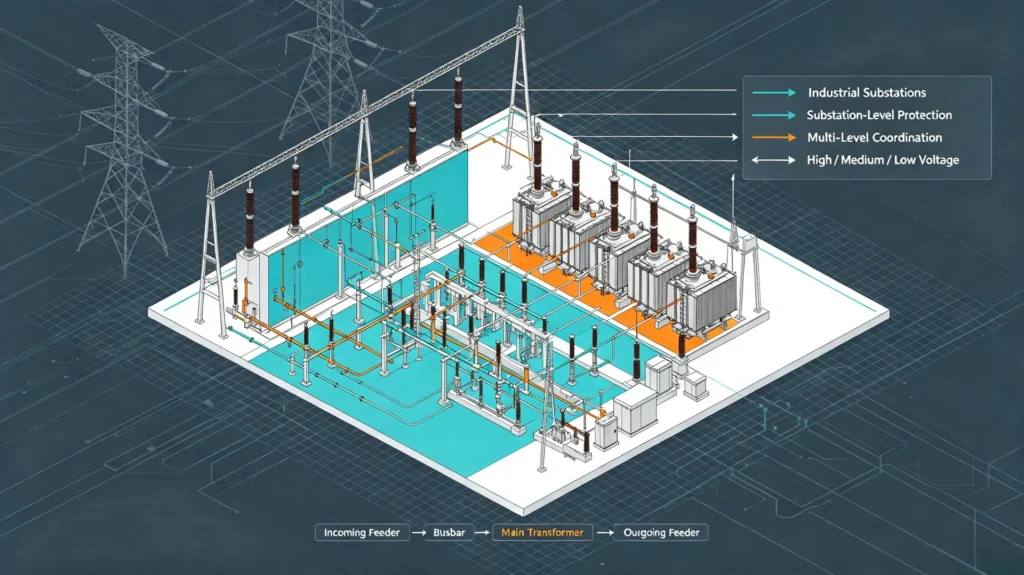
The protective relay in substation realizes substation-level protection covering incoming feeder, busbar, main transformer, and outgoing feeder protection. Multi-level protection coordination between high, medium, and low voltage levels ensures hierarchical fault disposal and improves overall power system stability.
Core Protective Relay Functions for Heavy Industry
Overcurrent Protection (ANSI 50/51)
Divided into instantaneous overcurrent (ANSI 50) and time-delayed overcurrent (ANSI 51). Instantaneous protection responds to severe short-circuit faults within milliseconds; time-delayed protection targets minor overload and slow-developing faults, widely used in feeders, motors, and transformer backup protection.
Earth Fault Protection (ANSI 50N/51N)
Ground faults are the most frequent faults in industrial power systems, caused by cable aging, insulation damage, and equipment leakage. Relays judge faults through residual current and zero-sequence current detection, effectively protecting personnel safety and preventing insulation breakdown accidents.
Differential Protection (ANSI 87)
Differential protection judges internal faults by comparing current values at the inlet and outlet of protected equipment. It features high sensitivity and fast action, serving as the main protection for key equipment such as large transformers, generators, and high-power motors.
Thermal Protection (ANSI 49)
Simulate equipment thermal accumulation characteristics in real time, monitor motor winding and transformer temperature rise, and avoid insulation aging and equipment burnout caused by long-term overload operation.
Voltage & Frequency Protection (ANSI 27/59/81)
Abnormal grid voltage and frequency cause motor speed deviation, equipment resonance, and load tripping. Relays monitor real-time parameters and execute alarm or trip actions to stabilize industrial load operation.
How Protective Relays Boost Industrial Power System Reliability
For EPC contractors and project owners, reliable protective relays directly improve project operational benefits and safety indicators:
- Reduce core equipment damage rate and lower replacement and maintenance costs
- Minimize unplanned production downtime and improve plant operation efficiency
- Realize selective fault isolation to avoid large-area power outages
- Support predictive maintenance through fault recording and data analysis
- Improve on-site personnel electrical safety protection level
- Seamlessly integrate with SCADA and industrial automation systems to realize remote monitoring
Protection Coordination in Heavy Industrial Power Systems
Protection coordination is the core of industrial power system design, determining whether the protection system can act accurately without misoperation or refusal. It refers to the matching of action current and time between primary and backup protection of all levels of equipment.
Core Coordination Logic
Primary protection acts first for faults; backup protection acts only when primary protection or breakers fail, ensuring no unprotected dead zones.
Key Coordination Parameters
Pickup current, time multiplier setting (TMS), system short-circuit current, CT ratio, relay characteristic curve, and breaker clearing time.
Standard Industrial Coordination Sequence
Load terminal equipment → Motor/feeder protection → Switchgear protection → Transformer protection → Main incoming feeder protection
Professional Selection Guide for Heavy Industry Protective Relays
1. Confirm System Electrical Parameters
Match relay specifications according to system rated voltage, rated current, frequency, short-circuit capacity, and grounding mode to ensure device matching with grid characteristics.
2. Match Load Equipment Parameters
Select targeted protection schemes based on motor rated power, transformer capacity, generator parameters, and load fluctuation characteristics.
3. Clarify Protection Function Requirements
Confirm required ANSI functions, protection stages, alarm/trip output logic, and customized protection logic according to project design specifications.
4. Adapt to On-Site Environmental Conditions
Select industrial-grade relays with wide temperature resistance, vibration resistance, dustproof, corrosion-resistant, and high EMC anti-interference performance to adapt to harsh industrial environments.
5. Support System Communication Integration
Priority should be given to relays supporting Modbus RTU/TCP, IEC 61850, and Ethernet communication to meet SCADA remote monitoring, remote parameter configuration, and centralized management requirements for intelligent factories.
Advantages of Numerical Protective Relays for Industrial Scenarios
Traditional electromechanical and static relays have single functions and fixed logic, unable to meet the needs of modern intelligent industrial projects. Numerical protective relays have become the mainstream choice for EPC high-standard projects due to their outstanding advantages:
- Multi-function integration: One device realizes multiple protection functions, saving cabinet space and project cost
- Data recording: Support fault recording, oscillography, and event log for post-fault analysis
- Self-diagnosis: Real-time self-check of device hardware and software status to avoid hidden faults
- Remote operation: Support remote parameter setting, monitoring, and upgrade
- Strong expandability: Adapt to subsequent project capacity expansion and function upgrade
Relay Testing and Commissioning Specifications
Testing and commissioning are key links to ensure reliable relay operation, avoiding nuisance tripping or failure-to-trip faults after project delivery.
Common Testing Methods
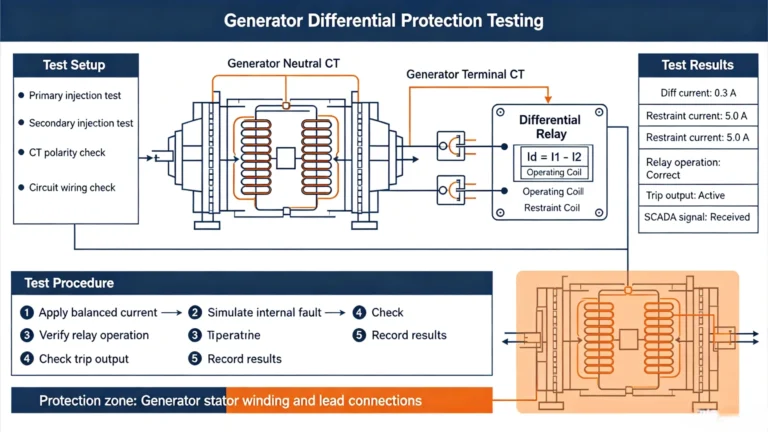
Secondary injection testing, primary injection testing, functional logic testing, trip circuit testing, and communication protocol testing.
Standard Commissioning Process
- Review protection design drawings and parameter settings
- Verify on-site wiring and CT/VT connection correctness
- Input accurate relay setting parameters
- Complete secondary injection testing to verify protection logic
- Test breaker trip execution performance
- Verify alarm signal and SCADA communication data
- Sort out and file commissioning test reports
Common On-Site Faults and Solutions
Nuisance Tripping
Caused by unreasonable parameter settings, motor starting impulse current, CT saturation, and electromagnetic transient interference. Solution: Optimize time-current curves, set starting delay locking, and select high-precision CTs.
Failure to Trip
Caused by wrong wiring, relay hardware failure, DC control power loss, and breaker stuck faults. Solution: Standardize construction wiring, regularly inspect control power and executing mechanisms.
Poor Protection Coordination
Caused by mismatched time-current settings and incorrect CT ratios. Solution: Recheck system short-circuit parameters and perform overall protection coordination calculation.
Communication Abnormality
Caused by network failure and inconsistent protocol parameters. Solution: Unify communication parameters and regularly maintain industrial network equipment.
Applicable Industry Standards
All industrial protective relay design, selection, testing, and operation must comply with international and industry authoritative standards to meet project safety and compliance requirements:
- IEC 60255 series: Core international standards for measuring relays and protection equipment, covering performance, testing, and EMC requirements
- EN IEC 60255-26:2025: Latest EMC standard for protective relays, regulating anti-interference performance in complex industrial electromagnetic environments
- IEC 61850: Substation communication network and system standard, guiding intelligent relay communication integration
- ANSI/IEEE C37 series: American standard for power system protection and relay coordination
- ANSI device number standard: Unified definition of relay protection functions for global industrial projects
Protective Relay Applications
Case 1: Steel Plant Large Motor Protection
Steel plant rolling mill motors feature high power, frequent startup, and heavy impact load. The project adopts integrated motor protection relays equipped with the motor protection relay module supporting ANSI 46/48/49/50/51 composite functions. It effectively avoids motor burnout caused by phase unbalance, locked rotor, and overload faults, ensuring continuous operation of rolling production lines.
Case 2: Cement Plant Transformer Protection
The main transformer of this substation is configured with ANSI 87 differential main protection, non‑electrical quantity protection, and backup protection of transformer. This protection suite prevents substation power‑supply paralysis and reduces annual equipment maintenance costs by 30%.
Case 3: Mining Power System Protection
Mining sites feature long-distance feeders, complex load distribution, and severe on-site vibration and dust. Selected industrial-grade numerical relays have strong environmental adaptability and earth fault protection optimization, solving frequent ground fault problems in long-distance mining lines.
Case 4: Oil & Gas Substation Protection
Oil and gas projects belong to high-risk industrial scenarios, requiring redundant protection configuration. Dual protection schemes and IEC 61850 communication integration are adopted to realize real-time remote monitoring, meeting high safety and reliability requirements of petrochemical projects.
Bits on Protective Relaying
1. What are protective relays used for in heavy industry?
As core power equipment for power grid security, Protective Relays in Heavy Industry Applications monitor the operating status of heavy industrial power systems and key equipment, quickly identify electrical faults, isolate faulty branches, protect equipment and personnel safety, and ensure continuous and stable production.
2. Which relay is best for industrial large motors?
Specialized motor protective relays integrating ANSI 46/48/49/50/51 functions are the optimal choice, covering unbalance, locked rotor, thermal overload, short circuit, and phase loss protection.
3. What relays are used for transformer protection?
Main protection adopts ANSI 87 differential protection; backup protection adopts 50/51 overcurrent and 50N/51N earth fault protection, matched with overtemperature and Buchholz protection.
4. What is the difference between overcurrent and differential protection?
Overcurrent protection is backup protection for system external faults with delayed action; differential protection is high-sensitivity main protection for internal equipment faults with instantaneous action.
5. How often should industrial protective relays be tested?
Full functional testing is required before commissioning; routine inspection once a quarter and comprehensive calibration testing once a year are recommended for operating equipment.
6. What ANSI functions are most commonly used in heavy industry?
ANSI 50/51 (overcurrent), 50N/51N (earth fault), 87 (differential), 49 (thermal), 27/59 (voltage), 81 (frequency) are the most widely used core functions.
7. Are numerical relays suitable for large industrial plants?
Yes. Numerical relays integrate multiple functions, support intelligent monitoring and remote management, and fully meet the high reliability and intelligent operation requirements of large steel, mining, and petrochemical plants.
8. How do protective relays communicate with SCADA?
Realize data interaction and remote monitoring through Modbus RTU/TCP or IEC 61850 Ethernet communication protocols, uploading fault records, real-time parameters, and alarm signals.
9. How to prevent relay nuisance tripping?
Optimize setting parameters, match CT/VT accurately, configure startup locking logic, select high anti-interference industrial-grade relays, and standardize on-site construction and grounding.
Q10: What are the fundamental requirements of protective relays?
The four fundamental requirements of protective relays are reliability, selectivity, speed, and sensitivity. These core criteria govern relay performance and serve as evaluation standards for protective relay coordination in heavy‑industry substations.
Q11:What is protective relay nomenclature based on?
Global protective relay nomenclature is primarily based on ANSI standard device function codes, widely used in heavy‑industry substations.
Q12: What is a protective relay technician?
A protective relay technician installs, tests, calibrates, commissions and troubleshoots protective relays and related secondary‑circuit equipment at substations and industrial power sites.
Conclusion
Protective relays in heavy industry applications are indispensable core equipment for ensuring the safety, stability, and efficient operation of heavy industrial power systems. Different core equipment such as motors, transformers, generators, and substations requires matched professional protection schemes.
For EPC contractors and project owners, scientific type selection, accurate protection coordination, standardized testing and commissioning, and daily maintenance can effectively reduce equipment failure rates and production downtime risks.
Modern numerical multi-functional protective relays, with their intelligent, integrated, and remote management capabilities, have become the mainstream solution for high-standard heavy industrial projects, bringing long-term operational safety and economic benefits to industrial power systems.
Reference & Technical Sources
- IEC 60255 Series: Measuring Relays and Protection Equipment International Standards
- EN IEC 60255-26:2025: Electromagnetic Compatibility Requirements for Protection Devices
- IEC 61850: Communication Networks and Systems for Power Automation
- ANSI/IEEE C37.90: Standard for Relays and Relay Systems for Power System Protection
- IEEE Industry Applications Society: Industrial Power System Protection Design Guidelines
- International Electrotechnical Commission (IEC) Official Release Documents 2023–2025
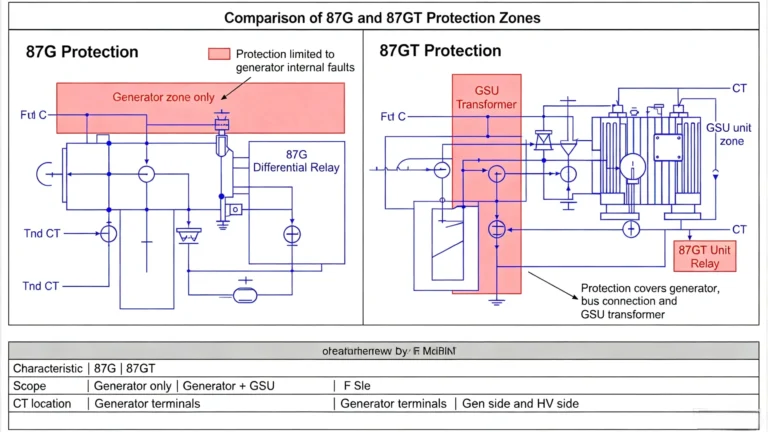
About Author

Hello, I'm Leno Zhang. I have 15 years of experience in the power relay protection industry with extensive pre-sales and after-sales project experience. Our company specializes in various complete sets of relay protection and automation equipment. I can assist customers in solving all practical on-site project challenges and provide optimal integrated solutions.
Tell Us Your Requirement
High Quality
Stable performance, reliable design, ensuring safe operation for power system protection and grid stability.
Fast Delivery
Timely delivery to support your urgent orders and project schedules efficiently and professionally at any time.
Best Warranty
Professional Warranty: Reliable after-sales support for stable relay protection and long-term customer satisfaction.