

-
Leon Zhang sales consultant
-
Email: zxl635973785@gmail.com
-
Phone/WhatsApp: +86 13655813266
Buchholz Relay Protection: Working Principle & Applications
Buchholz relay protection is a mechanical protection method used in oil-immersed transformers to detect developing internal faults through gas accumulation and sudden oil movement.
What Is Buchholz Relay Protection of Transformer?
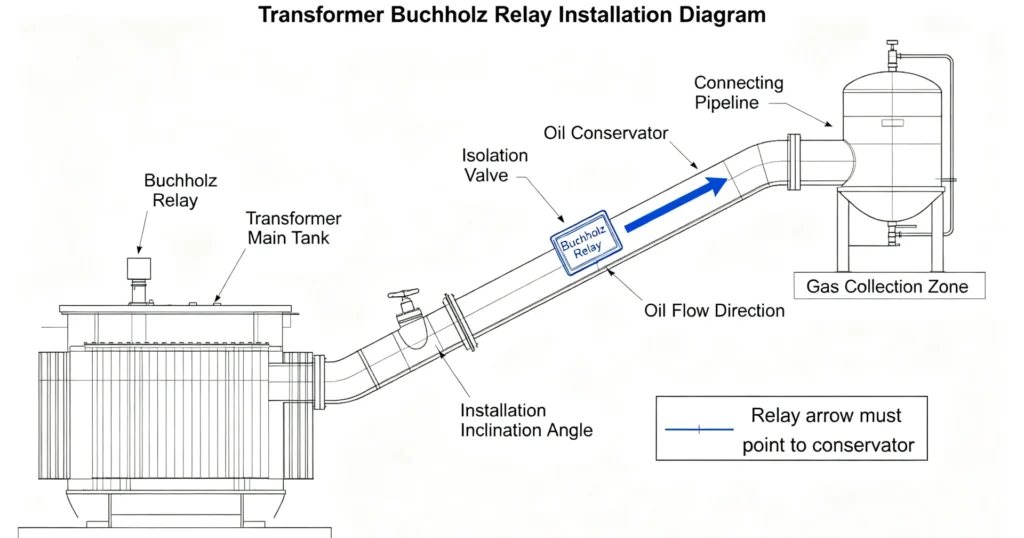
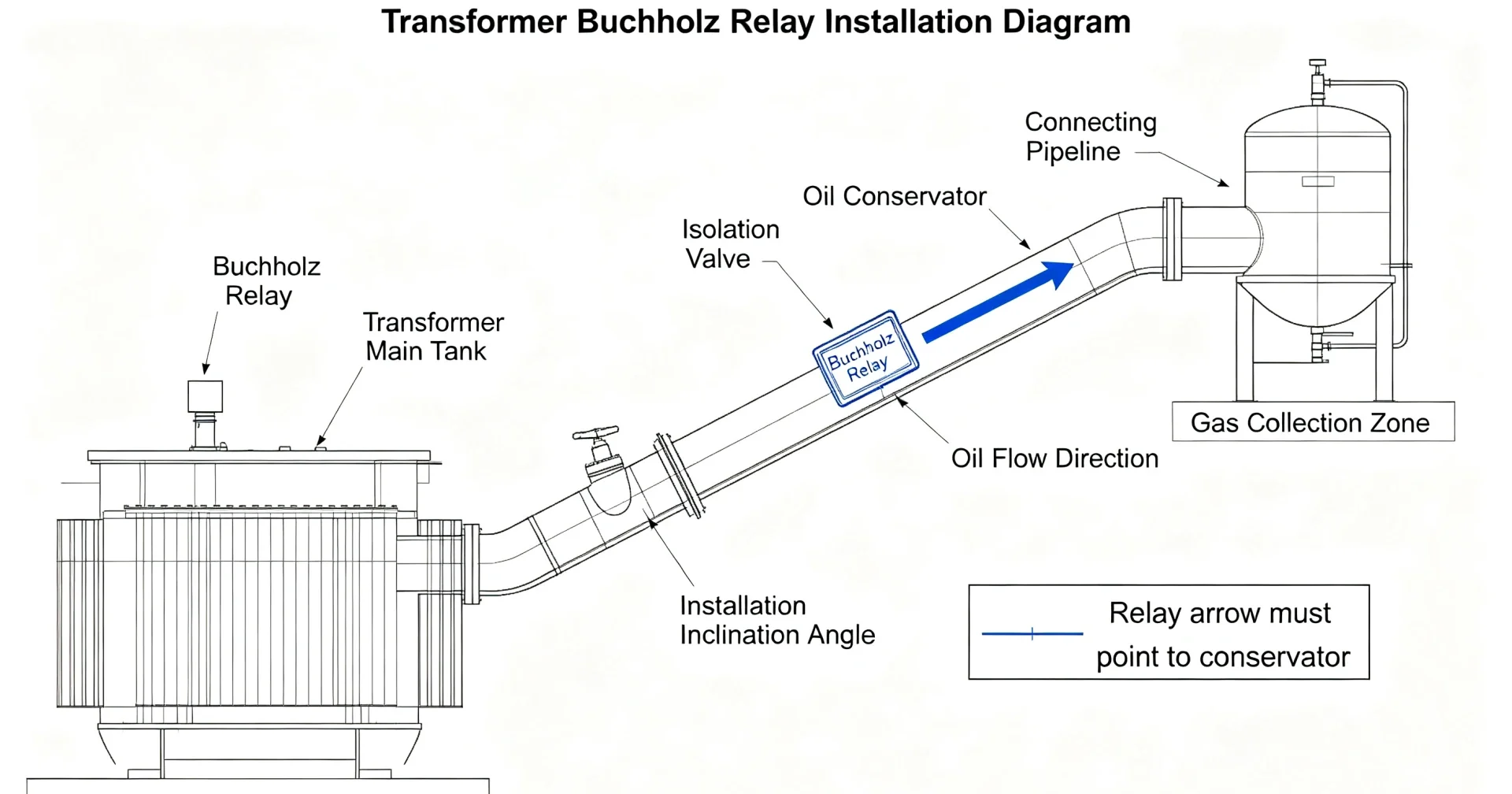
The gas path through the relay housing is what makes transformer gas protection work. Oil travels from the main tank into the conservator through the device, so gas or a surge heading for the conservator has to pass it first.
Buchholz relay transformer protection relies on a mechanical non-electrical protection device, the Buchholz relay, which is mounted on the connecting pipeline between the transformer main tank and conservator tank.
The gas-actuated device monitors two abnormal conditions inside oil-immersed transformers:
- Accumulation of decomposition gas
- Sudden oil flow velocity and pressure fluctuation
This protection is only applicable to oil immersed transformers equipped with an oil conservator. It works alongside the electrical protection relays instead of replacing them, and it needs a conservator to have a gas path at all.
This protection is only applicable to oil immersed transformers equipped with an oil conservator. It provides early warning alarm and main trip protection for internal transformer faults that electrical transformer protection relays may fail to detect.
Why Is Buchholz Relay Important for Transformer Protection?
Internal transformer faults usually develop gradually. Minor faults such as inter-turn short circuits and local insulation degradation generate little fault current, making them difficult to be captured by differential or overcurrent protection.
Common Internal Transformer Faults Detected by Buchholz Protection
- Winding inter-turn short circuit
- Core overheating
- Partial discharge
- Internal arcing
- Insulation ageing and oil decomposition
All these failures break down transformer oil and produce gas or rapid oil surges. Buchholz relay detects these signatures at the early stage and prevents catastrophic transformer damage.
How Does Buchholz Relay Work in Transformer Protection?
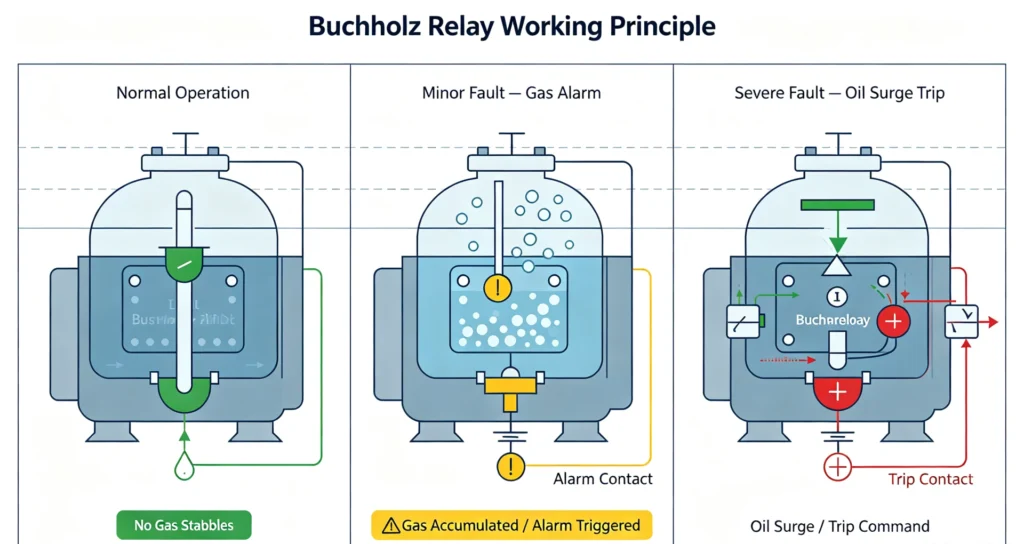
Buchholz Relay Operating Mechanism
The Buchholz relay working principle is mechanical end to end. No current transformer feeds it, no trip coil and no auxiliary supply are involved. Gas or oil movement alone pushes a float or deflects a baffle, and the contact closes on that movement.
- Normal operation Transformer oil circulates stably. No gas gathers inside the relay; float contacts remain open. No alarm or trip signal is issued.
- Minor developing faults (Gas alarm function) Slow insulation deterioration, loose connections or mild overheating decompose oil and generate gas. Gas accumulates at the top chamber of the relay and lowers the upper float, activating the alarm contact to send remote warning signals.
- Severe internal faults (Oil surge trip function) Internal short circuits or arcing create massive gas instantly. Sharp oil flow surges push the lower float. The trip contact closes, triggering the circuit breaker to isolate the faulty transformer.
Construction and Main Components of Buchholz Relay
| Component | Core Function |
|---|---|
| Upper float | Detect accumulated gas for alarm command |
| Lower float / baffle | Detect rapid oil surge for trip command |
| Magnetic / mercury contact switch | Transmit alarm or trip electrical signals |
| Relay housing | Sealed oil chamber, mechanical protection |
| Test valve | Manual function testing during commissioning |
Alarm and Trip Stages of the Gas Relay
Gas Accumulation Alarm Protection
Targets slowly evolving internal abnormalities: insulation ageing, local overheating, loose winding joints, slow oil leakage. It alerts maintenance crews to arrange inspections before faults escalate.
Oil Surge Trip Protection
Responds to sudden severe internal faults: winding short-circuit, internal flashover. It acts as critical non-electrical main protection to trip the transformer.
Fault Diagnosis Function
Engineers judge fault severity and type by sampling gas inside the relay, analysing gas volume, colour and composition. It delivers clear clues for post-fault troubleshooting.
Buchholz Relay Installation in Transformer
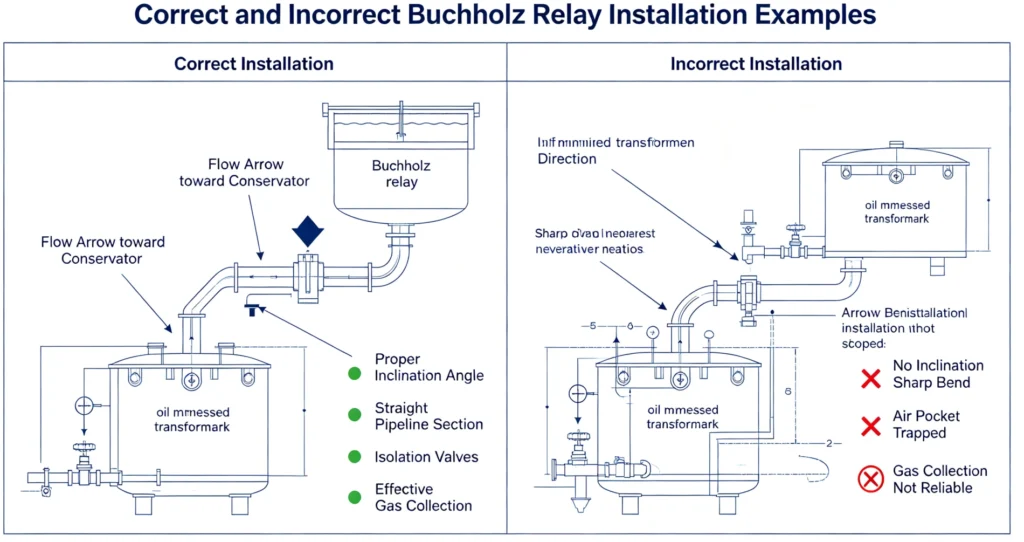
Installation Position
- Install on the pipeline linking transformer tank and conservator
- Maintain specified inclination angle to guarantee gas collection
- Flow arrow on relay housing must point toward the conservator
Installation Considerations
- Avoid trapped air pockets inside pipelines
- Strictly prevent flange oil leakage
- Separate wiring for alarm circuit and trip circuit
- Install isolating valves for relay maintenance without draining transformer oil
Where Exactly Is the Relay Mounted in the Oil Circuit?
A Buchholz relay is installed between the transformer main tank and the conservator.
Specifically, it is mounted in the connecting pipe that links the main tank to the conservator.
The relay is positioned so that oil flow passes through it as oil moves between the tank and the conservator.
The connecting pipe is usually given a slight inclination (upward toward the conservator) so that gas and oil can move freely toward the relay.
This location allows the Buchholz relay to detect faults such as gas accumulation or sudden oil surges inside the transformer.
Buchholz Relay Testing and Commissioning Procedure
This standard workflow is widely adopted by EPC teams during substation site acceptance.
- Visual inspection Check mechanical integrity, sealing leakage and control wiring condition.
- Alarm function test Inject compressed air into relay chamber and verify alarm contact actuation.
- Trip function test Simulate oil surge movement to confirm reliable trip signal transmission to protection relay panels.
- Contact resistance and insulation test Measure contact resistance and control circuit insulation resistance.
Common Buchholz Relay Problems and Troubleshooting
False Alarm Causes
- Air trapped inside transformer tank during oil filling
- Slow external oil leakage
- Incorrect installation inclination angle
- Continuous mechanical vibration on site
Unplanned Trip Without Transformer Internal Fault
- Excessive oil fluctuation caused by external load change
- Relay mechanical jamming
- Improper setting of oil surge threshold
- Short circuit on trip control wiring
No response during actual internal faults
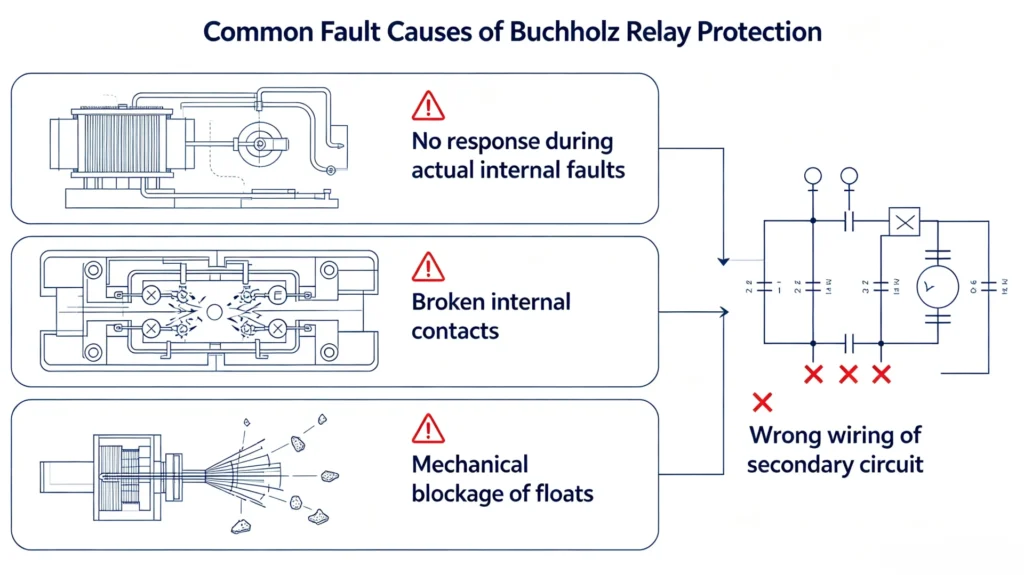
- Broken internal contacts
- Mechanical blockage of floats
- Wrong wiring of secondary circuit
Why Does a Buchholz Relay Give an Alarm in a Transformer?
A Buchholz relay gives an alarm when gas accumulates in the relay chamber or when oil flow disturbance is detected, signaling a potential problem inside the transformer.
This can happen due to gas accumulation from minor internal faults, air ingress into the oil system, or a low oil level in the conservator.
In some cases, a developing internal fault such as insulation breakdown or overheating produces small amounts of gas that rise to the relay and trigger the alarm.
Improper installation, such as incorrect pipe slope or trapped air, can also cause nuisance alarms.
Additionally, contact or mechanical issues within the relay itself may lead to false alarms.
The alarm stage is intended to warn operators of incipient faults so they can investigate before a more serious fault develops.
Difference Between Buchholz Relay and Other Transformer Protection Devices
| Protection Device | Detection Target | Typical Application |
|---|---|---|
| Buchholz Relay | Internal gas & oil surge non-electrical faults | Oil immersed transformer with conservator |
| Differential Protection Relay | Electrical internal winding faults | All medium & large power transformers |
| Pressure Relief Device | Sudden tank pressure rise | Heavy-duty power transformers |
| Winding Temperature Relay | Overheating of windings and oil | All oil immersed transformers |
Where Gas Relay Protection Is Specified
Distribution Transformers
Medium-capacity oil immersed distribution transformers for industrial parks and local power networks.
Substation Main Power Transformers
33kV, 66kV, 110kV and 220kV main transformers in transmission and distribution substations.
Industrial & Renewable Energy Transformers
Transformers deployed in mining facilities, thermal power plants, solar and wind farm collector substations.
Choosing a Reliable Buchholz Relay Manufacturer
Buchholz relay applications follow the transformer class rather than the maker. Distribution units of 630 kVA up to a few MVA take one relay on the conservator pipe. Main transformers of 33 kV and above normally get a relay with a sampling cock and a test valve for commissioning gas checks.
For EPC contractors and substation design teams, the following criteria reduce on-site failure risks during long-term operation:
Key Selection Criteria
- Product compliance with IEC relevant standards
- High-quality cast housing and corrosion-resistant internal components
- Stable mechanical action, low risk of contact sticking
- Complete FAT (Factory Acceptance Test) reports before shipment
- Manufacturer export experience and global after-sales technical support
Standard Project Execution Workflow
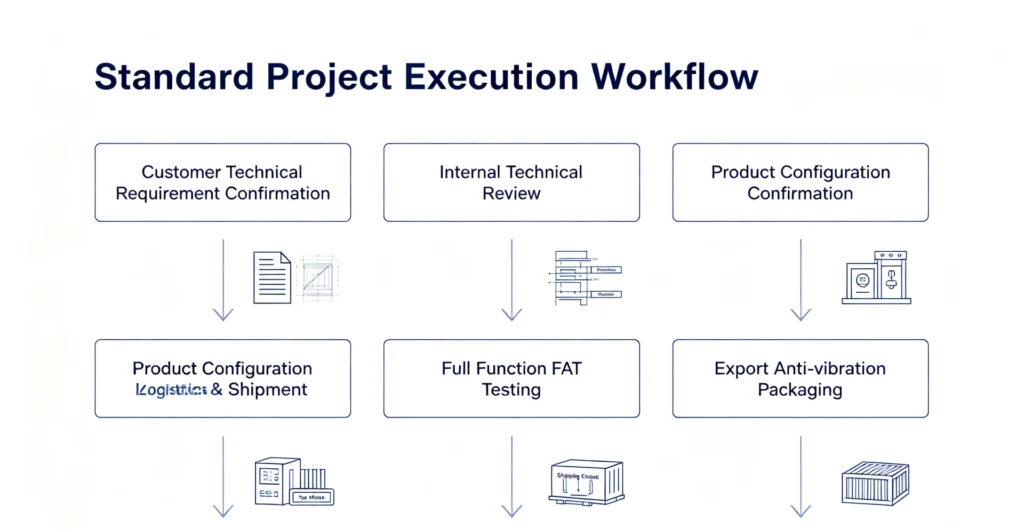
Please refer to the transformer selection section for matters concerning the selection of transformer protection.
FAQ: Installation, Testing and DGA Questions
What is Buchholz relay protection?
Buchholz relay protection is a gas-actuated, non-electrical protection scheme used specifically for oil-immersed transformers. It is installed in the pipe between the main tank and the conservator and serves as a main protection for internal faults, particularly sensitive to incipient faults that electrical protections may miss.
How does a Buchholz relay work?
It operates in two stages:
Alarm stage (slow gas accumulation): Minor faults (partial discharge, local overheating) decompose oil and generate small gas bubbles. Gas collects in the relay housing, displacing oil and lowering the upper float, which closes an alarm contact. The transformer stays in service, warning operators to investigate.
Trip stage (sudden oil surge): Severe faults (winding short circuit, flashover) vaporize oil violently, creating a high-velocity oil surge toward the conservator. The flow deflects a baffle plate, closing the trip contact and disconnecting the transformer within cycles.
What is a Buchholz relay in a transformer?
A Buchholz relay is a gas-actuated protective relay housed in the connecting pipe between the transformer main tank and the conservator. It contains floats and a baffle plate that respond to gas accumulation or oil flow, providing early fault detection for oil-filled transformers.
Why is a Buchholz relay used in transformers?
It detects incipient internal faults that differential protection cannot sense, such as turn-to-turn shorts, core overheating, and low oil level. It provides early warning (alarm) before a fault escalates and rapid disconnection (trip) for severe faults, limiting damage and preventing tank rupture or fire.
Where is a Buchholz relay installed in a transformer?
It is mounted horizontally in the connecting pipe between the main tank and the conservator. The pipe has a slight upward inclination (2%–4%) toward the conservator to ensure gas flows freely into the relay.
What does a Buchholz relay detect?
It detects gas accumulation from minor internal faults, air ingress, low oil level, and sudden oil surges caused by major faults. The collected gas can be sampled for dissolved gas analysis (DGA) to identify fault type.
What is the difference between Buchholz relay alarm and trip?
Alarm: Slow gas accumulation from incipient faults. The transformer remains in service; operators are warned to investigate.
Trip: Rapid oil surge from severe faults. The transformer is disconnected immediately to prevent catastrophic damage.
Can a Buchholz relay be used in a dry-type transformer?
No. Buchholz relays require an oil-filled tank and conservator system. Dry-type transformers have no oil or gas accumulation path, so this protection does not apply.
Does a Buchholz relay replace transformer differential protection?
No. They are complementary. Buchholz relay is sensitive to incipient faults and low oil level that differential protection cannot detect. Differential protection covers external and some internal faults but is blind to turn-to-turn shorts and gas generation. Both are required for comprehensive transformer protection.
Conclusion
Buchholz relay protection of transformer remains irreplaceable non-electrical protection equipment for oil immersed transformers. Correct installation, standard commissioning and periodic testing greatly improve transformer operational safety.
When combined with differential protection, backup overcurrent protection and temperature monitoring systems, it forms a complete protection scheme for power transformers in substations and industrial power projects.
Scope the gas device after the electrical side is fixed. The power transformer protection scheme is the place where the differential, overcurrent and earth-fault elements are listed, and the transformer fault types page maps each failure mode to the function that has to clear it. Once that list is agreed, the gas relay is a single line item on the pipe between main tank and conservator.
On the hardware side, the gas device belongs to the group of non-electrical detection devices rather than transformer non-electrical protection device supplies that sit alongside the electrical relay panel. It is a mechanical try-out item: floats, baffles, a sampling cock and a test valve, with no setting group to download.
Reference Technical Documents & Data Sources
- IEC 60076 Power Transformers Series Standard
- IEEE C57.104 Guide for the Interpretation of Gases Generated in Oil-Immersed Transformers
- IEC 61850 Substation Communication Standard
- IEC 60255 Measuring Relays and Protection Equipment
- International practice guide for transformer protection, Annual Conference for Protective Relay Engineers (CPRE)
- Manufacturer standard testing specification for Buchholz relays
About Author

Hello, I'm Leno Zhang. I have 15 years of experience in the power relay protection industry with extensive pre-sales and after-sales project experience. Our company specializes in various complete sets of relay protection and automation equipment. I can assist customers in solving all practical on-site project challenges and provide optimal integrated solutions.
Tell Us Your Requirement
High Quality
Stable performance, reliable design, ensuring safe operation for power system protection and grid stability.
Fast Delivery
Timely delivery to support your urgent orders and project schedules efficiently and professionally at any time.
Best Warranty
Professional Warranty: Reliable after-sales support for stable relay protection and long-term customer satisfaction.