
-
Leon Zhang Sales Manager
-
Email: sale@relayprotect.com
-
Phone/WhatsApp: +86 13655813266
Four Electric Motor Starter Methods, DOL to VFD
What is an electric motor starter and which method fits?
An electric motor starter is the switchgear that brings an AC motor up to speed, holds it under load and stops it cleanly. Most starters are rated for AC-3 duty under IEC 60947-4-1:2023, the repeated lock-rotor starting of a squirrel-cage machine; size it for the wrong category and the contacts weld. Three layers do the work: a contactor makes and breaks the power circuit, an overload drops the coil when a stuck load heats the winding, and control logic sequences start, stop and fault states. The four common methods trade starting current against torque. Direct-on-line applies full voltage; a 3 kW, 400 V motor draws eight times rated current for a fraction of a second. Star-delta drops winding voltage threefold, cutting inrush to roughly a third, and a soft start ramps voltage over seconds through thyristors. Motor rating follows IEC 60034-1:2026, device numbers IEEE C37.2. Setting review and quotation within 12 hours, MOQ 1, 7-15 working days.
An electric motor starter is the switchgear assembly that brings an AC motor up to speed, keeps it running under load, and shuts it down cleanly. It pairs a holding-in contactor with overload protection and the interlocks that make repeated starting safe on a real plant floor.
Most starters are rated for the AC-3 utilization category defined by IEC 60947-4-1:2023, which is the repeated lock-rotor start and stop of a squirrel-cage machine, not the light AC-1 switching a light switch does. A starter sized for the wrong category welds its contacts and fails months early.
What a motor starter actually does
The job of a motor starter is simple to state and harder to do well. It applies full or reduced voltage to the stator, lets the rotor pull up to speed, then holds and protects that circuit one cycle after the next, day after day, with no human at the switch.
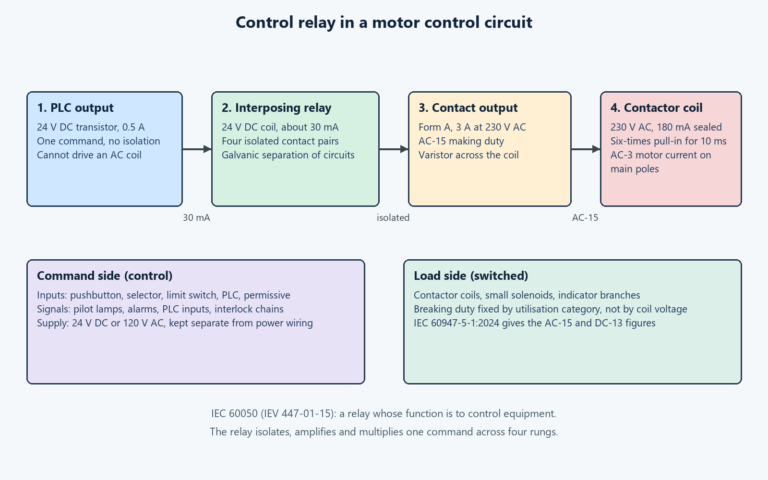
Every starter has three layers that do distinct work. The contactor makes and breaks the power circuit. The overload, whether thermal or electronic, watches the running current and opens the control coil when a fault or a stuck load drives the winding toward a thermal runaway. The control logic, from a hard-wired relay up to a microcontroller, sequences the start, stop and fault states so an operator can act from a panel or from a remote PLC.
A well-chosen starter adds very little to the bill of materials, yet it protects the machine it starts from the two events that actually damage motors: the inrush that trips a neighbour’s bus, and the overload that slowly burns a winding. The next section explains the parts, then the four starting methods the starter can be built around.
What is a motor starter: the electric motor starter
A motor starter, more precisely an electric motor starter, is the switchgear that energizes and de-energizes an AC motor under controlled voltage. It is not a plain switch: it carries the holding-in contactor, the overload and the interlocks that make a repeated start safe.
Four starting methods, from DOL to VFD
Selecting a relay for a live project?
Send the system voltage, CT ratio and tripping scheme. Our engineers confirm the model and reply within 12 hours.
The four common methods differ in one trade: how much starting current they let through and how much torque they produce in the first second. That trade is the whole decision, and it is what the next section sizes to the nameplate.
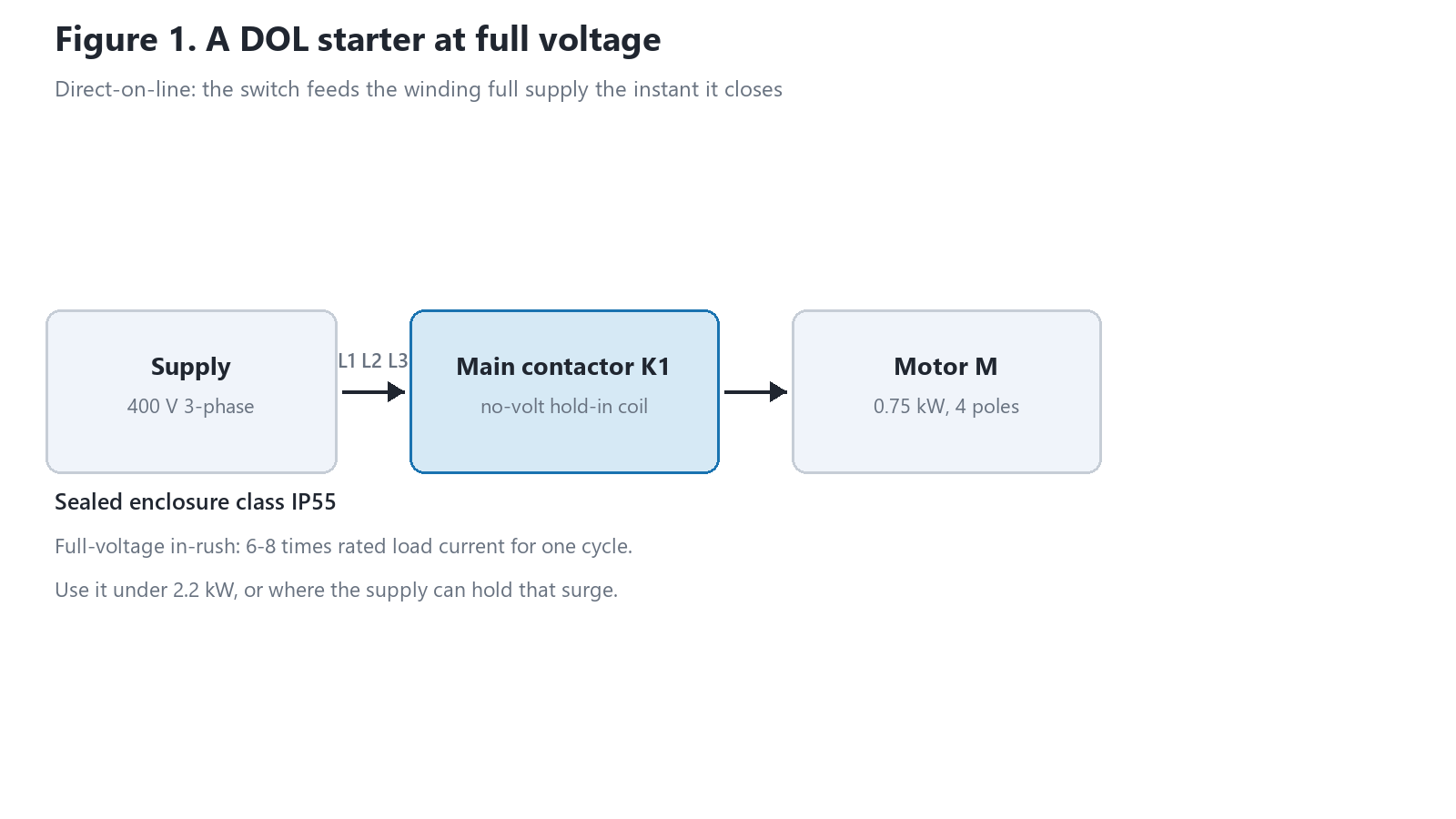
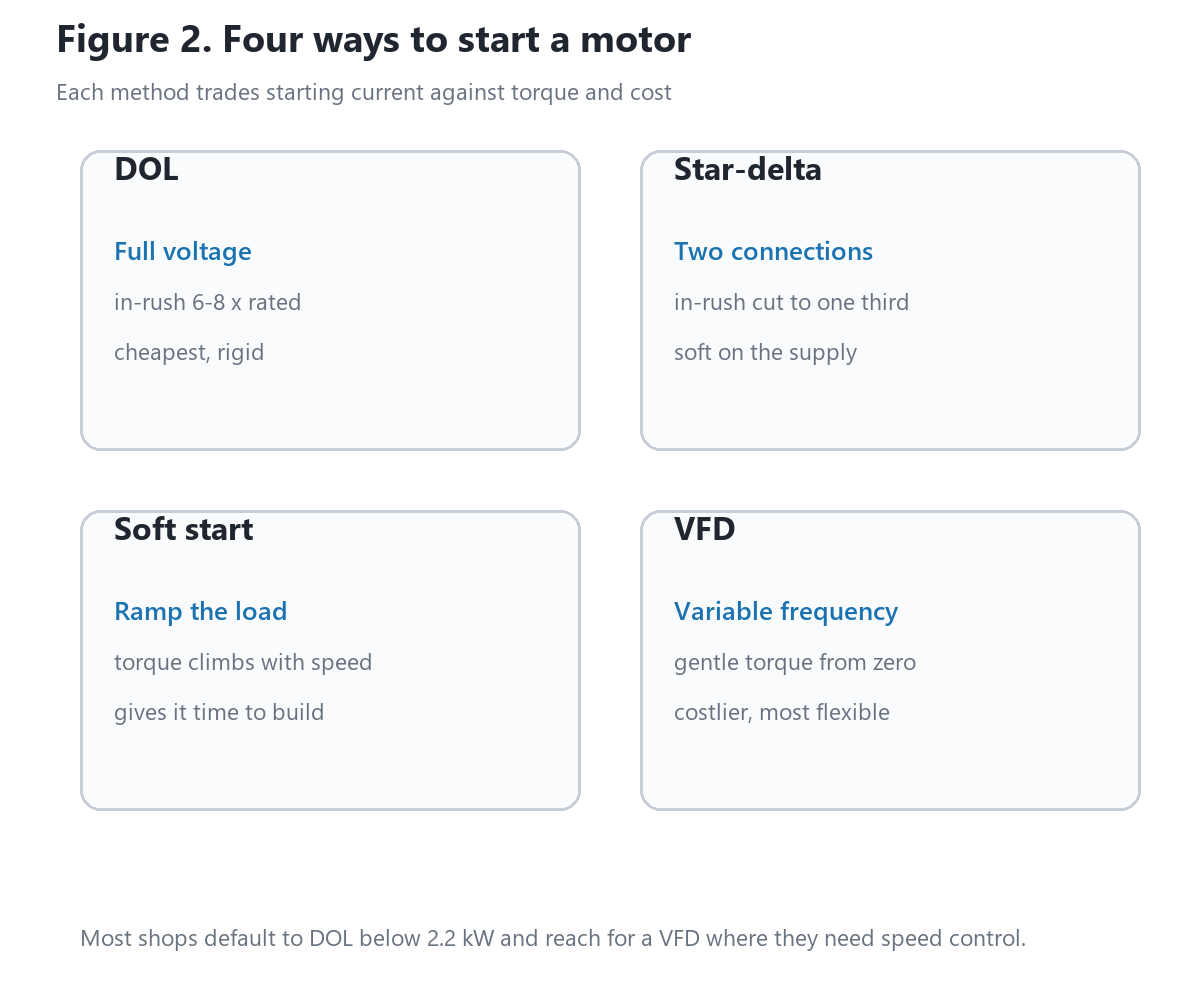
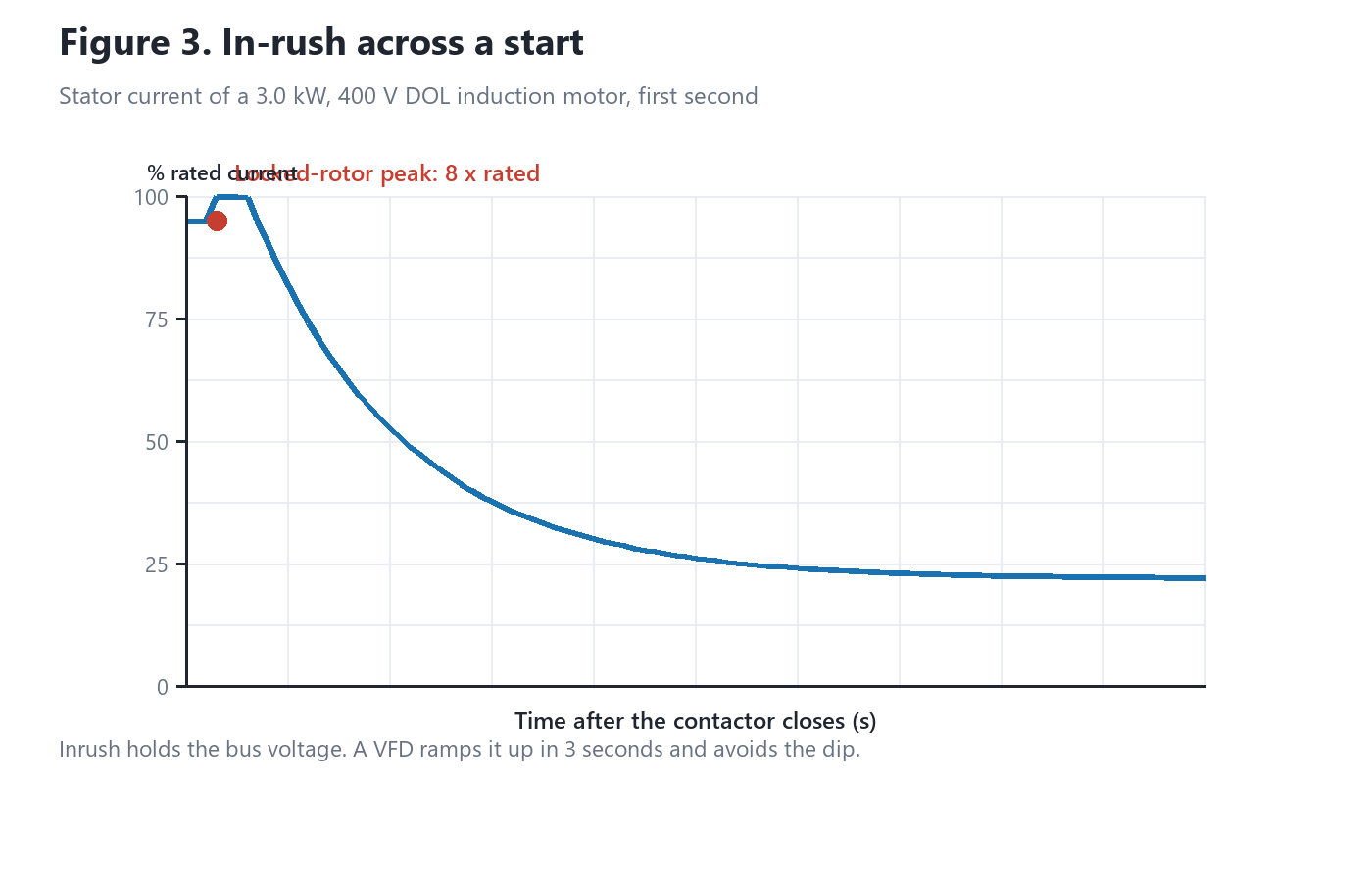
DOL, or direct-on-line, applies full voltage the moment the contactor closes. It is the cheapest option and the most rigid. A 3 kW, 400 V DOL motor pulls 8 times its rated current for a fraction of a second, which is fine on a stiff supply and rough on a long feeder. Where DOL is used on a heavy machine the bus sags, the lamps dip and a nearby drive can reset on the transient.
Star-delta reconnects the same windings from a star, where the line voltage across each winding drops by a factor of three, to a delta once the rotor is near speed. The inrush falls to roughly a third of the DOL figure and the torque follows suit, so a star-delta starter is the standard choice for pumps and fans that can build speed without a load bolted to the shaft.
A soft start uses phase-controlled thyristors or a small inverter to ramp the applied voltage over a few seconds. The inrush and the torque both climb gradually, which protects the belt, the gearbox and the motor itself from the mechanical shock of a hard start. A soft start is the cheapest way to soften a start when speed control while running is not needed.
A variable frequency drive, or VFD, generates its own voltage and frequency from DC bus to the motor. It starts at zero speed with full torque and can run at any speed in between, so it is the most flexible and the most expensive of the four. When a machine must run at variable speed, or when the panel sits on a long feeder and the inrush is the whole problem, the VFD is usually the correct tool despite the cost.
DOL versus star-delta, soft start and VFD in one table
| Method | Starting current | Starting torque | Cost | Speed control |
|---|---|---|---|---|
| DOL | 6 to 8 x rated | High | Low | None |
| Star-delta | About 1/3 of DOL | About 1/3 of DOL | Low | None |
| Soft start | Tunable, low | Ramping | Medium | None |
| VFD | Lowest | Full at zero speed | High | Continuous |
electric motor starter in practice: sizing and limits
Sizing the starter to the nameplate
Sizing a starter means matching three devices to the same set of numbers on the motor nameplate: the full-load amps, the locked-rotor current and the starting current multiplier. Get one of the three wrong and the panel fails in a way the next section will list.
The contactor must be AC-3 rated so its contacts survive the repeated lock-rotor inrush. A contactor bought as an AC-1, light-switching device for the same frame will ride the inrush once and then start to pit. The overload relay, whether a thermal link or an electronic I-squared-t monitor, is set to a fraction of the full-load amps so it opens on a genuine overload but ignores the short start peak. The supply cable and the terminal blocks must carry the locked-rotor peak for a few seconds without heating up, which usually drives the wire size rather than the trip.
In practice the locked-rotor multiplier is the number that decides the method. A typical induction motor locks at 5 to 7 times rated, a wound-rotor at 2 to 3, and a high-inertia flywheel load can ride the inrush for long enough that a soft start or a VFD is the only sane choice. The same multiplier is what a locked-rotor protection relay, as discussed in the related reading, watches for to open the coil before the winding heats past its limit.
The sizing standards are the ones in the source table: IEC 60947-4-1:2023 fixes the contactor ratings and the utilization categories, IEC 60034-1:2026 fixes the motor side, and NEMA 128 gives the full-load and locked-rotor tables that the whole sizing exercise reads from. A 15 kW motor on a 400 V supply locks at roughly 80 A, and that 80 A is the number the cable and the terminal have to carry for about 2 s on every start.
| Field | Use |
|---|---|
| Rated power (kW) | Picks the frame size |
| Full-load amps (FLA) | Sets the overload trip |
| Locked-rotor multiplier | Sets the contactor and cable |
| Utilization category | AC-3 vs AC-1 rating |
| Efficiency and power factor | Losses and the supply dip |
Standards the sizing reads from
Every number in the panel comes back to a standard, and the source table lists the ones that matter for a starter.
| Standard | Edition | Coverage |
|---|---|---|
| IEC 60947-4-1 | 2023 | Contactors, utilization categories AC-3 and AC-1, breaking ratings |
| IEC 60034-1 | 2026 | Rotating machines, ratings and performance of the motor side |
| NEMA 128 | 2023 | Full-load and locked-rotor current tables for sizing |
| IEC 60529 | 2021 | Degrees of protection, the IP codes on the enclosure |
| IEC 61180 | 2008 | Soft-start and reduced-voltage control methods for AC motors |
When a starter is the wrong tool: limits and mistakes
A starter is the wrong tool in a few specific places, and the failure modes are different from a plain overload trip. The next list is where a panel builder should stop and reconsider the whole method before the wiring begins.
Do not use a DOL starter where the supply sags, the machine is large, or the neighbours are sensitive to a voltage dip. The inrush holds the bus down for a moment and the lighting flickers or a PLC resets on the transient, and the complaint comes back a week later as a nuisance trip, not as a motor fault.
Do not use a VFD where the motor runs at a single fixed speed and the budget is tight; you are paying for a control range you will never use. A soft start covers the gentle-ramp need at a fraction of the cost and leaves the speed where it belongs.
Do not use any AC starter on a DC load, a battery-backed drive, or a servo that needs closed-loop position. Those want a DC controller or a drive with feedback, not a power switch, and the symptom of the wrong choice is a contact that welds on a machine that should not be switching at all.
- Stiff supply, small motor, cheap duty: DOL is fine.
- Sag-prone supply, large motor: star-delta, soft start or VFD.
- Single speed, low budget: skip the VFD, use a soft start.
- DC load or servo: not a starter, use a DC controller.
Enclosure and environment
The enclosure decides whether the contacts and the coil survive the environment around the panel. Dust, water, salt air and the temperature of the room all shift the rating you need, and the code on the door is not just a cosmetic label.
IP54 keeps dust out and stops splashing water, which suits a dry factory hall where the panel sits on the wall. IP65 and IP66 add spray and wash-down resistance for a wash bay, a loading dock or an outdoor post where a hose goes through the door every shift. The IEC 60529:2021 enclosure scale defines each code, and a starter bought for the wrong IP code will corrode its terminals within a season, starting at the bottom row where condensation collects first.
The device numbers on the control side follow ANSI/IEEE C37.2-2022, so the stop, start, fault and overload pushbuttons on the door map to the numbers on the drawing. The thermal overload and the control relay follow IEC 61180:2008 where a soft start or a reduced-voltage method is involved, and a starter bought on the wrong standard trips on the very first commissioning start.
The temperature class matters just as much as the IP code. A panel that runs in a hot plant at 45 C will trip its overload earlier than the same panel in a cool room, so derating the overload to the ambient is part of the commissioning, not an afterthought.

Failure modes and the faults that cause them
The most common field failures of a starter are not mysterious. A weak holding-in coil lets the contactor chatter on and off, the interlock that should keep the contactor from energizing during a fault lets it ride through, and the contacts erode until they weld and stop opening. Each of the three is visible if you look at the panel before you replace it.
Every failure traces back to one of three root causes: too many starts per hour, a supply that sags under the inrush, or a contactor under-rated for the AC-3 duty. A latching relay that sticks, or a time-delay relay that resets to zero on every trip, hides the real overload and lets the winding overheat until a puncture and a burn start at the terminal.
Diagnosis follows the same path every time. Listen first: a chattering contactor sounds, and so does one about to weld. Then read the trip history on the overload and match it to the starts-per-hour. A starter that resets after one clean start but trips after ten is not an overload, it is a duty problem, and the answer is a softer method, not a bigger fuse.
Choosing the method for the load
The method is where the starter earns its keep, and it is the one decision that the rest of the panel hangs on. A 15 kW motor on a sag-prone feeder with a long cable run is not a DOL machine, no matter how cheap the panel builder would like it to be.
DOL suits a stiff supply and a small machine. Star-delta suits a pump or a fan that can build speed without load. A soft start suits a machine that must not shock the belt or the gearbox. A VFD suits a machine that must run at variable speed or hold torque at zero. Each is the correct answer for one of four different plants, and the wrong answer for the others.
The electric motor starter you end up with is the method made into a panel. Get the method right and the rest follows; get it wrong and the panel fights the supply on every single start for the life of the machine.
Picking the right starter for a load
Picking the right starter for a given load follows a short path from the nameplate to the panel. Read the full-load and locked-rotor numbers, work out the duty in starts per hour, choose the method that holds the inrush, then match the enclosure to where the panel actually sits. Skipping one of those steps is where the panel comes back with a trip on the first commissioning.
A two-amp nameplate, a handful of starts an hour and a dry hall points at a plain DOL starter, the cheapest correct answer. A ten-amp nameplate on a sag-prone supply that also needs speed control points at a VFD. A pump that must start against a full head on a stiff supply points at a soft start, because it cannot build speed without a load. The path is quick, but every step is a hard number, not a guess, and the number is on the nameplate, not in a catalogue.
When the machine is a large motor, the differential protection on the feeder and the locked-rotor relay on the panel already have an opinion on the method, and the starter must agree with both. A panel that starts the motor before the protection has had its setting written in will protect nothing. The sizing is the same exercise the source table covers, read once at tendering and again at commissioning.
Wiring, interlocks and commissioning
Wiring a starter is the step where the three sizing numbers become a panel, and where the interlocks that keep a fault from riding through are actually wired in. The power side runs from the supply through the main contactor to the motor, and the control side runs from the stop and start buttons through the overload trip and the holding-in coil.
The interlock that matters most is the one that ties the overload into the control circuit. When the thermal trip opens, it must open the control coil, not just the overload contact, so the starter cannot be restarted into the same fault. A panel that skips that interlock will happily re-energize a motor that is still on fire at the winding, which is the classic way an electric motor starter fails on a commissioning test.
Commissioning follows the same path. Check the three numbers against the nameplate, verify the interlock, then do a single start against a real load and read the inrush. If the bus dips where the next section says it should not, the method is wrong for the supply and the answer is a softer start, not a bigger contactor.
The wiring standard is IEC 60947-7-1:2007 for the terminal and the connection, and IEC 60204-1:2016 for the control loop of the machinery it serves. A starter wired to the wrong control-loop standard will pass a single start and then fail on the fault that is supposed to test the interlock, which is the most expensive failure there is.
At a glance
- A starter brings a motor up to speed under controlled voltage
- DOL is cheapest and rigid; it rides 6 to 8 times rated inrush
- Soft start and VFD ramp the load to protect the supply and the machine
- AC-3 is the duty that a starter must be rated for, not AC-1
- Enclosure classes IP54 to IP66 match the working dust and water
- Sizing follows NEMA and IEC 60947-4-1:2023, FLA and FLC from the nameplate
- A 2.2 kW threshold often decides between a plain starter and a VFD
- Wiring errors and weak interlocks are the usual failure causes on site
FAQ
What is the main difference between a motor starter and a simple switch?
A switch only opens and closes a circuit. An electric motor starter adds the holding-in contactor, overload protection and interlocks needed to start, run and stop a motor safely and repeatedly.
When should I choose a soft start instead of a VFD?
Pick a soft start when you only need to reduce inrush and give the machine a gentle ramp, and you do not need variable speed while running. A VFD adds continuous speed and torque control.
What does AC-3 mean on a starter nameplate?
AC-3 is the utilization category for starting and running a squirrel-cage motor. A starter must be AC-3 rated, not just AC-1, to survive repeated lock-rotor inrush cycles without welding its contacts.
How do I size a starter for a given motor?
Read the full-load amps and the locked-rotor current on the nameplate, then match the contactor, overload and cable so each carries the locked-rotor peak for a few seconds without derating. NEMA 128 and IEC 60947-4-1:2023 give the tables.
Can I use a DOL starter on a large motor?
Only if the supply can hold the voltage dip. Above about 2.2 kW on a stiff line, or where you have a long cable or sensitive neighbours, use star-delta, soft start or a VFD to keep the inrush under control.
Why do starter contacts weld over time?
Repeated inrush and a poor power factor make the contact arc longer. Erosion, a failed interlock that lets the contactor chatter, and a weak holding-in coil all raise the arc energy until the poles weld shut.
Does an electric motor starter improve motor life?
Yes. Controlling the inrush and giving the machine a clean start protects the windings and the mechanical bearings. A starter that trips early on an overload also prevents a thermal runaway that would otherwise burn the stator.
Conclusion
An electric motor starter is the switchgear that starts, runs and stops a motor under controlled voltage. Pick the method to the supply, the duty and the enclosure, size every device to the nameplate numbers, and the starter does its job for years without a weld, a trip or a burn.
The decision is short and the numbers are on the nameplate. Match the contactor to the AC-3 duty, the overload to the full-load amps and the cable to the locked-rotor peak, and the panel will hold the inrush that is the whole reason the starter is there in the first place.
Related reading
- Motor protection relay functions and the overload elements that ride the stator current
- Motor differential protection and how the DC bus shapes the start
- Locked-rotor protection and the AC-3 duty that decides when a starter welds
- Motor protection relay selection: matching the starter to the load and the duty
Questions on the settings in this guide go to the engineering team, normally answered the same working day.
Protection matched to starter methods: low voltage motor protection relay; ASD-441H motor protection relay; 87M motor differential relay.
About Author

Hello, I'm Leon Zhang. I have 15 years of experience in the power relay protection industry with extensive pre-sales and after-sales project experience. Our company specializes in various complete sets of relay protection and automation equipment. I can assist customers in solving all practical on-site project challenges and provide optimal integrated solutions.
Tell Us Your Requirement
High Quality
Stable performance, reliable design, ensuring safe operation for power system protection and grid stability.
Fast Delivery
Timely delivery to support your urgent orders and project schedules efficiently and professionally at any time.
Best Warranty
Professional Warranty: Reliable after-sales support for stable relay protection and long-term customer satisfaction.