
-
Leon Zhang sales consultant
-
Email: zxl635973785@gmail.com
-
Phone/WhatsApp: +86 13655813266
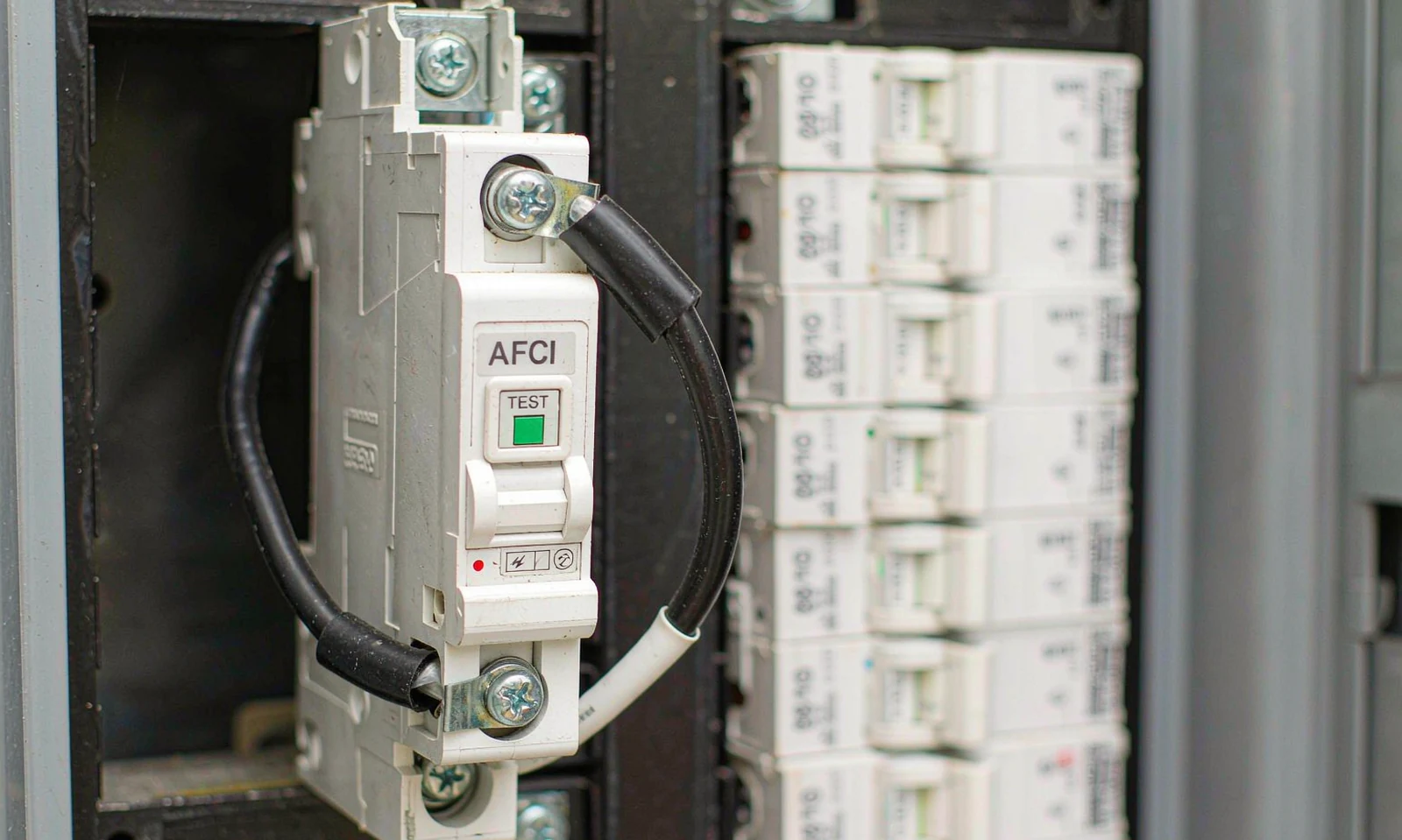
Arc Fault Breaker: A Practical Guide
An AFCI trips on the waveform signature of a burning arc rather than on current magnitude. This guide covers detection, device types, code rules and nuisance-trip diagnosis.
Arc fault breaker protection answers a question a thermal-magnetic breaker cannot: is the insulation already burning? An AFCI samples the branch-circuit current, looking for broadband noise and a flattened shoulder near the zero crossing, then trips in a fraction of a second, long before the arc has enough energy to ignite the cable jacket.
At a glance
- An AFCI detects arcs by waveform signature, not by current level, so it catches faults a breaker of the same rating ignores.
- Series arcs carry roughly the load current. Parallel arcs are limited by conductor impedance. Both sit below most magnetic trip thresholds.
- UL 1699 defines the device in North America. IEC 62606:2013 defines the AFDD used in Europe, the Middle East and much of Asia.
- NEC 210.12 requires AFCI protection on 120 V, 15 A and 20 A dwelling-unit branch circuits. The 2023 edition dropped the room list.
- A combination device covers the branch circuit, the cord and parallel arcing. A branch/feeder device covers the branch circuit only.
- Most nuisance trips trace to a shared neutral, a brushed motor or a switch-mode supply, not to a faulty breaker.
- A failed device usually fails safe by tripping on self-test. A breaker that stays closed through a real arc is the dangerous case.
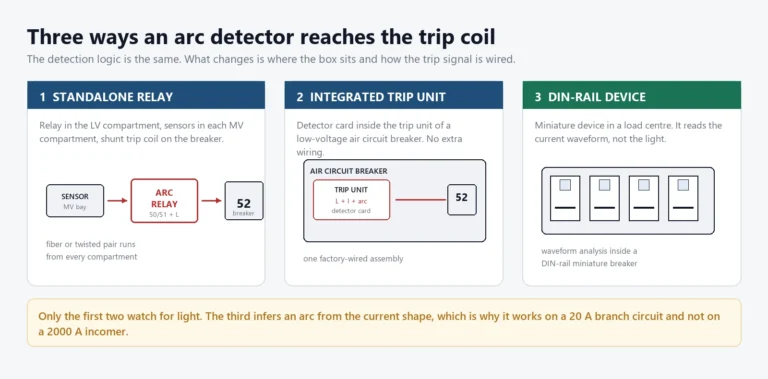
- Medium-voltage arc protection is a different device: optical sensors plus a current criterion, tripping in about 10 ms.
How an Arc Fault Breaker Reads a Waveform
Every AFCI contains the same four blocks. A current sensor, either a small current transformer or a shunt, feeds a solid-state amplifier and a band-pass stage. A processor compares the filtered signal against a library of arc signatures. A trip mechanism, usually shared with the thermal element, opens the contacts. Nothing in that chain measures true RMS the way a thermal element does.
No current threshold is involved anywhere in that chain.
An arc does not look like a resistor. Near each zero crossing the arc extinguishes and has to restrike, so the current hesitates for a fraction of a millisecond. On a scope that hesitation reads as a flat shoulder. Add the broadband noise of a restriking arc, from a few kilohertz up into the megahertz range, and the pattern becomes distinctive enough to classify.
Classification is the easy half. The hard half is refusing to trip on legitimate arcing. Brush motors arc at the commutator by design. Dimmers chop the waveform. Switch-mode supplies pull current in narrow pulses. A device that reacted to any of those would be pulled off the panel within a week, so the algorithm demands persistence and amplitude, and masks arcing that correlates with a normal switching event.
That masking is where the practical limits live. A 5 A series arc hides inside the normal current of a small appliance, and its RMS value looks like a 5 A load. A vacuum cleaner with a worn brush generates much the same signature as a damaged cord. The device separates them on timing and amplitude, and it does not always succeed.
| Signal | What it points to | Why a thermal-magnetic device misses it |
|---|---|---|
| Flat shoulder at the zero crossing | Restriking arc in series with the load | Current stays inside the thermal curve for minutes |
| Broadband noise above 1 kHz | Loose terminal or a nicked conductor | Filtered out of the thermal element by design |
| Current step without an inrush curve | Parallel arc across two conductors | Magnitude is limited by conductor impedance |
| Arcing that stops when a load is switched off | Arc inside the appliance or its cord | Looks like normal switching to a current-only device |
Two consequences follow from that architecture. First, the device cannot be graded like an overcurrent element, because there is no inverse time curve to grade against. Second, its accuracy depends on a signature library, so behaviour differs between manufacturers on the same fault. Two brands on the same panel can disagree about a vacuum cleaner, and both can be within their listing.
Series Arc and Parallel Arc
A series arc sits in the current path. A loose terminal screw, a conductor nicked by a staple, a broken strand in a cord. The arc carries the load current, so the current stays roughly where it was and the circuit keeps working.
That is what makes it dangerous. The load still runs, the breaker still holds, and the only evidence is a faint crackle and a warm spot at the terminal. A parallel arc bridges two conductors at different potential, line to neutral or line to earth, and the current bypasses the load entirely. Magnitude then depends on conductor impedance and on the arc itself.
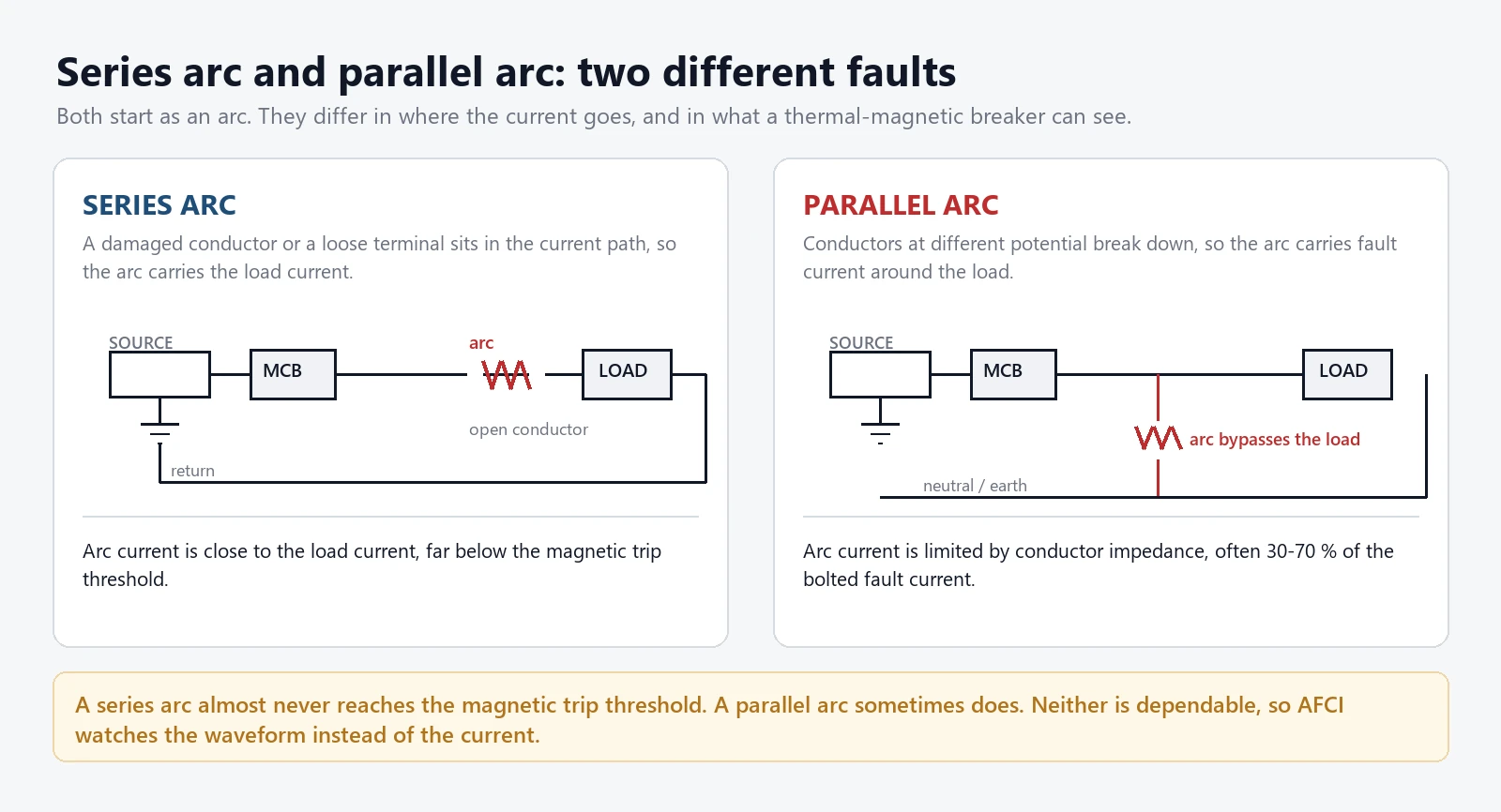
Both erode metal.
A 5 A series arc across a 15 V gap deposits about 75 W into a spot the size of a grain of rice, and that spot usually sits inside a wall. Ignition takes minutes rather than seconds, which is the only reason the fault is survivable at all: there is time to detect it.
| Fault path | Typical current | Thermal-magnetic response | AFCI response |
|---|---|---|---|
| Series arc at a loose terminal | 2 A to 30 A | Holds, the current sits inside the thermal curve | Trips on signature within seconds |
| Parallel arc, line to neutral | 30 A up to several kA | Trips if the current passes the magnetic threshold | Trips on signature, often first |
| Parallel arc to earth | Limited by the earth path impedance | May never trip | Trips on signature or on earth leakage |
| Bolted short circuit | Prospective fault current | Trips magnetically in 10 ms to 20 ms | Both elements agree, no advantage |
AFCI, GFCI and the Plain MCB
Three devices answer three different questions. A miniature circuit breaker asks how much current is flowing. A GFCI or RCD measures differential current and asks whether any of it is coming back by the wrong path. An AFCI asks what the current looks like. Fitting one does not cover the others, which is why dual-function devices now dominate the residential market.
An RCD trips at 30 mA for shock protection, or 300 mA for fire protection where the code allows it. That threshold sits far above the current a series arc draws, so the device ignores the fault until the arc develops into an earth fault. An AFCI has no earth-fault element at all, so it will not save a person who touches a live conductor.
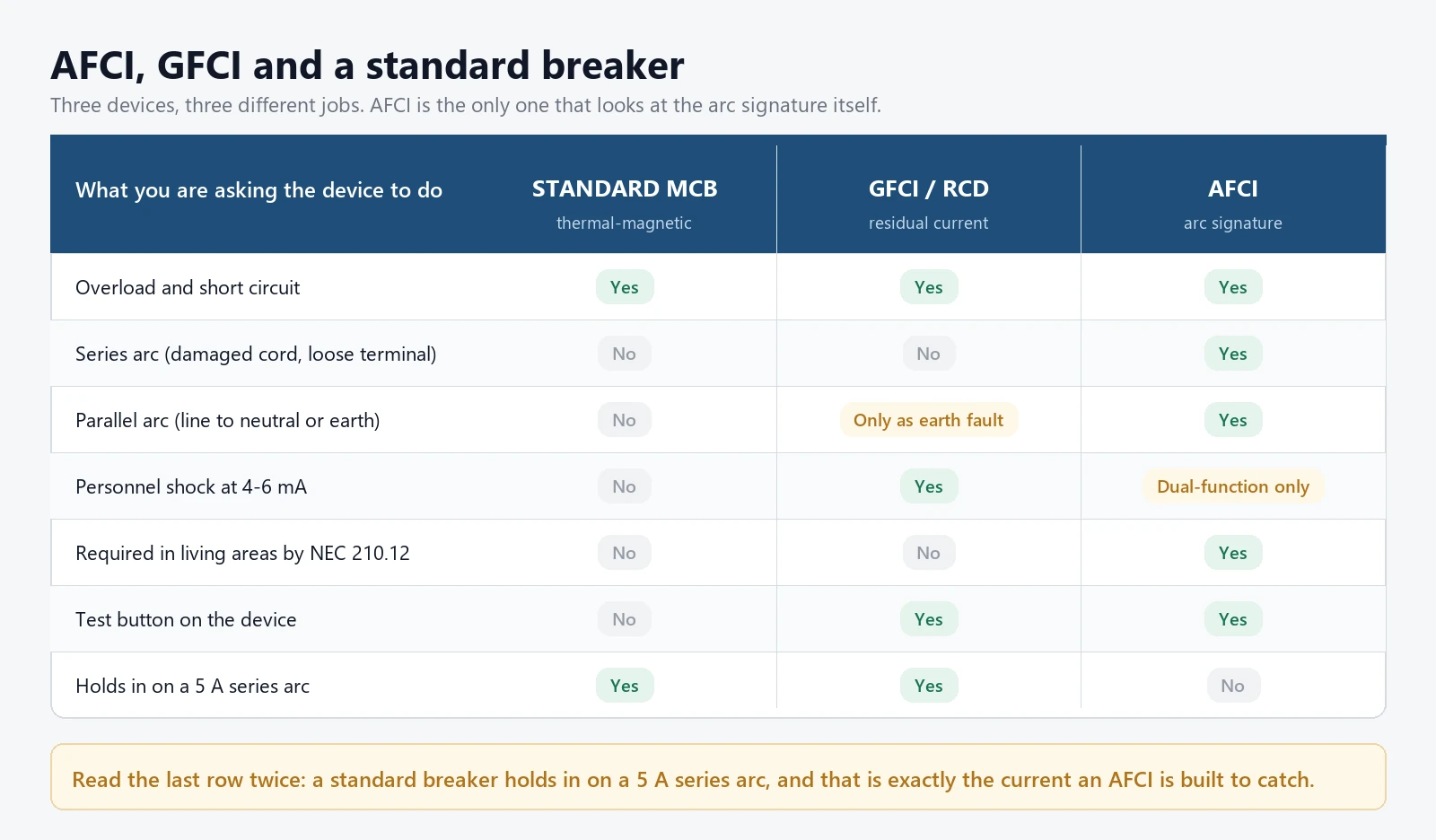
A standard MCB of the same rating is not a cheaper substitute for either. It protects cable from overload and from short circuit, and it does that job well. It simply has no opinion about a 5 A arc, because the current never leaves the range it was designed to tolerate.
Where the Codes Require an Arc Fault Breaker
North America leads. NEC 210.12 has required AFCI protection on dwelling-unit branch circuits since the 1999 edition, starting with bedrooms and spreading outward. The list of rooms grew through 2002, 2008 and 2014, until the 2023 edition dropped it and applied the rule to all 120 V, single-phase, 15 A and 20 A branch circuits in a dwelling unit.
The device standard behind that rule is UL 1699. It sets the test arcs, the masking requirements and the response times for branch/feeder, combination, outlet circuit, cord and portable devices. A breaker carrying an AFCI label but tested only to a branch/feeder protocol will not catch a cord fault at the receptacle, and the label alone does not tell you which protocol was used.
Outside North America the picture is patchier. IEC 62606:2013 with Amendment 2 (2022) defines the arc fault detection device, an AFDD, for household and similar installations up to 440 V and 63 A. Several national codes reference it. Few make it mandatory on every final circuit, and that gap is why AFDD uptake in Europe has run behind the maturity of the standard.
The edition that matters is the one your authority has adopted.
Branch, Combination and Outlet Circuit Versions
UL 1699 splits the family by what the device can see. A branch/feeder unit watches the busbar and the branch conductors. A combination arc fault breaker adds the cord and the parallel arc path, which was the point of the 2008 code change. Outlet circuit units sit at the first receptacle, and cord or portable versions travel with the appliance.
| Device | Coverage | Where it is used | Mounting |
|---|---|---|---|
| Branch/feeder AFCI | Panel busbar and branch wiring | Feeders, older panels, retrofit | Breaker in the panel |
| Combination AFCI | Branch wiring, cord and parallel arcs | Dwelling-unit branch circuits under NEC 210.12 | Breaker in the panel, one or two poles |
| Outlet circuit AFCI | Wiring downstream of the first outlet | Retrofit where panel space is short | Receptacle box |
| Cord AFCI | The appliance cord only | Portable tools, extension leads | Inline or plug-in |
| Portable AFCI | Whatever is plugged into it | Temporary and job-site circuits | Inline unit |
Sizing, Neutral Routing and Panel Coordination
Rating follows the conductor, not the load.
14 AWG copper takes a 15 A device and 12 AWG takes 20 A. An AFCI is not exempt from that rule, and a 20 A device on 14 AWG is a code violation whether or not the electronics inside it are cleverer than a thermal element.
Wiring is where most installations go wrong. A single-pole AFCI has a coiled neutral pigtail that lands on the panel neutral bar, and the circuit neutral must return through the device. Two circuits sharing one neutral in a multiwire branch circuit will trip the device every time, because it sees current leaving on a path it did not supply.
Coordination with the main device is a separate question. An AFCI is a branch device with a limited interrupting rating, and it leans on the upstream breaker for fault levels above that rating. Check the series rating combination on the panel schedule before assuming the pair is listed together.
A service-level ground fault relay and an arc fault breaker do different jobs at different points in the system. The relay watches the main bonding jumper for leakage across the whole installation. The branch device watches one circuit for a joint that is starting to burn.
Nuisance Tripping: Diagnosis in Five Steps
Half the callbacks on an AFCI installation are not device failures. They are a real fault the electrician has not found yet, or an installation detail the device was never going to tolerate. Work the circuit before replacing the breaker.
Shared neutrals top the list.
A multiwire branch circuit with two hots on opposite phases and one neutral works fine on thermal breakers and trips instantly on AFCI. Pig-tailing the neutral at the first outlet solves it, and so does moving one circuit onto its own neutral.
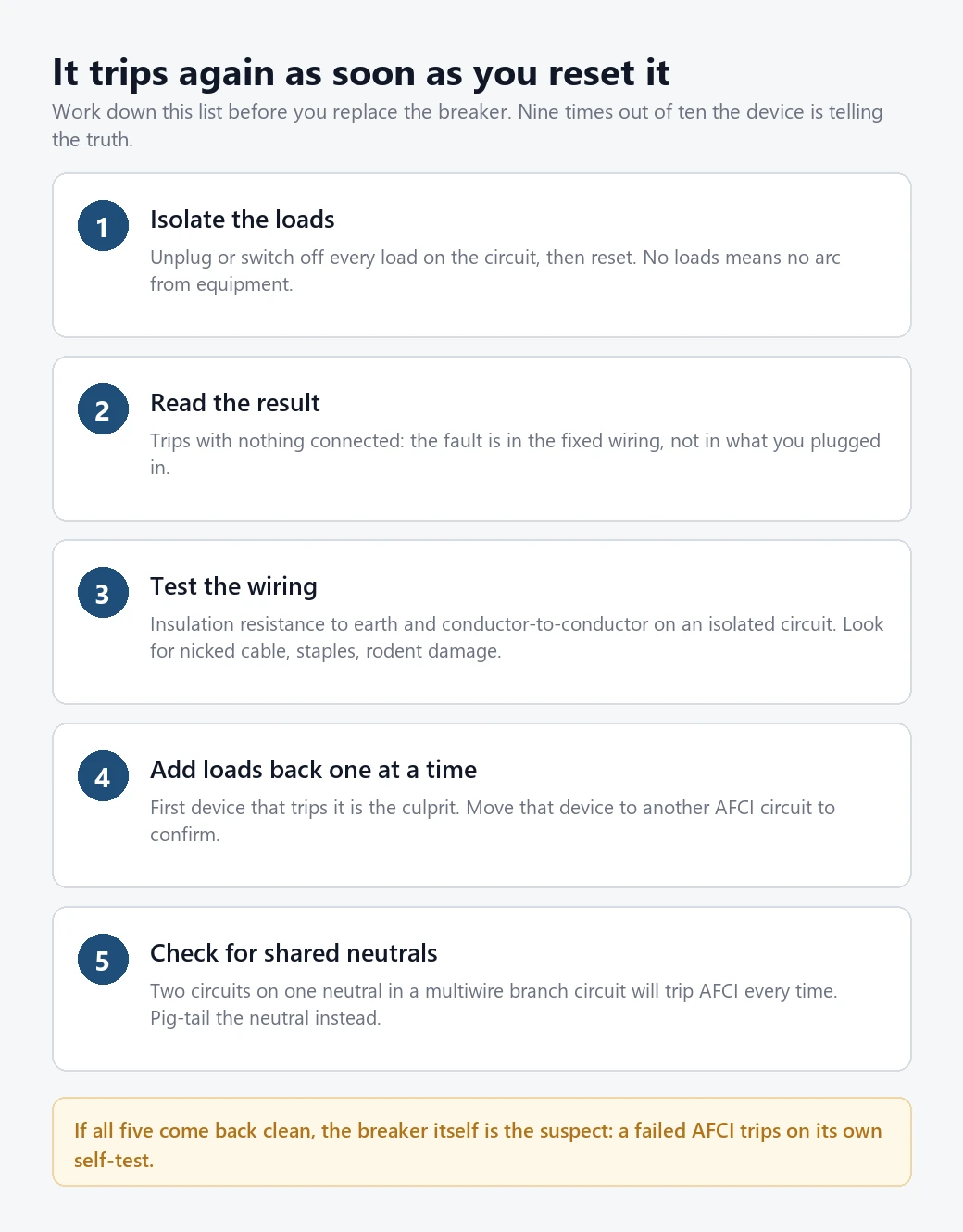
Brushed motors come second. A vacuum cleaner, a circular saw, a drill with a tired commutator. The arcing is real, it happens inside the appliance, and a combination device is meant to discriminate against it. Most do. Some do not, especially when the brushes are near the end of their life and the arc burns steadily instead of in bursts.
Switch-mode supplies come third. A large television, a gaming machine, a battery charger with a poor power factor draws current in narrow pulses that look like arcing to a simple classifier. High inrush at switch-on is the tell: a trip in the first second points at the supply, not at the wiring behind the wall.
The moisture case is the one that hides. A circuit that trips only in wet weather, or only in the early morning, has water in a junction box or a cable damaged by a roof leak. Nothing in the panel will show it. An insulation resistance test on an isolated circuit will, and that test is the only way to tell a genuine series arc from a device that is over-sensitive.
When an Arc Fault Breaker Is the Wrong Device
The device has a narrow job description. Five situations sit outside it, and forcing it in creates a different hazard rather than a smaller one.
- Service and feeder conductors. A 200 A feeder needs ground fault protection at the service, not a branch-circuit arc detector. Use a ground fault relay or insulation monitoring.
- Medium-voltage switchgear. A 5 A arc at 11 kV releases energy on a different scale entirely, and light-sensing protection with a 10 ms trip is the correct device.
- VFD-fed motor circuits. The drive’s switching frequency and leakage current sit inside the detection band, and nuisance trips follow the installation.
- PV direct-current strings. Direct current never crosses zero, so the arc signature differs. UL 1699B covers PV arc-fault interrupters, and an AC device is not interchangeable.
- Life-safety circuits. A spurious trip on a fire pump or an emergency lighting circuit is itself a failure mode. Thermal protection with monitoring is the usual answer.
Testing and Commissioning an AFCI
The TEST button is a limited instrument. It injects a simulated arc signal into the sensing circuit and confirms the electronics can reach a trip decision. It does not fire the trip coil through the full trip path, and it will not reveal welded contacts.
Self-testing fills part of that gap.
Most modern devices run an internal check every few hours and trip on failure, which is why a dead AFCI usually shows up as a breaker that will not stay closed rather than one that stays closed when it should not.
Commissioning an arc fault breaker on a new circuit takes three steps. Press TEST and reset, then confirm the circuit energises. Load the circuit to its rating and confirm no trip. Then repeat TEST with the load still connected, which exercises the trip path under current rather than at no load.
Keep a trip log for the first month on any large installation. Date, circuit, load connected, weather. Three entries are usually enough to point at the cause, and the log settles arguments about whether a device is faulty far faster than a replacement does.
AFCI and Medium-Voltage Arc Protection Are Not the Same Job
Both devices exist because an arc is not a short circuit, and both are sold under the word arc. That is where the similarity ends.
An AFCI works at 120 V or 230 V, on a 15 A or 20 A branch circuit, and it exists to stop a slowly developing fault inside building wiring. Its response is measured in seconds. Current levels are small enough that the arc does negligible damage at the moment of detection, and the danger is cumulative heating instead.
An arc protection relay works at 3 kV to 36 kV, where a phase-to-phase arc reaches 20 kA or more and the pressure wave from the arc root can deform a cubicle door in under 100 ms. Detection uses optical sensors inside each compartment, confirmed by a current criterion, and the trip reaches the breaker in about 10 ms. IEEE 1584-2018 sets out how the incident energy is calculated, and IEC 60255-1:2022 covers the relay hardware itself.
Confusing the two leads to specifying a residential device where a light-and-current scheme is needed, or the reverse. The light and current arc protection scheme covers the medium-voltage case in detail, including sensor placement and the 10 ms trip budget. Our own ATN-800H arc protection relay is built to that arrangement.
Cost, Service Life and Replacement
An arc fault breaker costs two to four times what a thermal-magnetic device of the same nameplate rating costs. Across a 20-circuit panel that is a real number, and it is the reason retrofits often stop at the circuits the code actually names.
Price is not the deciding variable.
Service life is set by the electronics, not the contacts. Manufacturers publish figures in the region of 10 to 20 years, and the self-test is what ends it in practice. A device that has tripped on self-test and will not reset is at end of life, not faulty in the warranty sense.
Replacement usually comes down to two questions. Has the device tripped on self-test? Has the installation changed underneath it, with a new multiwire circuit or a larger inverter on the same panel? Either answer points at a new device or a change to the wiring, and neither points at a bigger rating.
Mistakes That Cause Repeat Callbacks
Five errors account for most of the repeat visits we hear about. None of them is exotic, and all of them are cheaper to avoid than to fix.
- Fitting the device on a circuit with a shared neutral. It is doing its job and will keep doing it until the wiring changes.
- Upsizing the breaker to stop nuisance trips. That removes the protection and leaves the fault in place.
- Treating the TEST button as proof of the trip path. It proves the sensing circuit and nothing beyond it.
- Using a branch/feeder unit where the code asks for combination protection. The cord fault stays invisible.
- Replacing the device without an insulation test. The new one trips as well, and the second visit costs more than the first.
Conclusion
An arc fault breaker is a waveform instrument wearing a breaker’s clothes, and that is the source of both its value and its reputation for nuisance tripping. It catches the fault a thermal device cannot see, at the cost of judging current shape rather than current size.
Specify it by the code article that applies, wire the neutral the way the device expects, and diagnose a trip before condemning the hardware. Most of what goes wrong on these circuits sits in the wiring, not in the electronics.
Frequently asked questions
What is the difference between an AFCI and a GFCI?
An AFCI looks at the shape of the current and trips when it recognises the signature of an arc. A GFCI measures the difference between current leaving on the live conductor and returning on the neutral, and trips at 30 mA or less. One protects wiring from a burning joint, the other protects people from a shock.
Will it stop me getting a shock?
No. Shock protection needs a residual current element at 30 mA or below. A device with both functions is sold as a dual-function or combination unit, and that is the one to specify where both risks exist.
Why does it trip when I plug in a vacuum cleaner?
A brushed motor arcs at the commutator as a normal part of running, and a worn brush set makes the arc steadier. The device is seeing genuine arcing and cannot always separate it from a fault. Try the appliance on another protected circuit before assuming the breaker is faulty.
Can I replace it with a standard breaker?
Only where the code does not require arc protection on that circuit. Replacing a required device with a thermal-magnetic one removes a code requirement and leaves the original fault path unprotected. On a circuit that keeps tripping, the substitution hides the symptom rather than solving it.
How often should the device be tested?
Monthly is the figure most manufacturers print on the label, and quarterly is what most installations actually get. The self-test runs far more often, every few hours on modern units, so the manual test is confirmation rather than the primary check.
Do kitchen circuits need arc protection?
Under the 2023 edition of NEC 210.12, yes. The room list was removed, so the requirement now covers all 120 V, single-phase, 15 A and 20 A branch circuits in a dwelling unit, kitchen and laundry included. Older editions treated those rooms differently.
What does it mean when the breaker will not reset?
Either a fault is still present on the circuit, or the device has failed its self-test and is holding itself open. Isolate every load and try once more. If it still refuses with nothing connected, the wiring or the device is at fault, and an insulation test separates the two.
Related reading
- Short-circuit protection relays, for the fault current a parallel arc eventually grows into.
- Circuit breaker selection, for interrupting capacity and trip curves on the same panel.
- Nuisance tripping on protection relays, the same diagnostic logic applied to substation schemes.
- Earth fault relay settings, when the fault path runs to earth rather than to neutral.
Sources and standards
| Source | What it covers | Type | Edition |
|---|---|---|---|
| UL 1699 | Arc-fault circuit-interrupters: device categories, test arcs, masking | Standard | Current |
| IEC 62606:2013 | Arc fault detection devices for household use, up to 440 V and 63 A | Standard | 2013 + AMD2 2022 |
| IEC 60898-1:2015 | Miniature circuit-breakers for household and similar installations | Standard | 2015 |
| IEC 61009-1:2013 | RCBOs combining overcurrent and residual current protection | Standard | 2013 |
| IEC 60364-4-42:2010 | Protection against thermal effects, including arc fault detection | Standard | 2010 |
| IEC 60947-2:2016 | Low-voltage circuit-breakers: ratings, tests, utilisation category | Standard | 2016 |
| IEEE 1584-2018 | Incident energy calculation for arc flash in switchgear | Guide | 2018 |
| IEC 60255-1:2022 | Measuring relays and protection equipment, common requirements | Standard | 2022 |
| ANSI/IEEE C37.2-2022 | Device function numbers, including 50, 51 and 86 | Standard | 2022 |
Table 4. Standards referenced above, with the edition each figure in this guide was taken from.
Field observations in this guide come from our own panel builds and commissioning records between 2023 and 2026, on 415 V distribution boards and 11 kV switchgear. They describe what we measured on those installations and nothing beyond them.
About Author

Hello, I'm Leno Zhang. I have 15 years of experience in the power relay protection industry with extensive pre-sales and after-sales project experience. Our company specializes in various complete sets of relay protection and automation equipment. I can assist customers in solving all practical on-site project challenges and provide optimal integrated solutions.
Tell Us Your Requirement
High Quality
Stable performance, reliable design, ensuring safe operation for power system protection and grid stability.
Fast Delivery
Timely delivery to support your urgent orders and project schedules efficiently and professionally at any time.
Best Warranty
Professional Warranty: Reliable after-sales support for stable relay protection and long-term customer satisfaction.