
-
Leon Zhang Sales Manager
-
Email: sale@relayprotect.com
-
Phone/WhatsApp: +86 13655813266
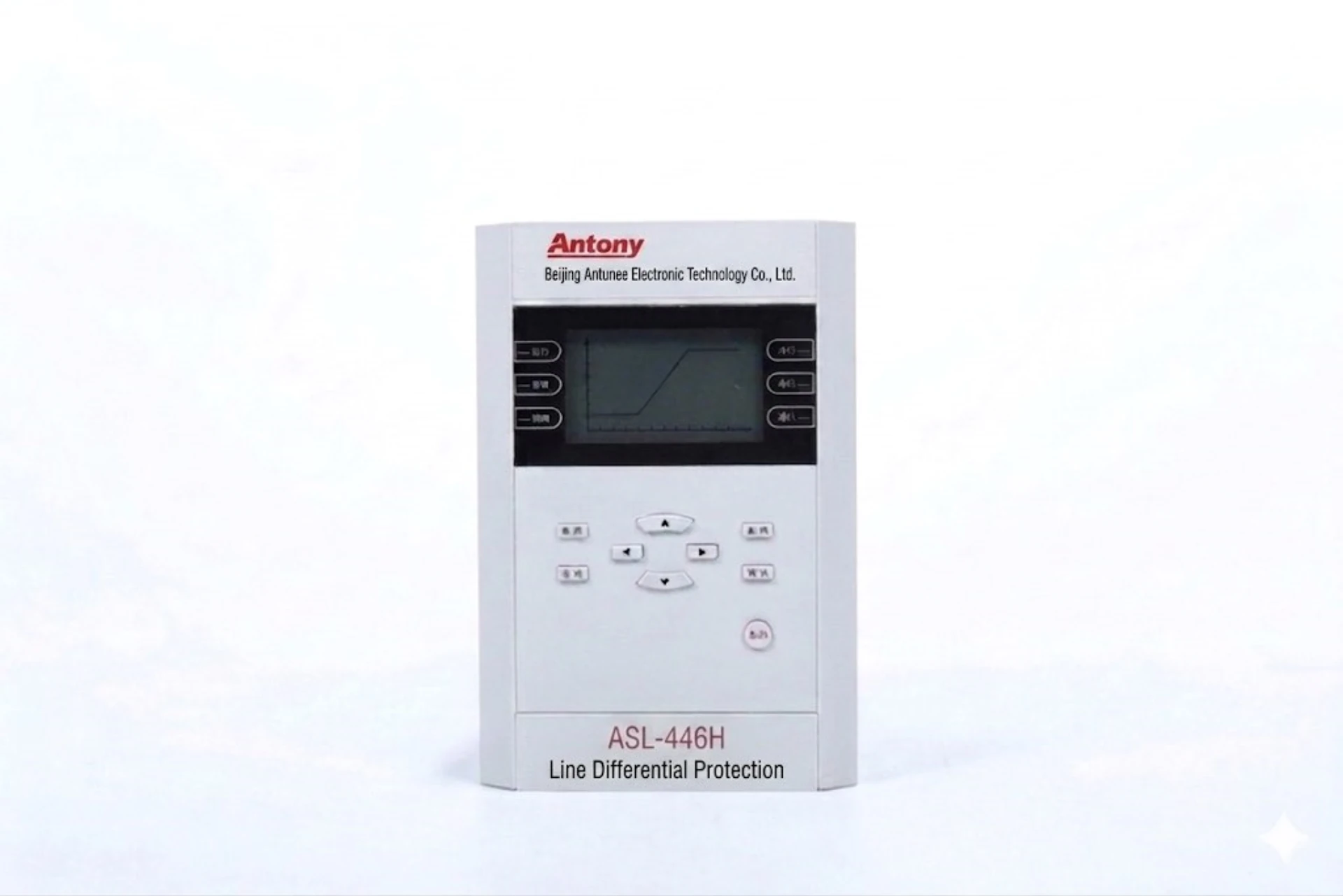
Line Differential Protection: Choosing, Setting, Testing
Where an 87L scheme is worth its channel cost, what the two line ends must share, and how to commission the scheme end to end.
What is line differential protection and when is an 87L scheme worth it?
Line differential protection compares current entering a line with current leaving it; when the difference exceeds charging current and measuring error, the fault is inside the zone and both ends trip at once. ANSI 87L is the device number, and 87B covers the busbar zone. A scheme needs two matching relays, a communication path and an end-to-end test involving both sites, so the cost has to buy something. A dedicated fibre pair is easiest to commission because its delay stays fixed after a re-route; on a routed channel the relay must measure and compensate a varying delay. The CTs are part of the protection, not accessories: CT supervision detects a missing input, blocks the zone and alarms instead of tripping a healthy line. GPS, BeiDou or IEEE 1588 PTP aligns sampling clocks when samples come from merging units on a process bus using IEC 61850. Installed schemes run from 6 kV to 110 kV. Setting review and quotation within 12 hours, MOQ 1, 7-15 working days.
Line differential protection compares the current entering a line with the current leaving it. When the difference is larger than the charging current and the measuring error, the fault is inside the protected zone and both ends trip at once. The idea is simple. Making it work across a communication channel is where projects go wrong. This page covers the decisions a buyer or design engineer has to make: where the scheme is worth its cost, what the two ends must share, and how the scheme is proved before energisation.
Where an 87L Scheme Is Worth the Channel
A line differential scheme needs two matching relay sets, a communication path between the substations, and an end-to-end test that involves both sites. That is a real cost, so it is worth being clear about what it buys.
- Short lines. On a line of a few kilometres the distance zones collapse on top of each other and reach cannot be set with confidence.
- Lines fed from both ends. Infeed from the far end changes what a distance element sees. A differential zone sees the sum of both currents instead.
- Cable circuits. Charging current and sheath effects make impedance measurement unreliable, while a differential zone compares currents directly.
- Tapped or teed lines. A third terminal can join the same differential zone. A distance scheme cannot protect a tee cleanly.
- Stability limits. Where a delayed clearance threatens transient stability, unit protection with no intentional delay is the usual answer.
Current Transformers at Both Line Ends
The scheme can only compare what the two ends measure, so the current transformers are part of the protection, not accessories.
- Use a dedicated core. Sharing a core with metering or with another protection adds burden and puts a second client on the same winding.
- Keep the ratio the same where possible. Where the two ends must differ, the relay scales the remote currents and that ratio has to appear in both setting files.
- Star point toward the line at both ends, so the currents enter the zone with the same polarity. A reversed polarity at one end is one of the most common commissioning faults.
- Check the CT class against the connected burden, not against the rated burden on the nameplate.
- Expect saturation on through faults with DC offset. Bias and saturation detection handle most of it, but the setting has to leave room for it.
- Enable CT supervision. When one end loses a current input the relay should block the zone and alarm, not trip on a false differential.
Channel Options and Their Trade-offs
A dedicated fiber pair is the easiest to commission because the delay does not change after a network re-route. Routed networks still work, but the relay has to measure and compensate the delay, and the protection engineer has to know what happens when the route changes at three in the morning.
Time Synchronisation Without a GPS Clock
Two methods are in use, and they answer different questions.
- Channel-based timing. The relay measures the round-trip delay over the same channel it uses for currents and splits it in half. No absolute time reference is needed, so a scheme over a dedicated fiber pair can run without GPS or BeiDou.
- Absolute time. GPS or BeiDou one-pulse-per-second, or IEEE 1588 PTP, aligns the sampling clocks at both ends. This becomes mandatory when samples arrive from merging units over a process bus, because the relay no longer owns the sampling instant.
Commissioning an 87L Scheme End to End
- Compare the two setting files. Line length, CT ratio, channel type, zone limits and relay addresses must agree. A mismatch here is the most common reason a scheme trips on load the first time it is energised.
- Measure the channel delay in both directions and record the asymmetry in the commissioning file.
- Inject secondary current at both ends. Confirm the element restrains on balanced current and operates on an injected differential.
- Use the relay end-to-end test mode where the relay provides one. It exercises the real channel instead of a simulated one.
- Prove CT supervision. Open one current circuit, then confirm the zone blocks and the alarm appears.
- Check trip transfer and breaker failure interaction, then sign off the results with the client witness present.
Faults That Look Like 87L Problems
When 87L Is the Wrong Scheme
- A radial feeder with one source. Overcurrent protection clears the fault and there is no second end to compare with.
- A line where no communication path exists and none can be built inside the project budget.
- A very short cable inside a switchyard that a busbar zone already covers.
- Projects whose protection philosophy places unit protection at the transformer and distance protection on the lines.
What the Scheme Needs From the Substation
The relay is the visible part of the scheme. The rest has to be in the substation before the relay can work.
- Two current circuits per end, wired from dedicated cores to the relay terminals, with test blocks so a secondary injection can be applied without opening the circuit at the CT.
- A fiber termination point at each end, with the pigtail, the splice box and the spare pair documented. A single pair with no spare is a single point of failure for the protection.
- Auxiliary supply for both relays, normally a station battery, with the DC alarm wired back to the station annunciator.
- Trip circuits to both breakers, plus the channel to the remote end for trip transfer where the scheme uses it.
- Panel space and wiring drawings agreed before production, so the factory wiring matches the site terminal numbers.
What to Send for a Line Protection Quotation
A quote for an 87L scheme depends on facts only the buyer has. Send these and the reply comes back as a model match rather than a list of questions.
- Single-line diagram with line length, voltage and the number of terminals.
- CT ratios and classes at both ends, and whether the cores are dedicated.
- Channel type: dedicated fiber, multiplexed channel, or none decided yet.
- Functions required: 87L alone, or 87L together with distance and teleprotection.
- Mounting: rack, panel or outdoor cabinet, and the design standard in use.
- Delivery point and required date.
Send the single-line diagram and the line data through the contact form, and the reply includes a model match, the terminal count and a delivery date. Both 87L relays are listed with their full function tables: ASL-441XLH and ASL-446H. Distance protection and busbar zones are covered in the distance protection guide and the 87B guide.
Field record
Line differential in our record is concentrated between 6 kV and 110 kV: Vietnam (6-110 kV steel plants, hydro stations and mine substations), Myanmar (35-110 kV mine and industrial substations), Kazakhstan (6-35 kV) and Saudi Arabia (33-110 kV). Below roughly 35 kV the pilot channel is usually fibre inside a plant, not a utility circuit, which changes the commissioning test but not the setting calculation. See the project record.
Questions Engineers Ask About 87L
Is line differential protection the same as 87L?
Yes. ANSI 87L is the device number for the line differential function, and most European designs use the same term for the same scheme.
Can 87L work without a fiber channel?
Yes, if a multiplexed channel is available. The relay needs a two-way path for currents, not fiber specifically. What changes is the delay: a routed or multiplexed channel varies more, so delay measurement matters more.
What happens when one CT circuit fails?
A current-operated differential sees the loss as a large differential current and would trip. CT supervision detects the missing input, blocks the zone and raises an alarm, so the scheme degrades to backup protection instead of tripping on a healthy line.
Does 87L need GPS timing?
Not when the relay measures the channel delay itself. GPS, BeiDou or IEEE 1588 becomes necessary when samples come from merging units on a process bus, because the sampling instants must be aligned to a common clock.
Is there a minimum line length for 87L?
There is no fixed limit, but short lines are where the scheme earns its cost, because distance protection runs out of reach there. The practical limit is the charging current and the available channel, not the length on its own.
About Author

Hello, I'm Leon Zhang. I have 15 years of experience in the power relay protection industry with extensive pre-sales and after-sales project experience. Our company specializes in various complete sets of relay protection and automation equipment. I can assist customers in solving all practical on-site project challenges and provide optimal integrated solutions.
Tell Us Your Requirement
High Quality
Stable performance, reliable design, ensuring safe operation for power system protection and grid stability.
Fast Delivery
Timely delivery to support your urgent orders and project schedules efficiently and professionally at any time.
Best Warranty
Professional Warranty: Reliable after-sales support for stable relay protection and long-term customer satisfaction.