

-
Leon Zhang sales consultant
-
Email: zxl635973785@gmail.com
-
Phone/WhatsApp: +86 13655813266
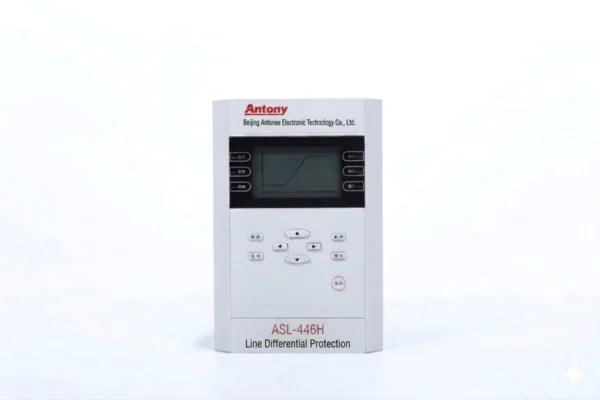
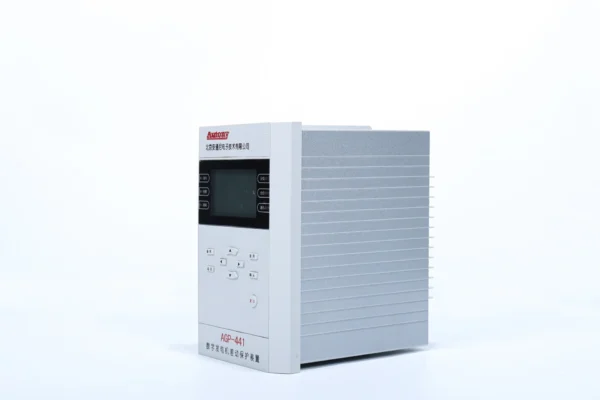
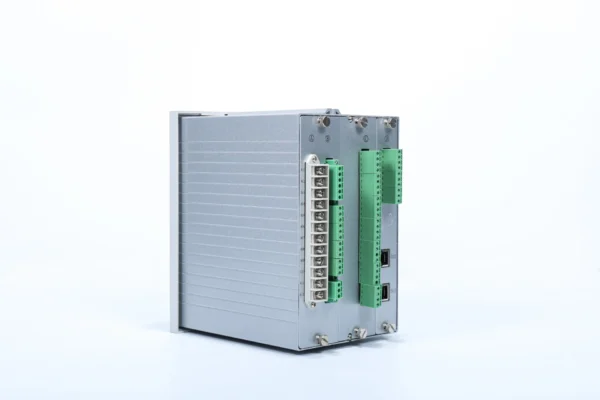
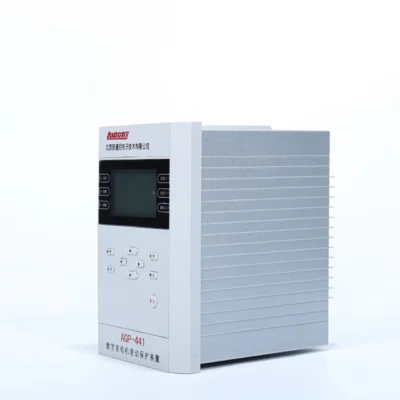
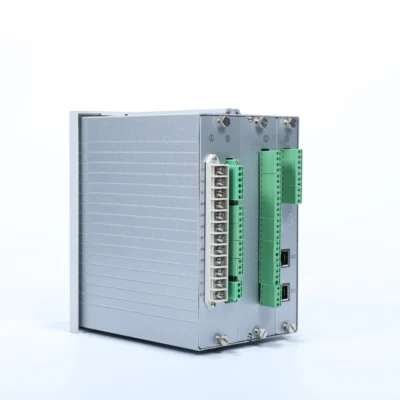
ASL-446H Line Differential Protection Relay
Numerical differential protection for fast and selective protection of short transmission lines
Key Features
- Line current differential protection
- Differential instantaneous overcurrent protection
- CT disconnection detection and blocking
- Fast internal fault clearance
- Real-time current comparison between line terminals
- Fault recording and event logging
- RS-485 / CAN / Ethernet communication
- IEC 60870-5-103 communication
Typical Applications
Short transmission lines · Overhead lines · Cable lines · Substations · Distribution networks
Send your requirements, we will quote for you within 12 hours
Description
ASL-446H Line Differential Protection Relay Overview
The ASL-446H is a high-speed numerical line differential protection relay specifically designed for the protection of short overhead lines, cable feeders, and mixed line systems where distance protection may face limitations. It operates on the well-established current differential principle—continuously comparing the magnitude and phase of currents measured at both terminals of the protected line via a communication channel.
Under normal load or external fault conditions, the currents at both ends remain substantially balanced, resulting in a differential current close to zero. In this state, the relay remains stable and does not trip. However, when an internal fault occurs—such as a phase-to-phase short circuit, three-phase fault, or earth fault within the protected zone—the current balance is broken. The relay detects a significant differential current and issues an instantaneous trip command to clear the fault with high speed and full selectivity.
The ASL-446H supports fiber-optic communication between line terminals, ensuring secure and reliable data exchange. It is an ideal primary protection solution for distribution networks, industrial power systems, and renewable energy collector lines requiring dependable high-speed protection.
ASL-446H ANSI 87L Protection Functions
Transmission Line Differential Protection (ANSI 87L)
Continuously compares current magnitude and phase at both ends of the line. The protected zone is defined by the CTs at each terminal. Under normal load or external fault conditions, currents are balanced and differential current ≈ 0. During internal faults, the balance is broken, differential current increases, and the relay trips instantaneously. The restraint characteristic ensures stability during external faults.
Differential Instantaneous Protection
When differential current exceeds the high-set threshold, the relay trips instantaneously without intentional delay. This element is independent of the percentage restraint, ensuring fast clearing of severe internal faults.
CT Disconnection Protection
Detects open circuits in CT secondary circuits, issues an alarm, and blocks differential protection when configured—preventing false tripping caused by spurious differential currents from CT circuit faults. Blocking logic is configured via the CT Broken Line Blocking Differential setting.
How Does Line Differential Protection Work?
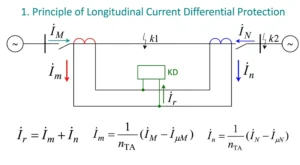
Line differential protection (ANSI 87L) compares currents at both ends of the protected line. Any difference indicates an internal fault.
Normal Operation
Current flows in from one end (I₁) and out from the other (I₂). The two currents are approximately equal, the differential current approaches zero, and the relay remains inactive.
External Fault
During an external fault, fault current flows through the line, but both CTs see the same through-current. The current balance is maintained, differential current ≈ 0, and the relay remains stable—no trip.
Internal Line Fault
During an internal fault, the current balance is broken. The currents at the two ends become unequal, differential current exceeds the threshold, and the relay issues an instantaneous trip command—opening breakers at both ends simultaneously.
CT Disconnection
A CT secondary circuit open circuit creates a false current imbalance, simulating an internal fault. The relay’s CT disconnection detection issues an alarm and, when configured, blocks differential protection to prevent false tripping. Protection remains active on healthy phases.
Summary
| Condition | Current Balance | Differential Current | Relay Action |
|---|---|---|---|
| Normal Operation | Balanced | ≈ 0 | No trip |
| External Fault | Balanced (both high) | ≈ 0 | Stable—no trip |
| Internal Fault | Unbalanced | > Threshold | Instantaneous trip |
| CT Disconnection | False unbalance | False differential | Alarm + Optional differential blocking |
Line Differential Protection Working Principle
Communication for Line Differential Protection
Because line differential protection requires current information from both ends of the protected line, reliable communication between line terminals is an essential part of the protection scheme.
| Communication | Application |
|---|---|
| RS-485 | Serial communication |
| CAN | Device communication |
| Ethernet | Network communication |
| IEC 60870-5-103 | Substation automation |
Line Differential Protection Communication Requirements
Line differential protection (87L) relies on continuous, reliable end-to-end communication between the relays at each terminal of the protected line to exchange current data and status information. The availability of the communication link directly influences the performance and security of the protection system. The practical requirements for its implementation are typically considered in terms of:
-
Data Exchange – Each relay needs to transmit sampled current values to the opposite terminal in real-time, enabling the comparison calculation.
-
Synchronization – The current measurements from both ends must be time-aligned to ensure accurate differential calculation. This is often achieved through channel-specific techniques.
-
Communication Reliability – The communication path (fiber optic, pilot wire, or microwave) must be highly reliable, as any disturbance can affect protection performance.
Communication Failure is a key consideration for system engineers. If the communication link is interrupted, the relays can no longer compare currents, and the differential protection function is typically blocked to prevent unwanted tripping. In this scenario, the system depends on backup protection schemes, such as distance protection (ANSI 21) or overcurrent protection (ANSI 50/51), to clear faults with a time delay. A communication failure alarm is usually generated to alert operators to restore the channel as soon as possible. Detailed logic may depend on the specific relay model and project configuration.
Technical Specifications
| Parameter | ASL-446H |
|---|---|
| Relay Type | Numerical line differential protection relay |
| Main Protection | Line differential protection |
| Differential Instantaneous Protection | Supported |
| CT Disconnection Blocking | Supported |
| Response Time | ≤35 ms* |
| Precision Current Range | 0.08–20 In |
| Current Setting Error | ≤±2.5%* |
| Voltage Setting Error | ≤±3%* |
| Current / Voltage Accuracy | Class 0.2 |
| Power / Reactive Power | Class 0.5 |
| Remote Signal Resolution | ≤2 ms |
| Communication | RS-485 / CAN / Ethernet |
| Protocol | IEC 60870-5-103 |
Setting List of Transmission Line Differential Protection
| No. | Display Name | Range | Step | Remarks |
|---|---|---|---|---|
| 1 | Differential Instantaneous Trip Setting | |||
| 1.1 | Differential Instantaneous Trip Protection | 1/0 | — | Differential instantaneous trip: Enable(1) / Disable(0) |
| 1.2 | Instantaneous Trip Setting Value | 0.40~99.99A | 0.01A | |
| 2 | Differential Protection Setting | |||
| 2.1 | Differential Protection Enable/Disable | 1/0 | — | Differential protection: Enable(1) / Disable(0) |
| 2.2 | CT Broken Line Blocking Differential | 1/0 | — | CT broken line blocking differential: Enable(1) / Disable(0) |
| 2.3 | Differential Setting Value | 0.50~99.99A | 0.01A | |
| 2.4 | Restraint Setting Value | 0.50~99.99A | 0.01A | |
| 2.5 | Differential Current Setting Value | 0.50~99.99A | 0.01A | |
| 2.6 | CT Broken Line Setting | 0.50~99.99A | 0.01A | |
| 2.7 | Slope Coefficient | 0.30~0.70 | 0.01 | |
| 2.8 | Balance Coefficient | 0.100~1.999 | 0.001 | |
| 3 | General Setting | |||
| 3.1 | Control Circuit Broken Line | 1/0 | — | Control circuit broken line alarm: Enable(1) / Disable(0) |
| 3.2 | Display Current Angle | 1/0 | — | Display current angle: Enable(1) / Disable(0) |
| 3.3 | Current Corresponding to 1A | 1/0 | — | Set (1) as 1A / Set (0) as 5A |
| 3.4 | Interlock C6-C7 | 1/0 | — | Enable(1) inter-tripping / Disable(0) inter-tripping |
| 3.5 | Rated Current | 0.50~99.99A | — | Secondary rated current of local line side |
ASL-446H Applications
The ASL-446H is a high-speed numerical line differential protection relay designed for short transmission lines and feeders up to 110 kV. It is particularly suited for applications where distance protection may face limitations due to short line lengths, and where fast and selective fault clearing is required.
| Application | Key Benefit | Typical Users |
|---|---|---|
| Short Transmission Lines | Full-line high-speed tripping without reach limitations | Utilities, industrial plants |
| Overhead Lines | Instantaneous fault clearing regardless of fault current | Utilities, renewable projects |
| Cable Lines | High-speed isolation minimises cable damage | Industrial, commercial networks |
| Substation Interconnections | Definitive zone boundaries for selective fault clearing | Utilities, system operators |
| MV/HV Line Protection (≤110kV) | Comprehensive differential + backup protection | Utilities, EPC contractors |
Line Differential Protection vs Distance Protection
| Feature | Line Differential | Distance Protection |
|---|---|---|
| ANSI | 87L | 21 |
| Basic principle | Current comparison | Impedance measurement |
| Communication | Required | Not always required |
| Selectivity | High | Zone-based |
| Fault location principle | Current difference | Apparent impedance |
| Typical application | Short/important lines | Transmission lines |
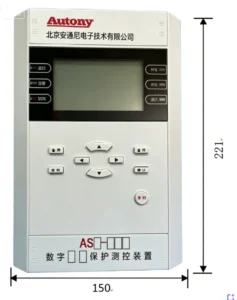
Outline and Installation Dimensions
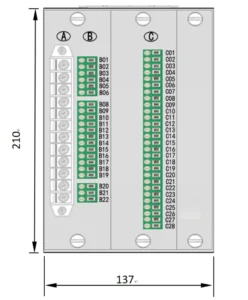
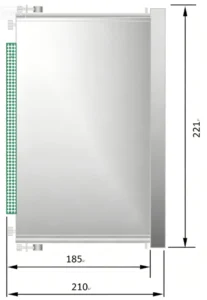
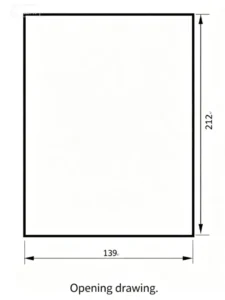
FAQ
1. What is a line differential protection relay?
A high-speed relay that compares currents at both ends of a line and trips when a difference indicates an internal fault.
2. How does line differential protection work?
Under normal or external fault conditions, currents at both ends are balanced, and differential current ≈ 0. During an internal fault, the balance is broken, differential current exceeds the threshold, and the relay trips instantaneously.
3. What is ANSI 87L protection?
ANSI 87L is the standard designation for line differential protection—a high-speed primary scheme that uses current comparison between line terminals for sensitive and selective fault detection.
4. Difference between line differential and distance protection?
| Aspect | 87L | 21 |
|---|---|---|
| Principle | Compares currents | Measures impedance |
| Speed | Full-line high-speed | Zone 1 fast; Zones 2/3 delayed |
| Communication | Required | Not required |
| Short lines | Ideal | Reach limitations |
5. Why is communication required?
Real-time current data exchange between line terminals is needed to compare currents and determine whether a fault is internal or external.
6. What happens during a CT secondary disconnection?
The relay detects the CT disconnection and issues an alarm. If configured via the CT Broken Line Blocking Differential setting, it blocks differential protection for the affected phase to prevent false tripping.
7. What line types can the ASL-446H protect?
Suitable for short transmission lines and feeders up to 110 kV, including: short overhead lines, cable feeders, substation interconnections, medium-voltage (10–35kV) and high-voltage (66–110kV) lines.
8. What information is required to configure the ASL-446H?
Required information includes: system voltage (≤110 kV), CT ratios at both ends, line length and impedance, communication channel parameters, protection settings (differential pickup, restraint slope, etc.), and communication protocol. Settings must be performed by qualified protection engineers.
2 reviews for ASL-446H Line Differential Protection Relay
Related products
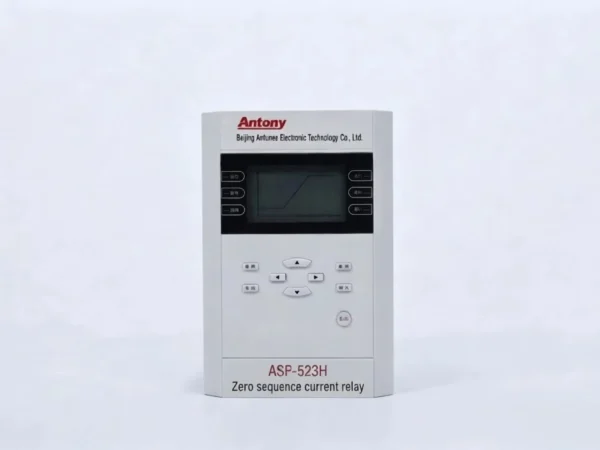
High Quality
Stable performance, reliable design, ensuring safe operation for power system protection and grid stability.
Fast Delivery
Timely delivery to support your urgent orders and project schedules efficiently and professionally at any time.
Best Warranty
Professional Warranty: Reliable after-sales support for stable relay protection and long-term customer satisfaction.
xiao zhang –
Reliable differential line protection (ANSI 87L), rapid fault response, robust against CT saturation, suitable for overhead & cable transmission lines worldwide.
Jack –
Suitable for various wiring configurations, strong versatility — worry-free in use.