
-
Leon Zhang Sales Manager
-
Email: sale@relayprotect.com
-
Phone/WhatsApp: +86 13655813266
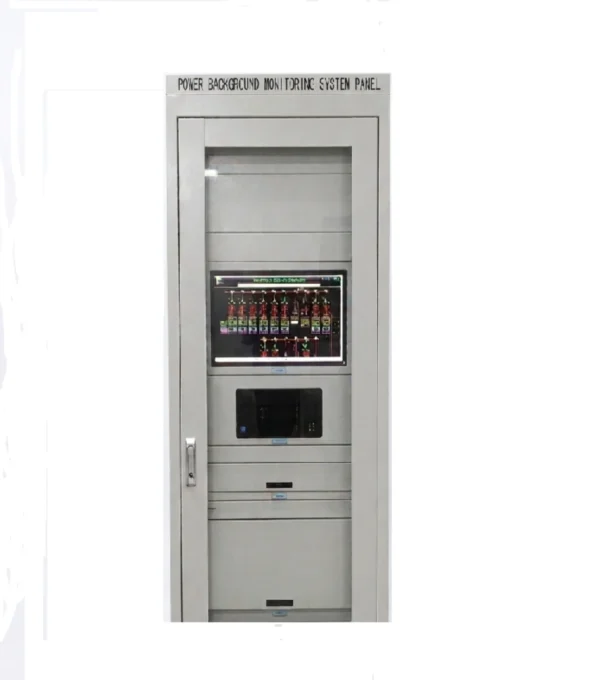
11kV/22kV Power Monitoring SCADA Cabinet
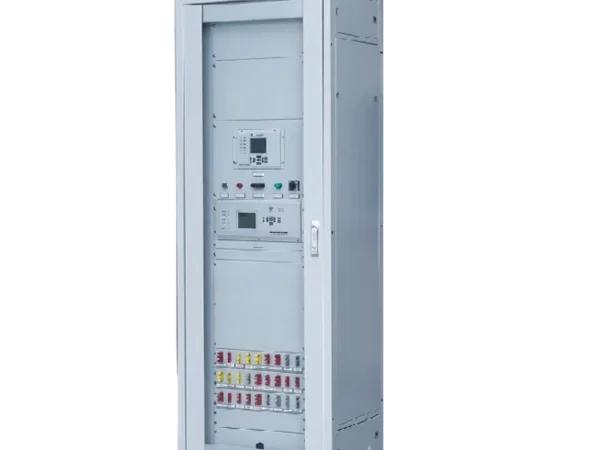
Power SCADA Monitoring Cabinet is an integrated console for power system monitoring. It is fitted with Lenovo monitoring host, DELL 19-inch LCD monitor, monitoring software and Kylin secure OS, together with HP printer and Edifier speaker. The cabinet dimension is 2260×800×600 with RAL7035 finish, supporting real-time data display, signal supervision and report output.
Send your requirements, we will quote for you within 12 hours
MOQ: 1 setLead time: 7-15 working daysPayment: T/T, L/C, Western Union, PayPalWarranty: 12 monthsTrade terms: EXW, FOB, CIF, DDUCertification: CEDifferent rating, protocol or mounting: send the specification and we confirm before you order.
Description
What Is a Power Monitoring SCADA Cabinet?
A power monitoring SCADA cabinet is a factory-assembled supervisory control unit that gathers current, voltage, power and breaker status from 11 kV and 22 kV switchgear and presents them on one operator interface. This cabinet integrates the RTU, communication gateway, HMI and marshalling terminals in a single enclosure, so field wiring lands once instead of being split across three suppliers. It carries IEC 61850 toward station-bus devices and IEC 60870-5-101 or 104 toward utility telecontrol, which keeps one build usable in both a substation automation scheme and a dispatch centre. Typical duty is a distribution substation, a plant intake or a pump station where switchgear is already installed but the monitoring layer is not. Each cabinet is assembled to the project single-line diagram and point list, and an engineer checks the IO schedule against the drawing before release. Point-list review and quotation within 12 hours, MOQ 1, delivery 7-15 working days.
How Does Power Monitoring SCADA Work?
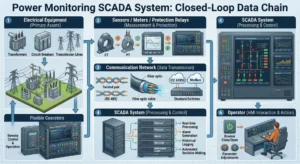
A Power Monitoring SCADA system enables a complete closed-loop data chain from field devices to operator actions:
Electrical Equipment – Primary assets such as transformers, circuit breakers, and transmission lines are the objects of monitoring and protection.
↓
Sensors / Meters / Protection Relays – CTs, PTs, multifunction meters, and protection relays measure parameters including current, voltage, and power in real time, while also detecting fault signals.
↓
Communication Network – Data is transmitted to the SCADA system via fiber optics, Ethernet, or RS-485, using standard protocols such as IEC 61850 and Modbus.
↓
SCADA System – Receives and processes data to enable real-time monitoring, alarm generation, historical logging, and automated decision-making.
↓
Monitoring Cabinet – Serves as the local human-machine interface (HMI), displaying single-line diagrams, trend graphs, alarms, and event logs in a centralized manner.
↓
Operator – Monitors the system via the HMI and performs actions such as breaker open/close operations and parameter adjustments. Remote control capability ensures safe and stable grid operation.
SCADA Role in Monitoring Critical Equipment and Power Grids
Real-Time Monitoring of Critical Electrical Equipment
The Power Monitoring SCADA system provides continuous real-time visibility into all critical electrical assets, enabling operators to detect abnormalities instantly and take timely corrective actions.
| Equipment | Key Monitoring Parameters | Alarm / Notification |
|---|---|---|
| Circuit Breakers | Breaker position (open/closed), SF6 gas pressure, spring charging status, trip/close coil health, operation cycle counts | Failure to trip/close, low gas pressure, control circuit supervision fault |
| Transformers | Winding/oil temperature, oil level, tap changer position, cooling fan status, DGA (dissolved gas analysis) alarms | Overheating, low oil level, gas accumulation, fan failure |
| Feeders | Current, voltage, power (MW/MVAr), power factor, energy consumption | Overcurrent, earth fault, phase unbalance, under/over voltage |
| Protection Relays | Relay settings, measured values, fault records, oscillography data, relay status, self-diagnostics | Relay trip, alarm output, communication loss, self-check failure |
| Switchgear | Busbar voltage, current loading, compartment temperature, breaker position, interlock status | Overload, high temperature, interlock violation, breaker position mismatch |
| Generators | MW, MVAr, voltage, current, frequency, bearing temperature, vibration, cooling system status, excitation system | Over/under frequency, over/under voltage, reverse power, overspeed, overheating, vibration alarm |
In summary, SCADA real-time monitoring provides a unified view of all critical equipment, enhancing reliability, safety, and grid stability.
Power Grid Status and Electrical Parameter Monitoring
The Power Monitoring SCADA system provides continuous, real-time monitoring of grid status and key electrical parameters across all critical equipment, enabling operators to maintain system stability, optimize performance, and respond swiftly to abnormal conditions.
| Parameter | Description | Monitoring Purpose |
|---|---|---|
| Voltage | RMS voltage levels at each busbar, feeder, and equipment terminal | Detect overvoltage, undervoltage, and voltage sag/swell; ensure power quality and equipment safety |
| Current | Load current flowing through feeders, transformers, and other equipment | Monitor loading conditions; detect overcurrent, unbalance, and earth faults |
| Active Power (MW) | Real power consumed or generated by each feeder and equipment | Balance generation and load; optimize power flow and energy management |
| Reactive Power (MVAr) | Reactive power flow in the system | Maintain voltage stability; control power factor; reduce system losses |
| Power Factor | Ratio of active power to apparent power (cos φ) | Assess load characteristics; improve energy efficiency; avoid penalty charges |
| Frequency | Grid frequency measured at busbars and generators | Detect overfrequency/underfrequency events; trigger load shedding or generation adjustment |
| Equipment Status | Operating status of breakers, isolators, transformers, switchgear, etc. (open/closed, normal/alarm/trip) | Provide real-time situational awareness; enable fault detection and rapid restoration |
In summary, real-time monitoring of these parameters ensures stable grid operation, enhances equipment protection, and supports informed decision-making by operators.
Power Grid Status and Electrical Parameter Monitoring
The SCADA system provides continuous real-time monitoring of grid status and key electrical parameters across all critical equipment, enabling operators to maintain system stability, optimize performance, and respond swiftly to abnormal conditions.
| Parameter | Description | Significance |
|---|---|---|
| Voltage | RMS voltage at each busbar, feeder, and equipment terminal | Detects overvoltage, undervoltage, and sags/swells; ensures power quality and equipment safety |
| Current | Load current flowing through feeders, transformers, and lines | Monitors loading conditions; detects overcurrent, unbalance, and earth faults |
| Active Power (MW) | Real power consumed or generated by feeders and equipment | Balances generation and load; optimizes power flow and energy management |
| Reactive Power (MVAr) | Reactive power flow in the system | Maintains voltage stability; controls power factor; reduces system losses |
| Power Factor | Ratio of active power to apparent power (cos φ) | Assesses load characteristics; improves energy efficiency; avoids penalties |
| Frequency | Grid frequency measured at busbars and generators | Detects over/under frequency events; triggers load shedding or generation adjustment |
| Equipment Status | Operating status of breakers, isolators, transformers, switchgear (open/closed, normal/alarm/trip) | Provides real-time situational awareness; enables fault detection and rapid restoration |
In summary, real-time monitoring of these parameters ensures stable grid operation, enhances equipment protection, and supports informed decision-making by operators.
Fault Detection and Alarm Management
The SCADA system continuously monitors electrical parameters and equipment status to detect abnormalities in real time. Upon fault detection, it generates alarms, logs events, and alerts operators for rapid response and fault isolation. The table below outlines key fault types, detection methods, and corresponding alarm actions.
| Fault / Alarm Type | Detection Method | Alarm Action |
|---|---|---|
| Overcurrent | Monitored via CTs; triggered when current exceeds preset threshold (definite-time or inverse-time characteristic) | Annunciator alarm, SCADA event log, remote notification; initiates breaker trip if sustained |
| Short Circuit | Detected by protection relays (overcurrent, differential, or distance elements); characterized by a sudden surge in current with voltage dip | Instantaneous trip command to circuit breaker; fault recorded with time-stamped waveform; alarm displayed on HMI |
| Earth Fault | Detected via zero-sequence current (core balance CT or residual connection); sensitive detection for ground leakage | Alarm and trip (depending on setting); fault location and resistance value recorded for analysis |
| Overvoltage | Monitored via PTs; triggered when voltage exceeds high limit (e.g., >110% of nominal) | Alarm generated; may initiate corrective actions (e.g., tap changer operation, capacitor bank switching) |
| Overload | Detected by thermal overload protection or long-term overcurrent monitoring; based on I²t thermal model | Pre-alarm at threshold, trip at critical level; load shedding recommended if persistent |
| Breaker Status | Monitored via auxiliary contacts (open/closed), spring charge status, SF6 pressure, trip/close circuit integrity | Alarm for position mismatch, failure to trip/close, low gas pressure, or loss of control supply |
| Communication Failure | Detected via heartbeat signals or periodic polling between SCADA master and field IEDs/RTUs | Alarm for loss of communication, data stale flag; indicates potential hardware or network issue |
In summary, the SCADA system provides comprehensive fault detection and alarm management, enabling operators to quickly identify, isolate, and rectify system abnormalities, thereby minimizing outage duration and enhancing overall grid reliability.
Historical Data and Fault Analysis
SCADA does not only provide real-time monitoring; it also stores historical data and alarm records to support fault diagnosis and maintenance, forming a closed loop from monitoring to analysis to maintenance.
The system continuously records voltage, current, power, frequency, and equipment status. All alarms, protection trips, and breaker operations are logged with precise time-stamps. Fault oscillography data is captured for detailed analysis when disturbances occur.
Based on historical data, operators can diagnose fault root causes, analyze performance degradation trends, and forecast load demands.
For maintenance, historical data supports condition-based and predictive maintenance strategies, triggering actions based on actual equipment condition. This reduces downtime, extends equipment life, prevents failures, and ensures compliance with audit trail requirements.
Remote Monitoring and Control of Power Equipment
SCADA enables centralized remote monitoring and control of power equipment, improving response speed, efficiency, and safety.
| Feature | Description |
|---|---|
| Remote Monitoring | Real-time viewing of parameters (voltage, current, power, frequency), equipment status, and alarms via HMI with single-line diagrams and event logs |
| Remote Operation | Authorized operators issue control commands (breaker open/close, tap adjustment, capacitor switching) from SCADA master station. All operations logged with user ID and time-stamp |
| Authorized Control | Multi-level authentication and role-based permissions ensure only qualified personnel perform critical operations. Interlocking logic prevents incorrect commands |
| Unattended Substations | Substations operate without on-site staff. SCADA continuously supervises equipment and alerts operators via SMS or email when abnormalities occur |
| Centralized Operation | Multiple sites managed from one control center, enabling coordinated dispatch and optimized system-wide performance |
In summary, SCADA enables safer, more efficient, and more reliable operation, supporting unattended substations and centralized management.
What Equipment Can a Power Monitoring SCADA System Monitor?
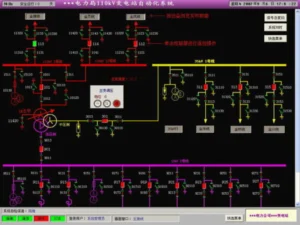
| Equipment | Monitoring Data |
|---|---|
| Circuit Breakers | Open/close status, trip status |
| Transformers | Voltage, current, temperature, alarms |
| Protection Relays | Protection status, trip signals, events |
| Feeders | Current, voltage, power, energy |
| Switchgear | Switch status, electrical parameters |
| Generators | Voltage, current, frequency, power |
| Busbars | Voltage, current and system status |
Power Monitoring SCADA Applications
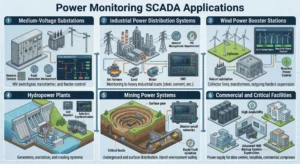
Our Power Monitoring SCADA solutions are deployed across a wide range of power systems, providing real-time monitoring, remote control, and alarm management tailored to the specific needs of each application.
Medium-Voltage Substations
Monitoring and control of MV switchgear, transformers, and feeders. Enables remote operation, fault detection, and load management for reliable distribution.
Industrial Power Distribution Systems
Real-time monitoring of power supply to heavy industrial loads (steel, cement, petrochemical, etc.). Supports demand management, power quality improvement, and equipment protection.
Wind Power Booster Stations
SCADA monitors collector lines, transformers, and outgoing feeders. Provides grid compliance, reactive power control, and remote supervision for unattended wind farm operation.
Hydropower Plants
Monitoring of generators, excitation systems, cooling systems, and switchgear. Supports unit dispatch, efficiency optimization, and safe synchronization to the grid.
Mining Power Systems
Robust monitoring of underground and surface power distribution. Ensures safety, continuity of critical loads, and rapid fault isolation in harsh environments.
Commercial and Critical Facilities
Monitoring and control of power supply for data centers, hospitals, and commercial complexes. Ensures high availability, power quality, and backup system supervision.
FAQ
Q1. What is a power monitoring SCADA system?
A power monitoring SCADA (Supervisory Control and Data Acquisition) system is a centralized platform that collects, processes, and displays real-time data from electrical equipment in substations, power plants, and industrial facilities. It enables operators to monitor grid status, detect faults, control equipment remotely, and analyze historical data for improved reliability and efficiency.
Q2. What equipment can a power monitoring SCADA system monitor?
The SCADA system can monitor all critical electrical equipment, including:
Circuit breakers
Power and distribution transformers
Transmission and distribution feeders
Protection relays (IEDs)
Switchgear assemblies
Generators
Capacitor banks
Voltage regulators and tap changers
Q3. How does SCADA monitor critical equipment in power grids?
SCADA monitors critical equipment through a complete data chain:
Field Equipment – Breakers, transformers, feeders, etc.
Sensors / Meters / Relays – CTs, PTs, digital meters, and protection IEDs measure parameters and detect faults
Communication Network – Data is transmitted via fiber optics, Ethernet, or serial communication using standard protocols
SCADA System – Processes and displays data, generates alarms, and stores historical records
Monitoring Cabinet (HMI) – Provides local visualization and control interface
Operator – Reviews data, responds to alarms, and issues control commands
This end-to-end chain ensures operators maintain full visibility and control over grid assets at all times.
Q4. What electrical parameters can the SCADA monitoring cabinet measure?
The SCADA monitoring cabinet can measure and display the following key electrical parameters:
| Parameter | Description |
|---|---|
| Voltage | RMS voltage at busbars, feeders, and equipment terminals |
| Current | Load current flowing through feeders and transformers |
| Active Power (MW) | Real power consumption or generation |
| Reactive Power (MVAr) | Reactive power flow for voltage support |
| Frequency | Grid frequency for stability monitoring |
| Power Factor | Ratio of active to apparent power (cos φ) |
Q5. Can the SCADA cabinet monitor 11kV and 22kV distribution systems?
Yes. The SCADA monitoring cabinet is fully compatible with medium-voltage distribution systems, including 11kV and 22kV networks. It monitors feeders, transformers, switchgear, and protection relays at these voltage levels, providing real-time data, alarm management, and remote control capabilities for reliable distribution operation.
Q6. Does the power monitoring SCADA cabinet support remote control?
Yes. The SCADA cabinet supports remote monitoring and control of power equipment. Authorized operators can issue commands from the SCADA master station or HMI to perform operations such as:
Breaker open/close
Transformer tap changer adjustment
Capacitor bank switching
Protection relay setting changes
All remote operations are logged with user identification and time-stamps for security and traceability.
Q7. Which communication protocols are supported by the SCADA system?
Our SCADA system supports a wide range of standard communication protocols to ensure interoperability with devices from various manufacturers:
| Protocol | Application |
|---|---|
| Modbus RTU/TCP | Widely used for meters, relays, and RTUs |
| IEC 60870-5-101 | Serial communication for telecontrol in power systems |
| IEC 60870-5-104 | Network-based telecontrol protocol (TCP/IP) |
| IEC 61850 | Smart substation automation (GOOSE, SV, MMS) – for advanced projects |
Additional protocols can be supported upon request.
Q8. How do I place an order?
Send your specification through the contact form, by email to sale@relayprotect.com or on WhatsApp. We check the rating, the protocol and the wiring against your application, confirm the model, and return a quotation. No account or registration is needed.
Q9. What is the minimum order quantity?
The minimum order quantity is one unit. A single unit can be ordered for evaluation or for a pilot installation, and project quantities are quoted separately.
Q10. What is the lead time?
Standard models ship in 7 to 15 working days after the order is confirmed and payment is received. Custom ratings, protocols or mounting arrangements are confirmed in writing before the order is placed, so the delivery date is known in advance.
Q11. Which payment methods and trade terms do you accept?
Payment by T/T, L/C, Western Union or PayPal. Trade terms are EXW, FOB, CIF and DDU. Every relay carries a 12-month warranty.
Need pricing, a datasheet or a wiring drawing?
Tell us your application – rated voltage, CT/VT ratios and the protection functions you need – and we will send a quotation with the matching model. Free technical guidance, parameter setting and commissioning support included.
MOQ 1 unit for samples | Bulk orders ship in 7-15 working days | 12-month warranty | EXW, FOB, CIF, DDU | Payment by T/T, L/C, Western Union or PayPal. New to ordering? See how to order – process, MOQ and lead time.
Related station-level devices in the same architecture: the ATN-400 SCADA system, the RTU communication management unit, the common measurement and control panel and the DTU-380H distribution terminal unit cover the remaining layers from field terminal to dispatch centre.
Related products
High Quality
Stable performance, reliable design, ensuring safe operation for power system protection and grid stability.
Fast Delivery
Timely delivery to support your urgent orders and project schedules efficiently and professionally at any time.
Best Warranty
Professional Warranty: Reliable after-sales support for stable relay protection and long-term customer satisfaction.
Reviews
There are no reviews yet.