

-
Leon Zhang sales consultant
-
Email: zxl635973785@gmail.com
-
Phone/WhatsApp: +86 13655813266
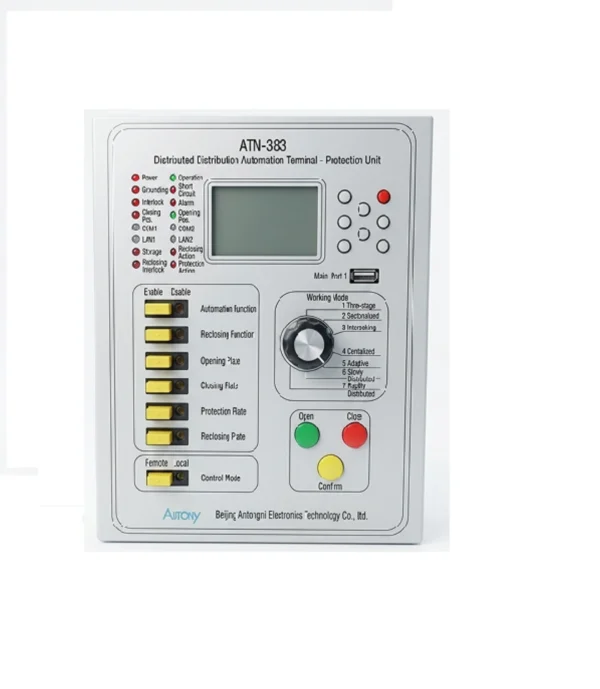
Distributed DTU | IEC 61850 Distribution Automation Terminal
This Distributed DTU is designed for protection, measurement, control and communication of interval units in 10kV and below ring main units.
Communication Mode
Optional: RS-485, CAN bus, Ethernet, IEC 60870-5-103 (IEC-103), IEC 61850
Send your requirements, we will quote for you within 12 hours
Description
Overview of Distributed DTU
- This DTU is designed for protection, measurement, control and communication of interval units in 10kV and below ring main units.
- Equipped with full functions of protection, measurement, control and communication monitoring, it works with circuit breakers and load switches to safeguard 10kV and below power lines and feeders.
- It can quickly isolate faulty sections, narrow power outage scope and resume power supply efficiently, ensuring stable and safe operation of distribution networks.
Functions
- The feeder terminal (protection & control unit) supports remote signalling, remote measurement, remote control and protection logic for corresponding bays. It adopts three-stage protection, master station centralized automation, voltage-time and voltage-current based feeder automation schemes.
- Applicable to all positions of 10kV distribution lines, including ring, radial and branch lines, low-resistance grounding and arc suppression coil grounding systems, as well as circuit breaker and load switch cabinets.
- It enables local fault isolation and self-healing. Three-remote data and fault messages can be uploaded to distribution dispatching master station to realize remote fault disposal and build fault location system.
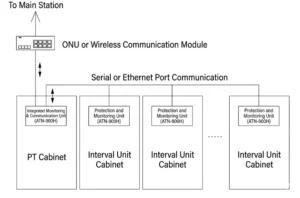
Differences Between Distributed DTU and Centralized DTU
Centralized DTU
- It adopts an integrated, centralized installation design, with all data acquisition, communication and processing units integrated into a single enclosure, which is placed in the terminal room.
- It features a compact structure but has poor scalability (replacing the entire unit is required when adding circuits), a high risk of single-point failure (a fault in the main control unit will paralyze the entire station), and requires a large number of cables routed from switch cabinets to the enclosure.
DTU
- It adopts a modular, decentralized installation design. Each functional unit (analog measurement, status monitoring, remote control modules) is independent, installed locally in the secondary compartment of the switch cabinet, and connected via an internal bus.
- Its advantages include strong redundancy (a fault in a single module does not affect others), support for hot swapping, significant cable savings, and flexible scalability (modules can be added as needed).
- Therefore, distributed DTU has become the mainstream choice for modern smart distribution networks.
FAQ
Q1: What is a Distributed DTU?
A: A Distributed DTU (Distributed Distribution Terminal Unit) is a modular, decentralized terminal for distribution automation, used in smart grids to monitor and control switchgear, feeders, and ring main units.
A: A Distributed DTU (Distributed Distribution Terminal Unit) is a modular, decentralized terminal for distribution automation, used in smart grids to monitor and control switchgear, feeders, and ring main units.
Q2: What is the difference between Distributed DTU and Decentralized DTU?
A: They refer to the same concept. Distributed DTU is the standard term; Decentralized DTU emphasizes the non-centralized, distributed architecture, ideal for smart grid modernization.
A: They refer to the same concept. Distributed DTU is the standard term; Decentralized DTU emphasizes the non-centralized, distributed architecture, ideal for smart grid modernization.
Q3: What is Smart Grid DTU used for?
A: Smart Grid Distributed DTU enables real-time monitoring, fault detection, isolation, and restoration in smart grids. It supports feeder automation, remote control, and data communication for reliable grid operation.
A: Smart Grid Distributed DTU enables real-time monitoring, fault detection, isolation, and restoration in smart grids. It supports feeder automation, remote control, and data communication for reliable grid operation.
Q4: What is FTU DTU / Feeder Terminal Unit DTU?
A: Feeder Terminal Unit DTU (FTU DTU) integrates distributed DTU functions with feeder protection and control. It is deployed on overhead lines and feeders to handle faults, reconfiguration, and load management.
A: Feeder Terminal Unit DTU (FTU DTU) integrates distributed DTU functions with feeder protection and control. It is deployed on overhead lines and feeders to handle faults, reconfiguration, and load management.
Q5: What are the benefits of a Compact DTU?
A: A Compact Distributed DTU offers small footprint, low power consumption, and easy installation. It is suitable for space-limited substations, ring main units, and secondary distribution automation applications.
A: A Compact Distributed DTU offers small footprint, low power consumption, and easy installation. It is suitable for space-limited substations, ring main units, and secondary distribution automation applications.
Q6: Where can I use Distributed DTU ?
A: Distribution Automation DTU is widely used in urban/rural distribution networks, smart substations, ring main units, industrial parks, and renewable energy grid connections.
A: Distribution Automation DTU is widely used in urban/rural distribution networks, smart substations, ring main units, industrial parks, and renewable energy grid connections.
Q7: Does Distributed DTU support standard communication protocols?
A: Yes. Most Distributed DTU / Decentralized DTU support IEC 61850, IEC 60870-5-104, Modbus, and Ethernet, ensuring interoperability with SCADA and smart grid systems.
A: Yes. Most Distributed DTU / Decentralized DTU support IEC 61850, IEC 60870-5-104, Modbus, and Ethernet, ensuring interoperability with SCADA and smart grid systems.
2 reviews for Distributed DTU | IEC 61850 Distribution Automation Terminal
Related products
High Quality
Stable performance, reliable design, ensuring safe operation for power system protection and grid stability.
Fast Delivery
Timely delivery to support your urgent orders and project schedules efficiently and professionally at any time.
Best Warranty
Professional Warranty: Reliable after-sales support for stable relay protection and long-term customer satisfaction.
xiao zhang –
This distributed DTU adopts modular design with reliable anti-interference performance. It realizes fast fault location, isolation and power recovery on-site, effectively reducing main station load and field maintenance cost, ideal for ring main unit and substation automation projects.
Jack –
Delivered with comprehensive test reports — very professional.