
-
Leon Zhang Sales Manager
-
Email: sale@relayprotect.com
-
Phone/WhatsApp: +86 13655813266
Prefabricated Substation Suppliers Europe: Selection Guide
Prefabricated substation suppliers europe is a procurement search, not a product category: the buyer already knows the assembly exists and wants a vendor whose type-tested MV/LV kiosk survives a European distribution network operator review. IEC 62271-202:2022 defines the assembly up to 52 kV. The supplier paperwork decides whether approval takes two weeks or two quarters.
At a glance
- IEC 62271-202:2022 Edition 3 covers prefabricated substations from 1 kV to 52 kV, walk-in and non-walk-in.
- Rated power is a three-parameter value: kVA, total losses in watts, and a temperature rise limit.
- Enclosure class 5 to 30 K sets the permitted temperature rise of the air inside the enclosure.
- IAC is tested as A, B or AB; LSC2A or LSC2B describes what stays live during maintenance.
- Regulation (EU) 2024/573 bans F-gas insulation in new switchgear up to 24 kV from 1 January 2026.
- Tier 2 transformer loss limits have applied to EU shipments since 1 July 2021.
- Shortlists of prefabricated substation suppliers europe live or die on paperwork, not on kiosk geometry.
- Ask for the type test report number and the laboratory, never a photocopy of a cover page.
Prefabricated Substation Suppliers Europe: What the Term Covers
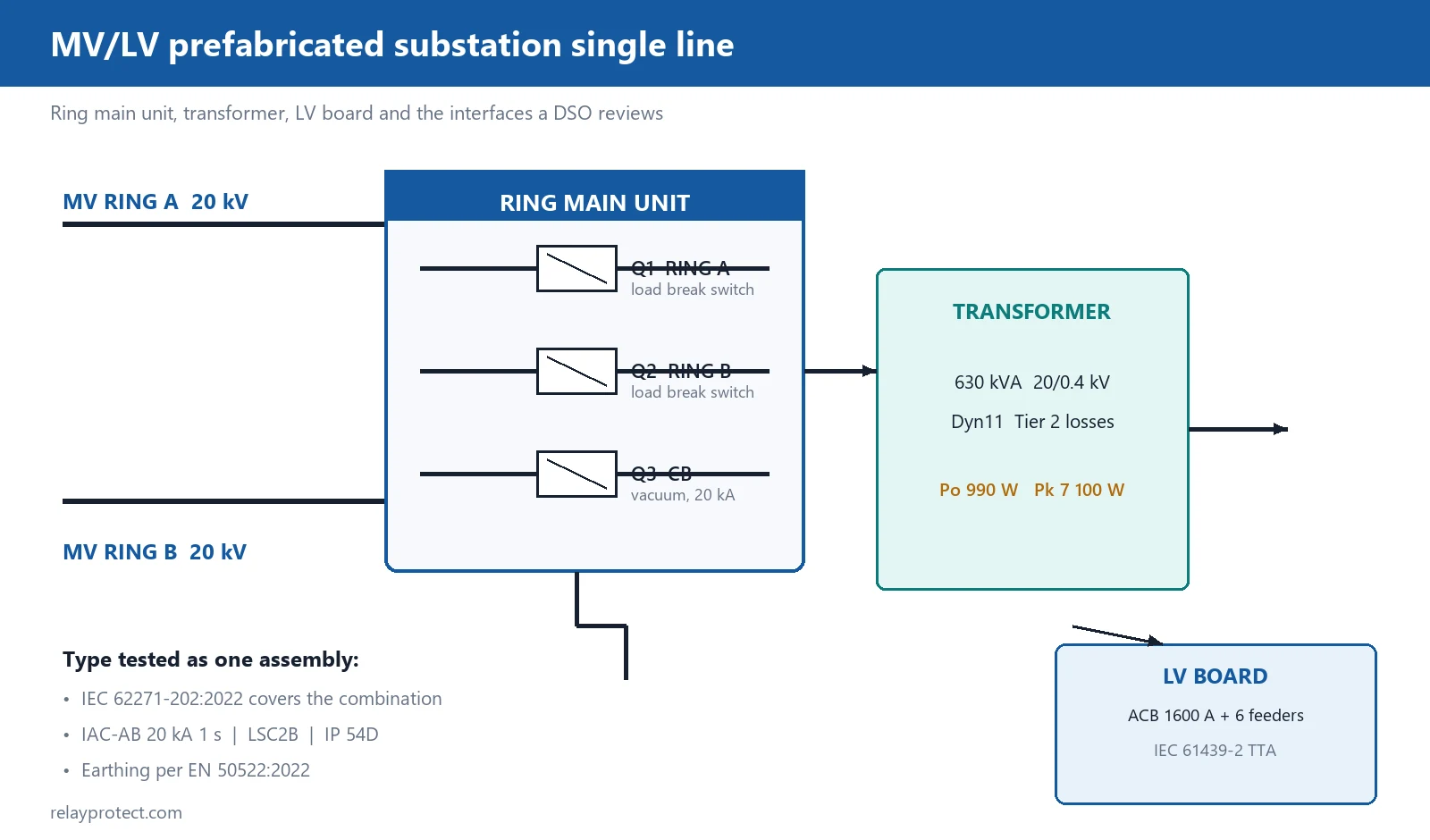
The standard defines the product before any vendor does. IEC 62271-202:2022 describes a prefabricated substation as a factory-assembled, type-tested combination of an enclosure, at least one power transformer and/or high-voltage switchgear, low-voltage switchgear, and the interconnections between them. It connects by cable to an AC network above 1 kV and up to 52 kV, at 50 Hz or 60 Hz, and it stands outdoors in places the public can reach.
Edition 3 changed the scope in ways a buyer can feel. The title now covers high-voltage switchgear substations, not only transformer kiosks. CEADS hybrid switchgear counts as a permitted component. Rated power became a three-parameter figure. Annex G adds a test method for solar radiation, Annex H covers where to mount electronic equipment, and access doors and operation aisles received minimum dimensions for the first time.
Read the edition on the certificate.
The word Europe in the search string adds a second layer. A European network operator does not accept an IEC type test on its own. It expects a report from a recognised laboratory, the EN adoption of the same text, a declaration of conformity for the low-voltage side, and a design that matches national installation rules. German operators also check VDE 0101 clearances; Scandinavian buyers ask for a documented snow load; coastal sites add a salt fog requirement.
Two hardware families sit under the same standard. Concrete kiosks suit residential streets, where noise and vandal resistance decide the argument. Aluminium or steel enclosures suit industrial parks and renewable sites, where crane access matters more than acoustics.
Selecting a relay for a live project?
Send the system voltage, CT ratio and tripping scheme. Our engineers confirm the model and reply within 12 hours.
Concrete or Metal: Choosing the Enclosure Family
Concrete enclosures carry mass, and the mass does three jobs at once. It damps transformer hum, which matters where a planning condition sets a night noise limit at the site boundary. It resists vandalism on streets where the kiosk stands unsupervised. It also gives the planning officer a surface that can be finished to match the neighbourhood, and that is often the fastest route through a municipal approval.
Metal enclosures win on logistics. A painted aluminium or steel box weighs a fraction of a concrete kiosk, ships on a standard trailer, and reaches wind farm sites and mountain substations that a concrete unit cannot. Coating systems for coastal and industrial air are a standard option, and a modular design can grow a bay at a time as the load grows.
Neither family is a compromise. Pick by site, not by habit.
Three questions sort the decision fast. How far is the nearest bedroom window, and does the planner care about the facade? Can a crane reach the foundation, and is there a road that carries the transport weight? Will the load grow, and by how much? A supplier who can answer those three from a site visit is a supplier who has delivered into Europe before.
The answer changes the standard you check. Concrete kiosks bought from local precast suppliers often arrive as partly type-tested assemblies with a national approval, while a metal unit from an international manufacturer arrives with a full IEC 62271-202 type test file. Both can pass a DSO review, but only if the paperwork matches what the tender asked for, and the difference between the two files is exactly where prefabricated substation suppliers europe compete on documentation rather than on steel.
Which Standards a European Supplier Has to Meet
A prefabricated substation is a system, and each part of the system carries its own standard. A quotation that cites only IEC 62271-202 tells you about the assembly, not about the switchgear, the transformer or the low-voltage board inside it.
The common clauses of IEC 62271-1:2017 with amendment AMD1:2021 set insulation coordination, temperature rise and test tolerances on the high-voltage side. IEC 62271-200:2021 governs the metal-enclosed medium-voltage switchgear, including the internal arc test. IEC 61439-2:2020 governs the low-voltage distribution board. IEC 61936-1:2021 covers the installation itself and EN 50522:2022 covers earthing above 1 kV. A dry-type transformer follows IEC 60076-11:2018, and IEC 60529:2013 fixes the IP code quoted on the enclosure.
| Standard | What it governs in the kiosk | Edition in force |
|---|---|---|
| IEC 62271-202 | The assembly: enclosure, transformer, HV and LV switchgear, tests | 2022 (Ed 3, Cor 1:2023) |
| IEC 62271-1 | Common clauses: insulation, temperature rise, test tolerances | 2017 + AMD1:2021 |
| IEC 62271-200 | MV metal-enclosed switchgear, internal arc classification | 2021 |
| IEC 61439-2 | LV power switchgear and controlgear assemblies | 2020 |
| IEC 61936-1 | Installation rules for systems above 1 kV AC | 2021 |
| EN 50522 | Earthing of power installations above 1 kV AC | 2022 |
| IEC 60076-11 | Dry-type power transformers | 2018 |
| IEC 60529 | IP code for the enclosure | 2013 |
Table 1. The stack a European prefabricated substation is normally tested against.
Buyers comparing prefabricated substation suppliers europe should ask which of these rows the quotation actually covers. Most quotes cite the assembly standard and stay silent about the rest, and the silence is where a design review finds its first problem.
EN adoptions matter for a different reason. The same IEC text appears as BS EN IEC 62271-202:2022 in the United Kingdom and DIN EN IEC 62271-202 in Germany, and a national authority may cite the EN number in its forms. Ask the supplier for the EN adoption reference alongside the IEC one, so the paperwork matches the form the inspector is holding.
One detail decides more arguments than any other. IEC 61439-2:2020 separates a type-tested assembly (TTA) from a partially type-tested assembly (PTTA). A tender that asks for TTA and receives a PTTA board with a folder of component certificates will fail the design review, and the retrofit costs more than the original board.
Enclosure Class, IAC and LSC: Reading a Datasheet
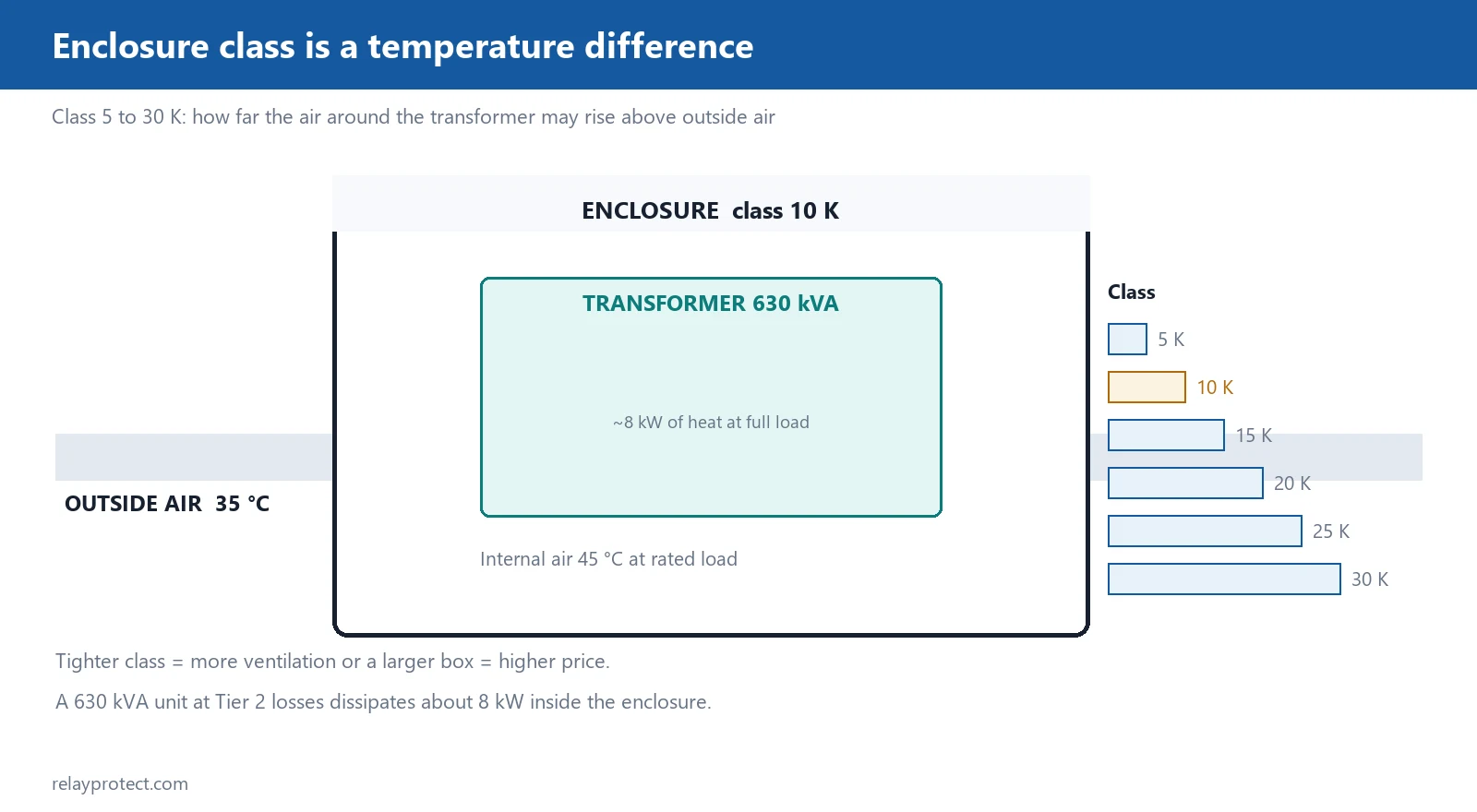
The enclosure class is a temperature difference, not a weather rating. Class 10 means the air around the transformer inside the kiosk may run at most 10 K above the outside air at rated load. The standard lists six classes: 5, 10, 15, 20, 25 and 30 K. A tighter class needs more ventilation or a larger box, and both show up in the price.
Rated power is quoted as three values under the 2022 edition, for example 630 kVA, 5,500 W of total losses and a 60/65 K oil and winding limit. The single kVA figure that older quotations used hid the loss level, and the loss level is what the network operator loss calculation and the ecodesign file actually need.
Internal arc classification comes in three forms. IAC-A protects a person standing at the open door during operation. IAC-B protects the public outside a closed door. IAC-AB covers both. A 24 kV kiosk on a pavement normally needs AB at 20 kA for 1 s, and the report should name the ignition points and the pressure relief path, not just the classification string.
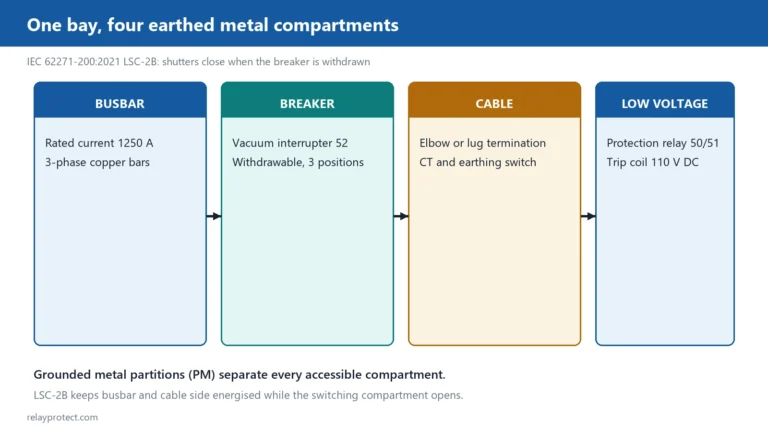
Loss of service continuity is written LSC2A or LSC2B. LSC2A keeps the busbar section live while a functional unit is opened for maintenance. LSC2B adds the cable compartment, so cable work happens with the busbar energised. A ring main unit feeding two directions usually needs LSC2B, because ring cable work never waits for a convenient outage.
Ask for the classification string, not the brochure.
| Enclosure class | Permitted ΔT | Where it fits | Design consequence |
|---|---|---|---|
| 5 K | Very tight | Shaded site, load well below rating | Largest ventilation openings or forced air |
| 10 K | Tight | Urban kiosk, load up to about 80% | Common default on European tenders |
| 15 to 20 K | Moderate | Industrial parks, higher load factor | Smaller box, higher internal losses tolerated |
| 25 to 30 K | Loose | Low duty or monitored sites | Cheapest box, watch transformer life |
Table 2. Enclosure classes and what they cost you in box size.
Medium Voltage Switchgear and the End of SF6
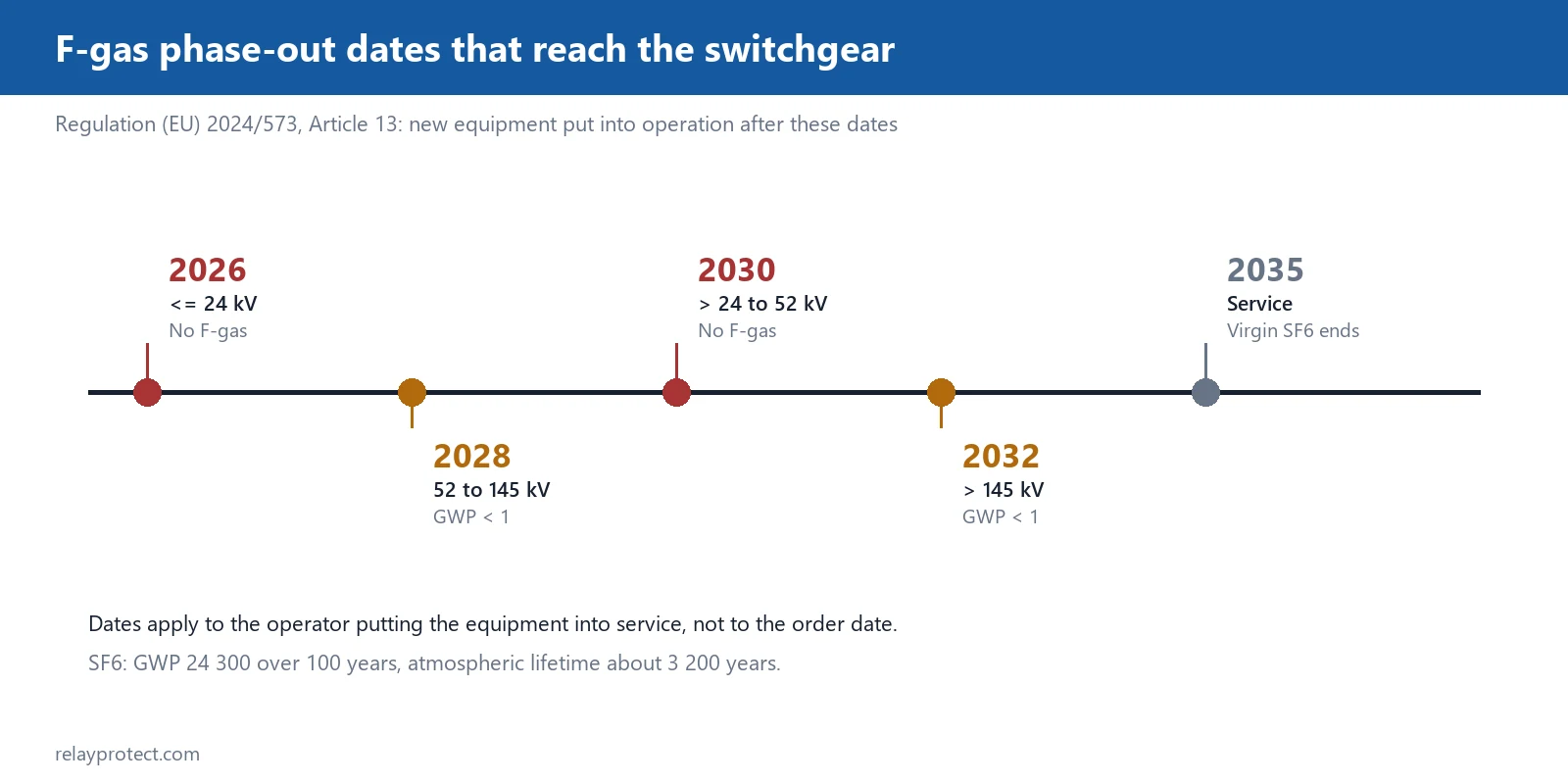
Regulation (EU) 2024/573 reshaped the shortlist. New electrical switchgear that uses fluorinated greenhouse gases in insulation or interruption cannot be put into operation in the EU from 1 January 2026 at 24 kV and below, from 1 January 2030 above 24 kV up to 52 kV, from 1 January 2028 between 52 kV and 145 kV, and from 1 January 2032 above 145 kV. Virgin SF6 for servicing ends on 1 January 2035.
The dates bind the operator who puts the equipment into service, not only the manufacturer. A kiosk ordered in 2025 and energised in 2026 at 24 kV falls inside the ban. Derogations exist where a tender produces no compliant bid, and they need documented evidence, not a letter of intent.
SF6 carries a 100-year global warming potential of 24,300 and an atmospheric lifetime near 3,200 years, which is why the regulation targets it first. Vacuum interruption with clean air insulation covers the medium-voltage range today. Fluoronitrile and fluoroketone mixtures also meet the limit, but their own future depends on the PFAS restriction file, and a buyer signing a thirty-year asset should read that uncertainty into the decision.
A supplier with a real European order book shows type-tested F-gas-free ring main units at 12 kV and 24 kV, and a plan for 36 kV. A supplier who offers the same SF6 design under a new label is selling a 2030 retrofit.
Great Britain has not adopted the EU dates. GB operators still work under leak checking and record-keeping duties, with a policy review under way, so a kiosk for a UK site is a different procurement conversation than one for Rotterdam or Hamburg. A mainland European supplier who understands that difference saves both sides a round of edits.
What the Type Test Package Actually Contains
The phrase type tested hides a folder of separate proofs, each with its own report. A complete package for a European tender contains the temperature rise test on the assembled unit, the power-frequency and lightning impulse dielectric tests, the internal arc test with its ignition points, the IP verification, the functional sequence tests, and the Earth fault checks that prove the earthing path.
Each report should carry the laboratory name, the report number, the date and the design designation it applies to. A kiosk is type tested as one design; a change of transformer, a different ventilation grille or a larger LV board can move the unit outside the tested configuration, and the supplier must show the derivation that keeps it inside.
Check the laboratory, not the logo.
Derivation documents are the part buyers skip. IEC 62271-1:2017 allows a manufacturer to extend a design by comparison, but the comparison itself needs a written justification. A one-line sentence on the quotation is not a derivation. Ask for the document, read which tests it reuses, and file it with the purchase order.
Transformer Losses Under the EU Ecodesign Rules
Commission Regulation (EU) 548/2014, as amended by Regulation (EU) 2019/1783, sets maximum losses for transformers placed on the EU market. Tier 2 has applied since 1 July 2021. A 630 kVA dry-type unit with a 24 kV primary may not exceed 990 W no-load loss or 7,100 W load loss. The liquid-immersed equivalent at the same rating is limited to 540 W and 4,600 W.
Those numbers reach into the kiosk. A dry transformer that meets Tier 2 carries more core steel than a Tier 1 design, so the enclosure grows and the transport weight rises with it. A quotation with a Tier 1 loss figure in 2026 means old stock or an unread amendment.
Losses also set the enclosure class. Every watt dissipated inside the box heats the internal air, and the class caps how hot that air may run. At full load a 630 kVA Tier 2 dry unit releases roughly 8 kW, about the output of three domestic fan heaters in a steel box.
| Rated power | Liquid immersed Po / Pk (W) | Dry type Po / Pk (W) |
|---|---|---|
| 400 kVA | 387 / 3,250 | 675 / 4,500 |
| 630 kVA | 540 / 4,600 | 990 / 7,100 |
| 1,000 kVA | 693 / 7,600 | 1,395 / 9,000 |
Table 3. Tier 2 maximum no-load (Po) and load (Pk) losses for 24 kV units, Regulation (EU) 548/2014 as amended.
Grid Codes That Filter Prefabricated Substation Suppliers Europe
Grid codes do not appear in IEC 62271-202, yet they decide whether the kiosk is ever energised. VDE-AR-N 4110:2018 applies in Germany to customer installations connected between 1 kV and 60 kV, and layers protection, metering and communication requirements on top of the product standards. A generation facility above 135 kW falls under it; above 36 MW, parts of VDE-AR-N 4120 take over.
The United Kingdom runs a different route. The connection offer from the network operator names the protection settings and the metering arrangement, and the owner proves compliance at commissioning, not at the factory gate.
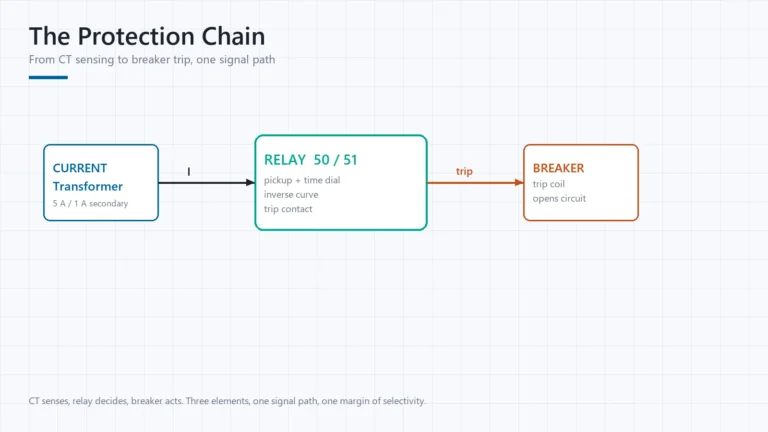
Protection is where a generic kiosk fails most often. A transformer feeder needs an overcurrent and earth fault relay with a curve the operator accepts, a monitored trip coil, and a test facility that lets a commissioning engineer inject current without opening the panel. The overcurrent curve also needs magnetising inrush restraint, because a 630 kVA transformer draws a multiplier of rated current for the first few cycles after energisation. Where the operator asks for unit protection, a differential relay joins the panel and the CT stars must match. Drawings that use ANSI device numbers per ANSI/IEEE C37.2-2022 read faster in a review, because both sides speak the same notation.
Communication rides on the same panel. A remote PLC or RTU covers the operator requirements in VDE-AR-N 4110, and the low-voltage board carries the auxiliary supplies for it. Motor feeders on that board switch through a contactor rated to the right utilization category, and the breaker that protects them is a separate decision from the MV switchgear in the kiosk.
| Market | Rule | Edition | What it adds to the kiosk |
|---|---|---|---|
| Germany | VDE-AR-N 4110 | 2018 | Protection, metering and communication for 1 to 60 kV connections |
| EU wide | EN 50522 | 2022 | Earthing design and touch voltage proof |
| EU wide | EN 50160 | 2022 | Voltage characteristics the LV side must deliver |
| United Kingdom | DNO connection offer | per project | Site specific protection and metering settings |
Table 4. Rules that sit outside IEC 62271-202 but decide energisation.
CE Marking and the Document Pack
CE marking is a declaration, not a certificate. The assembly falls under the Low Voltage Directive 2014/35/EU for the low-voltage side, the EMC Directive 2014/30/EU for control and communication electronics, and the RoHS Directive 2011/65/EU for materials. The manufacturer signs an EU declaration of conformity and keeps a technical file for ten years.
The technical file should hold the type test reports, the routine test records, the risk assessment, the earthing design and the drawings that were actually built. A file assembled after the factory acceptance test from a template is the most common reason an operator rejects a submission.
Grid-code compliance sits outside the CE declaration. A kiosk can carry a valid CE mark and still be refused energisation because the protection settings or the metering class do not match the connection agreement. Keep the two document tracks separate and ask for both.
Factory Tests, FAT and Site Commissioning
Routine tests under IEC 62271-1:2017 run on every unit: a power-frequency dielectric test on the main circuit, tests on auxiliary and control circuits, a mechanical operation check, a wiring check, and a verification of the enclosure against its IP claim. The type tests were done once on a representative design. The routine tests prove that the unit in front of you matches it.
A factory acceptance test is a commercial event, not a standard one, so write the agenda into the purchase order. Ten items cover most disputes: the single line against the as-built, the protection settings file, the interlock sequence, trip coil supervision, CT ratio and polarity, heater and thermostat operation, door limit switches, cable termination space, nameplate data and the spares packing list.
On site, earthing resistance, the HV withstand test, relay secondary injection and the interlock sequence decide the energisation date. A stuck door interlock or a drifting thermostat is a nuisance trip waiting for the first cold morning.
The defects repeat across projects, which is why the agenda repeats too. Across prefabricated substation suppliers europe the same five items show up at FAT: heater circuits wired without a supply, trip coils without supervision wiring, CT nameplates that disagree with the settings file, cable gland plates drilled for a different transformer position, and paint damage on lifting beams. Every one of them is cheap at the factory and slow on site.
Book the witness test before the kiosk leaves the works.
Transport, Civil Works and Footprint
A 630 kVA concrete kiosk weighs roughly 6 to 9 tonnes and needs the crane reach stated on the drawing, not a lorry-mounted loader. Transport unit limits decide the route, and a wide load permit in one country is a different process in the next.
Civil works are usually the schedule risk. The foundation must carry the point loads at the lifting and jacking positions, the cable trench must line up with the gland plate, and the ventilation openings must stay clear of later walls or fences. A kiosk rated for 40 °C ambient with 30% of its ventilation blocked by a fence built two years later runs a class hotter than the nameplate says.
For renewable sites the footprint often decides the layout. Two kiosks 4 m apart cost less to install than one large walk-in station with a 12 m access road, and they can be energised in stages as the plant grows.
Oil containment is the last civil item buyers forget. A liquid-immersed transformer inside a kiosk needs a bund or an oil drain system sized to national water protection rules, and German sites reference the AwSV regulation. The bund belongs in the foundation drawing, not in an email after delivery, because moving a kiosk that has already been set costs the crane day twice.
How to Shortlist Prefabricated Substation Suppliers Europe
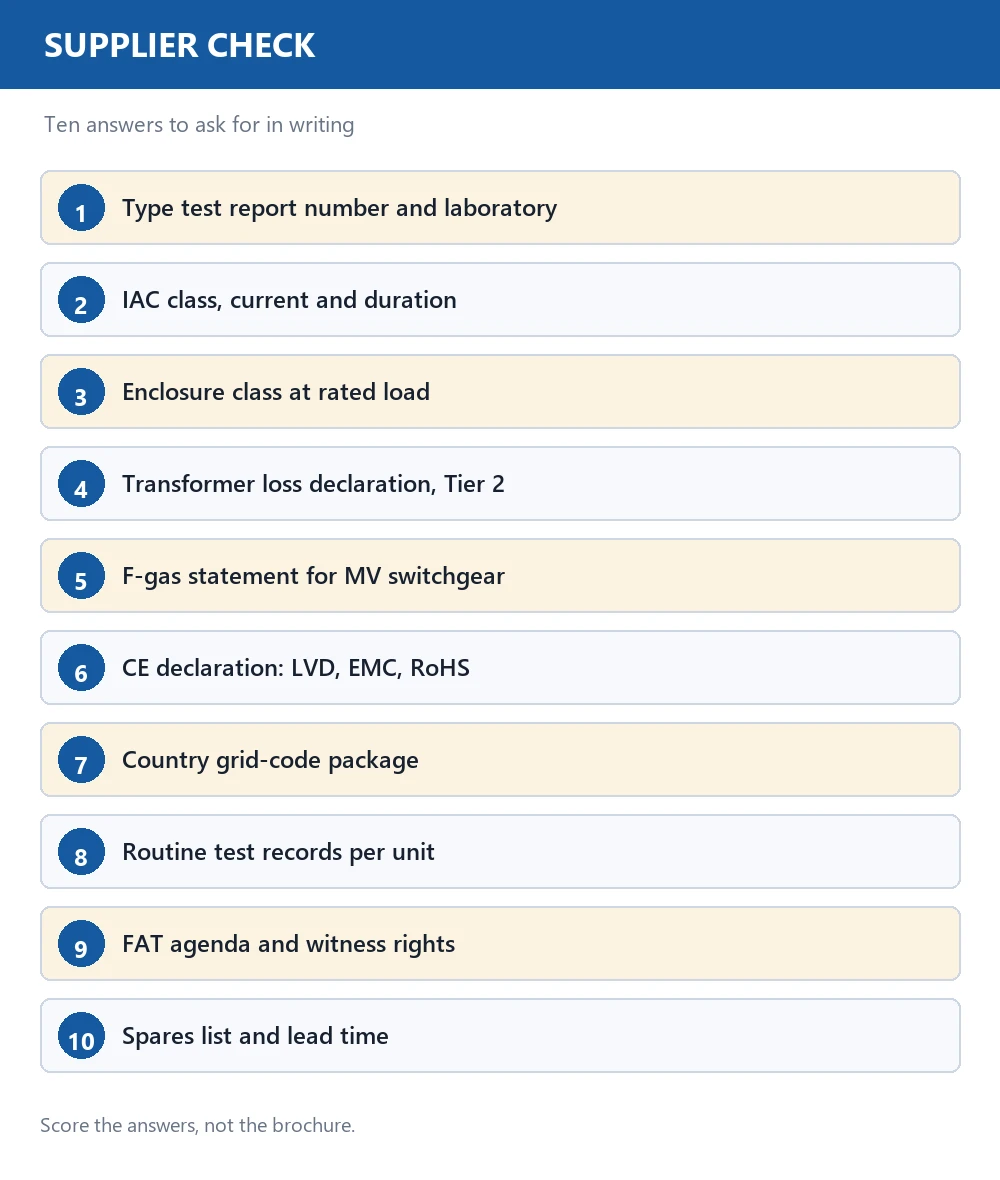
A shortlist built on price alone re-opens at commissioning. The ten questions below separate a supplier who has delivered into European networks from one who has exported catalogues. Ask for each answer in writing and file it with the purchase order.
- Type test report number, laboratory and date for the IEC 62271-202 assembly test.
- IAC classification with test current and duration, and the ignition points used.
- Enclosure class at rated load, and the load factor curve behind it.
- Transformer loss declaration against Tier 2, with the test report.
- Written F-gas statement for the MV switchgear and its gas, if any.
- CE declaration of conformity naming LVD, EMC and RoHS.
- The grid-code package for your country, including a sample settings file.
- Routine test records for the specific serial numbers you are buying.
- FAT agenda, witness rights and the retest rule if an item fails.
- Spares list, lead time and the warranty terms in years.
Score the answers, not the brochures. A supplier who sends a report with a laboratory name, a number and a date is easier to qualify than one who sends a certificate of conformity with no test behind it.
When a Prefabricated Substation Is the Wrong Choice
The format is the wrong answer more often than the sales literature admits. Four boundaries come up again and again in European projects.
- Above 52 kV the standard stops. A 110 kV connection needs a different design, a building and a transmission-grade review.
- Transformers beyond the medium power scope, roughly above 3,150 kVA, exceed the transport and thermal basis of a kiosk.
- A basement or inner-city plot without crane access turns the transport unit into a rigging problem; a walk-in room in the building is cheaper.
- Where an existing building is sound and only the switchgear is being replaced, refurbishment avoids a foundation, a permit and a new earthing design.
- For a genuinely temporary load, a rented mobile substation beats a kiosk that will stand idle after the project.
Say no early. A wrong kiosk is a twenty-year mistake.
Frequently asked questions
What does IEC 62271-202:2022 add over the 2014 edition?
The third edition extends the scope to high-voltage switchgear substations, admits CEADS hybrid switchgear as a component, defines rated power as three parameters (kVA, total losses and temperature rise), adds Annex G for solar radiation and Annex H for electronic equipment, and sets minimum dimensions for access doors and operation aisles.
Do prefabricated substation suppliers europe need CE marking?
Yes for the EU market: the assembly carries CE marking under the Low Voltage Directive 2014/35/EU, the EMC Directive 2014/30/EU and the RoHS Directive 2011/65/EU, backed by an EU declaration of conformity. CE marking proves product safety directives, not grid-code compliance.
Which enclosure class should I specify for a hot site?
Class 10 fits a shaded urban site with load up to about 80%. Where the kiosk stands in full sun or the load runs near rated current, class 15 or 20 keeps the transformer inside its temperature limits, and Annex G of the 2022 edition gives a method to assess solar radiation.
Is SF6 still allowed in a new 24 kV kiosk?
Not in the EU from 1 January 2026, when Regulation (EU) 2024/573 prohibits putting fluorinated gas switchgear up to 24 kV into operation. Existing SF6 equipment may stay in service, and the use of virgin SF6 for servicing ends on 1 January 2035.
What transformer losses must a 630 kVA unit meet?
Under Tier 2 of Regulation (EU) 548/2014 as amended, in force since 1 July 2021, a 630 kVA dry-type unit is limited to 990 W no-load loss and 7,100 W load loss; the liquid-immersed equivalent is limited to 540 W and 4,600 W.
How long does a European delivery take?
Plan for 6 to 10 weeks of design and document review, 12 to 20 weeks of manufacture after approval, and 2 to 4 weeks for the factory acceptance test, transport and site commissioning. Country-specific grid-code reviews can add time on top.
Which documents should arrive with the kiosk?
The EU declaration of conformity, type test reports with report numbers and laboratory names, routine test records for your serial numbers, as-built drawings, the protection settings file, the earthing calculation, and an operation and maintenance manual in the local language.
Conclusion
Prefabricated substation suppliers europe should be judged on four documents before anyone compares prices: the type test report for the assembly, the Tier 2 loss declaration, the written F-gas statement for the switchgear, and the grid-code package for the connection country. A kiosk that passes those four checks is a buyable asset. One that cannot produce them is a delivery date waiting to slip.
The standards are stable. IEC 62271-202:2022, IEC 61439-2:2020 and Regulation (EU) 2024/573 give a buyer a fixed yardstick. Use it, and the shortlist does most of the engineering for you.
Related Reading
- Substation: Classes, Equipment and Busbar Schemes. What a distribution substation contains and how busbar schemes differ.
- Vector Groups, Cooling and Ratings on a Power Transformer. How to read a transformer nameplate before you set losses.
- What Counts as Switch Gear, and What Does Not. Where switchgear ends and assemblies begin.
- How Circuit Breakers Clear a Fault and Extinguish the Arc. Arc behaviour behind the ratings you just specified.
For a model recommendation, send the system voltage and the load details to our engineering team.
About Author

Hello, I'm Leon Zhang. I have 15 years of experience in the power relay protection industry with extensive pre-sales and after-sales project experience. Our company specializes in various complete sets of relay protection and automation equipment. I can assist customers in solving all practical on-site project challenges and provide optimal integrated solutions.
Tell Us Your Requirement
High Quality
Stable performance, reliable design, ensuring safe operation for power system protection and grid stability.
Fast Delivery
Timely delivery to support your urgent orders and project schedules efficiently and professionally at any time.
Best Warranty
Professional Warranty: Reliable after-sales support for stable relay protection and long-term customer satisfaction.