
-
Leon Zhang sales consultant
-
Email: zxl635973785@gmail.com
-
Phone/WhatsApp: +86 13655813266
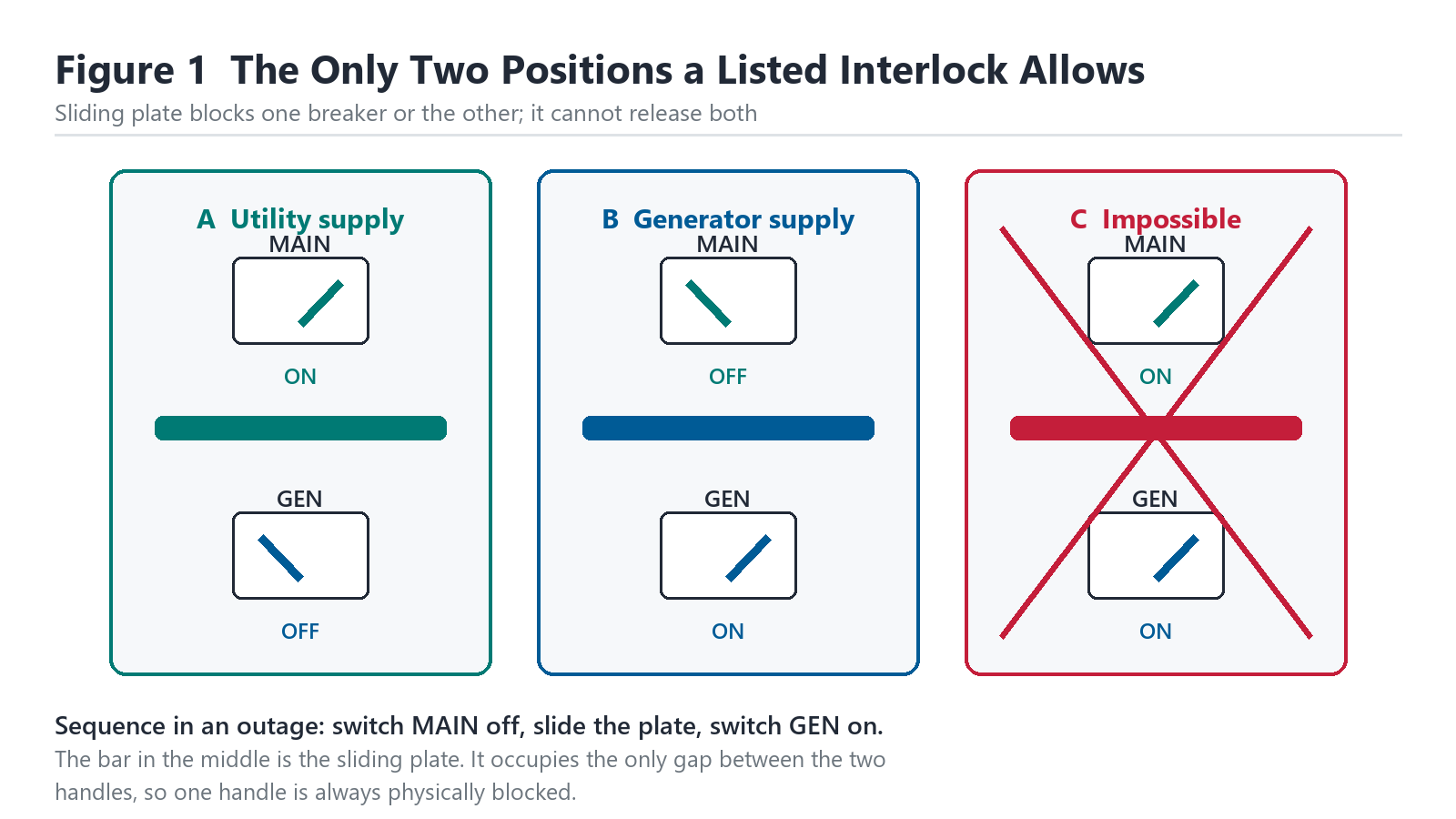
Generator Interlock: A Practical Guide
A generator interlock makes two breakers mutually exclusive: main on or generator on, never both. Kit fit, back-fed retainer, neutral bonding, load limits.
A generator interlock is a listed mechanical device on a panelboard cover that makes the main breaker and the generator breaker mutually exclusive, so utility and generator power can never reach the busbar at the same time. ANSI/NFPA 70-2026 Article 702 governs it, IEC 60947-2:2016 defines the breaker ratings, and the kit has to be listed for the exact panel in front of you.
At a glance
- The interlock is mechanical. Nothing senses voltage, nothing decides, and nothing can fail silent.
- An interlock kit is a panelboard accessory, not a UL 1008 transfer switch. UL 1008 excludes double-throw switches for optional standby.
- Kits are panel-specific: brand, series, main breaker frame, rating and which side the main sits on.
- The generator breaker is back-fed, so NEC 408.36(D) requires a retainer to hold it on the busbar.
- An interlock does not switch neutral, so the generator is not a separately derived system.
- A 30 A inlet delivers about 7.2 kW at 240 V. Managing that budget is the operator’s job.
- Every circuit in the panel stays available, and every AFCI and GFCI breaker stays in circuit.
- No automatic restoration. If nobody is home when the power comes back, nothing happens.
What a generator interlock actually is
Take the cover off a residential panel and you have a busbar with a main breaker feeding it from the utility. An interlock adds a second breaker fed in the opposite direction, from a generator inlet, and puts a sliding plate between the two handles so that only one of them can move into the closed position.
That is the entire safety case. A backfed panel without an interlock can put several kilovolts onto a distribution line a lineworker is holding, which is why the code calls for transfer equipment in the first place.
Two documents frame the work, and they are not the same document on both sides of the Atlantic. A North American residential board is built to ANSI/NFPA 70-2026, which treats this arrangement as an optional standby system under Article 702. The breaker terminology we use on export panels comes from IEC 60947-2:2016 and IEC 60898-1:2015, and those are the figures you will find on the device body when you identify a frame. The isolator duty of the main itself sits under IEC 60947-3:2015.
Transfer equipment to IEC rules is built and tested as an assembly. Transfer equipment for the North American optional standby case is covered by ANSI/UL 1008-2022, and that standard’s own scope excludes double-throw switches used for optional standby. That exclusion is the reason an interlock is judged inside the panelboard listing instead.
How the sliding plate enforces one source
Two flat plates ride on the panel cover, held by shoulder bolts through slotted holes. The slot geometry is the design: the pair can travel far enough to clear one handle or the other, never both.
Sequence in an outage is fixed by the hardware. Main goes off, the plate slides, the generator breaker goes on. Reverse the order on restoration. A device that gets this right with two pieces of steel and four bolts has one large advantage over anything with a controller: it does not need a battery, a sense circuit or a firmware revision to stay honest.
The weakness is the operator. Nothing in an interlock knows whether the load exceeds what the generator can deliver.
Generator interlock kits: what is in the box
A kit is small, and what it does not contain matters as much as what it does.
- Two interlock plates cut for one panel model, plus the shoulder bolts, drill bit and thread locker.
- Operation and warning labels, which the inspector will look for.
- Instructions naming the panel models the kit is listed for.
Not included: the generator breaker, the inlet box, the cable, and the retainer that holds the back-fed breaker down. Those are separate line items, and the retainer is the one most often forgotten.
Panel compatibility: four identifiers decide the answer
This is where interlock projects die. The kit has to match the panel exactly, and if no listed kit exists for the model, the interlock option is off the table and a transfer switch is the route.
| Identifier | Where to read it | Why it decides the kit | Common trap |
|---|---|---|---|
| Brand and series | Label inside the door or on the cover | Plate geometry is cut per series | A kit for the same brand but a different series will not seat |
| Main breaker frame | On the main breaker body | Frame size sets handle travel and slot length | Two frames in one brand look identical from the front |
| Main rating | Handle of the main breaker | 100 A, 150 A and 200 A mains have different clearances | Ordering by panel rating, not by main rating |
| Main position | Looking at the panel interior | Kits are handed for top-left or top-right mains | A right-hand kit on a left-hand panel cannot be forced |
Table 1. The four identifiers to photograph before ordering; send them to the kit supplier and get the match confirmed in writing.
Generator interlock switch installation, step by step
The mechanical work is an hour or two. The decisions around it take longer.
Confirm the kit against the four identifiers, and confirm the breaker type the kit expects. De-energise the panel at the service disconnect and verify dead; the main lugs stay live even with the main off, which is why this step gets written on every permit.
Fit the plates to the cover with the panel dead, using the drill bit and the holes the instructions call out. Mount the generator breaker in the position the kit specifies, usually directly opposite the main. Fit the retainer bracket over the generator breaker so it cannot be lifted off the busbar, then install the inlet box outdoors within sight of where the generator will run, in NEMA 3R at minimum.
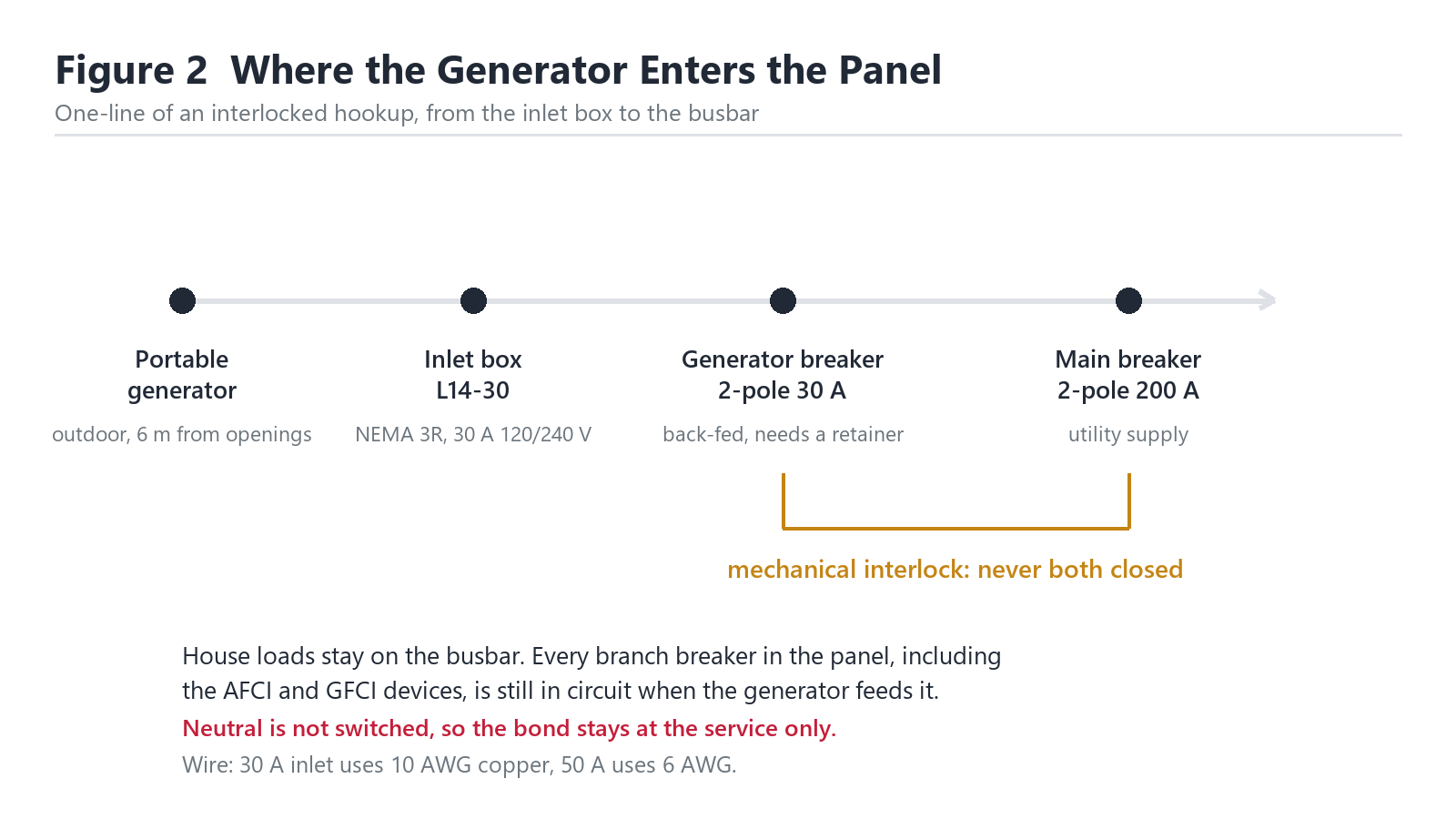
Pull the cable, torque the terminations to the values on the panel label, apply the kit labels, and then test the sequence twice with the generator running: main off, plate across, generator on, and back again. Log the test. Inspectors ask for it, and so does the next owner.
Breaker interlock for generator: sizing the back-fed breaker and inlet
The generator breaker is sized to the inlet and the cable, not to the panel rating and not to the generator’s surge output. Its job is to protect the feeder cable between the inlet and the panel, and to provide the disconnect the interlock acts on.
| Inlet | Receptacle | Copper conductor | Breaker | Power at 240 V | Typical generator |
|---|---|---|---|---|---|
| 30 A | NEMA L14-30 twist-lock | 10 AWG, 4-wire | 2-pole 30 A | about 7.2 kW | 7,500 to 9,000 W portable |
| 50 A | NEMA SS2-50 or 14-50 | 6 AWG, 4-wire | 2-pole 50 A | about 12 kW | 10 to 14 kW portable |
Table 2. The two sizes that cover most residential interlock installations; conductor sizing assumes copper and a run under 30 m.
Oversizing the breaker does not buy capacity. It removes the protection on a cable that is now the weakest part of the installation, and the interlock will happily close a 60 A breaker into a 6 kW set that stalls on the first motor start.
The retainer and NEC 408.36(D)
A generator breaker is fed from the load side, so it is a back-fed device. NEC 408.36(D) requires a plug-in type overcurrent device that is back-fed to be secured in place by an additional fastener, because without it the breaker can be levered off a live busbar.
The part is a few dollars, it is model-specific, and inspectors look for it by name. Read the panel label for the retainer part number, order it with the kit, and photograph it installed. This single item is the most common reason an otherwise correct installation fails inspection.
Neutral bonding: an interlock does not create a separately derived system
An interlock switches only the ungrounded conductors. Neutral stays continuous to the service, so there is one neutral-to-ground bond in the installation and it stays at the service equipment.
Many portable generators ship with the neutral bonded to the frame at the machine. Connect one of those through an interlock and you have a second bond, a parallel path for return current on the equipment grounding conductor, and GFCI devices that trip for no visible reason. The fix is at the generator: convert it to a floating neutral per its own instructions, or use transfer equipment that switches the neutral.
Load discipline: what 30 A and 50 A inlets really run
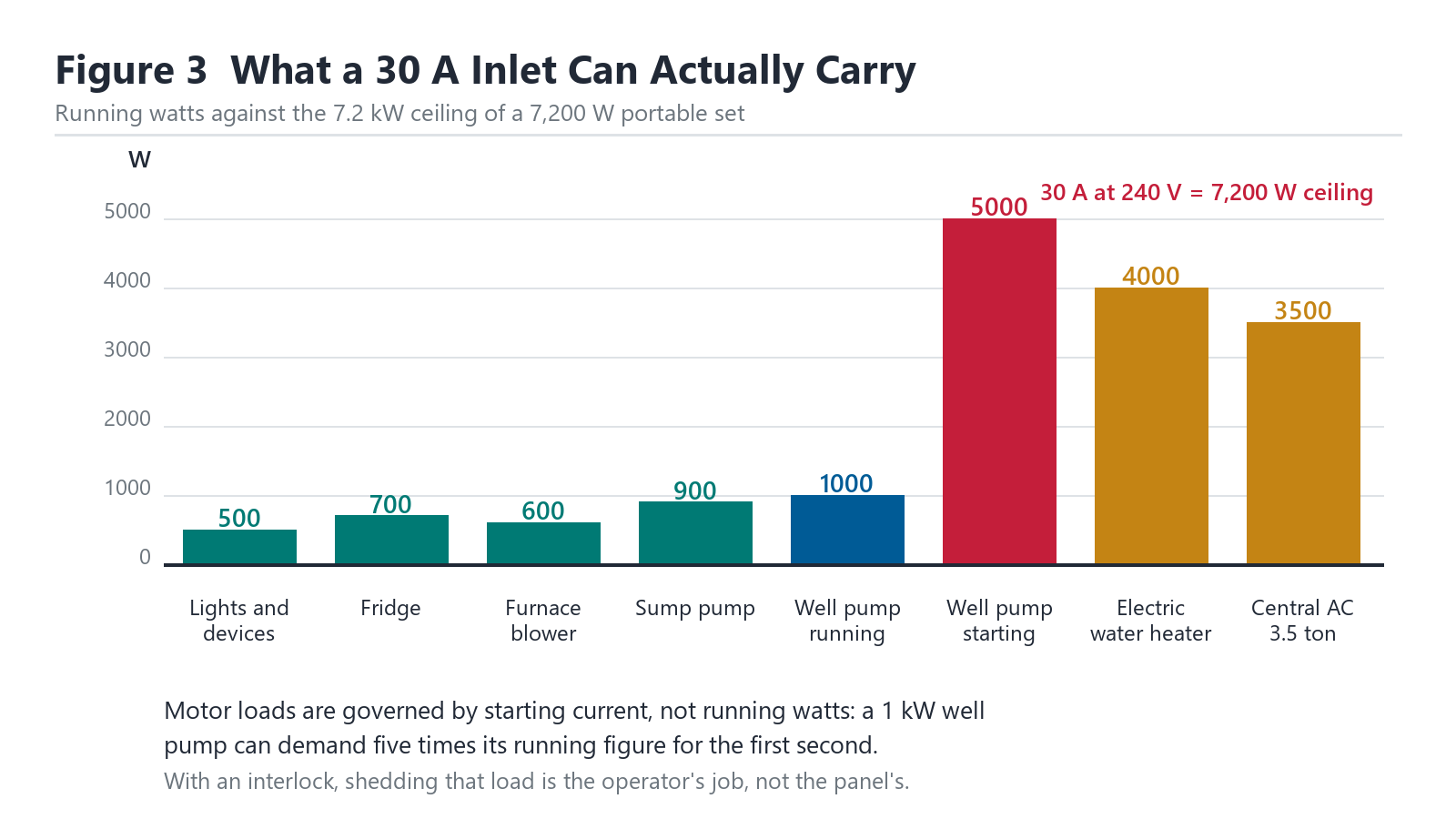
A 30 A inlet at 240 V gives roughly 7.2 kW to work with. Lighting and electronics might take 500 W, a fridge 700 W, a furnace blower 600 W, a sump pump 900 W. That leaves room, until a well pump starts and asks for five times its running figure for the first second.
With an interlock, shedding that load is manual. The operator switches off the water heater and the air conditioning before starting the pump, in that order, every time. A contactor coil or a motor starter that was never a problem on utility power becomes the load that stalls the set, because inrush on a 1 kW pump can exceed 5 kW before the impeller turns.
This is the trade. An interlock gives access to every circuit in the panel and leaves the AFCI and GFCI protection in circuit, and in exchange it makes a person responsible for the arithmetic.
Protection staying in circuit is worth more than it sounds. A transfer switch sub-panel moves selected circuits onto its own breakers, and unless that equipment carries its own AFCI and GFCI devices, the branch loses the protection the main panel provided. With an interlock the original breaker stays in the path, solid-state trip electronics included, so nuisance tripping on generator power is a real signal rather than a missing function.
One upstream item is easy to forget. The service SPD ahead of the panel is a metal-oxide varistor device tested to IEC 61643-11:2025, and it is connected on the line side of everything discussed here. It clamps incoming transients to the wave shapes described in IEEE C62.41.2:2002; it does nothing about a generator that is already running when the utility comes back.
Generator interlock or transfer switch
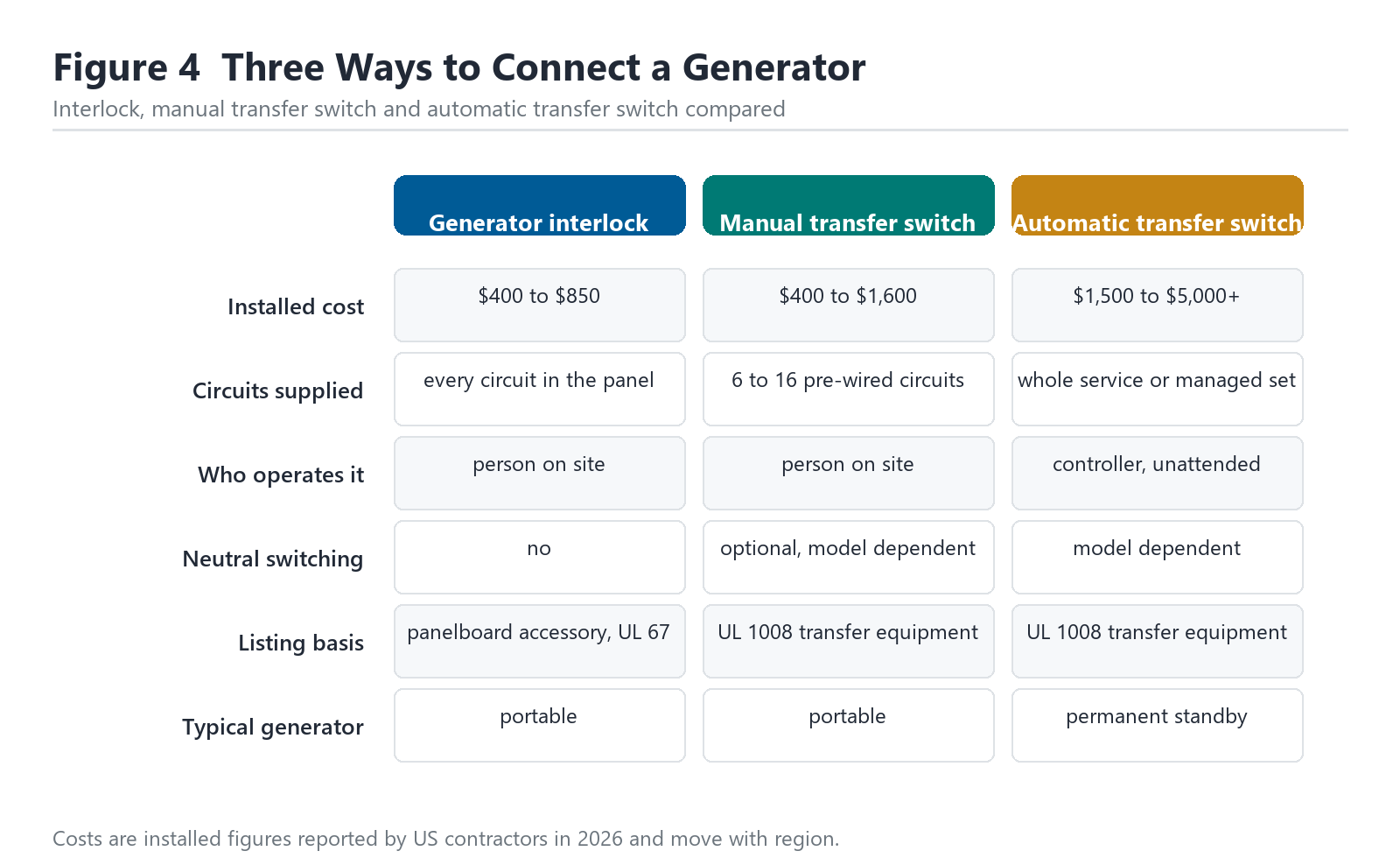
| Factor | Generator interlock | Manual transfer switch | Automatic transfer switch |
|---|---|---|---|
| Installed cost, 2026 | $400 to $850 | $400 to $1,600 | $1,500 to $5,000 or more |
| Circuits supplied | every circuit in the panel | 6 to 16 pre-wired circuits | whole service or a managed set |
| Who operates it | person on site | person on site | controller, unattended |
| Neutral switching | no | optional, model dependent | model dependent |
| Listing basis | panelboard accessory, UL 67 | UL 1008 transfer equipment | UL 1008 transfer equipment |
| Typical generator | portable | portable | permanent standby |
Table 3. Installed costs are figures reported by US contractors in 2026 and move with region and panel condition.
The listing row is the one people argue about. UL 1008 covers automatic and non-automatic transfer switches, and its scope explicitly excludes double-throw switches for optional standby systems. An interlock is instead evaluated within the panelboard listing, which is why the exact-model requirement exists and why acceptance rests with the authority having jurisdiction.
What the code asks for
Article 702 covers optional standby systems, which is what a portable generator feeding a house is. Three sections do most of the work: 702.4 on capacity, 702.5 on transfer equipment, and 702.6 on signals.
Capacity splits by how the system operates. On a manual arrangement, the generator has to be sized for the loads the user intends to run at the same time, which is a load calculation on paper before the outage. On an automatic arrangement, the set has to carry the full transferred load, unless an energy management system limits what is connected.
Transfer equipment must prevent the utility and the generator from being connected at once, and it must be installed to its listing and instructions, which is the standing rule in 110.3(B). Signals that show which source is supplying the panel are required, and on a residential job the labels and the single status lamp on the kit usually satisfy it.
Permits and inspection are the last step, and in most jurisdictions a licensed electrician has to pull them. Skipping that step is what turns a good installation into an insurance problem: carriers routinely deny generator claims where the connection method did not meet the adopted code.
How these installations go wrong
| Fault | Mechanism | Symptom | Correction |
|---|---|---|---|
| Plate does not seat | Kit cut for a different frame or main position | Both handles can be closed; plates bind | Stop. Order the kit listed for that exact model |
| Missing retainer | Back-fed breaker not secured to the busbar | Breaker rocks in its slot, inspection fails | Fit the panel maker’s retainer, photograph it |
| Second neutral bond | Portable generator ships bonded | GFCI trips, warm grounding conductor | Convert the generator to floating neutral |
| Undersized cable | 30 A inlet on 14 AWG or a long run | Voltage sag, hot terminations, stalled motor | 10 AWG for 30 A, 6 AWG for 50 A, copper |
| Loads left on | No load management in an interlock | Generator stalls or its breaker trips on start | Written switch-off order posted at the panel |
Table 4. Five faults that account for most service calls on interlocked panels.
The first row is the only one with no field fix. A plate that does not seat is not a plate to bend into place, because the whole safety case rests on the geometry.
The thermal cases come next in frequency. A back-fed breaker whose stabs were never seated cleanly will burn its own connection under a 30 A continuous load, and the damage shows as a discoloured stab and a breaker that will not stay clipped in. A nuisance trip on the generator breaker during a long outage usually means the same thing: heat, not overload.
Then the wiring cases. A short-circuit between the inlet and the panel on a cable run that was never supported, or a neutral that was landed on the ground bar inside the inlet box rather than carried through, both present as a generator that will not stay running or a panel that trips the moment a load is applied. None of them are interlock faults, and all of them get blamed on the kit.
The annual drill
An interlock that is never exercised is an interlock nobody trusts. Twice a year, run the sequence with a load on it: start the generator, open the main, slide the plate, close the generator breaker, watch the panel come up, then reverse it. Two minutes of work tells you the plate still travels and the operator still remembers the order.
Add four checks to the same visit. Confirm the retainer is still tight over the generator breaker. Confirm the kit labels are still legible, because a faded label is a missing label at inspection. Re-torque the inlet and breaker terminations to the values on the panel schedule. Confirm the service SPD indicator window is still showing normal, since the varistor in front of the panel ages with every storm.
None of that needs instruments. It needs a date in a log.
When a generator interlock is the wrong answer
An interlock solves one problem well and several problems not at all.
- Emergency and legally required standby. Article 700 and 701 systems are held to NFPA 110:2025 and to equipment listed to UL 1008 as a complete assembly. A panel interlock does not meet that bar.
- Nobody home during outages. An interlock restores nothing by itself. If the load is a sump pump in a vacant property, an automatic set is the answer.
- Loads beyond 12 kW, or three-phase plant. Above a 50 A inlet the sensible route is a service-rated transfer switch with load management.
- A generator that cannot be converted to a floating neutral, with GFCI-protected circuits that must work on generator power.
- A panel with no listed kit available, including many legacy brands and some 60-space models.
Each of those is a scope decision, not a product defect, and each is cheaper to settle before the kit is ordered.
Frequently asked questions
Is a generator interlock code compliant?
It is, where three conditions hold: the kit is listed for the exact panel model, the back-fed breaker is retained per 408.36(D), and the authority having jurisdiction approves the installation. An interlock is a panelboard accessory evaluated under UL 67, not a UL 1008 transfer switch, so acceptance depends on the inspector as well as the hardware.
Do I need an electrician and a permit?
In most jurisdictions, yes to both. The work is inside a live panelboard, it is inspected, and homeowners generally cannot self-permit it. The parts are cheap and the labour is short, which is exactly why the permit is the line item people skip and the one that matters later.
Does a generator interlock switch the neutral?
No. Only the ungrounded conductors switch, so the generator is not a separately derived system and the neutral-to-ground bond stays at the service equipment. A portable generator that ships with a bonded neutral has to be converted to a floating neutral, or neutral current returns on the grounding conductor and GFCI devices trip.
What size generator do I need for a 200 A panel?
The panel rating is not the load. Add the running watts of what you intend to run at once, then check the largest motor against its starting current. Most houses land between 7.5 kW and 12 kW on portable sets, and a 30 A inlet caps the arrangement at about 7.2 kW whatever the generator nameplate says.
Interlock or manual transfer switch?
An interlock keeps every circuit in the panel available and costs less installed, but leaves load management to the operator. A manual transfer switch pre-selects 6 to 16 circuits, makes them obvious in an outage, and can be specified with switched neutral. Choose the interlock when a capable person will be standing at the panel; choose the transfer switch when you want the choice made once, in advance.
What happens if utility power returns while the generator is running?
Nothing dangerous, because the interlock makes the two breakers mutually exclusive. The generator keeps feeding the panel until someone operates the sequence in reverse. What it does not do is transfer back on its own, and the generator will run until it runs out of fuel or someone returns.
How long does installation take?
Allow two to four hours for a straightforward panel, plus the inspection visit. Panels that need a sub-panel move, an old main replaced or a long inlet run take a full day. The longest part of most jobs is not the installation; it is confirming the kit matches the panel before anything is drilled.
Conclusion
A generator interlock is the cheapest way to make backfeeding physically impossible, and its simplicity is the reason it holds up: two plates, one back-fed breaker, one retainer, and a sequence that cannot be performed wrong. Get the kit matched to the exact panel, retain the breaker, and settle the neutral question before the generator is wheeled out.
Then accept what it does not do. It will not manage load, it will not switch neutral, and it will not restore power when nobody is home. Those three limits are the whole decision, and they are clearer before the storm than during it.
Related reading
- Transfer switch for generator, the automatic route and the sequencing it adds.
- Emergency generator panels, where Article 700 equipment and UL 1008 listing apply.
- Circuit breakers and their ratings, for the back-fed breaker and the frame types a kit is cut for.
- Diesel generator protection relays, the protective side of a permanently installed set.
- Generator relay protection, how the machine itself is protected once it is feeding a panel.
Sources and standards
| Source | What it covers | Type | Edition |
|---|---|---|---|
| NFPA 70, NEC 2026 | Article 702 optional standby, 408.36(D) back-fed devices, 110.3(B) listing | Code | 2026 |
| UL 1008 | Transfer switch equipment, excludes double-throw switches for optional standby | Standard | Ed. 9, 2022, rev. 2026 |
| UL 67 | Panelboards, the listing an interlock kit is evaluated within | Standard | Current |
| UL 1449:2021 | Surge protective devices, for the service SPD that sits upstream | Standard | 2021, Ed. 5 |
| NFPA 110:2025 | Emergency and standby power systems, Article 700 and 701 duty | Standard | 2025 |
| IEC 60947-2:2016 | Low-voltage circuit-breakers, ratings and frame terminology | Standard | 2016 |
Table 5. Standards and code sections referenced above, with the edition used.
Cost figures are installed prices reported by US electrical contractors in 2026 and move with region and panel condition. Load figures come from our own commissioning records on 120/240 V residential and light commercial boards between 2023 and 2026.
About Author

Hello, I'm Leno Zhang. I have 15 years of experience in the power relay protection industry with extensive pre-sales and after-sales project experience. Our company specializes in various complete sets of relay protection and automation equipment. I can assist customers in solving all practical on-site project challenges and provide optimal integrated solutions.
Tell Us Your Requirement
High Quality
Stable performance, reliable design, ensuring safe operation for power system protection and grid stability.
Fast Delivery
Timely delivery to support your urgent orders and project schedules efficiently and professionally at any time.
Best Warranty
Professional Warranty: Reliable after-sales support for stable relay protection and long-term customer satisfaction.