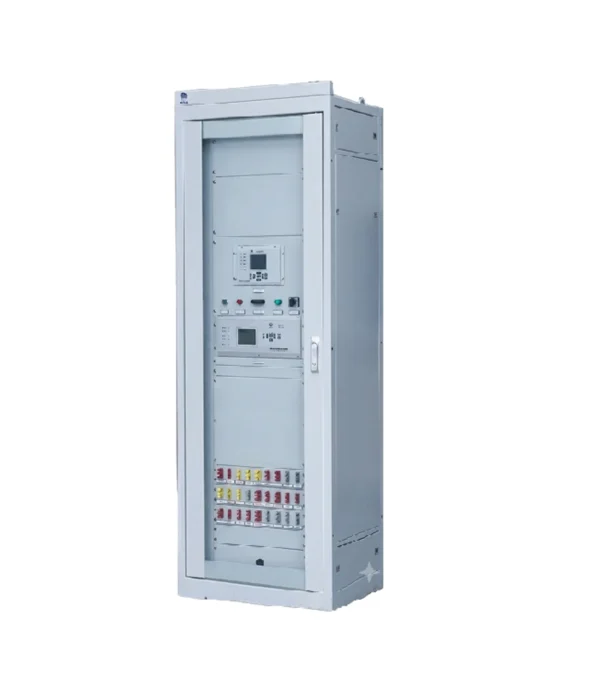
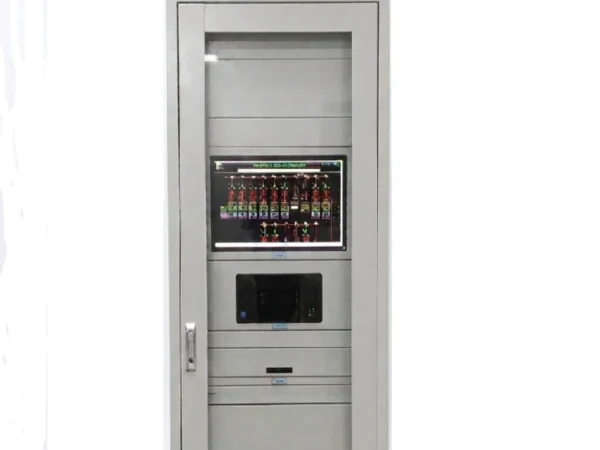
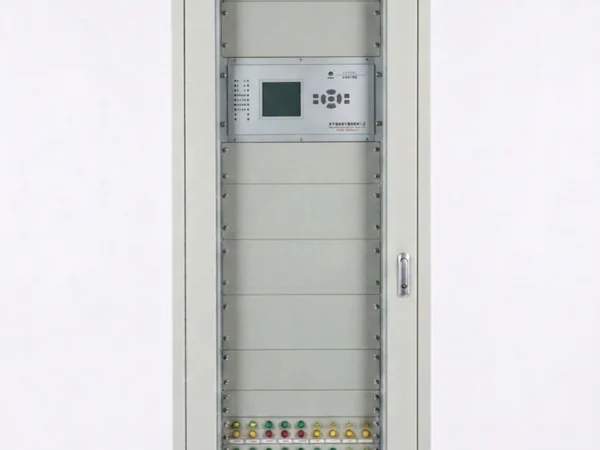
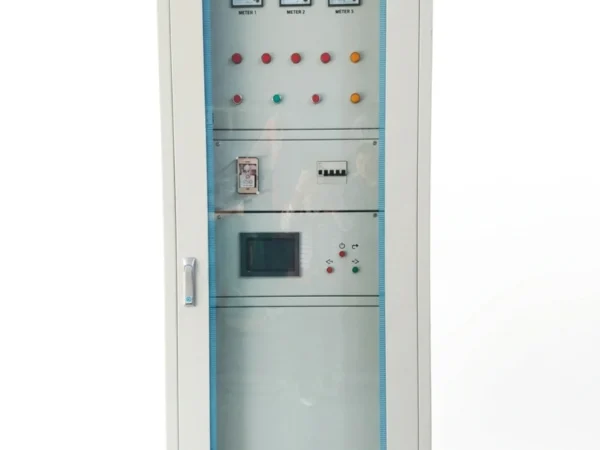
Our Line Protection and Control Panel is an integrated substation solution for 11kV–110kV transmission & distribution lines. Customizable with line differential protective relay (fiber differential) or multi-stage distance relays as core units, it provides full fault protection, real-time measurement, remote control and intelligent communication.
Send your requirements, we will quote for you within 12 hours
A line protection panel, sometimes also referred to as a line protection and control panel, is a dedicated protection and control cabinet used to protect transmission and distribution lines against phase-to-phase faults, earth faults, overloads and other abnormal operating conditions. Depending on the line voltage, length and protection requirements, the panel can integrate distance protection, fiber optic line differential protection, overcurrent and earth fault protection, automatic reclosing, fault recording and communication functions.
Our transmission line protection panels are available in three core configurations to suit different line types and operational requirements. Each configuration can be customized with auxiliary functions, communication protocols, and cabinet design based on project needs.
Fiber Differential Protection Panel
Designed for critical lines requiring high-speed, zero-delay fault clearance. Real-time current data exchange between both line ends via dedicated optical fiber channels.
Key Features:
Instantaneous full-line tripping for internal faults, reliable blocking for external faults
CT saturation detection, phase compensation, and broken fiber alarm
Suitable for short cables, tie lines, and ring networks
Typical Applications: Important interconnector lines, short cable lines, ring main unit (RMU) networks, lines with stringent stability requirements
Distance Protection Panel
Suitable for long-distance overhead lines and conventional distribution lines. Provides zone-based protection through real-time impedance monitoring.
Key Features:
Zone 1/2/3 distance protection with independent time settings
3-stage overcurrent and zero-sequence backup protection
Auto-reclosing, overload protection, and PT disconnection detection
Typical Applications: Long overhead transmission lines, conventional distribution lines, lines with variable loading conditions
Backup Overcurrent and Earth Fault Protection Panel
Provides cost-effective and reliable backup protection for lines already equipped with primary protection. Serves as the second line of defense when main protection fails.
Key Features:
Definite-time/inverse-time overcurrent and earth fault protection
Directional overcurrent option available
Compact design with easy parameter setting
Typical Applications: Backup for primary line protection, small to medium-sized substations, distribution feeders, budget-conscious projects
Note
Panel configurations are project-specific. Final composition is subject to actual technical specifications and procurement requirements. The above is for reference only.
It should be noted that the configuration of the line protection panel is not fixed. The final composition shall be subject to the technical requirements and purchase list of each specific project. The contents listed above are for reference only.
Main Functions of the Line Protection Panel
Full Fault Protection: Cover fiber differential, distance protection, overcurrent, zero-sequence, overload, overvoltage/undervoltage and PT disconnection detection, realizing all-round line fault monitoring.
Intelligent Measurement & Control: Real-time collection of line voltage, current, power, frequency and other operating data, supporting local display and remote data upload.
Automatic Reclosing: Built-in high-precision reclosing logic, adaptable to transient and permanent line faults to improve power supply reliability.
Fault Recording & Alarm: Automatically record fault time, fault type and operating parameters, with sound-light alarm and remote alarm output for quick troubleshooting.
Standard Communication: Support IEC61850, IEC60870-5-103 and Modbus protocols, compatible with mainstream substation automation systems for seamless networking.
Line Protection and Control Panel Technical Specifications
Parameter
Specification
Rated Voltage
110V DC / 220V DC (optional)
Rated Current
1A / 5A (CT secondary)
Rated Frequency
50Hz / 60Hz
Auxiliary Power Supply
110V DC / 220V DC / 240V AC
Protection Accuracy
Current: ±3%, Voltage: ±3%, Frequency: ±0.02Hz
Fault Response Time
≤ 30ms (differential) / ≤ 50ms (distance)
Auto-Reclosing Attempts
1~3 times, programmable
Communication Protocols
IEC 61850, IEC 60870-5-103, Modbus RTU/TCP
Enclosure Protection Rating
IP30 (indoor) / IP54 (outdoor, optional)
Enclosure Dimensions
2260×800×600mm or 2360×800×600mm (customizable)
Operating Temperature
-25°C ~ +55°C
Relative Humidity
≤ 95% (non-condensing)
Altitude
≤ 3000m (higher altitude customizable)
Electromagnetic Compatibility
IEC 60255 series
Dielectric Strength
2kV / 1min
Note: The above are general specifications. Final parameters are subject to actual project technical requirements.
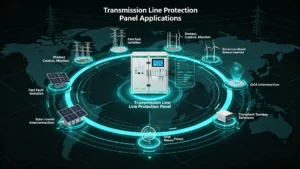
Transmission Line Protection Panel Applications
Transmission Line Protection Panel Applications
Our transmission line protection panels are widely deployed across a broad range of power system applications, providing reliable line protection, control, and monitoring for various scenarios.
Substations Protection of incoming and outgoing feeders in transmission and distribution substations, ensuring stable and secure grid interconnection with fast fault isolation and automatic restoration.
Transmission Lines Safeguard long-distance overhead transmission corridors with distance protection (Zone 1/2/3), ensuring selective fault clearance and minimizing outage impact.
Distribution Networks Protect medium-voltage distribution feeders in urban and rural networks, providing overcurrent, earth fault, and autoreclosing functions to enhance supply reliability.
Solar Power Plants Protect grid-connected transmission lines from solar farms to booster stations, handling bidirectional power flow and variable fault current characteristics.
Wind Power Plants Suitable for collection lines and outgoing transmission lines in onshore and offshore wind farms, supporting weak source and islanding detection.
Industrial Power Systems Protect critical power supply lines in steel, mining, petrochemical, and manufacturing plants, ensuring continuous operation and equipment safety.
EPC Projects Provide ready-to-install protection solutions for turnkey power projects, fully compliant with international standards and local grid codes, simplifying procurement and commissioning.
Communication and Protection Standards
All our line protection and control panels are designed, manufactured, and tested in strict compliance with international and industry standards, ensuring seamless integration into global power systems.
Protection Standards (IEC)
Standard
Description
IEC 60255-1
General requirements for protection relays
IEC 60255-121
Functional standard for distance protection
IEC 60255-151
Functional standard for overcurrent/earth fault protection
IEC 60255-22
EMC testing requirements
IEC 60255-27
Safety requirements for protection relays
Communication Standards
Protocol
Application
IEC 61850
Smart substation automation (GOOSE, SV, MMS)
IEC 60870-5-103
Legacy substation protection communication
Modbus RTU/TCP
SCADA and third-party device data exchange
DNP 3.0
North American power system communication (optional)
Other Compliance
IEEE / ANSI standards (optional, for North American projects)
GB/T 14285 (Chinese domestic standard for protection equipment)
CE / UL certification available upon request
Custom Line Protection Panel Configuration
We understand that every power project has unique requirements. Our engineering team provides fully customized line protection panel configurations tailored to voltage level, line type, grid topology, and customer preferences.
Drawing Development – Provide general arrangement drawings, wiring diagrams, and schematic diagrams for approval.
Manufacturing – Assemble and wire in our ISO-certified facility.
Testing – Conduct factory acceptance testing (FAT) per project requirements.
Delivery & Support – Ship and provide on-site commissioning assistance as needed.
Note: The above descriptions and specifications are for general reference only. Final configurations are subject to actual project requirements and purchase orders. For a tailored solution, please consult our engineering team.
FAT, Testing and Commissioning
We implement a complete testing and commissioning system for each protection panel, covering Factory Acceptance Testing (FAT), Site Acceptance Testing (SAT), and on-site commissioning support, to ensure equipment reliability, safety, and performance.
Factory Acceptance Testing (FAT)
Prior to shipment, each panel must pass FAT to verify that components, wiring, and protection logics comply with drawings, specifications, and contractual requirements.
Standard FAT Scope:
Visual and Mechanical Inspection: Enclosure integrity, component mounting, wiring, and labeling
Insulation Resistance Test: Insulation resistance ≥ 100MΩ at 500V/1000V
Dielectric Strength Test: 2kV AC for 1 minute
Auxiliary Power Supply Test: Supply range, polarity, and DC/AC conversion stability
Relay Parameter Verification: Verify all protection settings per coordination study
Protection Logic Test: Simulate various fault types to verify trip/block logic and timing
Breaker Control Test: Local/remote open/close, interlocks, and status feedback
Alarm and Indication Test: Alarm LEDs, annunciators, and remote alarm outputs
Fault Recording Test: Trigger recorder to capture and store fault waveforms
FAT is conducted at our manufacturing facility (customer witness available). A test report and certificate will be issued upon successful completion.
Site Acceptance Testing (SAT)
After delivery to site, SAT is performed to confirm the panel remains in good condition after transport and installation, and is ready for grid connection.
Standard SAT Scope:
Repeat key FAT items (insulation, power supply, basic relay checks)
Interface verification with external CTs, PTs, breakers, and DC supply
Communication integration with station SCADA/HMI and remote control center
Primary injection test (if required) to verify CT polarity and ratio
Auto-reclosing logic commissioning with actual circuit breaker
On-Site Commissioning Support
Our experienced engineers provide on-site technical support to ensure smooth energization of the protection panel.
Commissioning Services:
Pre-commissioning Check: Installation quality, wiring, and grounding
Relay Configuration: Upload final settings, verify logic, and fine-tune parameters
Primary/Secondary Injection Tests: Validate protection element operation
Breaker Trip Test: Verify coordination with associated breakers
SCADA/DCS Integration: Data exchange, control commands, and alarm reporting
System Energization Support: Witness line energization and first loading
Training: On-site training for operation and maintenance personnel
Documentation Handover: As-built drawings, test records, and O&M manuals
Quality Assurance & Compliance
All test procedures comply with international standards including IEC 60255 (relay testing), IEC 61850 (communication conformance), and customer-specific requirements.
FAQ
What Is a Line Protection and Control Panel?
An integrated substation cubicle that provides protection, control, measurement, and communication for transmission and distribution lines, housed in a standardized enclosure with relays, control switches, and communication interfaces.
What Is a Line Protection Panel Used For?
It detects line faults (short circuits, earth faults, overloads) and issues trip commands to isolate faulty sections, while also enabling remote monitoring, breaker control, auto-reclosing, and fault data recording.
What Is a Transmission Line Protection Panel?
A specialized panel for high-voltage transmission lines (66kV and above), featuring advanced protection such as fiber differential or multi-zone distance protection for high-speed, selective fault clearance over long-distance corridors.
What Protection Functions Can Be Integrated into a Line Protection Panel?


Jack –
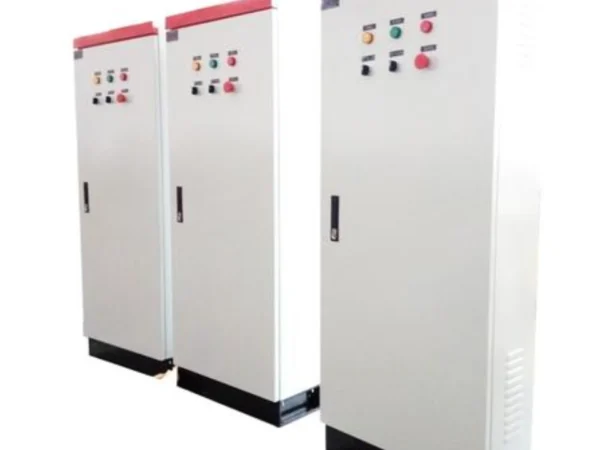
The cabinet is reasonably designed and meets all operational requirements, passing acceptance inspection smoothly.
tester-252938be –
Blocksy AFU review 252938be
nxguest –
Nx_khaled_zd woff2 bypass probe