

-
Leon Zhang sales consultant
-
Email: zxl635973785@gmail.com
-
Phone/WhatsApp: +86 13655813266
Modbus, IEC 101/102/103/104 & 61850 Substation Comms
IEC 60870‑5‑101, 102, 103 and 104 belong to the IEC 60870‑5 family of power telecontrol protocols formulated by IEC TC57. They are designed respectively for serial telecontrol, energy data transmission, relay protection and TCP/IP network communication.
Modbus is one of the most widely adopted industrial communication protocols. This article gives a detailed introduction to all these protocols.
What is Modbus communication?
MODBUS is a serial communication protocol widely used in industrial automation, power systems, building control, and other fields.
In simple terms, it defines a set of rules that allow one master device (such as a computer, PLC, or SCADA system) to read or control data from multiple slave devices (such as protection relays, power meters, smart meters,switchgear operation display device,variable frequency drives, and sensors) over the same communication line.
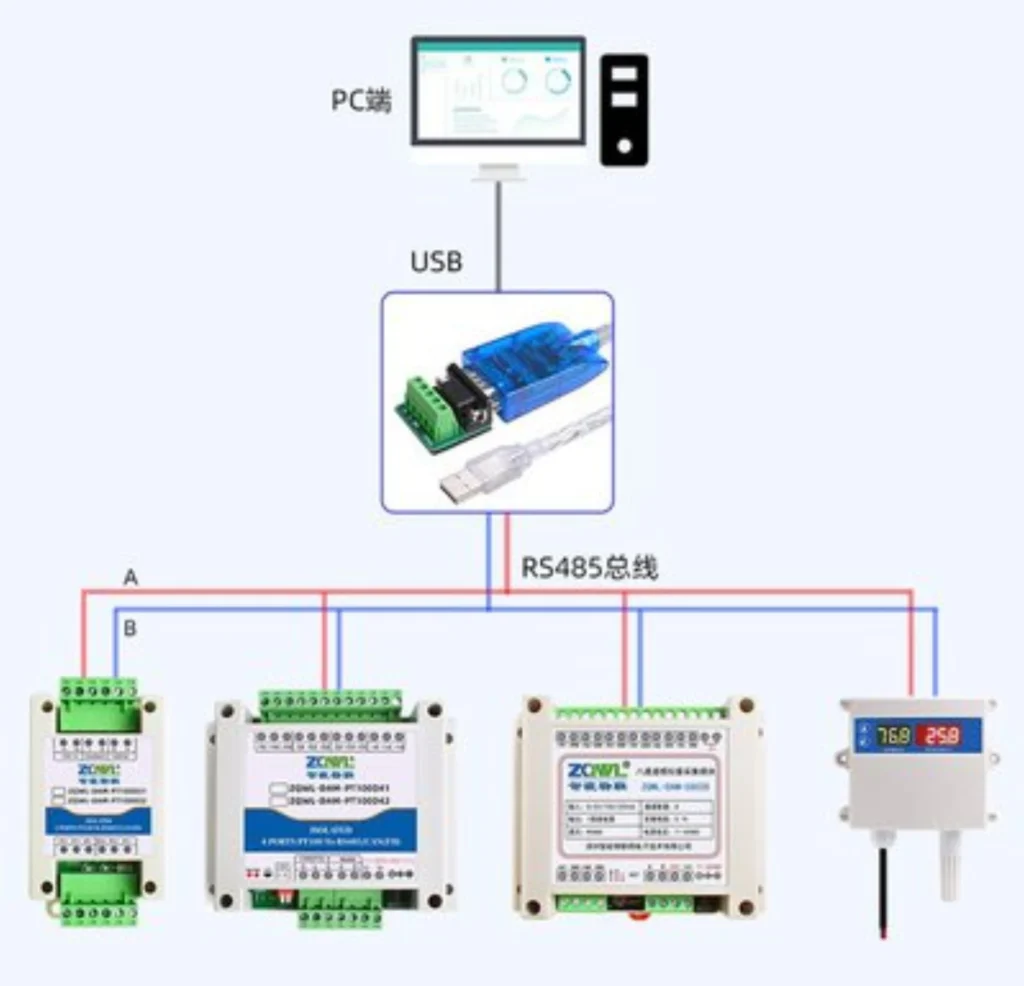
Modbus is available in two mainstream variants: Modbus RTU and Modbus TCP, which differ significantly in transmission medium, communication structure and applicable scenarios.
Modbus function codes
Note: Some manufacturers customize Modbus function codes for their proprietary equipment, leading to inconsistent protocol definitions across different brands.
| Function Code | Function Name | Application Description |
|---|---|---|
| 01 | Read Coils | Read digital output status |
| 02 | Read Discrete Inputs | Read field digital input signals |
| 03 | Read Holding Registers | Fetch protection setting values and analog parameters, widely used for relay protection devices |
| 04 | Read Input Registers | Obtain real-time sampled data like voltage and current |
| 05 | Write Single Coil | Single-point remote switching control |
| 06 | Write Single Register | Download single device parameter |
| 15 | Write Multiple Coils | Batch remote digital output control |
| 16 | Write Multiple Registers | Batch modification of equipment setting values |
What is Modbus Rtu?
Modbus RTU is a binary-coded serial communication protocol commonly operating over RS485 bus. Adopting master-slave architecture and CRC checksum, it delivers compact and high-efficiency data transmission, ranking among the most widely used communication solutions for field industrial devices.
What is Modbus Tcp?
Modbus TCP is an Ethernet-based version of the Modbus protocol that uses TCP/IP for high-speed communication between industrial devices over standard network infrastructure.
Modbus Rtu vs Tcp
| Comparison Item | Modbus RTU | Modbus TCP |
|---|---|---|
| Transmission Medium | RS485 shielded twisted pair | Ethernet cable |
| Underlying Protocol | Serial port physical layer | TCP/IP Ethernet protocol |
| Message Format | Native binary coding | Modbus messages encapsulated into TCP packets |
| Network Topology | Bus-type, master-slave structure | Star Ethernet topology |
| Communication Speed | Max 115200 bps baud rate | 100Mbps/1Gbps high-speed Ethernet |
| Transmission Distance | Long distance up to kilometers | Max 100m per cable, extendable via switches |
| Typical Application | Field relay protection & onsite instruments | Central substation networking & remote monitoring |
Can vs Modbus
| Comparison Item | CAN Bus | Modbus(RTU/TCP) |
|---|---|---|
| Underlying Standard | ISO 11898 | Modbus RTU(RS485)/Modbus TCP(Ethernet) |
| Physical Interface | CAN_H/CAN_L twisted pair | RS485 or RJ45 Ethernet |
| Network Mode | Multi-master architecture | Modbus RTU: Master-slave; Modbus TCP: Client-server |
| Error Handling | Built-in hardware error detection & retransmission | Depend on upper-layer program CRC check |
| Transmission Speed | Up to 1Mbps(short distance) | RTU: Max 115200bps; TCP: 100Mbps |
| Core Application | Automotive, new energy, industrial servo | Power relay protection, PLC, substation automation |
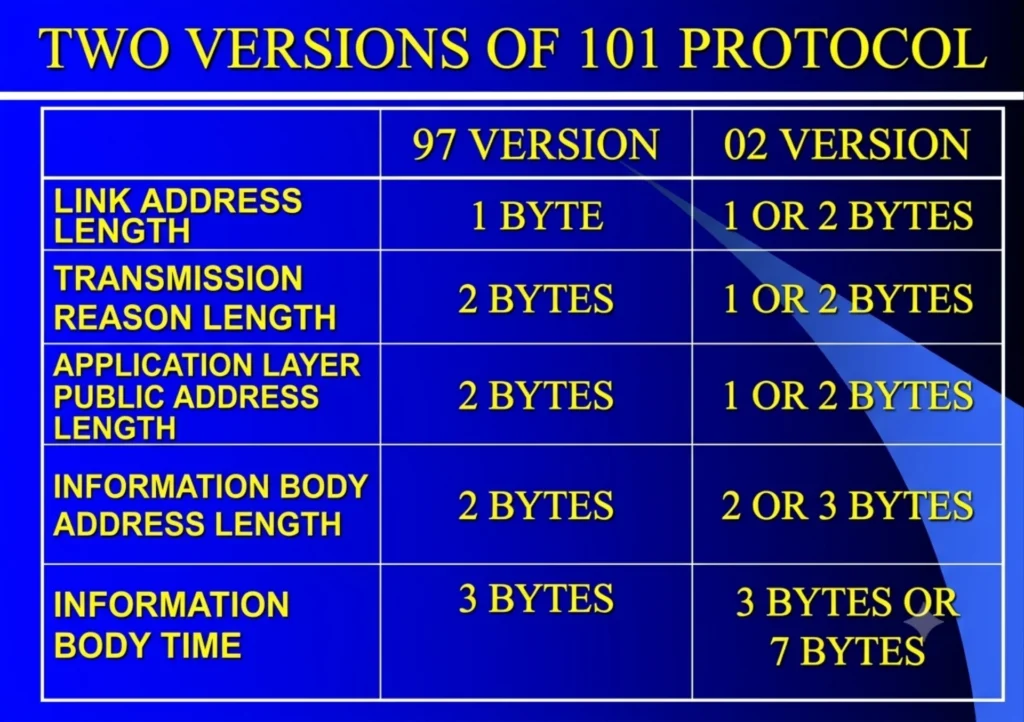
IEC 60870‑5‑101 (IEC 101 Protocol)
Origin
Full name: IEC 60870-5-101, released in the 1990s. It is the fundamental serial telecontrol protocol of the IEC 60870-5 family.
Positioning
Designed for low-speed serial links including RS-232/RS485 and power line carrier, it adopts master-slave polling communication mechanism.
Applications
It realizes data communication between master stations (dispatching & monitoring center) and RTUs installed in substations, distribution stations and power plants.
It transmits four types of remote control data: remote measurement, remote signal, remote control and remote regulation, supporting conventional power SCADA systems.
Applicable scenarios: point-to-point and point-to-multipoint medium/low-speed, medium-short distance power automation communication.
IEC 60870-5-102 (IEC 102 Protocol)
Origin
Full name: IEC 60870-5-102, a dedicated protocol specified for electrical energy data transmission.
Positioning
Developed based on the IEC 60870-5-101 framework, it focuses on reliable transmission of integrated total values and electric energy metering data.
Application
Used for data communication between master stations, electricity meters and energy acquisition terminals.
Transmission content: forward/reverse active/reactive energy, maximum demand and time-of-use metering data.
Application Scenarios
Specialized communication for power system electricity billing, line loss calculation and energy management.
IEC 60870-5-103 (IEC 103 Protocol)
Origin
Full designation: IEC 60870-5-103, a dedicated communication protocol for relay protection equipment.
Positioning
Extended from the IEC 60870-5-101 specification, it defines proprietary data models for protection events, fault oscillography, protection setting values and related information.
Application
Facilitates communication between dispatch/supervision master stations and substation relay protection devices as well as fault recorders.
Transmitted data: protection operation events, fault reports, equipment status, setting value read/write data and oscillographic recording data.
Application Scenarios
Widely deployed in relay protection information substations and fault information management systems to enable rapid fault location and troubleshooting in power grids.
Main Disadvantages
Diversified requirements of protection functions: protection principles, operating logics, alarm classifications and setting structures vary greatly among protection devices from different manufacturers. The standard IEC 103 specification cannot cover all manufacturer-specific proprietary functions.
IEC 60870-5-104 (IEC 104 Protocol)
Origin
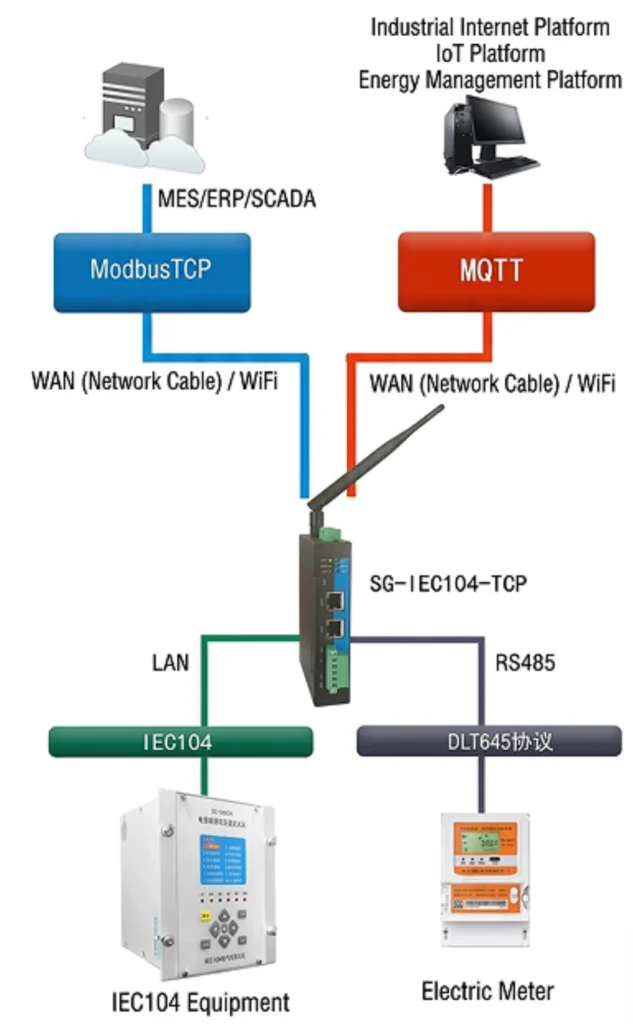
Full designation: IEC 60870-5-104, released around 2000. It is the TCP/IP network-based version of IEC 60870-5-101.
Positioning
Running over TCP/IP with default port 2404, it follows the client-server architecture and enables multi-node high-speed network communication.
Application
It handles Ethernet data exchange between dispatching master stations, substation automation systems (SAS) and power plant monitoring systems.
It transmits the same four-remote data as IEC 101, featuring larger bandwidth, superior real-time performance and excellent expandability.
Application Scenarios
It serves as the mainstream communication protocol for smart grids, digital substations and wide-area power monitoring networks.
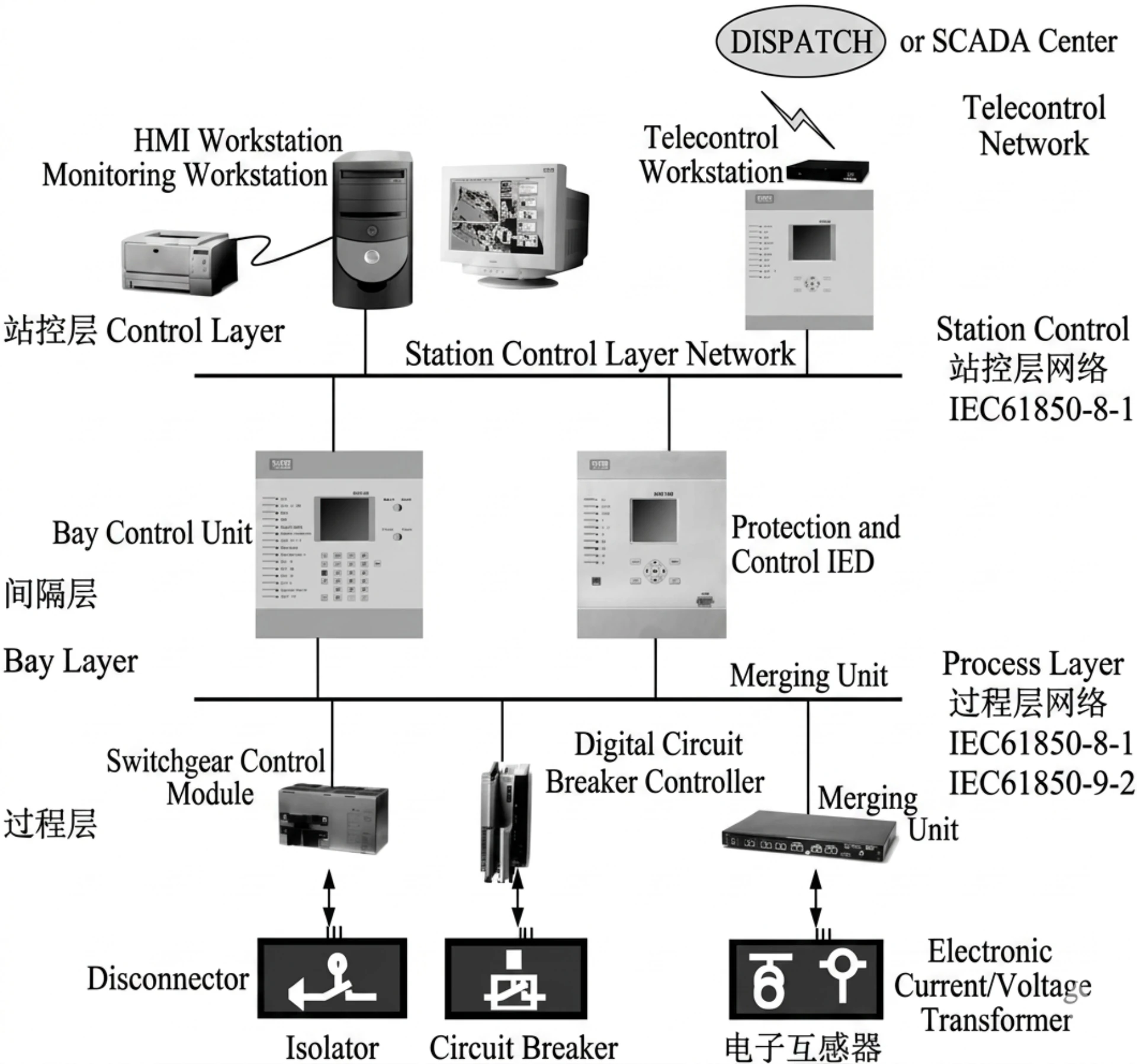
IEC 61850
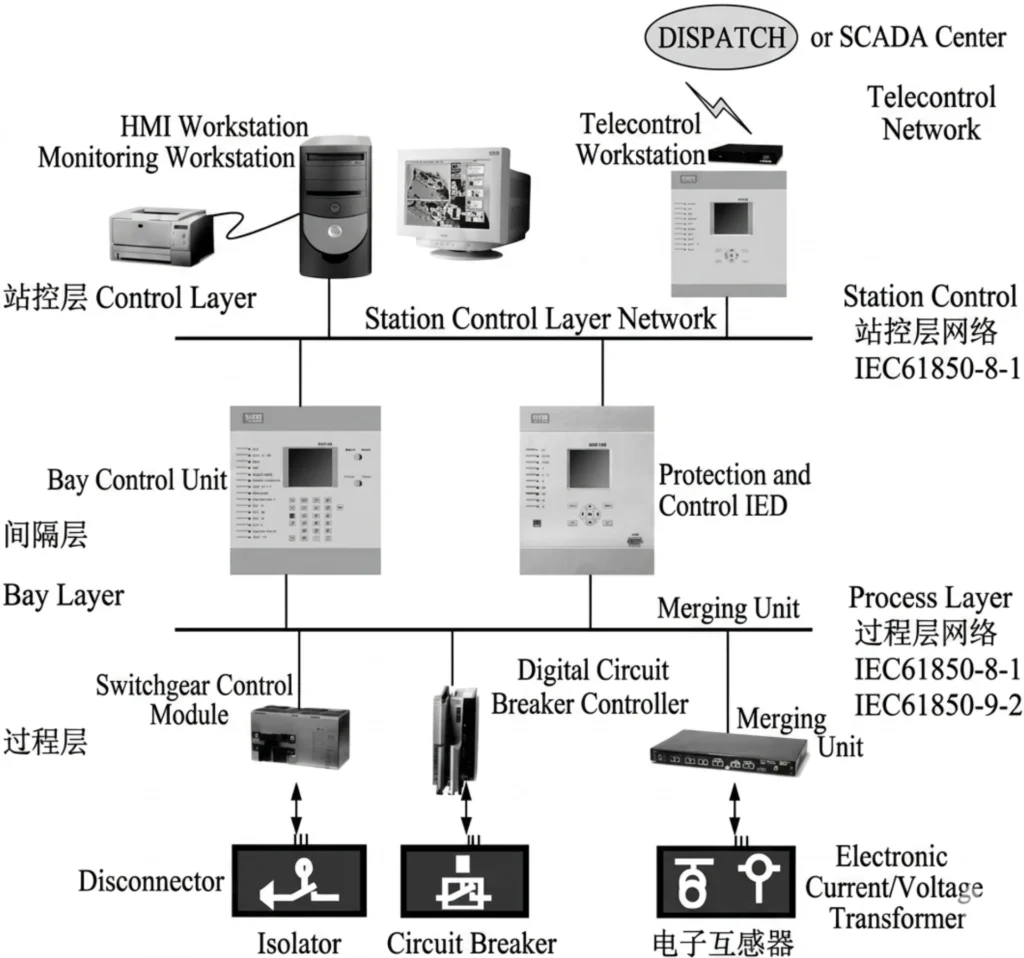
Origin
Full name: IEC 61850, formally released in 2004 by IEC TC57, succeeding traditional IEC 60870‑5‑103 serial protocol and UCA2.0 standard, the core international specification for digital substation communication.
Positioning
Built entirely on Ethernet architecture with object‑oriented unified data modeling; defines three core communication services: MMS, GOOSE and SV, adopts publisher‑subscriber & client‑server hybrid mode, solves multi‑vendor IED interoperability which serial protocols cannot realize.
- MMS: TCP/IP client‑server for non‑real-time configuration & SCADA data
- GOOSE: Layer 2 multicast, ≤4ms latency for protection interlock & trip signal
- SV: Layer 2 sampled value transmission for synchronized CT/VT digitized data Equipped with XML-based SCL configuration language (ICD/CID/SCD files) for standardized project debugging.
Application
Realizes full digital communication among dispatching master station, substation automation system (SAS), intelligent electronic devices(IED), merging units and smart primary equipment.
Covers full data transmission including four remote signals, protection trip commands and synchronized analog sampling data, cancels massive traditional hard wiring inside substations.
Application Scenarios
Mandatory mainstream protocol for digital & intelligent substations, widely deployed in smart grid, new energy power station, distributed energy storage and industrial high‑voltage power monitoring system.
Protocol Selection for Relay Protection Devices
Main Protocols & Applications
- IEC 61850 Fit ≥110kV intelligent substations, renewable booster stations & high-end overseas projects; Ethernet/fiber with MMS/GOOSE/SV, cross-brand compatible.
- IEC 60870-5-103 For 35kV~110kV traditional substations & retrofit; RS485/Ethernet, fast spontaneous alarm upload for protection.
- Modbus RTU/TCP 10kV distribution, Southeast Asia & Africa projects; low cost, wide PLC compatibility, polling-only data fetch.
- IEC 60870-5-104 Exclusive for substation remote data upload to dispatch center via TCP.
- DNP3 Export to North America, Middle East, Australia; replace 103/104 for bay & remote communication.
Selection Tip: DNP3 for America/Middle East, Modbus for SEA/Africa, IEC61850/103 for China-standard projects.
Selection by Voltage Grade
| Voltage | Preferred | Alternative |
|---|---|---|
| ≥220kV | IEC61850 | IEC104 |
| 35~110kV | IEC103 | Modbus TCP |
| 10kV | Modbus | IEC103(high-end) |
Switchgear Matching
- HV switchgear: IEC103 / IEC61850 for relay & display unit
- LV panel meters: unified Modbus RTU/TCP
FAQ
What is IEC 61850?
IEC 61850 is an international standard for substation automation and digital substation communication. It defines how protection, control, measurement, and monitoring devices communicate in modern smart substations.
What is IEC 61850 communication protocol?
IEC 61850 is a vendor-neutral, Ethernet-based communication protocol for power substations. It uses standard data models, services, and messaging (MMS, GOOSE, SV) to enable interoperability between devices from different manufacturers.
How does IEC 61850 work?
- Uses standard object models (logical nodes, data objects)
- Runs over Ethernet (no traditional RS‑485/serial)
- Divides substation into three levels: station, bay, process
- Uses real-time messages for protection and control
- Supports seamless device interoperability
What is IEC 61850 GOOSE messaging?
GOOSE (Generic Object-Oriented Substation Event) is a fast, real-time message used for:
- Tripping commands
- Interlocking
- Protection signals
- Fast event transfer It is multicast, low-latency, and mission-critical for substation control.
How to implement IEC 61850?
Typical steps:
- Design substation architecture (station / bay / process level)
- Use Ethernet network (redundant recommended)
- Configure IEDs with standard logical nodes
- Set up MMS for SCADA, GOOSE for protection, SV for sampling
- Test interoperability and real-time performance
- Deploy cybersecurity and redundancy
About Author

Hello, I'm Leno Zhang. I have 15 years of experience in the power relay protection industry with extensive pre-sales and after-sales project experience. Our company specializes in various complete sets of relay protection and automation equipment. I can assist customers in solving all practical on-site project challenges and provide optimal integrated solutions.
Tell Us Your Requirement
High Quality
Stable performance, reliable design, ensuring safe operation for power system protection and grid stability.
Fast Delivery
Timely delivery to support your urgent orders and project schedules efficiently and professionally at any time.
Best Warranty
Professional Warranty: Reliable after-sales support for stable relay protection and long-term customer satisfaction.