

-
Leon Zhang sales consultant
-
Email: zxl635973785@gmail.com
-
Phone/WhatsApp: +86 13655813266
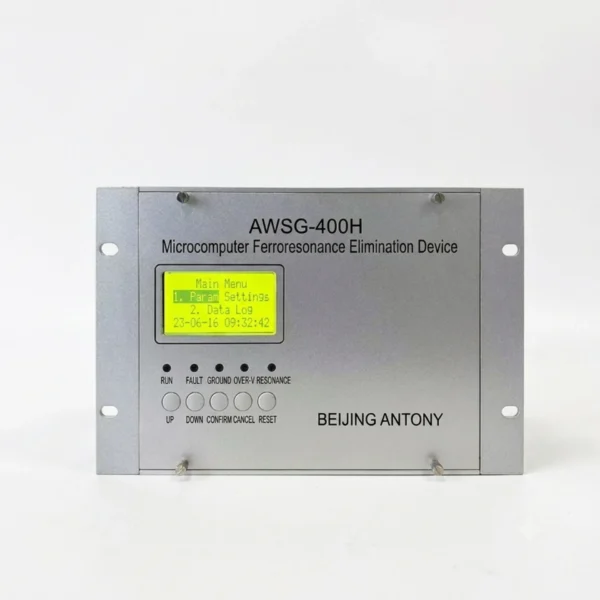
Premium Microprocessor-Based Resonance Eliminator / AWSG-400H
Microcomputer Ferromagnetic Resonance Elimination Device for PT Protection
Developed specifically for power systems, the Microcomputer Resonance Elimination Device effectively prevents severe faults including burnout and explosion of voltage transformers (PT) triggered by ferromagnetic resonance.
Communication Mode
Optional: RS-485, CAN bus, Ethernet, IEC 60870-5-103 (IEC-103), IEC 61850
Send your requirements, we will quote for you within 12 hours
Description
Overview of Microprocessor-Based Resonance Eliminator
- Developed specifically for power systems, the Microcomputer Resonance Elimination Device effectively prevents severe faults including burnout and explosion of voltage transformers (PT) triggered by ferromagnetic resonance.
- The Microprocessor-Based Resonance Eliminator displays system clock and PT open delta voltage components at 17Hz, 25Hz, 50Hz and 150Hz in real time. It identifies overvoltage, ferromagnetic resonance and single-phase earth faults, and features communication ports to upload fault information, perfectly suitable for unattended substations.
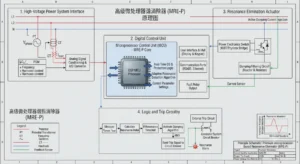
Premium Microprocessor-Based Resonance Eliminator – Technical Parameters
| Parameter Item | Specification |
|---|---|
| Applicable System Voltage | 0.38kV~66kV, neutral ungrounded system |
| Available Resonance Frequency | 17Hz(1/3 sub-harmonic),25Hz(1/2 sub-harmonic),50Hz(power freq),150Hz(3rd harmonic) |
| Detectable Fault Type | Ferro-resonance / Single-phase grounding / Transient overvoltage |
| Working Power Supply | AC/DC 220V±15%, total power ≤20W |
| Alarm Relay Contact | 250VAC/5A,30VDC/5A |
| Communication | RS485, Modbus-RTU protocol |
| Max. Monitoring Busbar | 1~4 segments optional |
| Display Mode | LCD menu / LED indicator |
| Fault Storage | Store ≥300 fault records, data no-loss after power off |
| Ambient Condition | -10℃~+55℃, RH<90% non-condensation |
| Response Time | ≤20ms after resonance detected |
Premium Microprocessor-Based Resonance Eliminator – Selection
| Model Type | Structure | Applicable Scenario |
|---|---|---|
| Basic Type(WXB-I) | Single bus monitoring, no print function | 10kV single PT cabinet, small distribution room |
| Standard Type(WXB-II) | 1~2 bus, optional micro-printer | Conventional substation, industrial 10kV switchgear |
| Multi-channel Type(WXB-IV) | Max.4 bus segments, full communication | Multi-section distribution room, PV booster station |
| Intelligent IEC61850 Type | Ethernet + RS485 dual communication | Smart substation, new grid construction project |
Working Principle
- The Microprocessor-Based Resonance Eliminator monitors PT open delta voltage and calculates four frequency components of zero-sequence voltage. It identifies fault types once abnormalities occur. In case of ferromagnetic resonance, it rapidly activates resonance elimination components in accordance with preset procedures to eliminate resonance, meanwhile displays, stores fault data and outputs alarm signals.
- It adopts three-stage resonance elimination mode with three operations per stage. Each thyristor conducts for 3 cycles with an interval of 1 second. After the first stage, it checks elimination effect. If all harmonic voltages drop below reset values, resonance elimination terminates without triggering the second stage.
- Similarly, after the second stage completes, resonance elimination of the third stage will not be triggered if resonance voltage is lower than the reset value.
- If resonance still exists after the third stage, it will be judged as permanent fault, alarm resonance elimination failure and stop relevant operation.
- The resonance elimination function will be re-enabled 10 seconds after all resonance voltages drop below the reset value.
Simulation testing
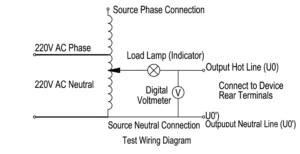
Earth Fault Test
- Apply voltage to the zero-sequence voltage terminal via single-phase autotransformer with voltmeter for accurate reading. Raise voltage gradually from below 30V to 30V, the device activates: earth fault indicator lights up, and fault info can be queried and uploaded via serial port.
- Gradually lower the voltage. Due to reset coefficient, the fault state remains and indicator stays on when voltage is above 27.9V. The fault resets once voltage drops below 27.9V. Alarm logs shall record the exact fault occurrence time.
Overvoltage Test
- Apply voltage to the zero-sequence voltage terminal with a single-phase autotransformer fitted with a voltmeter for precise voltage reading. Gradually raise the voltage from below 120V up to 120V, the device triggers action: the overvoltage indicator lights on, and fault information can be queried and uploaded via serial port.
- Slowly reduce the voltage. Due to the reset coefficient, the fault state persists and the indicator remains lit when the voltage is no lower than 111.6V. The fault resets automatically when the voltage drops below 111.6V. The alarm records shall keep the exact time of fault occurrence.
Resonance Test
- Apply voltage to the zero-sequence voltage terminal of the device by a single-phase autotransformer (connect a voltmeter for accurate voltage observation). Gradually increase the voltage from below 150V to 150V.
- The device will act: resonance indicator and resonance elimination indicator light up, alarm relay closes with its contacts conducting when measured by multimeter, and the buzzer sounds. Fault data can be checked and uploaded via serial port. Meanwhile, resonance elimination components start working with visible bulb flashing. The resonance elimination indicator turns off after completion of three-stage elimination.
- Gradually lower the voltage. Due to the reset coefficient, the fault state remains and the resonance indicator stays on when voltage is no less than 148V. When voltage drops below 148V, the resonance indicator goes out, the alarm relay breaks after 1-second delay, and the resonance elimination function restores after 10 seconds. Alarm records shall store fault occurrence time and resonance elimination failure information. If voltage falls below 148V during three-stage elimination, resonance elimination is judged successful.
- The test methods and working phenomena for 17Hz, 25Hz and 150Hz are basically the same. Replace the autotransformer with relay protection tester or other professional instruments. Since the corresponding voltage is low and output power is insufficient, bulb flashing cannot be observed. Do not test without series-connected bulbs, otherwise temporary conduction of resonance elimination thyristors may damage test equipment. Strictly ensure equipment and personal safety during the whole test process.
FAQ
Q:What are the differences between a Microprocessor-Based Resonance Eliminator, a PT measurement and control device, and a PT parallel connection device?
A:The Microprocessor-Based Resonance Eliminator eliminates PT ferromagnetic resonance and suppresses overvoltage to protect voltage transformers. The PT monitoring device collects voltage data, monitors grid anomalies and realizes remote communication. The PT paralleling device switches and parallels secondary circuits of busbar PTs to ensure stable voltage supply during switching operations.
Q1 What is this resonance eliminator?
An intelligent secondary protection device with microprocessor core, specially designed for 6kV/10kV/35kV ungrounded neutral distribution systems. It monitors PT open delta zero-sequence voltage to detect and eliminate ferromagnetic resonance overvoltage automatically, protecting voltage transformers and switchgear insulation from breakdown。
Q2 What hazard does ferromagnetic resonance bring?
Resonance generates sustained high overvoltage and inrush current, leading to PT fuse blowing, PT burnout, insulation aging, lightning arrester damage and even busbar equipment flashover faults。
Core Working Principle & Functions
Q3 How does it eliminate resonance?
It samples zero-sequence voltage, adopts FFT spectrum analysis to identify resonance frequency; once confirmed, the solid-state relay switches on high-power damping resistor within 20ms to consume oscillation energy and break LC resonance loop。
Q4 Which resonance frequencies can it suppress?
Covers four typical resonant modes: 17Hz (1/3 frequency division), 25Hz (1/2 frequency division), 50Hz power frequency, 150Hz triple frequency。
Q5 Key intelligent distinguishing capability
It accurately tells three working conditions without misoperation:
- Ferromagnetic resonance → execute rapid resonance elimination
- Single-phase earth fault → only output alarm, no damping input
- Transient overvoltage/harmonic disturbance → filter and lock action
Q What signal needs to be connected?
Only access the open delta secondary winding voltage of bus PT, no CT current wiring required; one device corresponds to one independent bus section。
Q Can one unit serve double busbar?
No. Each bus section must be equipped with a separate eliminator to avoid cross-interference of zero-sequence signals between two buses.
Q What local display & storage functions are available?
LCD screen shows real-time zero-sequence voltage, fault type and action time; it stores historical fault records including resonance start/end time, frequency and voltage value for post-fault inquiry。
Q Supported communication modes
RS485 Modbus RTU, upload fault alarms and operating status to SCADA/background monitoring system; dry contact relay output for remote signal transmission。
Q Is there a protection delay setting?
Short filtering delay to ignore instantaneous voltage fluctuation caused by switch closing or lightning strike; resonance elimination output is instantaneous after fault confirmation to minimize overvoltage duration.
Q Will the device keep damping resistance on after resonance disappears?
No. It automatically cuts off the damping loop once resonance is eliminated, avoiding long-term power consumption and heat loss of internal components.
Q Frequent resonance alarm but no actual PT damage
Check PT secondary wiring looseness, open delta circuit disconnection or system frequent switching operation inducing transient resonance.
Q No elimination action during confirmed resonance
PT signal missing, device control power loss, internal solid-state relay failure or threshold parameter set excessively high.
Q Continuous earth fault false alarm
PT polarity reversed, three-phase voltage imbalance on bus or zero-sequence loop external interference.
Q Mandatory commissioning items
PT open delta voltage wiring verification, resonance simulation test, single-phase ground signal identification test, alarm and communication point debugging.
Q Daily maintenance requirements
Check device power indicator and online status monthly; clear cabinet dust annually; avoid live plugging of wiring terminals.
Q Difference vs primary resonance eliminator
- Primary type: Installed on PT primary neutral point, passive nonlinear resistance, only suppress resonance passively
- Microprocessor secondary eliminator: Intelligent active judgment, fault recording & remote upload, stronger anti-interference and fault diagnosis ability
2 reviews for Premium Microprocessor-Based Resonance Eliminator / AWSG-400H
Related products
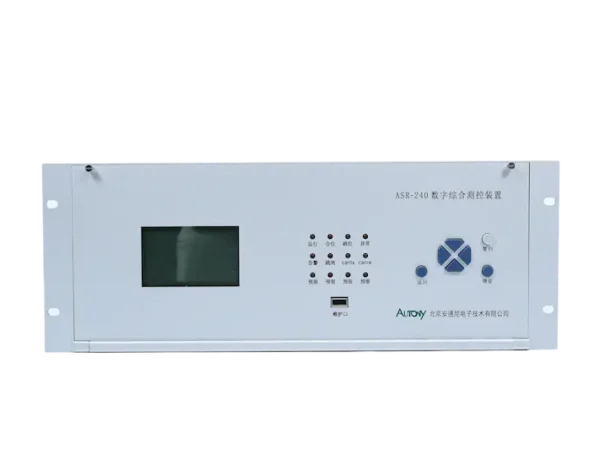
High Quality
Stable performance, reliable design, ensuring safe operation for power system protection and grid stability.
Fast Delivery
Timely delivery to support your urgent orders and project schedules efficiently and professionally at any time.
Best Warranty
Professional Warranty: Reliable after-sales support for stable relay protection and long-term customer satisfaction.
xiao zhang –
It quickly eliminates ferroresonance within 20ms to protect PT, supports Modbus-RTU and fault recording, fit for 0.38kV~66kV ungrounded power grids.
Jack –
The product is fully featured and capable of resolving practical issues during field application.