

-
Leon Zhang sales consultant
-
Email: zxl635973785@gmail.com
-
Phone/WhatsApp: +86 13655813266
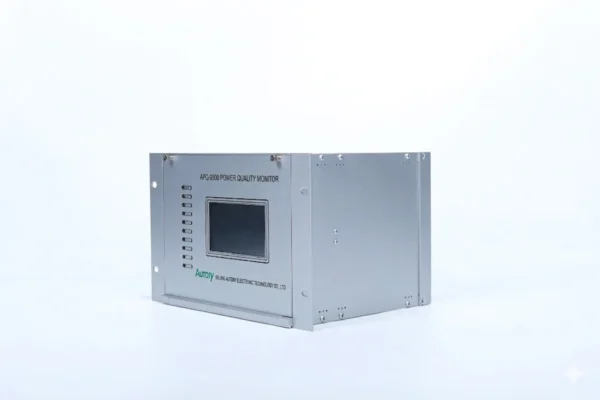
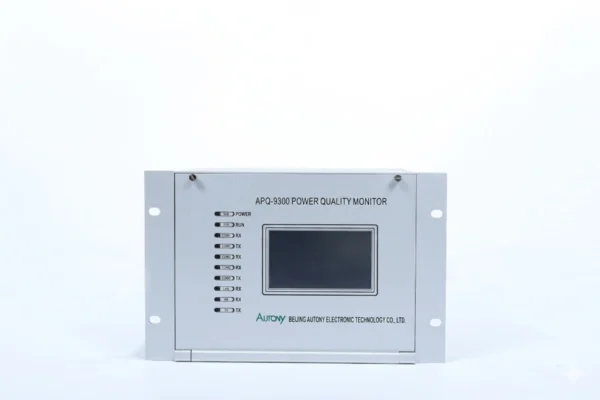
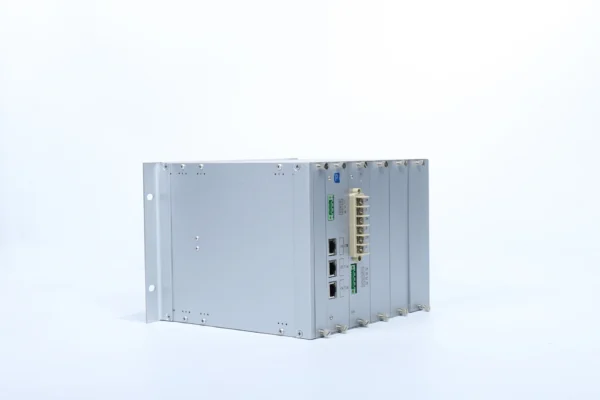
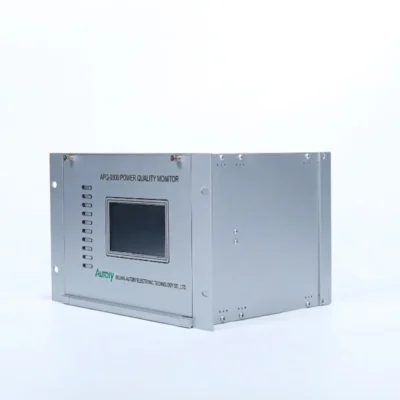
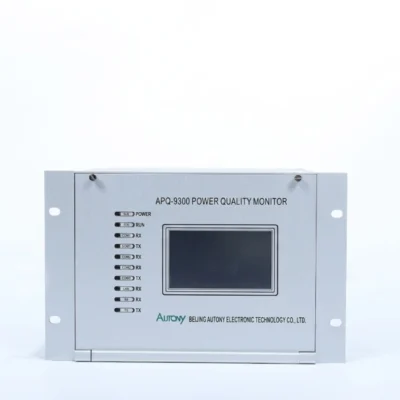
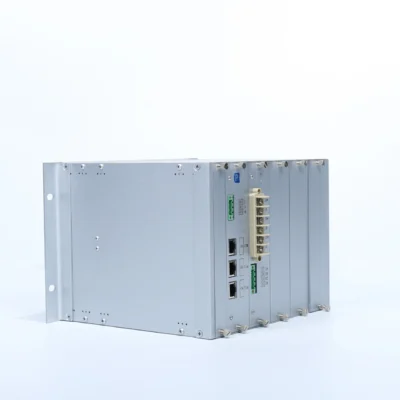
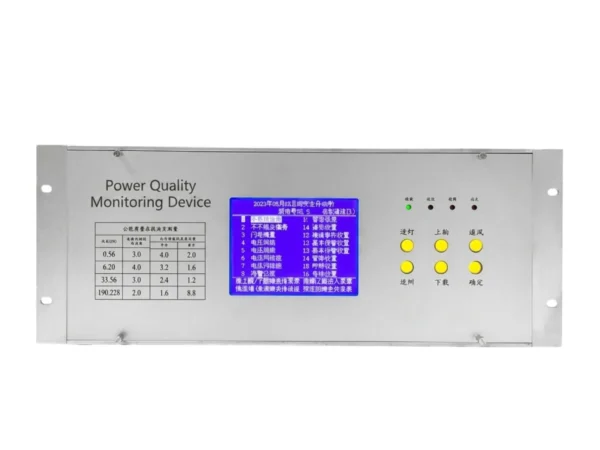
APQ-9100H Power Quality Monitors
Overview of Power Quality Monitors
As a professional Power Quality Monitor among Power Quality Products, it delivers real-time monitoring of critical grid parameters for Power of Quality assessment, including harmonic content up to the 63rd order, total harmonic distortion (THD), three-phase voltage unbalance, flicker and frequency. It also tracks active and reactive power of each harmonic, true and displacement power factors, true RMS and sequence components, offering a comprehensive overview of power grid operating status.
Send your requirements, we will quote for you within 12 hours
Description
Overview of Power Quality Monitors
- As a premier choice among professional Power Quality Monitors, the APQ-9100H serves as a core device for comprehensive electric power quality management. Powered by an advanced 32-bit ARM processor, this unit seamlessly integrates high-speed sampling, calculation, analysis, and communication to ensure the delivery of stable and quality power.
- As a professional Power Quality Monitor among Power Quality Products, it delivers real-time monitoring of critical grid parameters for Power of Quality assessment, including harmonic content up to the 63rd order, total harmonic distortion (THD), three-phase voltage unbalance, flicker and frequency. It also tracks active and reactive power of each harmonic, true and displacement power factors, true RMS and sequence components, offering a comprehensive overview of power grid operating status.
Power Quality Monitoring Scope
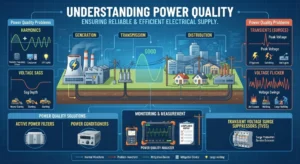
- From the perspective of power supply, power quality refers to the degree of compliance of power supply parameters with relevant standards as well as power supply reliability.
-
From the perspective of electrical equipment manufacturers, power quality represents the electrical performance characteristics required for normal equipment operation.
-
Power quality measurement serves to quantify such performance, while a power quality logger and power quality recorder continuously capture and store on-site operational data.
-
Power quality characterizes the overall grade of electric energy, mainly consisting of voltage quality and frequency quality.
Features of Power Quality Monitoring Equipment
Basic Measurement Quantities
- Grid frequency; RMS voltage and current; total active power, reactive power and power factor.
Basic Monitoring Indicators
- RMS value of three-phase fundamental voltage and current, fundamental power, power factor, phase angle, etc.
- Voltage deviation
- Frequency deviation
- Three-phase voltage unbalance degree, three-phase current unbalance degree, negative-sequence voltage and current
- Harmonics (2nd~63rd order): including total harmonic distortion rate of voltage and current, individual harmonic ratio, amplitude and phase; active power and reactive power of each harmonic order.
Advanced Monitoring Indicators
- Inter-harmonics
- Voltage fluctuation and flicker
- Voltage swell, voltage sag and short-time interruption
Setting Functions
- Power quality monitoring devices support configuration of the device hardware clock, as well as configuration, modification and viewing of monitoring parameters. Password protection is also provided for authority management.
Recording and Storage Function
- The device can save basic and advanced monitoring indicators in real time. The statistical time interval is configurable.
3-minute data (storing one of the maximum value, minimum value, average value, and 95% probability maximum value) can be retained on the device for more than one year, and will be updated automatically on a first-in, first-out basis afterwards.
Statistical Function
- Power quality meters are equipped with an online statistical function for major monitoring indicators, capable of calculating their maximum value, minimum value, average value and 95% probability maximum value within a specified time period.
Communication Function
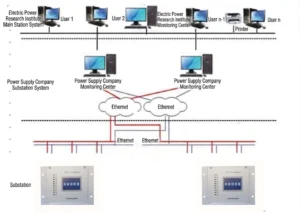
- The device is provided with multiple communication interface modes to realize real-time transmission of monitoring data or regular retrieval of stored records. It can communicate with the remote power quality management center via the industrial Ethernet interface, and also support remote communication through the RS232 interface by Modem or GPRS mode.
GPS Time Synchronization Function
- The device is equipped with a hardware GPS time synchronization interface, which can receive IRIG-B code time synchronization or second pulse time synchronization signals to keep the clock consistent with the remote management center.
Event-triggered Wave Recording Function
- Event trigger conditions (manual or automatic) can be set as required. The device records and stores real-time data before and after event triggering, and saves event logs for inquiry.
Current Signal Input
| Item | Specification |
|---|---|
| Input mode | Current transformer input |
| Rated current (In) | 5A / 1A |
| Measuring range | AC 200mA~5A or AC 50mA~1A |
| Power consumption | ≤0.5VA per channel |
| Overload capability | 1.2In continuous operation
2In for 1 second |
Voltage Signal Input
| Item | Specification |
|---|---|
| Input mode | Voltage transformer input |
| Rated voltage (Un) | 57.7V / 100V
400V version available (specify when ordering) |
| Measuring range | AC 0.5V~120V |
| Power consumption | ≤0.5VA per channel |
| Overload capability | 1.3Un for continuous operation
1.4Un for 1 second |
| Input impedance | >100kΩ |
Digital Input
| Item | Specification |
|---|---|
| Operating voltage | AC 220V / DC 30V |
| Input type | Dry contact or active contact |
| Isolation mode | Optoelectronic isolation, isolation voltage: 2500V |
Accuracy of Monitoring Indicators
| Item | Accuracy / Specification |
|---|---|
| Voltage & Current | 0.2% |
| Power & Power Factor | 0.5% |
| Frequency Deviation | 0.01 Hz |
| Voltage Deviation | 0.2% |
| Three-phase Voltage Unbalance | 0.2% |
| Three-phase Current Unbalance | 0.1% |
| Harmonics | Complies with Class A requirements in Appendix D of GB/T 14549-1993 |
| Inter-harmonics | Refer to Class A requirements for harmonics in Appendix D of GB/T 14549-1993 |
| Flicker | 5% |
| Voltage Fluctuation | 5% |
Power quality monitoring system
The Importance of Power Quality Management
- Power quality management ensures the safe and efficient operation of power systems and electrical equipment by monitoring and addressing indicators such as voltage deviation, harmonics, flicker, and three-phase imbalance. It reduces energy losses, extends equipment lifespan, and meets national standards.
- Power quality engineers analyze data collected by power quality analyzers, identify the root causes of power quality issues according to specific application scenarios, and deliver professional evaluation and analysis to formulate targeted power quality solutions for stable grid operation.
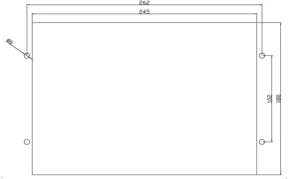
Installation Dimensions
FAQ
Q:What is the difference between a power quality monitor and a relay protection device?
A:Power quality monitor mainly records and analyzes grid harmonic, voltage fluctuation and other power parameter anomalies, while relay protection device rapidly trips to cut faulty circuits to prevent equipment damage when electrical faults occur.
Q: What is a Power Quality Monitor (PQM)?
A power quality monitor is a measuring device used to continuously collect, analyze and record grid electrical parameters. It monitors power quality disturbances in real time and complies with IEC 61000 and IEEE power quality standards.
Q: What main parameters can PQM monitor?
It monitors three-phase voltage, current, frequency, power factor, active/reactive power, harmonic distortion (THD), voltage fluctuation, flicker, unbalance, sag, swell and transient events.
Q: What is THD monitoring?
THD (Total Harmonic Distortion) reflects waveform distortion caused by nonlinear loads. PQM calculates THD-V and THD-I and records harmonic components from 2nd to 50th order.
Q: What are voltage sag and swell?
Voltage sag is a short-term voltage drop caused by faults or startup of heavy loads. Voltage swell is a brief overvoltage rise. PQM captures the amplitude, duration and time stamp of each event.
Q: What is unbalance monitoring?
It detects three-phase voltage and current unbalance, which is mainly caused by uneven load distribution. Severe unbalance will cause overheating of transformers and motors.
Q: Does PQM support flicker measurement?
Yes. It monitors short-term flicker (Pst) and long-term flicker (Plt) to evaluate lighting fluctuation caused by rapid load changes.
Q: Where is PQM commonly applied?
Substations, industrial power distribution rooms, renewable energy stations (PV/wind), data centers and key power consumption enterprises for grid quality assessment and fault analysis.
Q: What signals does PQM access?
It connects VT secondary voltage signals and CT secondary current signals to achieve full synchronous sampling of three-phase power parameters.
Q: What communication protocols does PQM support?
Common protocols include Modbus RTU/TCP, IEC 61850, IEC 104, DNP3. It supports remote data upload and real-time monitoring.
Q: Can PQM record historical data and events?
Yes. It continuously logs power quality data, trend curves and disturbance event records for later analysis, troubleshooting and power quality evaluation reports.
Q: Why does THD data show abnormal surge?
Main causes: large number of nonlinear loads (inverters, rectifiers), device sampling interference, or incorrect PT/CT ratio settings.
Q: Why are unbalance values too high?
Uneven single-phase load distribution, faulty line contact or abnormal three-phase power supply.
Q: No data upload remotely?
Check communication wiring, baud rate, IP address and protocol matching; verify device online status and network stability.
Q: What standards does PQM comply with?
It fully complies withIEC 61000-4-30 power quality measurement standards and national grid power quality assessment requirements.
Q: What are the advantages of PQM compared with ordinary power meters?
Ordinary meters only measure basic power parameters. PQM can capture transient disturbances, harmonic data and power quality events, which is essential for grid fault analysis and power quality improvement.
2 reviews for APQ-9100H Power Quality Monitors
Related products
High Quality
Stable performance, reliable design, ensuring safe operation for power system protection and grid stability.
Fast Delivery
Timely delivery to support your urgent orders and project schedules efficiently and professionally at any time.
Best Warranty
Professional Warranty: Reliable after-sales support for stable relay protection and long-term customer satisfaction.
xiao zhang –
High-precision power quality monitor captures harmonics, voltage fluctuation, unbalance and transient abnormality. Rich data storage plus optional multi-type communication, ideal for substation and industrial power monitoring globally.
Jack –
Every unit we’ve installed has performed flawlessly for over three years.