

-
Leon Zhang sales consultant
-
Email: zxl635973785@gmail.com
-
Phone/WhatsApp: +86 13655813266
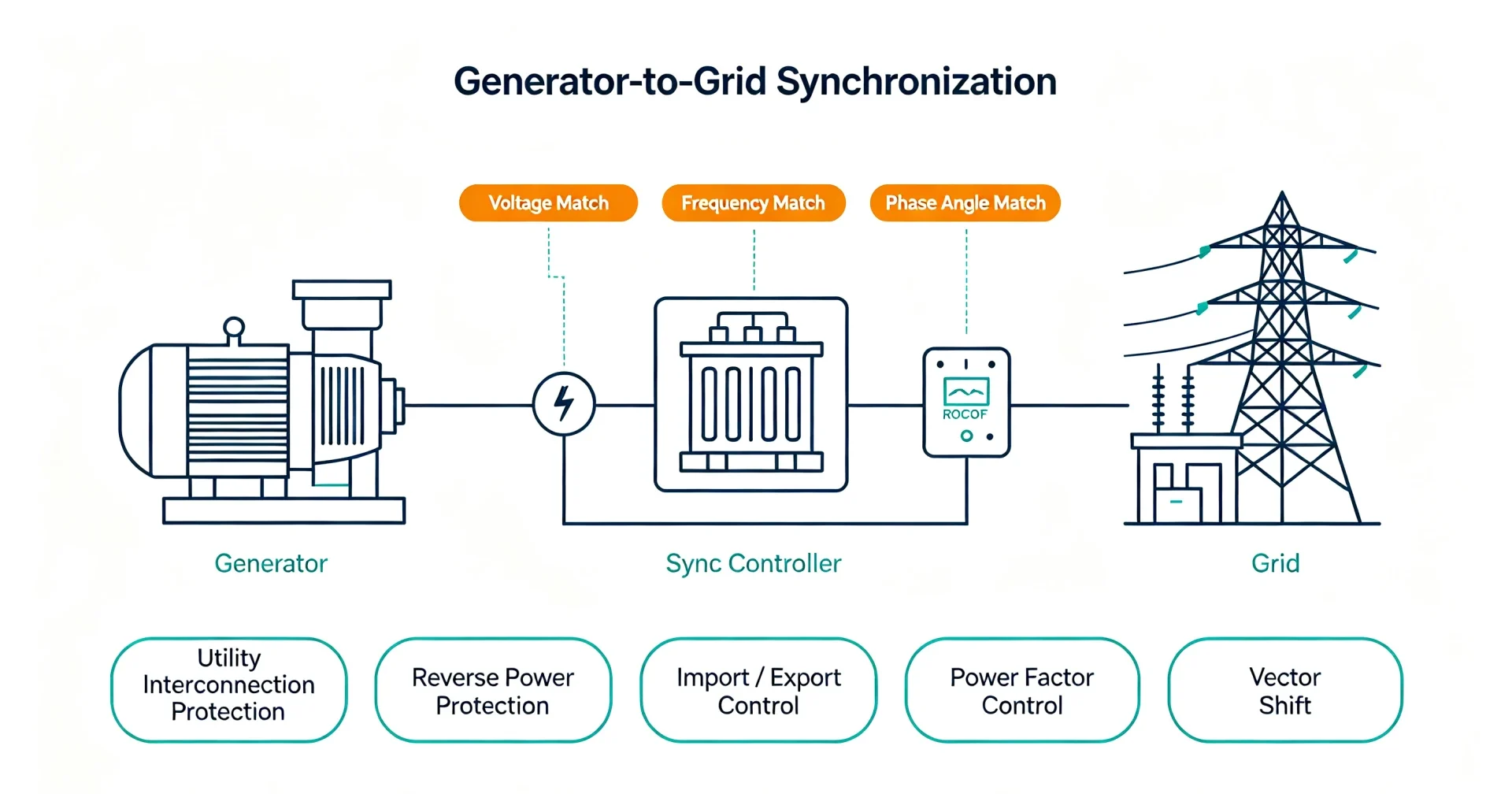
How to Select a Generator Synchronization Panel: A Practical Guide
Introduction
Selecting a generator synchronization panel involves more than choosing a controller brand or panel size. Several factors determine the correct configuration: the number of generators, voltage and capacity, governor and AVR compatibility, and whether the system operates in island mode or parallel with the utility.
Some engineers focus only on the controller and overlook load-sharing requirements or future expansion. Others select a panel based on generator capacity alone and later discover compatibility issues during commissioning.
This guide walks through the key selection factors. Use it as a reference when specifying a synchronization panel for your next project.
In Generator Synchronization Panel Selection, the suitable unit shall be chosen based on generator configuration, electrical system, operating mode and control requirements, rather than merely panel price or controller brand.
What Should You Evaluate When Selecting a Generator Synchronization Panel?
A generator synchronization panel is a control assembly that safely connects a generator to a live bus or utility grid. It matches voltage, frequency, and phase angle before closing the breaker.
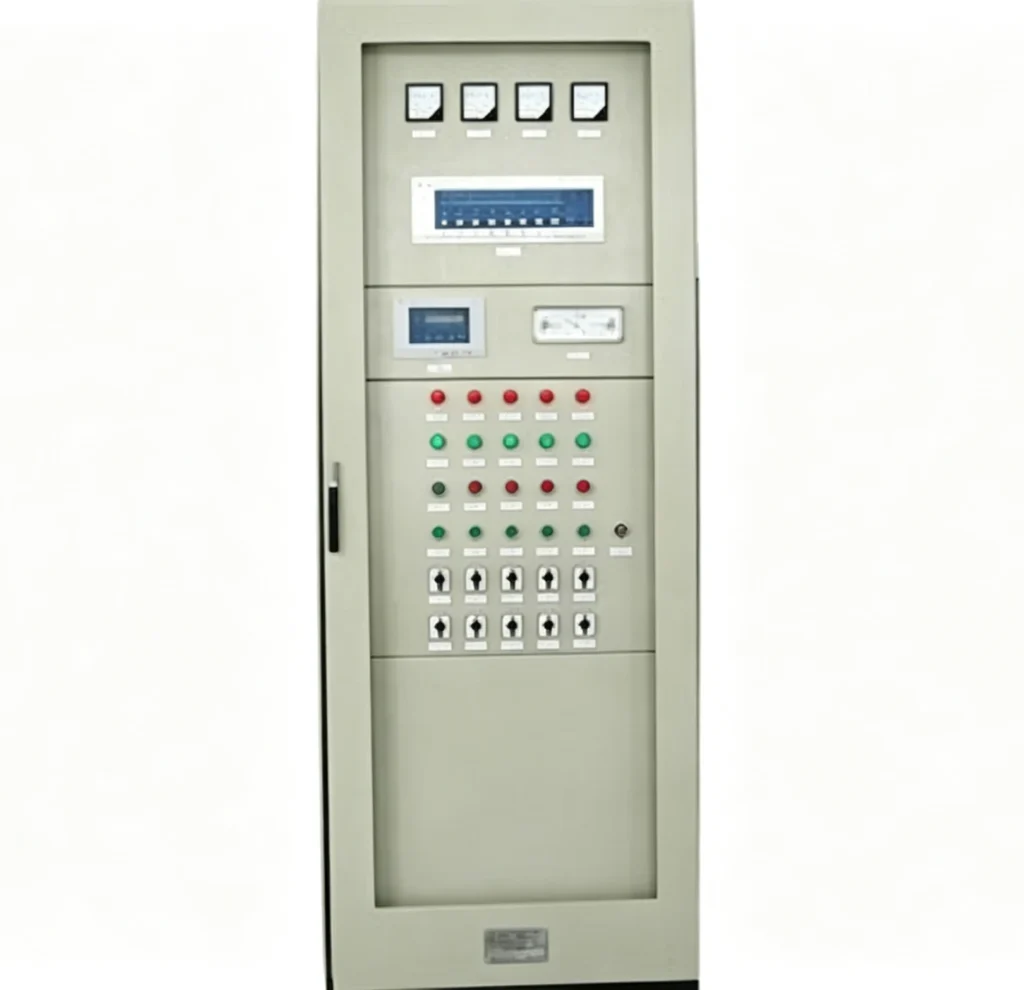
What Functions Should Be Considered During Panel Selection?
- Voltage matching
- Frequency matching
- Phase-angle matching
- Phase-sequence checking
- Breaker closing control
- Generator paralleling
- Load sharing
- Generator start/stop control
For generator synchronization details, please see the relevant section.
When Do Generator Requirements Determine the Panel Configuration?
- Two or more generators operating in parallel
- Common bus operation
- Standby generator systems
- Prime power systems
- Generator-to-grid operation
- Capacity expansion
- Critical power systems (data centers, hospitals)
Generator Synchronization Panel vs. Generator Paralleling Panel
Some engineers use these terms interchangeably. They are related but distinct.
| Function | Synchronization | Paralleling |
|---|---|---|
| Voltage matching | ✓ | — |
| Frequency matching | ✓ | — |
| Phase-angle matching | ✓ | — |
| Breaker closing | ✓ | ✓ |
| Load sharing | — | ✓ |
| Multiple generators on common bus | — | ✓ |
Synchronization is the process that makes safe paralleling possible. Paralleling covers the complete operation of generators connected to the same electrical bus.
8 Key Factors in Generator Synchronization Panel Selection
The generator synchronization panel selection process should start with the electrical system and operating requirements.
1. Number of Generator Sets
The number of generators determines the complexity of synchronization, breaker control, communication, and load-sharing logic.
Typical system sizes:
| System Size | Generator Quantity | Typical Application |
|---|---|---|
| Small | 2–3 | Commercial / Industrial |
| Medium | 4–8 | Factory / Hospital |
| Large | 9–16 | Data Center / Mining |
| Extra Large | 16+ | Power Plant / Microgrid |
Consider future expansion. A system designed for 4 generators today may need to support 6 or 8 in the future. Select a controller platform that supports additional units without replacing the entire panel.
Most modern controllers support up to 16 or 32 generators on a single bus.
2. Generator Rated Power, Voltage, and Frequency
The panel must match the generator’s electrical parameters. Provide these specifications to your supplier:
| Parameter | Typical Values |
|---|---|
| Generator rating | 100 kVA – 3000+ kVA |
| Rated voltage | 400V / 415V / 440V / 6.3kV / 10.5kV |
| Frequency | 50Hz / 60Hz |
| Rated current | Depends on generator capacity |
| Power factor | Typically 0.8 |
| Short-circuit level | Determines breaker rating |
3. Generator Controller Compatibility
Controller compatibility must be confirmed before the panel is finalized.
Generator Controller
The generator controller manages start/stop, engine protection, and basic electrical protection. The synchronization panel must interface with the existing controller. Common controller brands include Deep Sea Electronics, ComAp, and SmartGen.
Governor Interface
The synchronizer adjusts engine speed through the governor. Interfaces include:
- CANbus (J1939) – electronic engines
- Analog (0–10V or 4–20mA) – mechanical or older engines
- Magnetic pickup (MPU) – speed sensing
AVR Interface
The synchronizer adjusts generator voltage through the AVR. Interfaces include:
- CANbus (J1939)
- Analog (0–10V)
- Digital communication
4. Automatic or Manual Synchronization
| Synchronization Mode | Best For |
|---|---|
| Automatic | Industrial and commercial systems |
| Manual | Operator-controlled systems, commissioning |
| Automatic + manual backup | Critical power applications |
Automatic synchronization uses a digital controller to handle the entire paralleling process. The controller checks voltage, frequency, phase sequence, phase angle, and slip frequency before closing the breaker.
Manual synchronization requires an operator to observe a synchroscope and initiate breaker closure. This mode is useful for maintenance, testing, or emergency scenarios.
Most modern systems use automatic synchronization with manual override capability.
5. Load-Sharing Requirements
Synchronization connects generators to the same bus. Load sharing controls how load is distributed after paralleling.
kW Load Sharing
The controller adjusts the engine governor to share active power (kW) proportionally based on generator ratings. Two methods exist:
- Isochronous – all generators maintain exact frequency, proportional kW sharing
- Droop – frequency drops slightly with load, stable without inter-unit communication
kVAR Load Sharing
The controller adjusts the AVR to share reactive power (kVAR) proportionally. This maintains stable voltage and prevents circulating currents.
Equal vs. Proportional Load Sharing
Equal sharing – identical generators share load equally. Proportional sharing – generators of different ratings share load in proportion to their capacity.
Load-Dependent Start/Stop
Advanced systems automatically start additional generators when load exceeds a threshold and stop them when load drops. This improves fuel efficiency and reduces wear.
6. Generator-to-Generator or Generator-to-Grid Synchronization
Generator-to-Generator Synchronization
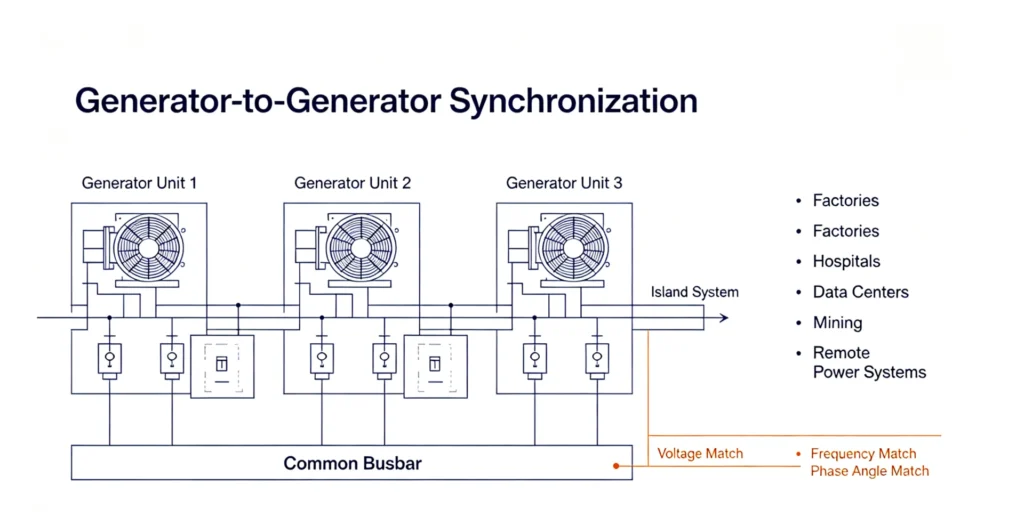
Used in island systems where generators operate independently from the utility. Common in factories, hospitals, data centers, mining, and remote power systems.
The first generator to reach rated voltage and frequency closes to the dead bus. Subsequent generators synchronize to the running bus and close their breakers.
Generator-to-Grid Synchronization
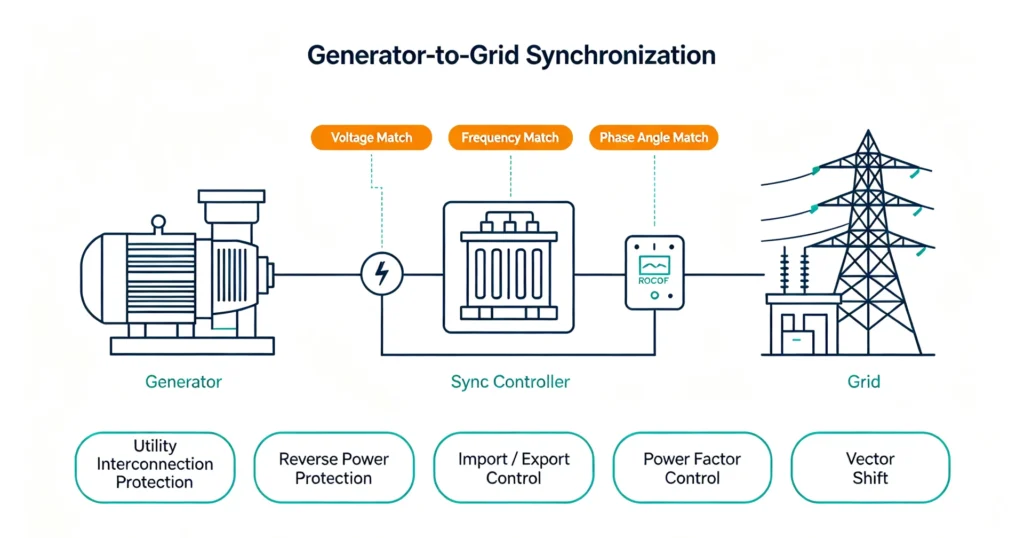
Connecting generators to a live utility grid is more complex. The generator must match the grid’s voltage, frequency, and phase angle exactly.
Additional requirements:
- Utility interconnection protection
- Reverse power protection
- Import/export control
- Power factor control
- Loss of mains detection (ROCOF and vector shift)
- Grid code compliance
7. Protection and Synchronism Check Functions
The synchronization panel must include essential protection functions.
| ANSI Function | Purpose |
|---|---|
| 25 | Synchronism check – prevents out-of-phase closing |
| 27 | Undervoltage protection |
| 59 | Overvoltage protection |
| 81 | Over/underfrequency protection |
| 32 | Reverse power protection |
| 50/51 | Overcurrent protection |
Why Is ANSI 25 Important?
The ANSI 25 relay prevents the breaker from closing when synchronization conditions are outside permitted limits. A 12-degree angular difference during synchronization can apply 1.5 per unit (150% of full load) torque on the generator shaft. This can damage the generator, coupling, and connected equipment.
The ANSI 25 relay provides independent supervision, verifying that voltage, frequency, and phase angle are all within safe limits before permitting breaker closure. Most manufacturers recommend limiting out-of-phase synchronizing to no more than 10 degrees maximum.
8. Communication, HMI, and SCADA Requirements
Modern synchronization panels integrate with building management and SCADA systems.
Common Communication Protocols
- RS-485
- Modbus RTU / Modbus TCP
- Ethernet
- CANbus
- IEC 61850
Integration With SCADA and BMS
Verify the panel supports:
- Remote monitoring and control
- Alarm and trip status reporting
- Event records and fault records
- Measured values (kW, kVAR, voltage, current, frequency)
Selecting the Right Synchronization Panel Configuration
Typical Generator Synchronization Panel Components
| Component | Main Function |
|---|---|
| Synchronization Controller | Synchronizes generator to bus |
| Generator Controller | Manages start/stop and engine protection |
| PLC | Executes control logic |
| HMI | Local operation and monitoring |
| Circuit Breaker | Connects generator to bus |
| CT/PT | Current and voltage measurement |
| Protection Relay | Electrical protection |
| AVR Interface | Voltage control |
| Governor Interface | Speed control |
| Communication Module | SCADA/remote monitoring |
How to Select the Right Generator Synchronization Panel Configuration
For 2-Generator Systems
Two generators can operate in parallel for redundancy or increased capacity. The panel typically includes:
- Automatic synchronizer
- Load-sharing control
- ANSI 25 sync-check
- Basic protection functions
For Multi-Generator Systems (3–8+)
More generators require more complex control logic:
- Multiple synchronizers or master controller
- Advanced load-sharing control
- Generator sequencing (start/stop by load demand)
- SCADA communication
For Standby Generator Systems
Generators start automatically when utility fails. The panel includes:
- Automatic start and synchronization
- Load-sharing control
- Automatic transfer switch interface
- Protection functions
For Prime Power Systems
Generators are the primary power source. The panel includes:
- Continuous load-sharing control
- Generator sequencing
- Fuel management
- Remote monitoring
For Generator-to-Grid Applications
Generators parallel with the utility grid. The panel includes:
- Grid synchronization capability
- Import/export control
- Loss of mains protection
- Grid code compliance
Generator Synchronization Panel Selection Checklist
Electrical Parameters
- [ ] Number of generators
- [ ] Generator kW/kVA rating
- [ ] Rated voltage
- [ ] Frequency (50Hz or 60Hz)
- [ ] Rated current
- [ ] Short-circuit level
Control Requirements
- [ ] Automatic synchronization
- [ ] Manual synchronization
- [ ] Load sharing (kW and kVAR)
- [ ] Generator sequencing
- [ ] Governor interface type
- [ ] AVR interface type
Protection
- [ ] ANSI 25 synchronism check
- [ ] Overcurrent protection
- [ ] Earth fault protection
- [ ] Over/undervoltage
- [ ] Over/underfrequency
- [ ] Reverse power protection
Communication
- [ ] HMI local operation
- [ ] PLC control
- [ ] SCADA integration
- [ ] Modbus protocol
- [ ] Ethernet connectivity
- [ ] Remote monitoring
What Information Should You Provide When Requesting a Quote?
Providing these details allows the supplier to recommend a synchronization panel configuration based on actual project requirements.
| Required Information | Example |
|---|---|
| Generator quantity | 4 |
| Generator rating | 500 kVA each |
| Voltage | 400 V / 415 V |
| Frequency | 50 Hz |
| Generator type | Diesel or gas |
| Generator controller | Model/brand |
| Governor | Model/interface |
| AVR | Model/interface |
| Breaker rating | 800 A |
| Operating mode | Standby / Prime |
| Grid parallel | Yes / No |
| Load sharing | Required |
| SCADA | Required |
| Communication | Modbus TCP |
| Installation | Indoor / Outdoor |
| SLD | Required |
Common Mistakes in Generator Synchronization Panel Selection
Selecting the Panel Based Only on Generator Capacity
Generator capacity is one factor, but controller compatibility, load sharing, and protection requirements matter equally.
Choosing the Controller Before Defining the System
The controller must match the generator’s governor, AVR, and communication requirements. Define the system first, then select the controller.
Ignoring Governor and AVR Compatibility
Incompatible interfaces cause synchronization failures. Verify the synchronizer can communicate with the existing governor and AVR.
Forgetting Load-Sharing Requirements
Synchronization alone does not ensure stable parallel operation. Load-sharing control is essential for multi-generator systems.
Not Considering Future Generator Expansion
A system designed for 4 generators may need to support 6 in the future. Select a controller platform that supports expansion.
Treating Synchronization and Load Sharing as the Same Function
Synchronization matches parameters before closing the breaker. Load sharing controls load distribution after paralleling. Both are required for stable parallel operation.
Failing to Provide a Single-Line Diagram
The SLD shows the system configuration and is essential for accurate panel design. Always provide an SLD when requesting a quote.
How to Compare Synchronization Panel Suppliers
When evaluating suppliers, consider these factors.
Technical Scope
- Number of generators supported
- Voltage and current range
- Synchronization functions
- Load-sharing capability
- Protection functions
Generator Controller Compatibility
Does the supplier support the specific controller, governor, and AVR models used in your generators?
Engineering and Customization
Can the supplier customize the panel for your specific requirements, or do they only offer standard configurations?
Factory Testing and FAT
Does the supplier conduct factory acceptance testing (FAT) before shipment? This reduces commissioning issues.
Commissioning and Technical Support
Does the supplier provide on-site commissioning support? What is their response time for technical issues?
Documentation
The supplier should provide:
- Single-line diagram (SLD)
- Wiring diagrams
- General arrangement (GA) drawings
- Bill of materials (BOM)
- I/O list
- FAT documents
- Operation manual
Generator Synchronization Panel Selection Example
Example: 4 × 500 kVA Diesel Generators
Project Requirements:
- 4 diesel generators, 500 kVA each
- 400 V, 50 Hz
- Common bus configuration
- Automatic synchronization
- Automatic load sharing
- Standby operation (island mode)
- SCADA communication
Recommended Configuration:
| Component | Selection Reason |
|---|---|
| Automatic synchronizer | Required for automatic parallel operation |
| Generator controllers | Match existing generator models |
| Load-sharing control | Proportional kW and kVAR sharing |
| ANSI 25 sync-check | Safety protection for all synchronizations |
| Overcurrent and earth fault protection | Basic electrical protection |
| HMI touchscreen | Local monitoring and control |
| PLC | Control logic and sequencing |
| Modbus TCP communication | SCADA integration |
| Indoor enclosure | IP54 protection |
This configuration supports automatic starting, synchronization, load sharing, and remote monitoring. The system can operate with 2, 3, or 4 generators running depending on load demand.
Frequently Asked Questions
What Information Is Needed to Select a Synchronization Panel?
Required information includes generator rated power, rated voltage, frequency, operating mode, synchronizing mode, protection demands and communication protocol requirements.
How Does Generator Quantity Affect Synchronization Panel Selection?
Most modern controllers support 2 to 32 generators on a single bus. Some systems support more with expanded configurations.
What parameters are checked during generator synchronization?
Voltage, frequency, phase angle, and phase sequence are checked. Slip frequency is also monitored to ensure proper closing timing.
What is the difference between synchronization and paralleling?
Synchronization is the process of matching parameters before closing the breaker. Paralleling is the ongoing operation of multiple generators connected to the same bus.
Does a synchronization panel support load sharing?
Yes. Most modern synchronization panels include load-sharing control for both kW and kVAR.
Can generators synchronize with the utility grid?
Yes, with appropriate control and protection functions. Generator-to-grid synchronization requires grid code compliance and loss of mains protection.
Should ANSI 25 Synchronism-Check Protection Be Included?
ANSI 25 is the synchronism check relay. It prevents breaker closure when synchronization conditions are outside safe limits.
What information is needed to select a synchronization panel?
Generator quantity, rating, voltage, frequency, controller type, governor and AVR interfaces, operating mode, communication requirements, and a single-line diagram.
Conclusion
The right generator synchronization panel selection starts with the complete electrical and operating requirements of the generator system.
Follow these steps:
- Determine the number of generators
- Confirm generator ratings and voltage
- Verify governor and AVR compatibility
- Choose automatic or manual synchronization
- Define load-sharing requirements
- Select required protection functions
- Determine grid-parallel requirements (if any)
- Specify communication and SCADA needs
- Plan for future expansion
The right generator synchronization panel is not simply the panel with the most features. It is the panel whose synchronization, control, protection and communication capabilities match the actual generator system and operating requirements.
If you are planning a multi-generator or generator-paralleling system, provide the generator ratings, controller models, breaker information and single-line diagram to obtain a configuration matched to your project requirements.
References
- IEEE Standard C37.91-2021 – Guide for Protecting Power Transformers.
- IEEE Transactions on Industry Applications – Art of Generator Synchronizing, Vol. 53, Issue 1, Jan.-Feb. 2017.
- IEC 60909-0 – Short-Circuit Currents in Three-Phase AC Systems.
- ANSI/IEEE Standard C37.2 – Electrical Power System Device Function Numbers.
- IEC 60255 Series – Measuring Relays and Protection Equipment.
- IEC 61850 – Communication Networks and Systems for Power Utility Automation.
- Deep Sea Electronics – DSE8610 MKII Synchronization and Load Sharing Controller Technical Specification.
- ComAp – InteliGen 200 Generator Controller Datasheet.
- SmartGen – HGM9510 Generator Controller Technical Manual.
- Eaton – Generator Paralleling Switchgear Design Guide DG027001EN.
About Author

Hello, I'm Leno Zhang. I have 15 years of experience in the power relay protection industry with extensive pre-sales and after-sales project experience. Our company specializes in various complete sets of relay protection and automation equipment. I can assist customers in solving all practical on-site project challenges and provide optimal integrated solutions.
Tell Us Your Requirement
High Quality
Stable performance, reliable design, ensuring safe operation for power system protection and grid stability.
Fast Delivery
Timely delivery to support your urgent orders and project schedules efficiently and professionally at any time.
Best Warranty
Professional Warranty: Reliable after-sales support for stable relay protection and long-term customer satisfaction.