

-
Leon Zhang sales consultant
-
Email: zxl635973785@gmail.com
-
Phone/WhatsApp: +86 13655813266
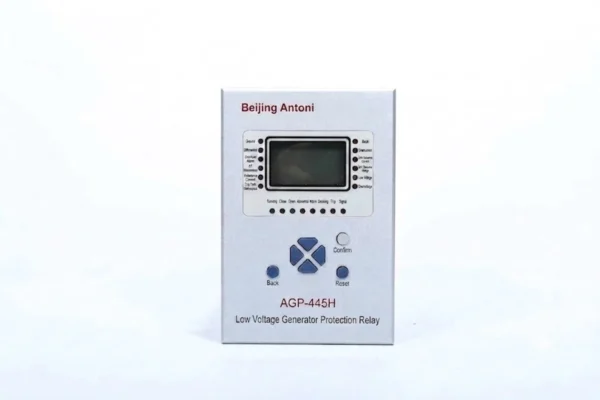
400V Low Voltage Generator Protection Relay
Low Voltage Generator Protection Relay delivers complete generator fault protection for 400V standby generator units. Equipped with negative sequence, 59N grounding, reverse power and loss-of-excitation protection, compatible with industrial SCADA systems for remote monitoring and fault data logging.
Send your requirements, we will quote for you within 12 hours
Description
The 400V Low Voltage Generator Protection Relay is a compact numerical protection and monitoring device designed for 400V synchronous generators, diesel generator sets, gas generators and small hydropower units. It integrates electrical protection, measurement, monitoring, event recording and communication in one device for low-voltage generator applications.
Key Specifications
| Item | Specification |
|---|---|
| Rated Generator Voltage | 400V |
| Application | Low-voltage generator sets |
| Generator Types | Diesel, gas, synchronous, small hydro |
| Protection | Overcurrent, overload, voltage, frequency, reverse power, earth fault |
| Measurement Accuracy | Class 0.2 |
| Communication | Ethernet / Modbus RTU |
| Installation | Panel-mounted |
| Application | Standby, industrial, distributed generation |
What Is a Low Voltage Generator Protection Relay?
A low voltage generator protection relay is designed for generator systems operating at low voltage levels, such as 400V generator sets. It monitors current, voltage, frequency and other electrical parameters and provides protection against abnormal operating conditions.
400V is the electrical application level, not an indication of reduced protection requirements.
Why Do 400V Generator Sets Need Protection?
While low-voltage (400V) generator sets are often considered simpler than medium-voltage units, they remain exposed to a wide range of faults—including short circuits, overloads, reverse power, voltage and frequency abnormalities, earth faults, and CT/PT failures—any of which can cause equipment damage, costly downtime, and safety risks.
Without proper protection, even a small fault can escalate into a major failure. Low-voltage generator sets used for standby power, industrial plants, commercial buildings, and distributed generation still require coordinated protection and monitoring to ensure reliable fault clearing, asset protection, operational continuity, and code compliance.
400V Low-Voltage vs Medium-Voltage Generator Protection
| Item | 400V Generator | Medium-Voltage Generator |
|---|---|---|
| Typical Voltage | 400V | 6.6kV / 10kV / 11kV etc. |
| Typical Application | Standby / industrial / distributed | Power plants |
| Protection Scheme | Integrated compact relay | More complex protection system |
| CT/PT Configuration | Simplified depending on system | Dedicated CT/PT protection |
| Differential Protection | Application-dependent | More common for larger generators |
| Communication | Modbus / Ethernet | IEC protocols / SCADA |
400V Low-Voltage Generator Applications
| Application | Typical Requirement |
|---|---|
| Industrial standby generator | Overcurrent, overload, reverse power |
| Diesel generator | Current, voltage, frequency and earth fault protection |
| Commercial backup power | Reliable protection and remote monitoring |
| Data center generator | Fast fault detection and SCADA integration |
| Small hydropower | Generator protection and grid connection monitoring |
| Distributed generation | Protection, measurement and communication |
| Off-grid generator | Generator control and abnormal-condition protection |
Protection Configuration
| Protection Item | Function Description | Operation Mode |
|---|---|---|
| Instantaneous Overcurrent | – | Trip |
| Time-delayed Instantaneous Overcurrent | With undervoltage blocking | Trip |
| Overcurrent | – | Trip |
| Inverse Time Overcurrent | Normal / Very Inverse / Extremely Inverse characteristic curves optional | Trip |
| Overload | Alarm or trip configurable | Alarm / Trip selectable |
| Zero-sequence Overcurrent | Self-produced zero-sequence current function optional | Alarm / Trip selectable |
| Overvoltage | – | Trip |
| Undervoltage | Current-blocked undervoltage protection optional | Alarm / Trip selectable |
| Overfrequency | – | Trip |
| Underfrequency | – | Trip |
| Reverse Power | – | Trip |
| CT Broken Circuit | – | Alarm |
| PT Broken Circuit | Undervoltage protection blocked upon PT failure | Alarm |
| Control Circuit Breakage | – | Alarm |
Key Advantages of the 400V Low-Voltage Generator Protection Relay
Industrial-Grade Stability
Adopts anti-interference industrial hardware design with a wide operating voltage range. It runs reliably under high temperature, high humidity and strong electromagnetic interference conditions, ideal for long-term unattended operation of generator sets.
High Precision & Low Measurement Error
Features Class 0.2 electrical measurement accuracy, guaranteeing precise monitoring of generator operating parameters and dependable protection tripping actions.
Easy Installation & Commissioning
Compact all-in-one structure for panel mounting. It supports flexible parameter configuration and programmable logic setup without complicated secondary development work.
Diversified Communication Protocols
Comes with Ethernet and standard communication ports, supporting mainstream protocols including Modbus RTU. Compatible with all types of industrial SCADA monitoring systems to enable remote real-time monitoring and data transmission.
Cost-Effective Integrated Design
Combines protection, measurement, monitoring and control into a single unit, replacing multiple single-function modules. It cuts down overall equipment procurement costs and field wiring expenses.
Low Voltage Generator Protection Relay settings
| No. | Menu Item (Setting Name) | Setting Range | Default Value | Remarks |
|---|---|---|---|---|
| 1 | PT Primary Rated Voltage | 0.1~999.99KV | 10KV | – |
| 2 | PT Secondary Rated Voltage | 100~999V | 100V | – |
| 3 | Measuring CT Primary Rated Current | 1~9999A | 600A | – |
| 4 | Measuring CT Secondary Rated Current | 1~5A | 5A | 5A or 1A |
| 5 | Protection CT Primary Rated Current | 1~9999A | 600A | – |
| 6 | Protection CT Secondary Rated Current | 1~5A | 5A | 5A or 1A |
| 7 | Zero Sequence CT Secondary Rated Current | 1~5A | 5A | 5A or 1A |
| 8 | Reserved | – | – | – |
| 9 | Number of PTs | 2~3 | 3 | – |
| 10 | Number of Measuring CTs | 2~3 | 3 | – |
| 11 | Zero Sequence Voltage Self-generation | 0~1 | 0 | 0: External; 1: Self-generated |
| 12 | Zero Sequence Current Self-generation | 0~1 | 0 | 0: External; 1: Self-generated |
| 13 | Protection Ia Polarity Reversal | 0~1 | 0 | Default |
| 14 | Protection Ib Polarity Reversal | 0~1 | 0 | Default |
| 15 | Protection Ic Polarity Reversal | 0~1 | 0 | Default |
| 16 | I0 Polarity Reversal | 0~1 | 0 | Default |
| 17 | Measuring IA Polarity Reversal | 0~1 | 0 | Default |
| 18 | Measuring IB Polarity Reversal | 0~1 | 0 | Default |
| 19 | Measuring IC Polarity Reversal | 0~1 | 0 | Default |
| 20~24 | Reserved | – | – |
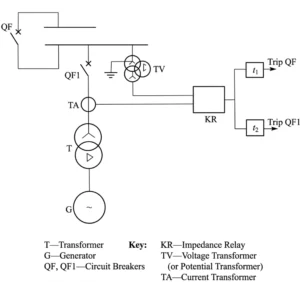
400V Low-Voltage Generator Single-Line Diagram
400V Low Voltage Generator Protection Relay – FAQ
1. What is a 400V low voltage generator protection relay?
A 400V low voltage generator protection relay is a compact digital device designed to monitor and protect low-voltage synchronous generators (400V/690V). It provides protection, measurement, and communication functions for diesel, gas, and small hydro generators.
2. What generators can this 400V protection relay be used for?
It is suitable for:
-
400V low-voltage synchronous generators
-
Diesel generator sets
-
Gas generator sets
-
Small hydropower generator sets
3. What protection functions are available for 400V generators?
| Function | Description |
|---|---|
| 50/51 | Overcurrent and inverse-time overcurrent |
| 49 | Overload (alarm/trip) |
| 46 | Negative sequence / unbalance |
| 50N/51N | Earth fault (zero-sequence) |
| 27/59 | Under/over voltage |
| 81U/81O | Under/over frequency |
| 32 | Reverse power |
| CT/PT break | Broken circuit detection (alarm) |
4. Can the relay protect diesel generator sets?
Yes. It is specifically designed for low-voltage diesel generator sets, providing overcurrent, overload, voltage, frequency, and reverse power protection—all essential for diesel genset applications.
5. Does the relay support reverse power protection?
Yes. The relay includes reverse power protection (ANSI 32) to prevent the generator from motoring when the prime mover fails. This protects the diesel/gas engine from mechanical damage.
6. Does the 400V low-voltage relay support SCADA?
Yes. The 400V low-voltage relay supports Modbus RTU and other standard communication protocols over Ethernet and serial ports, enabling integration with SCADA systems for remote monitoring, data logging and control.
7. What CT and voltage inputs are required?
| Input | Requirement |
|---|---|
| Three-phase currents | From protection CTs (primary rating configurable) |
| Three-phase voltages | From PTs (primary/secondary rating configurable) |
| Zero-sequence current | Optional (external CT or self-generated) |
8. Can the relay be used for generator protection retrofit projects?
Yes. Its compact panel-mount design and flexible parameter configuration make it suitable for replacing obsolete relays in existing panels with minimal rework. Existing CTs and PTs can typically be retained.
9. How are protection settings configured for a 400V generator?
Settings are configured through the relay’s front panel or communication software. Key parameters include:
-
CT/PT primary/secondary ratings
-
Protection pickup values (e.g., overcurrent, voltage thresholds)
-
Time delays and characteristic curves
-
Alarm/trip selections
Settings must be calculated based on generator rated current, CT ratios, and system fault levels.
10. What is the difference between 400V low-voltage generator protection and medium-voltage generator protection?
| Aspect | 400V LV Relay | MV Relay (e.g., 6.6kV/11kV) |
|---|---|---|
| Voltage class | 400V/690V | 3.3kV–13.8kV+ |
| Typical functions | Overcurrent, voltage, frequency, reverse power | Same + differential (87G), stator ground (64S) |
| CT/PT inputs | Lower current/voltage ratings | Higher ratings, more stringent accuracy |
| Complexity | Basic protection suite | More comprehensive functions, often dual-slope differential |
| Typical application | Standby, industrial, small hydro | Utility, large industrial, critical plants |
1 review for 400V Low Voltage Generator Protection Relay
Related products
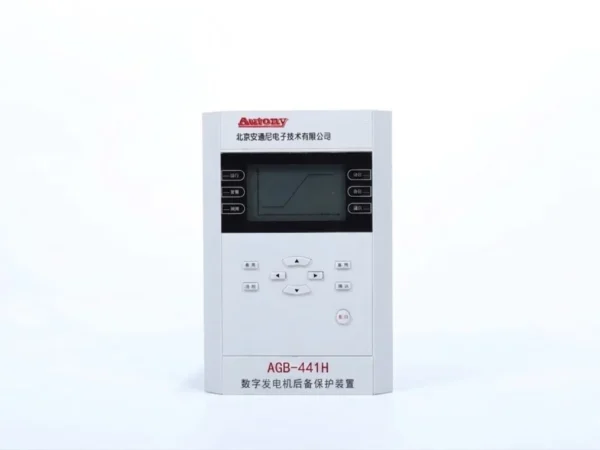
High Quality
Stable performance, reliable design, ensuring safe operation for power system protection and grid stability.
Fast Delivery
Timely delivery to support your urgent orders and project schedules efficiently and professionally at any time.
Best Warranty
Professional Warranty: Reliable after-sales support for stable relay protection and long-term customer satisfaction.
Jack –
The product is fully functional and particularly suitable for small hydropower projects.