Contact Form Demo

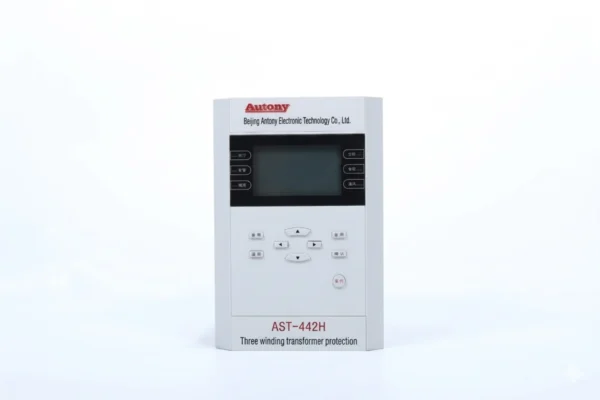
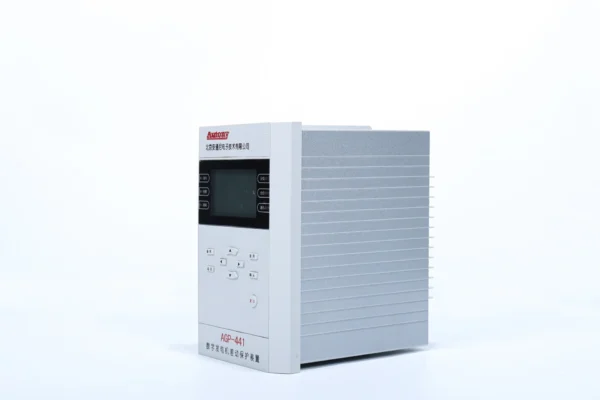
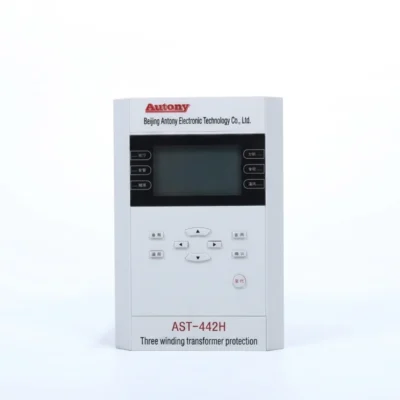
87T Three-Winding Transformer Differential Protection Relay

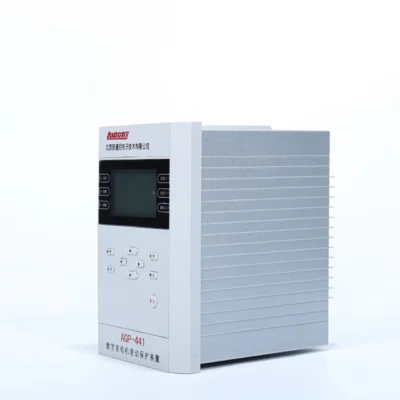
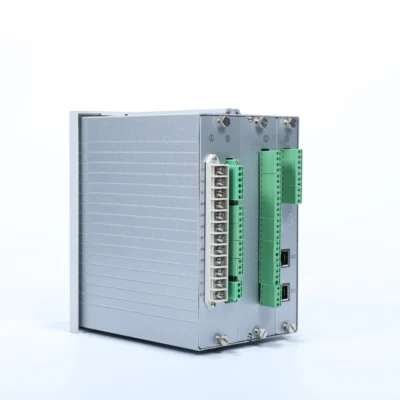
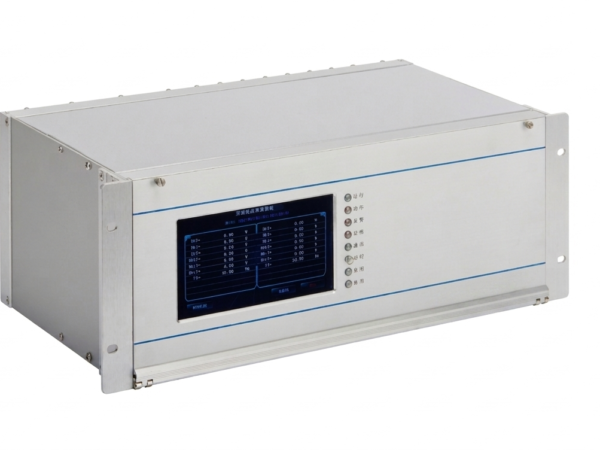
The AST-442H is a dedicated 87T three-winding relay for power transformers, providing differential protection for HV, MV and LV sides. It supports voltages up to 133 kV with panel-mounting design, and features configurable compensation, percentage restraint and harmonic blocking for reliable fault detection under all conditions.

ANSI:87/87T/50

Communication Mode

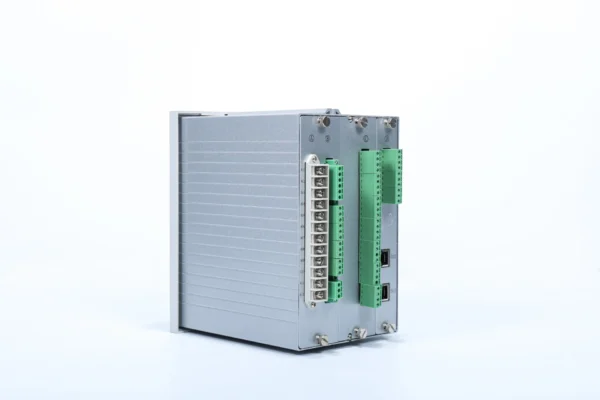
Optional: RS-485, CAN bus, Ethernet, IEC 60870-5-103 (IEC-103), IEC 61850

Send your requirements, we will quote for you within 12 hours
TEL: +86 13655813266
Whatsapp: +86 13655813266
zxl635973785@gmail.com

Description

87T Three-Winding Transformer Differential Protection Relay – Advanced numerical protection relay for three-winding power transformers, providing differential, earth-fault, overcurrent and auxiliary protection functions for HV, MV and LV transformer sides.

Table of Contents

Key Features of 87T Three-Winding Transformer Differential Protection Relay

  • Three-winding differential protection
  • Multi-side CT input
  • Transformer ratio and vector-group compensation
  • Percentage-restrained differential protection
  • Earth-fault and backup overcurrent protection
  • Fault and disturbance recording
  • Event/SOE recording
  • Communication for substation automation
  • Configurable protection logic

Three-Winding Transformer Differential Protection

Three-Winding Transformer Differential Protection

Three-winding transformer differential protection is designed for transformers with three separate windings—typically a primary (HV) side and two secondary (MV and LV) sides.

The relay continuously compares currents from all three windings within the defined differential protection zone, ensuring that under normal and external fault conditions, the vector sum of the currents is near zero.

Unlike two-winding applications, multi-winding protection requires more complex CT ratio and vector group compensation, as each winding may have different current magnitudes, phase displacements, and tap-changer positions.

The relay applies percentage restraint to maintain stability during external faults and through-fault conditions, where high fault currents may stress CTs and introduce measurement errors. It also incorporates CT saturation restraint algorithms to prevent misoperation under severe transient conditions.

These features—multi-winding current comparison, flexible compensation, and enhanced stability logic—are the key reasons why engineers select a dedicated three-winding 87T relay for generator step-up or transmission substation applications.

Applicable Three-Winding Transformer Configurations

Three-winding transformer differential protection is suitable for various engineering applications. The following table lists typical winding configurations and application scenarios. For actual selection, please refer to the voltage levels and applications supported by your specific product.

Winding Configuration (HV / MV / LV) Typical Application
110 kV / 35 kV / 10 kV Regional substation or industrial substation, commonly used in medium-to-high voltage distribution systems
Generator / Step-Up / Auxiliary Power plant unit connection, for protection of generator-transformer units and auxiliary transformers
System / Grid / Compensation or Load Side Autotransformers or special three-winding transformer applications with non-standard connection arrangements

Important Notes:

  • The core advantage of three-winding protection is the ability to compare currents from all three windings within a single relay, providing comprehensive differential protection.

  • The configurations above are examples only. Please confirm supported voltage levels, number of CT inputs, and compensation logic based on the product technical manual and project requirements.

87T Three-Winding Transformer Protection Relay Functions

Function ANSI Application
Transformer Differential 87T Main internal fault protection
Differential Instantaneous 87T Severe internal faults
Phase Overcurrent 50/51 Backup protection
Earth Fault 50N/51N Ground-fault protection
Negative Sequence 46 Unbalanced conditions
Overload 49 Thermal protection
Overexcitation 24 V/Hz protection
Breaker Failure 50BF Backup trip logic
Trip Circuit Supervision 74TC Trip circuit monitoring
Fault Recording Fault analysis
Communication SCADA / station automation

Technical Specifications

Parameter Specification
Application Three-winding transformer differential protection
Differential Protection 87T
Transformer Sides HV / MV / LV
CT Inputs 8 CT inputs (configurable for 1A or 5A secondary) 
Rated Frequency 50 / 60 Hz
AC Current 1 A or 5 A (selectable per input)
AC Voltage 100 VAC secondary (adjustable ratio) 
Binary Inputs 11 (expandable to 27) 
Binary Outputs 18 (expandable to 38) 
Communication IEC 61850 (GOOSE, MMS), Modbus, IEC 60870-5-103, DNP3 
Event Recording Yes
Disturbance Recording Yes (oscillography / COMTRADE) 
Setting Groups Multiple (configurable)
Mounting Panel mount / Rack mount (19-inch chassis) 
Power Supply 110–250 V DC / 100–230 V AC 

Setting Table of Three winding transformer protection

No. Setting Name Unit Range Remark
1 Secondary Rated Current(Ie) A 0.05~30 Calculated based on HV side rated current of transformer
2 Differential Protection Setting Ie 0.1~2
3 Differential Instantaneous Trip Setting Ie 0.1~20
4 Percentage Restraint Coefficient 0.3~1
5 2nd Harmonic Restraint Coefficient 0.1~0.3
6 3rd Harmonic Restraint Coefficient 0.1~0.3
7 MV Side Balance Coefficient 0~10
8 LV Side Balance Coefficient 0~10
9 Differential Current Overlimit Setting Ie 0.1~1 Generally 50% of differential protection setting
10 Differential Current Overlimit Delay s 0.1~20.00

Switch Status

Why Use a Dedicated Relay for a Three-Winding Transformer?

Feature Two-Winding Transformer Three-Winding Transformer
Current Inputs Two sides Three sides
Differential Calculation Two-side comparison Multi-side comparison
CT Compensation Required Required for multiple windings
Vector Group Compensation Required Required
Tap Compensation Applicable Applicable
Protection Zone Two winding sides Three winding sides

A three-winding transformer requires a protection scheme capable of processing and comparing current inputs from all protected windings. Standard two-winding differential relays do not have the input capacity or the compensation logic to handle three separate current sources, which is why a dedicated three-winding 87T relay is essential for multi-winding transformers.

Typical Applications

Application Description
Utility Substations Step down HV to MV/LV distribution levels. 87T ensures fast fault clearing for grid stability.
Industrial Substations Supply multi-voltage levels for plant operations. Provides full protection for transformers feeding motors, rectifiers, and process equipment.
Power Plants Connect generator to grid and auxiliary supply. Single 87T zone covers all three windings.
Generator Step-Up Transformers Link generator to HV grid with separate auxiliary winding. Coordinates with generator protection.
Renewable Energy Substations Collect power from inverters/turbines and step up to grid voltage. Handles variable generation conditions.
Large Industrial Transformers Supply different voltage levels to diverse facility loads. Comprehensive differential protection across all windings.

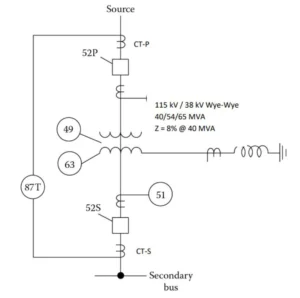
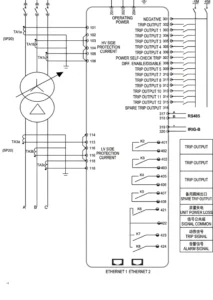
Typical Three-Winding Transformer Protection Scheme

Typical Three-Winding Transformer Protection Scheme

CT Requirements for Three-Winding Transformer Differential Protection

Requirement Description
CT Ratio Must match rated current of each winding to ensure secondary currents are within relay measurement range
CT Polarity Must be consistent across all three windings for correct vector summation; incorrect polarity causes sustained differential current
CT Accuracy High accuracy required (e.g., 5P or higher) to minimize errors during fault conditions
CT Saturation Adequate knee-point voltage and low burden needed, especially for windings with high through-fault current
Secondary Burden Must be within CT rated output, including relay input impedance and wiring resistance
CT Input Configuration Relay must support three independent three-phase CT sets with correct phase and winding assignment

CT selection should be verified against the transformer protection study and relay application requirements. For detailed calculation methods, refer to the Differential Protection Relay Setting Calculation guide.

Testing and Commissioning

Testing and commissioning of a three-winding 87T relay should be conducted according to the approved project test plan and relay manufacturer’s recommendations.

Typical tests include CT polarity verification to confirm correct phase alignment across all windings, secondary injection tests to verify pickup thresholds and slope characteristics, trip logic tests to confirm correct output contact operation, binary I/O checks for signal mapping, communication protocol tests for SCADA integration, and disturbance recording verification to ensure fault data is captured correctly.

These tests confirm that the relay is correctly configured and ready for service.

For complete testing procedures, refer to the Transformer Differential Protection Testing guide.

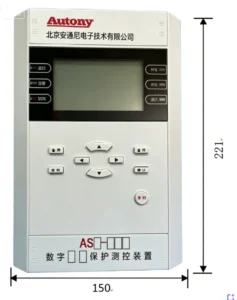
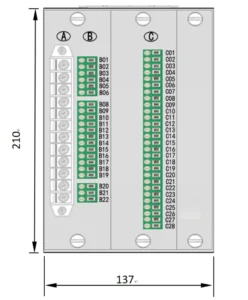
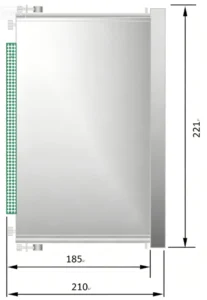
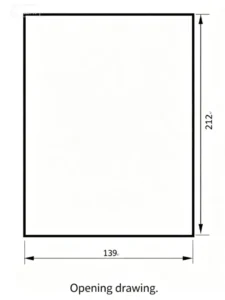
Outline and Installation Dimensions


Why Choose Our 87T Three-Winding Transformer Protection Relay?

Multi-Winding Protection

Designed for HV/MV/LV transformer protection.

Flexible Protection Configuration

Protection functions and logic can be configured according to project requirements.

Engineering Support

Support relay application, parameter configuration and protection scheme review.

Project Integration

Suitable for integration into protection and control panels and substation automation systems.

Factory Testing

Provide functional and communication testing before shipment according to project requirements.

After-Sales Technical Support

Support commissioning, troubleshooting and technical documentation.

FAQ

Q1. What is an 87T three-winding transformer protection relay?

An 87T three-winding transformer protection relay is a dedicated differential relay designed to protect transformers with three separate windings—typically HV, MV, and LV. It compares currents from all three sides to detect internal faults within the transformer.

Q2. Can the relay protect HV, MV and LV transformer windings?

Yes. The relay is specifically designed to accommodate CT inputs from three windings, providing complete differential protection across all sides of a three-winding transformer.

Q3. How does 87T differential protection work for a three-winding transformer?

The relay continuously compares currents from all three windings. Under normal and external fault conditions, the vector sum is near zero. When an internal fault occurs, the balance is disrupted and the relay trips.

Q4. Does the relay support CT ratio and vector group compensation?

Yes. The relay provides configurable CT ratio compensation for each winding and vector group compensation to correct phase displacement according to the transformer vector group.

Q5. What protection functions are available besides 87T?

Depending on the relay model, additional functions may include overcurrent protection (50/51), earth fault protection (50N/51N), restricted earth fault (REF), thermal overload protection (49), and overexcitation protection (24).

Q6. Can the relay be integrated with IEC 61850 substation automation?

Yes. The relay supports IEC 61850 with GOOSE and MMS services for integration into digital substation automation systems. Other protocols such as Modbus and IEC 60870-5-103 may also be available.

Q7. Can protection settings be customized for our transformer?

Yes. All protection settings are fully configurable based on transformer nameplate data, CT parameters, system fault levels, and project protection study requirements.

Q8. What transformer parameters are required for relay configuration?

Required parameters include MVA rating, voltage ratio, vector group, winding configuration, CT ratios, CT polarity, and grounding arrangement for each winding.

Q9. Do you provide FAT and commissioning support?

Yes. We offer factory acceptance testing (FAT), site commissioning support, and documentation to ensure correct installation and operation of the relay.

Q10. Can the relay be supplied as part of a transformer protection panel?

Yes. The relay can be supplied as a stand-alone device or integrated into a complete transformer protection and control panel with associated CTs, auxiliary relays, and communication interfaces.


4 reviews for 87T Three-Winding Transformer Differential Protection Relay

  1. xiao zhang

    The three-winding transformer differential protection adopts advanced multi-branch braking algorithm to restrain magnetizing inrush and CT saturation effectively. It precisely identifies internal winding faults of three-winding transformers and trips rapidly, perfectly matching substation main transformer protection configuration.

  2. Jack

    Accurate protection, safe to operate.

  3. Jack

    High-quality product, top choice for relay protection.

  4. Jack

    Fast response, ensures safety — very good.

Add a review

Your email address will not be published. Required fields are marked *

High Quality

Stable performance, reliable design, ensuring safe operation for power system protection and grid stability.

Fast Delivery

Timely delivery to support your urgent orders and project schedules efficiently and professionally at any time.

Best Warranty

Professional Warranty: Reliable after-sales support for stable relay protection and long-term customer satisfaction.