

-
Leon Zhang sales consultant
-
Email: zxl635973785@gmail.com
-
Phone/WhatsApp: +86 13655813266
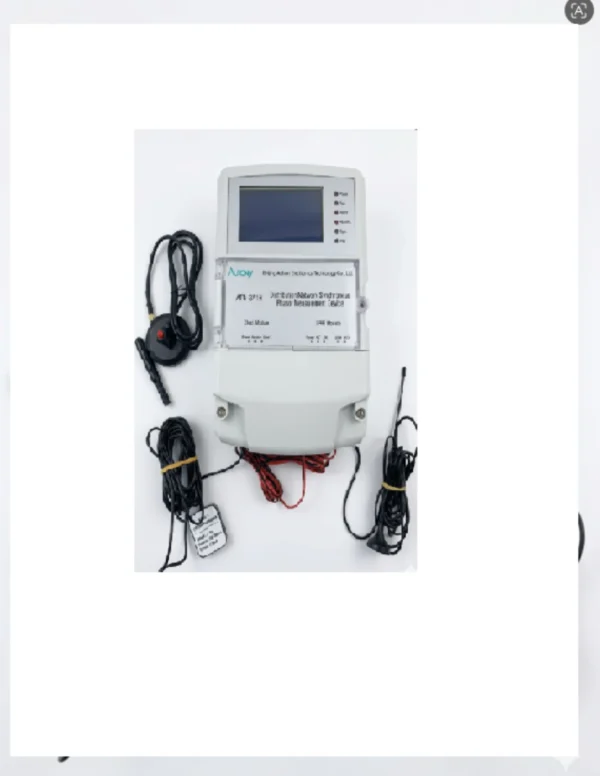
Phasor Measurement Unit (PMU)-ATN-371H
At present, secondary equipment deployed at grid connection points of distributed photovoltaic power stations and wind farms covers line protection, anti-islanding protection, power quality monitors and fault recorders, together with standalone Phasor Measurement Unit (PMU).
Send your requirements, we will quote for you within 12 hours
Description
what is phasor measurement unit
- At present, secondary equipment deployed at grid connection points of distributed photovoltaic power stations and wind farms covers line protection, anti-islanding protection, power quality monitors and fault recorders, together with standalone Phasor Measurement Unit (PMU).
- Against this background, this product is designed for grid connection points of distributed power sources, integrating traditional FTU monitoring & control, wide-area synchronous measurement, on-line power quality monitoring and fault recording functions. It features compact size, easy installation, space saving and cost reduction.
- As a phasor measuring unit, this device suits scattered and remote distributed power grid connection sites where full fiber communication is impractical, and it adopts 4G/5G communication to meet various application needs.
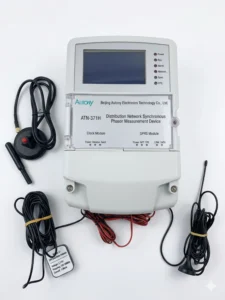
Distribution Network Synchronous Measurement Module
- This phasor measurement unit device is equipped with dual redundant GPS and Beidou timing system. It lowers costs by adopting dedicated synchronous measurement chips and variable-rate data communication to achieve high cost performance.
- Its synchronous voltage and current measurement accuracy reaches Class 0.2 with error below 0.2%. The maximum data uploading speed is up to 100 frames per second, and it is equipped with downlink control channels.
Transient Power Quality Synchronous Monitoring Module
- Power Quality Monitoring Function: It measures power quality indicators including harmonic components, three-phase voltage unbalance, flicker, voltage deviation, voltage fluctuation, frequency, active power, reactive power, power factor, positive sequence and negative sequence.
Compatible with Distribution Network Automation FTU Functions
-
As phasor measurement units for power systems and smart grids, this product is applicable to 10kV distribution lines.
-
It can be installed in switching stations, outdoor ring main units and smart community distribution substations to conduct real-time monitoring on feeder switches.
-
It transmits the operation status and various parameters of distribution systems to the distribution automation master station, including switch states, distribution network parameters, phase-to-phase faults, earth faults and relevant fault data.
-
In addition, it executes commands delivered by the distribution master station, realizing remote regulation and control of distribution equipment, fault location, fault isolation and rapid power supply restoration in non-fault areas.
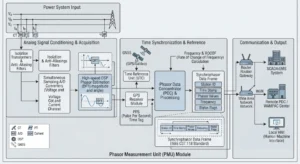
Support safe loop closing configuration for distribution network
- Equipped with phasor measurement units, it calculates loop closing inrush current based on synchronous measurement data and situational awareness information.
-
It realizes controllable loop closing inrush current through full-network reactive power and voltage regulation as well as active power flow control of distributed power sources.
-
It also supports the switch operation mode of closing first and opening later.
It is equipped with real-time dynamic phasor monitoring function
- It can measure and locally display data in real time, including three-phase fundamental voltage phasors, three-phase fundamental current phasors, fundamental positive-sequence voltage phasors, fundamental positive-sequence current phasors, active power, reactive power, system frequency and rate of frequency change.
- It can sequentially, evenly and in real time transmit required dynamic data such as three-phase fundamental voltage phasors, three-phase fundamental current phasors, fundamental positive-sequence voltage phasors, fundamental positive-sequence current phasors and system frequency to the master station as required, including full-second time data.
- The real-time transmission rate of dynamic data is adjustable, with optional rates of at least 25 times/s, 50 times/s and 100 times/s.
- It can transmit real-time sampled data of three-phase voltage and current with microsecond-level timestamps to the master station as required (this function is implemented with priority).
- It can send real-time information such as clock synchronization status and event marks to the master station.
With dynamic data recording function
- It can continuously record dynamic data including three-phase fundamental voltage phasors, three-phase fundamental current phasors, fundamental positive-sequence voltage phasors, fundamental positive-sequence current phasors and system frequency into non-volatile memory, and all recorded data are attached with time stamps.
- Capable of monitoring and recording clock synchronization status.
- Supports local display, analysis and export of recorded dynamic data.
- Able to transmit time-stamped historical dynamic data to the master station as required.
- The recorded data is highly secure, which will not be lost due to DC power interruption, cannot be deleted via external access, and has no manual deletion or modification functions.
Built-in transient data recording function (fault waveform recording)
- It can continuously record original sampling data of three-phase voltage and three-phase current into non-volatile memory with microsecond-level timestamps.
- During system transient disturbances, the device captures power system transient processes via high-speed synchronous sampling. The output format of transient recorded data complies with ANSI/IEEE C37.111-1999 (COMTRADE) standards.
- The fixed duration of transient recording is 12 cycles.
- Supported triggering modes for transient data recording:
ower voltage amplitude limit, upper voltage amplitude limit, lower positive-sequence voltage amplitude limit, upper positive-sequence voltage amplitude limit, upper current amplitude limit, upper positive-sequence current amplitude limit, lower frequency limit, upper frequency limit, voltage amplitude change rate, current amplitude change rate, frequency change rate and active power oscillation.
- It supports local display, analysis and export of transient recorded data.
- It can transmit transient recorded data to the master station as required.
- All stored transient data is well protected. It will not be lost after DC power failure, cannot be erased by external access, and no manual deletion or modification function is available.
Power Quality Monitoring Function
- Equipped with harmonic measurement function, capable of measuring 2nd to 63rd harmonics.
- Support total harmonic distortion rate measurement.
- Monitor voltage deviation and frequency deviation.
- Detect three-phase voltage unbalance and three-phase current unbalance.
- Realize inter-harmonic measurement.
- Measure voltage fluctuation and flicker.
- Capture voltage swell, voltage sag and short-time interruption.
Supports clock synchronization function
- Supports two time synchronization modes: satellite timing and IRIG-B timing, selectable either one.
- Satellite timing adopts dual-mode timing of GPS and Beidou, and features high-precision time holding function when clock signal is lost.
- It is equipped with IRIG-B timing interface to realize accurate time synchronization via IRIG-B code.
FAQ
Q:Where are phasor measurement units used and what are their main applications?
A:
PMU provides synchronous voltage and current phasors with precise timestamps via GPS and Beidou time synchronization.
It is mainly applied in Wide Area Measurement System (WAMS) to realize power grid power angle stability monitoring, low-frequency oscillation detection, online state estimation, fault location and frequency monitoring, as well as protection and control functions including out-of-step splitting and line differential protection.
It serves as the core sensing device enabling modern power grids to achieve visible observation, accurate measurement and reliable control.
Q:What is the price of the phasor measurement unit?
A:phasor measurement unit price
Standard PMU (6–8 channels, GPS/Beidou, IEC 61850): USD 30,000–45,000/unit
Substation PMU system (panel, antenna, commissioning): USD 50,000–65,000/set
High-precision wideband PMU: USD 45,000–60,000/unit
Q What is a PMU?
Phasor Measurement Unit, a power grid synchronous measurement device. It uses satellite clock synchronization to collect voltage/current phasors, frequency and rate of change of frequency at substation nodes with unified high-precision time tags.
Q Core application positioning
Mainly for wide-area power grid monitoring, stability analysis, oscillation identification, fault location and wide-area adaptive protection.
Q What data can PMU output?
Positive/negative/zero sequence phasors of three-phase voltage and current, power, grid frequency, df/dt, breaker status and alarm information.
Q Core advantage over conventional measurement devices
Conventional SCADA data lacks strict time synchronization; PMU realizes millisecond-level synchronous sampling across the whole power grid to reflect real-time dynamic grid operation.
Q How does PMU achieve time synchronization?
Receives GPS or Beidou satellite timing signals, unified time precision up to microsecond level, ensuring all station PMUs share the same time benchmark.
Q Which protocol is used for data transmission?
Mainly IEEE C37.118 standard protocol, transmitting real-time phasor data to the main station WAMS (Wide Area Measurement System).
Q Typical transmission delay
Data upload delay is within tens of milliseconds, meeting the requirement for real-time dynamic monitoring of large power grids.
Q Input signals for PMU
Three-phase PT voltage and CT current secondary analog quantities; digital signals for switch position and protection action.
Q Can PMU share CT/PT loops with protection or metering?
It is recommended to use independent secondary windings to avoid mutual influence on measurement precision and protection performance.
Q No phasor data uploaded
Loss of satellite timing signal, network disconnection, incorrect communication parameters or abnormal PT/PT sampling loops.
Q Obvious phasor data deviation
CT/PT polarity reversed, transformation ratio parameter set wrongly, or timing lock lost.
Q Timing loss alarm
Antenna damage, shielding interference blocking satellite signal, or timing module hardware failure.
Q Main commissioning items
Timing accuracy verification, signal wiring check, phasor value calibration, communication docking with WAMS main station.
Q Daily maintenance items
Regularly check satellite signal strength, online status and historical alarm records; avoid shielding the satellite receiving antenna.
2 reviews for Phasor Measurement Unit (PMU)-ATN-371H
Related products
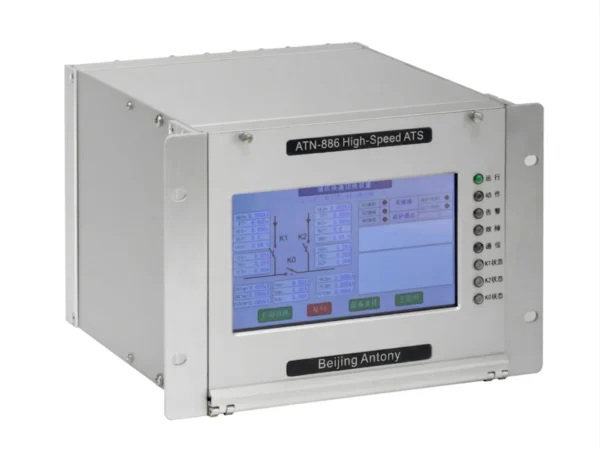
High Quality
Stable performance, reliable design, ensuring safe operation for power system protection and grid stability.
Fast Delivery
Timely delivery to support your urgent orders and project schedules efficiently and professionally at any time.
Best Warranty
Professional Warranty: Reliable after-sales support for stable relay protection and long-term customer satisfaction.
xiao zhang –
PMU captures synchronous phasor data accurately for real-time grid monitoring and fault analysis, improving power system stability.
Jack –
Stable performance, easy installation