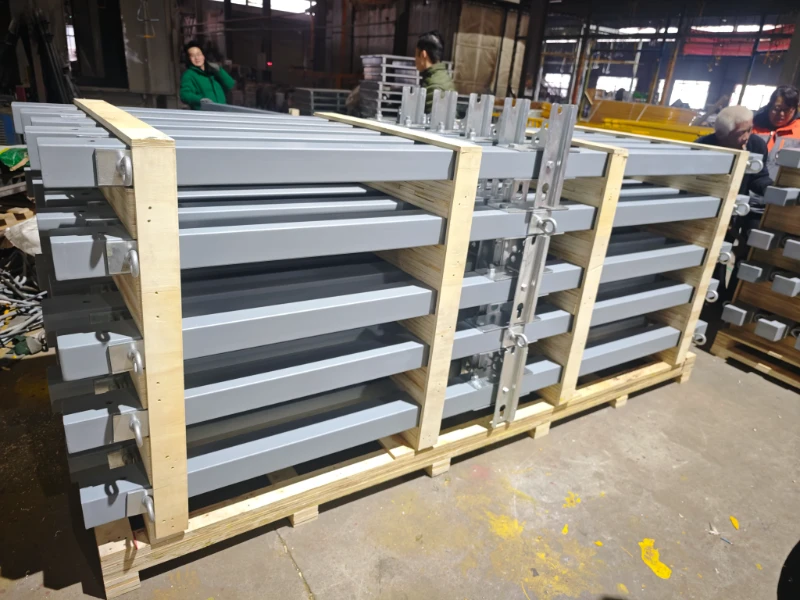
Fiberglass crossarms (FRP crossarms) serve as critical load-bearing components in overhead power lines, where they securely support electrical conductors and insulators. Unlike traditional wooden crossarms that rot, degrade, or fail over time, our fiberglass crossarms maintain structural integrity even in harsh conditions, ensuring stable power transmission and distribution. We design these crossarms to handle the mechanical stress of holding conductors, so they prevent sagging, short circuits, and other issues that disrupt power supply. Our product’s high strength-to-weight ratio—far exceeding that of wood—means it supports heavy loads without adding unnecessary weight to utility poles, making installation faster and safer for workers. Moreover, our fiberglass crossarms are cost-effective and high-quality, so they have become a trusted choice for power companies across many parts of Africa.
Replacing Traditional Wooden Crossarms to Reduce Maintenance Burdens
Utility companies use fiberglass crossarms to replace problematic wooden crossarms, which require frequent maintenance and yearly replacements due to damage from insects, birds, climate, and extreme weather. Our fiberglass crossarms eliminate these burdens because they do not rot, degrade, or attract pests—they resist all forms of natural wear and tear. We engineer each crossarm to have a much longer service life than wood; in fact, one of our fiberglass deadend or tangent crossarms can replace two wooden crossarms, significantly cutting long-term costs for utilities. This durability makes our product ideal for African regions, where remote areas and limited maintenance resources make frequent crossarm replacements impractical. We ensure our crossarms are affordable, so even budget-conscious utility companies in Africa can access high-quality, low-maintenance solutions.
Preventing Pole Top Fires and Enhancing Electrical Safety
Fiberglass crossarms play a vital role in preventing dangerous pole top fires, a growing concern for utility companies worldwide. Wooden crossarms catch fire easily when contaminants like salt, air pollutants, or dust create electrical paths that spark tiny arcs, igniting dry wood and heating metal fixtures. Our fiberglass crossarms are non-combustible and have excellent electrical insulation properties, so they stop these sparks from igniting and prevent fire spread. We manufacture our crossarms with superior dielectric strength, which also protects workers and the public by reducing the risk of electrical shocks during installation and maintenance. In African regions prone to wildfires or high levels of environmental contaminants, our crossarms provide an extra layer of safety that wooden crossarms cannot match—all at a price that fits local utility budgets.
Adapting to All Climates, Especially in African Regions
We design our fiberglass crossarms to perform reliably in all climate conditions, from the hot, arid savannas to the humid coastal areas of Africa. Unlike wood, which warps or rots in moisture and cracks in extreme heat, our fiberglass crossarms resist temperature fluctuations, humidity, salt spray, and UV radiation. They maintain their strength and insulation properties year after year, even in the harshest African environments. Many utility companies across Africa rely on our crossarms because they are lightweight and easy to install in remote or hard-to-reach areas—no heavy equipment is needed, which saves time and labor costs. Our commitment to high quality and low prices ensures that African utilities get a long-lasting, reliable product that meets their unique needs without straining their budgets.
Delivering Cost-Effective, High-Quality Solutions for African Utilities
Above all, fiberglass crossarms are used to provide utilities with a cost-effective, long-term solution for power infrastructure—and our product stands out as the best choice for African markets. We prioritize quality in every step of manufacturing: we use high-grade glass fibers and durable resins, and we follow strict production standards (including pultrusion processes) to ensure each crossarm meets or exceeds industry requirements. Despite our superior quality, we keep our prices affordable, making our crossarms accessible to utilities of all sizes across Africa. From rural villages to urban centers, our fiberglass crossarms support reliable power supply, reduce maintenance costs, and enhance safety—proving why they are widely adopted in many African regions and trusted by utility companies worldwide.